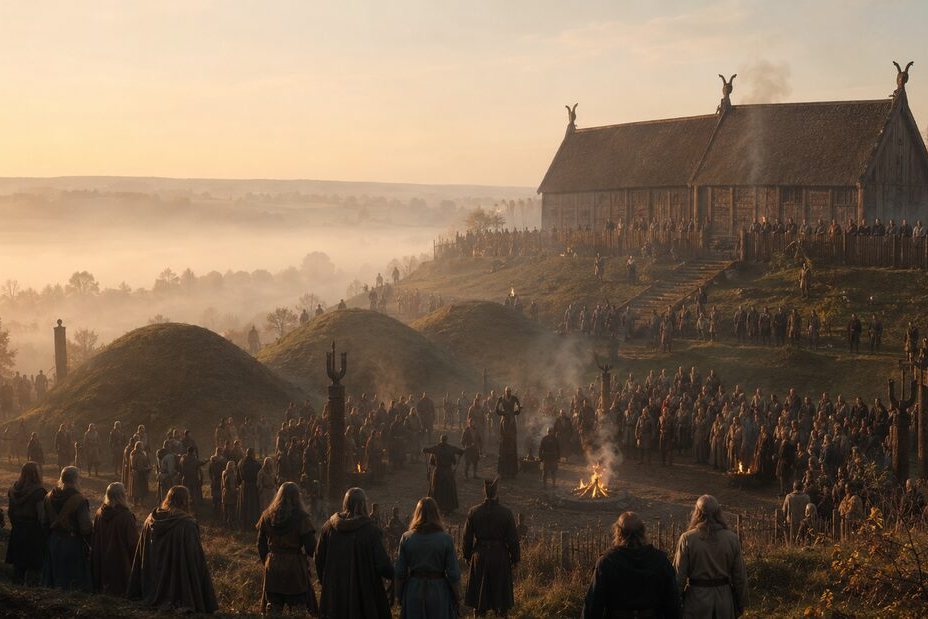
Almost everything we think we know about the pagan cult of eleventh-century Sweden – the golden temple of Uppsala, the sacrificial bodies hung in the grove, the earliest word of a land called Vinland – we owe to a single man who never set foot in Scandinavia. Adam of Bremen was a cathedral scholar, not a traveller. His chronicle is indispensable and, at the same time, to be handled with care. To understand the North, we must understand how Adam saw it – and why.
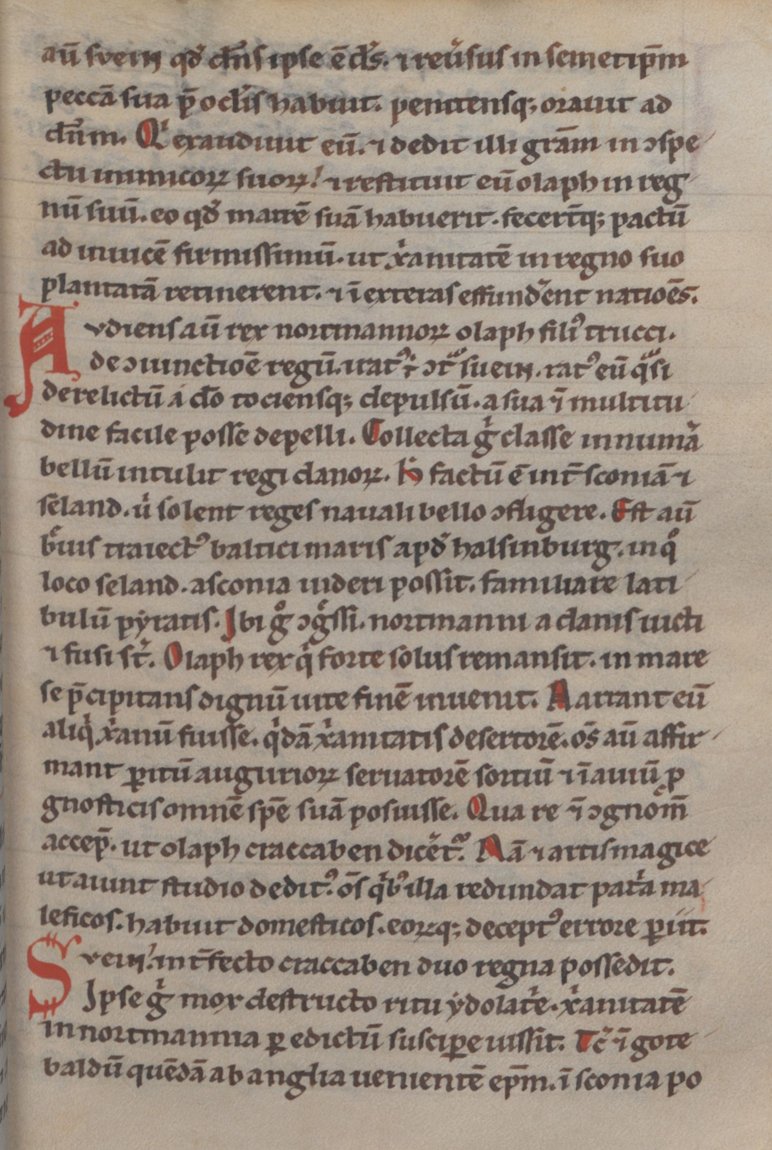
We know little of Adam's life, and most of that from his own work. He probably came from the Upper German lands – Franconia or southern Saxony – and arrived at the cathedral school of Bremen around 1066/67. He was called there by Archbishop Adalbert, that ambitious prince of the church whose rise and fall Adam would later chronicle so vividly. In Bremen, Adam became "magister scholarum", head of the cathedral school and thus one of the most learned men in the city. His year of death is uncertain: he died after 1081, probably before 1085. What survives of him is a single great book – and that book has shaped our picture of the Viking-Age North like almost no other.
Bremen was no ordinary place at the time. The archbishopric of Hamburg-Bremen claimed ecclesiastical authority over the entire North: Denmark, Sweden, Norway and the islands of the North Atlantic. Whoever wrote here wrote from the perspective of an institution that wished to convert – and to dominate – the North. That is the first key to understanding Adam: his work is not a neutral travelogue but the history of a church that saw itself as the gateway to the North.
Around 1075/76, Adam completed his major work, the "Gesta Hammaburgensis ecclesiae pontificum" – the Deeds of the Bishops of the Hamburg Church. He kept revising it until his death, adding notes (the so-called scholia). The work is divided into four books and tells the history of the archbishopric from its beginnings under Charlemagne down to Adam's own day. At its centre stand the archbishops, above all Ansgar, the "Apostle of the North", and Adalbert, Adam's own patron.
Yet the "Gesta" are far more than a diocesan history. Because the mission of the North was Adam's great theme, he gathered everything he could learn about the northern lands. In doing so his work became, unintentionally, something else: the richest continental source on Viking-Age Scandinavia we possess. Without Adam, we would know alarmingly little about the eleventh-century North, so scantily described from within.
The most famous part is the fourth book, the "Descriptio insularum aquilonis" – the description of the northern islands. Here Adam leaves the diocesan chronicle behind and becomes geographer and ethnographer. He describes Denmark with its landscapes and harbours, Sweden with the Svear and Götar, Norway as the poorest and harshest of the realms, whose inhabitants the sea forces into piracy. He lists the islands of the Baltic, speaks of the Orkneys, of Iceland – whose people he praises as frugal and pious – and of Greenland.
For Viking scholarship this "Descriptio" is a treasure trove: it supplies names, distances measured in sailing days, customs and trade routes. Much of it can be cross-checked against archaeological finds; other parts remain pure narrative. Adam blends what he heard, what he read in books, and pious interpretation into a picture that is always also the picture of a churchman surveying the edges of the known world.
In this fourth book stands a sentence that secures Adam a place in world history. He reports an island in the ocean, discovered by many in the North and called Vinland, because wild vines grew there yielding excellent wine. It is the earliest written mention of the North American continent in a continental European source – centuries before Columbus, and long before the Icelandic Vinland sagas were written down.
Adam did not take this news from books. He names his informant expressly: the Danish king Sven Estridsson (Sveinn Ástríðarson), whom he questioned in person at court. Sven was a well-travelled, learned ruler with the best connections throughout the North, and Adam prized him as his most important living source. What Adam writes about Vinland is therefore court knowledge, overheard, passed on and set down in Bremen – no eyewitness account, but a strikingly early echo of real voyages westward.
No passage of Adam's has had such an afterlife as his account of the pagan sanctuary at Uppsala. He describes a temple made entirely of gold, in which the people venerate the images of three gods. In the centre sits the mightiest, Thor, with a sceptre, lord of thunder, weather and fertility. At his sides stand Wodan – who grants war and courage, shown in armour – and Fricco (Freyr), who bestows peace and pleasure and is depicted with an enormous phallus. In war one sacrifices to Wodan, at weddings to Fricco, in famine and plague to Thor.
In this temple, which is entirely covered with gold, the people worship the statues of three gods. The mightiest of them, Thor, has his seat in the middle of the hall; on either side stand Wodan and Fricco. … Every nine years a common festival of all the provinces of Sweden is held at Uppsala. Of every kind of male living creature nine heads are offered, with whose blood they seek to appease the gods. The bodies, however, are hung in the grove that lies beside the temple.Adam of Bremen, Gesta Hammaburgensis IV, 26–27; own translation: Glanz & Gravur
The great sacrificial festival, Adam says, takes place every nine years and lasts nine days. On each day a human being is sacrificed alongside animals, so that in the end seventy-two bodies hang in the sacred grove beside the temple – men and beasts mingled together, until the branches are heavy with carcasses. A Christian, Adam adds, told him that he had seen these hanging bodies with his own eyes. It is a dark, unforgettable image – and precisely for that reason it must be read with particular care.
The decisive point: Adam of Bremen was never in the North. He never saw Uppsala, never entered a Swedish temple, never witnessed a sacrifice. Everything he reports is at second, often third hand: oral information at the Danish court, reports from merchants and missionaries, older books such as Rimbert's "Vita Anskarii". What he writes down is not a look into the North but a look at the North – from outside, from a distance, through the eyes of a Bremen cathedral cleric.
Then there is the intent. Adam wrote in the service of a clear cause: the primacy of the archbishopric of Hamburg-Bremen over the northern mission. The heathens had to be painted dark so that the light of the church might shine all the brighter. Cruel sacrifices, gold-laden idol temples, bloody groves – these are also rhetorical foils, against which the missionary work of his archbishops was meant to glow. Adam is best read the way one reads a report from the opposing side: attentively, grateful for every detail – and always asking what the author meant to achieve by it.
Evidence: The "Gesta Hammaburgensis ecclesiae pontificum" is securely dated as a work (around 1075/76, with later scholia added up to Adam's death after 1081) and survives in several medieval manuscripts. It is also certain that Adam names the Danish king Sven Estridsson expressly as his informant – making him a real, named source. The archbishopric of Hamburg-Bremen and its northern mission (Ansgar, Adalbert) are well attested historically. Uppsala was demonstrably an important pre-Christian cult and power centre: the great burial mounds of Gamla Uppsala and its continuity as a royal and assembly site are archaeologically secure.
Myth check: The "golden temple", the count of nine days, nine heads of each species and seventy-two hanged bodies are heavily stylised and bear clear marks of Christian number symbolism (9 and 72 are biblically loaded). No archaeological find confirms a gold-clad temple or a mass sacrifice of this kind. The famous excavation beneath the present church of Gamla Uppsala (Sune Lindqvist, 1920s), which interpreted post-holes as a "temple", is disputed in scholarship – much points rather to a great hall or several building phases than to Adam's splendid temple. Even the sentence about the Christian eyewitness can be translated ambiguously (it might also mean the informant was "seventy-two years old"). In short: Adam's Uppsala is a literary image blending real memory, hearsay and church interpretation – not a protocol.
Adam was, for his time, a conscientious author. He names his informants, refers to older writings, and occasionally even distinguishes between what he heard and what he read. Besides King Sven he drew on Rimbert's "Vita Anskarii", on Einhard, on papal charters and on the memory of older clerics. This care makes him valuable – but it also shows how much his North is a composite picture, a mosaic of many voices that he himself could never verify on the spot.
And in exactly this lies the double value of his work. Where Adam supplies concrete detail – place names, sailing distances, trading posts, the names of kings and missionaries – much can be matched against independent sources and finds and confirmed. Where he tips into the narrative – the golden temple, the number symbolism, the wildness of the heathens – he reveals more about his readers' expectations than about the reality of Sweden.
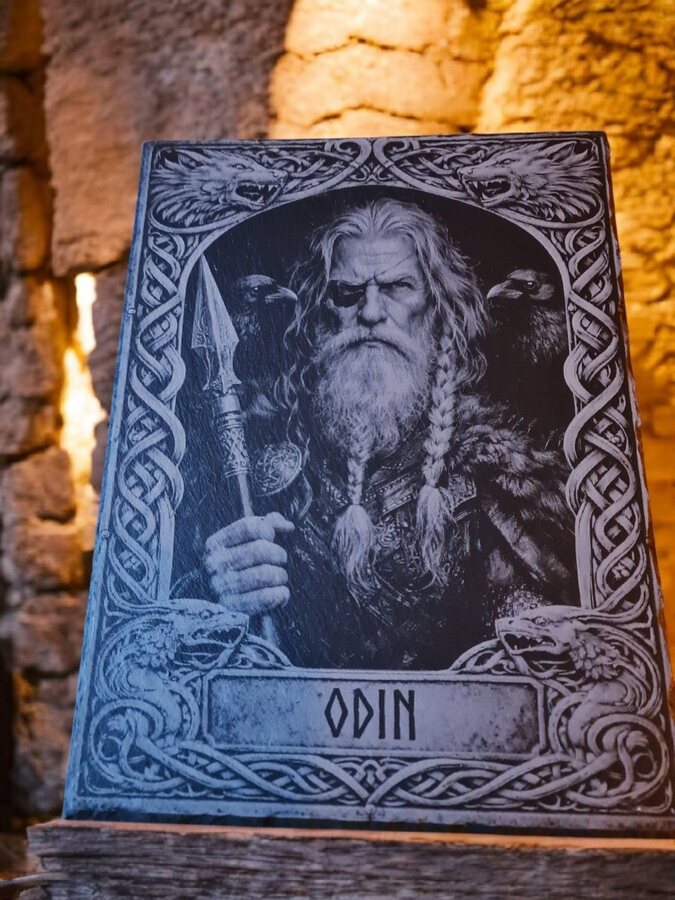
It is also telling how Adam arranges the Norse gods. His triad of Thor–Wodan–Fricco does not quite match the picture the Icelandic sources would draw two centuries later. There, Odin is the Allfather and lord; in Adam, Thor sits in the middle as the mightiest. This may reflect a genuine regional peculiarity of the Swedish cult – or Adam's attempt to press an alien faith into intelligible categories (he interprets the gods on a Roman model: Thor as Jupiter, Wodan as Mars, Fricco as Bacchus/Venus). Either way: Adam's picture of the gods is an interpretation from outside, not a self-testimony of the worshippers.
Adam is best understood by comparison. The Edda tradition of Snorri and the Icelandic sagas arose only in the thirteenth century, two hundred years after the conversion, written down by Christian Icelanders. Adam wrote closer to the pagan age, but further from the place – from the south, in Latin, with a church agenda. Snorri knows the inside view but has the temporal distance; Adam has the temporal nearness but the spatial and mental distance. Only when read together and weighed against one another do the sources yield a reliable picture – and none of them is a neutral window into the Viking world.
It is easy to forget that the "Gesta" were never meant to be about the North at all, but about a church. Adam's true heroes are the archbishops. First among them stands Ansgar, who in the ninth century travelled to Hedeby and Birka, founded the first churches there and bore the honorary title "Apostle of the North" – Adam draws his portrait of Ansgar almost entirely from Rimbert's older biography. At the end of the line stands Adalbert, Adam's own patron: a man of grand designs who dreamed of a "patriarchate of the North" and broke on that ambition. Adam depicts his pride, rise and fall with a psychological sharpness rare in the Middle Ages. These episcopal histories are the frame into which everything else – Uppsala, Vinland, heathen customs – is fitted. Whoever reads Adam reads first a story of churchmen, and only incidentally a history of the North.
Adam's work does not survive in the original but in several medieval manuscripts that differ in scope and arrangement. Especially valuable are the scholia – those marginal notes that Adam (and in part later hands) added to the text, often containing the most interesting geographical remarks. For centuries the "Gesta" remained the authoritative continental account of the North. Later authors leaned on him, and even the early-modern image of Scandinavia was shaped by his picture. Only modern source criticism has taught us to separate Adam's brilliant, dark narratives from his sober, verifiable data. It is precisely this double nature – indispensable and to be read with care – that makes him a model case of how medieval historiography works.
Despite every reservation, Adam of Bremen remains indispensable. He is the earliest detailed continental voice on the North, the first to mention Vinland, and the only one to give us any idea at all – however distorted – of the cult at Uppsala. His chronicle is not a window through which we look unclouded into the Viking world. It is a mirror in which the North is refracted: seen through the eyes of a learned, pious, partisan man from the south. Whoever knows this and reads accordingly gains more from Adam of Bremen than from almost any other source – and learns at the same time the most important rule of historical study: always ask who is telling, how he knows it, and why he tells it this way.
Uppsala · Hedeby · Viking Trade · Snorri Sturluson · The Christianisation of the Germanic Peoples.