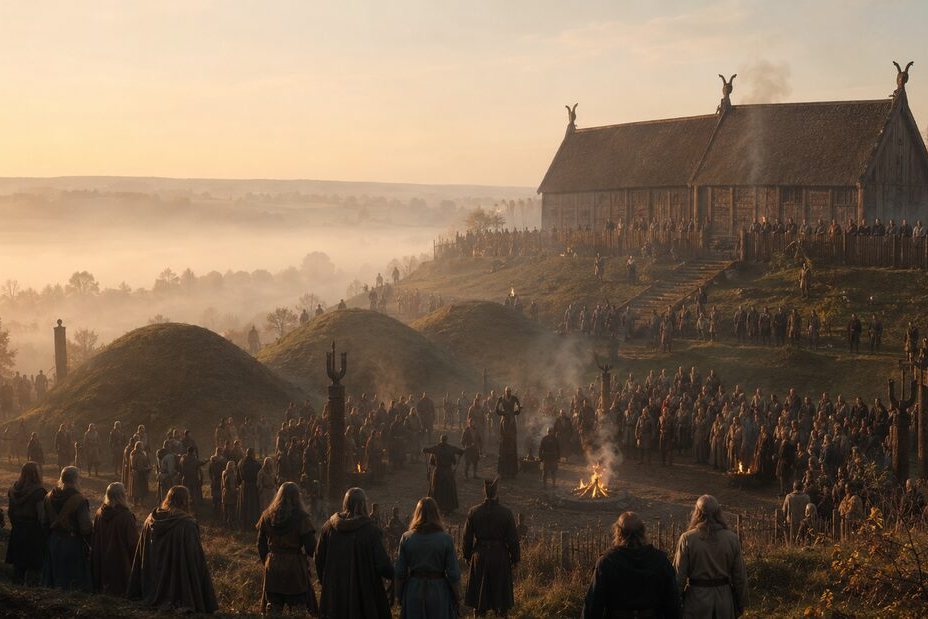
The Temple at Uppsala is known almost entirely from one source: around 1075, Adam of Bremen described a sanctuary "made entirely of gold" housing images of Thor, Wodan and Fricco, and a great sacrifice held every nine years. He never set foot there. What is certain is that Gamla Uppsala, just north of the modern city, was a centre of power and cult for the Svear, marked by Vendel Period royal mounds, a huge hall and kilometre-long rows of posts. Here we separate report, saga and evidence.
Three grassy humps in a flat farming landscape, a whitewashed church, a few grazing sheep. Gamla Uppsala, about five kilometres north of the university city of Uppsala, does not shout. Yet few places in the North carry so much meaning on so little visible ground. This is where the most famous pagan temple in Scandinavia supposedly stood, where saga tradition buried the kings of the Yngling dynasty, and where the Svear gathered for sacrifice, market and assembly.
The catch: almost everything that fires the imagination comes from texts written long after the events or far away from the place. What the soil itself reveals is soberer, but often more impressive. Let us work through it layer by layer.
Gamla Uppsala simply means "Old Uppsala". The prefix only appeared in the Middle Ages, when the archbishop's seat and the name moved south to the trading town of Östra Aros, today's Uppsala. Latin sources call the old site Ubsola or Upsala; Old Norse texts call it Uppsalir, "the upper halls" or "the high halls". The name itself points to buildings, not to graves or a temple.
The area lay in the heartland of the Svear, the people Tacitus already knew in the first century as the Suiones. Rich clay soils and waterways leading to Lake Mälaren and the Baltic made the spot a natural centre. It was never a "capital" in the modern sense. It was a royal estate, an assembly place and a cult site all at once, and that combination is exactly what makes it so interesting.
The landmark is the row of three great mounds, in Swedish Kungshögarna, strung along a glacial ridge and visible far across the plain. Beside them lie the flat-topped so-called Thing Mound, almost 50 metres across, and a cemetery of smaller barrows.
Digging started early. In the summer of 1846 the State Antiquary Bror Emil Hildebrand had a tunnel driven into the East Mound. It led to a stone cairn over a layer of burnt material: a cremation burial. The West Mound followed in 1874, again with a cremation. The finds include fragments of a Vendel-style parade helmet, gold filigree work and bones of a goshawk, a hunting bird and a mark of status at the time. The Middle Mound has never been systematically excavated.
So the royal mounds are not Viking graves. When the first Viking ships appeared off England around 790, the dead of Gamla Uppsala had already lain in the earth for some two hundred years. For the Vikings themselves, these mounds were already monuments of an ancestral age.
Who lies inside? The graves carry no names. The names come from much later tradition: the poem Ynglingatal, attributed to the Norwegian skald Þjóðólfr of Hvinir (its 9th-century date is debated), and the Ynglinga saga built upon it, with which Snorri Sturluson opened his Heimskringla around 1225.
Three kings appear there who were reportedly buried "at Uppsala". Aun the Old sacrifices his sons to Odin one after another to prolong his own life; when he wants to give up the last one, the Svear stop him and Aun dies. Egil is killed by a bull that had been meant for sacrifice. Adils falls from his horse during the dísablót while riding around the hall of the dísir, and smashes his head on a stone. Adils also appears in the Old English Beowulf as Eadgils, a hint that some of these names may preserve older memories.
In the 20th century the archaeologist Birger Nerman equated the three mounds with Aun, Egil and Adils. That is a hypothesis, not a finding. Older folk tradition linked the mounds with gods instead, calling them the mounds of Odin, Thor and Freyr, with the assignments varying from source to source. Neither gods nor specific kings can be identified in the graves. All we know for sure is that people of the highest rank were cremated here with elaborate ritual.
Now to the most famous text. Adam of Bremen was a canon and schoolmaster in Bremen. Around 1075/76 he completed his church history of the archdiocese of Hamburg-Bremen, the Gesta Hammaburgensis ecclesiae pontificum. Its fourth book is a description of the northern lands. Bremen claimed responsibility for missions throughout the North, and Adam wanted to show how much work remained. His key informant was the Danish king Sven Estridsson. Adam himself never went to Sweden.
In chapters IV.26 and IV.27 he describes Uppsala. Here are the core passages in our own translation from the Latin:
"That people has a most famous temple called Ubsola, situated not far from the town of Sigtuna. In this temple, which is made entirely of gold, the people worship the statues of three gods, arranged so that the mightiest of them, Thor, has his throne in the middle of the hall; Wodan and Fricco have their places on either side."— Adam of Bremen, Gesta Hammaburgensis IV.26 (c. 1075), our translation
Adam explains their roles straight away. Thor rules the air, governing thunder and lightning, wind and rain, fair weather and crops. Wodan, "that is, fury", wages war and gives people courage against their enemies. Fricco grants peace and pleasure; his image has an enormous phallus. Wodan is shown armed, as "we" depict Mars, and Thor with a sceptre, like Jupiter. Each god has his own priests. In times of plague and famine they sacrifice to Thor, in war to Wodan, at weddings to Fricco, that is Freyr. They also worship men who have been made gods.
The ranking stands out: Thor in the centre, not Odin, the All-Father of the Edda. Some scholars see precisely this oddity as a sign that Adam was processing real information rather than copying a template.
Chapter IV.27 describes the great festival. Every nine years, Adam says, all the provinces of the Svear held a common festival at Uppsala. No one was exempt; kings and people sent their gifts. What Adam finds crueller than any punishment is that those who have already accepted Christianity have to buy themselves out of the ceremonies.
"The sacrifice is of this kind: of every living creature that is male, nine heads are offered, and with their blood it is the custom to appease such gods. The bodies are hung in the grove next to the temple. This grove is so sacred to the heathens that they believe each single tree in it divine because of the death or decay of the victims."— Adam of Bremen, Gesta Hammaburgensis IV.27, our translation
There, Adam continues, dogs and horses hang alongside humans. A Christian told him he had seen 72 such bodies hanging there. The songs sung at the ritual are many and indecent, "and therefore better left unsaid". Of course the very songs we would most like to read today were the ones Adam considered unfit to print.
The manuscripts carry marginal notes beside the main text, known as scholia. Some probably go back to Adam himself, others to later editors. Three have become famous for Uppsala. Again in our own translation:
"Near that temple stands a very large tree spreading its branches wide, always green in winter and summer; what kind it is, nobody knows. There is also a spring where the pagans are accustomed to perform their sacrifices and to plunge a living man. If he is not found again, the people's wish will be fulfilled."— Scholion to Adam of Bremen IV.26, our translation
Another scholion describes a golden chain that surrounds the temple, hanging over the gables of the building and gleaming at visitors from afar. The temple, it says, stands on a plain ringed by hills like a theatre. A third scholion adds detail to the festival: for nine days there are feasts and sacrifices; each day one man is offered together with other animals, so that over nine days 72 living beings are sacrificed. This sacrifice takes place around the spring equinox.
The evergreen tree and the spring have stirred imaginations above all. They recall Yggdrasil, the world tree of the Edda, which is also evergreen and has wells at its roots. The historian of religion Olof Sundqvist has examined whether temple, tree and well reflect a cosmic symbolism here or a literary topos, a narrative pattern repeated at various cult sites. There is no neat answer. Sacred trees and springs are well attested in the Germanic world, as we show in our articles on sacred trees and groves and holy springs. That Adam's informants meant a real tree and a real spring is quite possible. Equating it with Yggdrasil, however, remains a modern interpretation.
Scholars have argued about this for more than a century, and opinions diverge widely. A few points are beyond dispute.
First, Adam wrote at second or third hand. He had informants at the Danish court and among missionaries, but was never in Uppland. Second, he wrote with a purpose: a dramatic paganism justified Bremen's missionary claims in the North. Third, his imagery is learned. The golden sanctuary evokes the Temple of Solomon, the number nine medieval number symbolism. In his 1998 dissertation Templum nobilissimum, the historian Henrik Janson went further: he read Adam's Uppsala chapters as a coded commentary on the church conflicts of his day, the Investiture Controversy. On this reading the "temple" was really an image of a church resisting Bremen's imperial church system. The thesis is contested, but it is a useful warning.
On the other side stand scholars such as Anders Hultgård and Olof Sundqvist, who see a genuine core in Adam's account despite all its colouring. Many details match other sources, such as animal sacrifice and the link between festival, assembly and market. Rudolf Simek likewise considers a cult building at Uppsala very likely, but the gold an exaggeration.
The number 72 is also striking: it appears in the scholion as the total of victims and in the main text as the number of bodies seen. Whether anyone actually counted, or whether a symbolic number (8 × 9) is wandering between the passages, remains open. More on sacrificial practice can be found in our overview of Germanic sacrifices and sanctuaries.
The wish to find the golden temple is old. In 1926 the archaeologist Sune Lindqvist dug beneath the floor of the church at Gamla Uppsala. He found postholes and reconstructed from them a square timber building with several rings of posts, which entered countless books as "the Temple at Uppsala". Those drawings of a tall building with a stepped roof go back to his reconstruction.
Later researchers were more sceptical. In the early 2000s Magnus Alkarp and Neil Price surveyed the church floor with ground-penetrating radar. Their result, published in the journal Fornvännen in 2005: the postholes belong to several building phases, not to a single structure. Lindqvist's temple plan can hardly be sustained. Whether the timber building the radar showed under the north transept was a cult house or an early wooden church could not be determined.
The biggest leap in knowledge came from rescue excavations. Ahead of a new railway line, archaeologists investigated large areas around Gamla Uppsala from 2012 onwards; according to the Upplandsmuseet, around 70,000 square metres in 2012 alone. Two enormous rows of posts came to light. According to current analysis one runs about 900 metres north–south, the other roughly 500 metres east–west. The posts stood about six metres apart; the project leader Lena Beronius Jörpeland estimated they may have been eight to ten metres tall. One posthole contained a puppy, perhaps a building sacrifice.
Then there is the great hall. On the artificial terraces south of the church, the so-called royal estate plateaus, stood a building about 50 metres long; the hall room proper measured roughly 26 by 8 metres. Radiocarbon dates place its construction in the late 6th or early 7th century, contemporary with the great mounds. It probably burned down in the decades around 800, apparently on purpose. Large numbers of pig bones nearby point to big communal meals, possibly sacrificial feasts.
What does this mean for the "temple" question? Many researchers now assume that cult in the North often took place not in dedicated temple buildings but in the rulers' halls themselves. We describe what such places looked like in our article on blót sites: hörgr, hof and cult hall. But there are counter-examples: at Uppåkra in southern Sweden, a small, tall cult building was excavated next to the hall, rebuilt again and again on the same spot over centuries. A separate cult building at Uppsala is therefore not out of the question. It was just certainly not made of gold.
Uppsala was not only a cult site but also a place of assembly. Snorri Sturluson, who travelled in Sweden in 1219, writes in Óláfs saga helga (ch. 77) that in Sweden it had been an ancient custom, while paganism prevailed, for the chief sacrifice to be held at Uppsala in the month of Gói (roughly February/March). It was offered for peace and victory for the king. At the same time people from all over Sweden gathered for the thing, the assembly, and a market was held for a week. After Christianisation, Snorri says, the assembly and market were kept, but the market was moved to Candlemas and cut to three days.
This explains the name Disting, Old Swedish Disaþing, "assembly of the dísir". The dísir were female guardian powers; the dísablót was offered to them. In Ynglinga saga Snorri mentions a dísarsalr at Uppsala, a hall of the dísir, around which King Adils was riding when he met his death. Remarkably, the Disting market has survived. It was officially abolished in 1895 but carried on, and it is still held in Uppsala in early February. You can read more about the pagan festival calendar in our article on Germanic festivals.
The most famous assembly at Uppsala is a saga scene. In Óláfs saga helga, Snorri has the lawspeaker Þorgnýr give the Swedish king Olof Skötkonung a dressing-down in front of the assembled crowd: in the old days, the farmers had thrown kings who would not listen into a bog. The king backs down and makes peace with Norway. The speech is 13th-century political literature, not a transcript. But it shows how Icelanders imagined the assembly of the Svear: as a place where even kings had to answer for themselves. Other assembly sites in the region are covered in our article on Bällsta, Anundshög and other thing and cult sites.
In Norse tradition Uppsala is closely tied to Freyr. In Ynglinga saga Snorri makes Freyr himself king of the Svear and has him build a great temple at Uppsala; his byname Yngvi-Freyr makes him ancestor of the Ynglings. Snorri interprets the gods here as deified humans of the distant past. What is striking is that Adam, a century and a half earlier and independently, also names Fricco at Uppsala.
Saxo Grammaticus, writing in Denmark around 1200, likewise places Frø near Uppsala and has him introduce human sacrifice there. Uppsala was evidently known throughout the North as a special place of Freyr's cult. We say more about the god himself and his family, the Vanir, in our article on Freyr and the Vanir.
The conversion of Sweden was slow and full of setbacks. Adam reports that King Olof Skötkonung (died c. 1022) wanted to destroy the temple at Uppsala; the pagans resisted, and it was agreed that the king should instead found a church in the western part of his realm, where Skara became a bishop's seat. Even in Adam's lifetime, then, Uppland was known as pagan. The sources do not say exactly when the last sacrificial cult at Uppsala ended.
A first church was probably built at Gamla Uppsala in the late 11th or early 12th century, by common opinion on the site of the old cult place. In 1164 Uppsala became the seat of Sweden's first archbishopric; the first archbishop was Stefan, a monk from Alvastra Abbey. The Romanesque stone church, now serving as cathedral, was about three times the size of today's. After a fire, probably in the early 13th century, a new cathedral was planned further south in Östra Aros. In 1273 the archbishop's seat was officially moved there, and the name Uppsala moved with it. The old cathedral shrank to a parish church; today's church interior is what remains of the former high choir.
That the church stands between the royal mounds and the royal estate is no accident: the new religion took over the seat of the old power, as it did almost everywhere during the Christianisation of the Germanic peoples.
The site is freely accessible. Paths lead across the burial ground to the royal mounds, the Thing Mound and the royal estate terraces. The Gamla Uppsala Museum, run by the Upplandsmuseet, displays finds from the mounds and explains the history of the excavations and the saga tradition. Next door is the Disagården open-air museum. Museum opening hours vary with the season, so check them before you travel.
Our tip: come in the late afternoon, when low light rakes across the mounds. For more destinations on a Scandinavian trip, see our overview of Viking museums.
Archaeologically secure are the royal mounds and great hall of the late 6th/7th century, monumental post rows and traces of large feasts. Adam's account is contemporary but second-hand; Snorri's information dates from the 13th century. Aun, Egil and Adils are saga tradition; Lindqvist's temple plan and the "Yggdrasil tree" are modern interpretation. What is left is not a golden temple but something better: a centre that grew over centuries, where kingship, ancestor cult, worship of the gods and law were bound together.
Did the Temple at Uppsala really exist? A cult site at Gamla Uppsala is very likely, and a dedicated temple building is possible but not securely proven. The temple "entirely of gold" is known only from Adam of Bremen, who never visited Uppsala.
How old are the royal mounds at Gamla Uppsala? The East and West Mounds date to the late 6th and early 7th centuries, the Vendel Period before the Viking Age. The Middle Mound has not been excavated.
Which gods were worshipped at Uppsala? According to Adam of Bremen, Thor, Wodan (Odin) and Fricco (Freyr), with Thor enthroned in the middle. Snorri links Uppsala above all with Freyr.
Were humans sacrificed at Uppsala? Adam reports human and animal sacrifices at a festival every nine years. For Gamla Uppsala this has not yet been clearly proven archaeologically, while animal offerings and sacrificial meals are better supported.
What is the Disting? Originally the assembly and market held at the time of the dísablót in late winter. The Disting market is still held in Uppsala in early February.
For courage. For remembrance. For legends that live on.
The Old Germanic Feasts · Freyr · Odin · The Norse pantheon.
All History & Finds articles →
In December 2020 a metal detector beeped in a field near Vindelev, only a few kilometres from Jelling. What came to …
Read more →A rare genetic trace in Iceland tells a story that sounds almost unbelievable: some Icelanders carry a maternal DNA …
Read more →About five centuries before Columbus, Norsemen set foot on American soil. For a long time this was thought a legend …
Read more →Vikings and Aachen? Sounds like two worlds with nothing to do with one another. Yet in the winter of 881/882 the …
Read more →