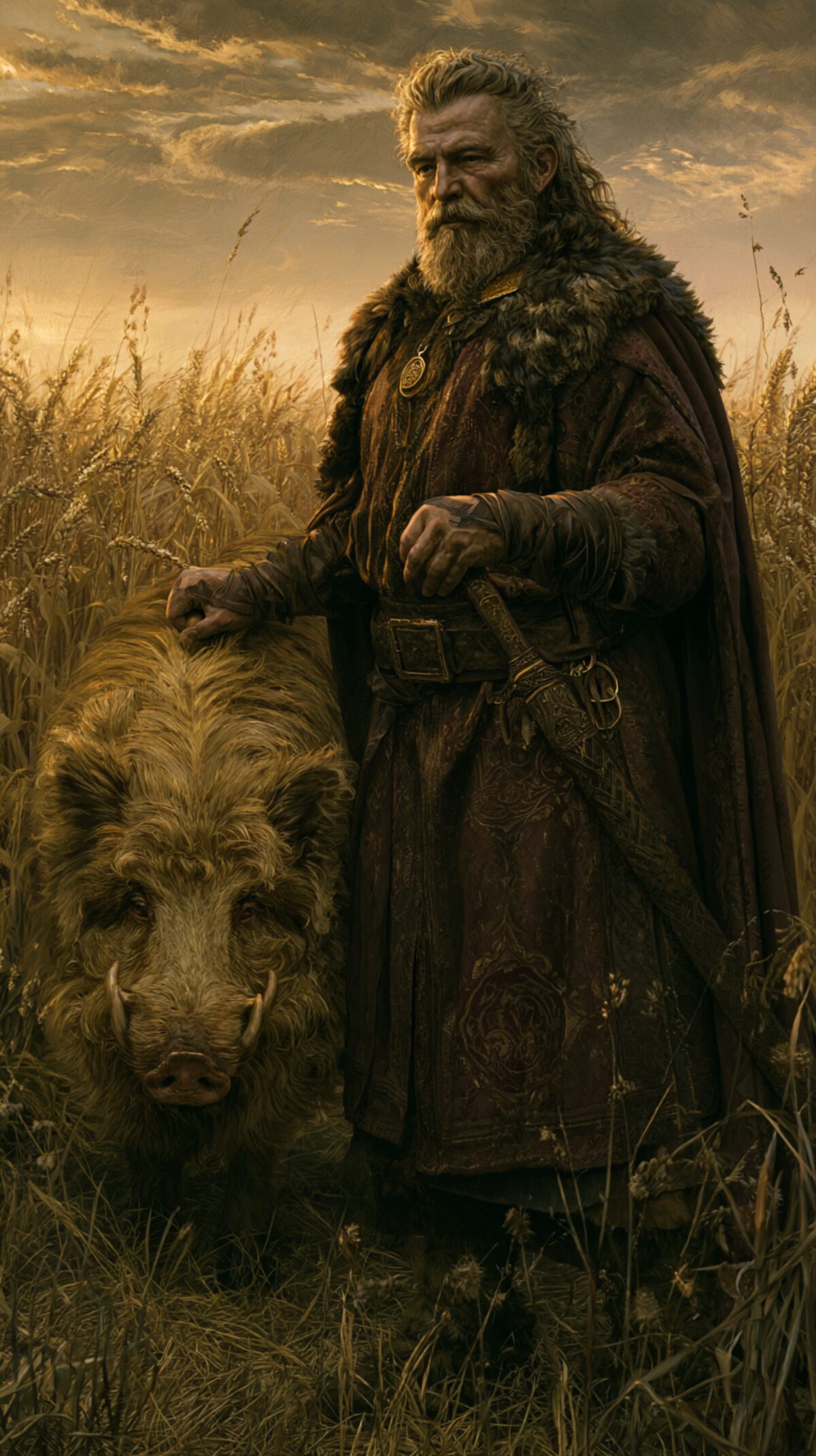
Freyr is the Norse god of fertility, harvest, prosperity and peace – the god people called on "for a good year and peace". His name simply means "lord". Snorri turns him into a king at Uppsala and ancestor of the Yngling dynasty, Adam of Bremen describes his idol with an enormous phallus, and the Edda tells how he gave away his sword to win the giantess Gerðr – which is why he dies unarmed against Surtr at Ragnarök. Add a golden boar, a ship that folds like a cloth and Icelandic saga priests, and you have one of the richest gods of the North.
Here is what we actually know about Freyr, and where each piece comes from: Eddic poems, Snorri Sturluson, a cathedral canon in Bremen, Icelandic sagas and a few finds from the soil. For every source we tell you how far you can trust it.
Freyr is not really a personal name at all. It is a title, going back to Proto-Germanic *frawjaz, "lord". Its relatives are Gothic frauja (the word Wulfila's Bible uses for "the Lord"), Old English frēa and Old High German frō. His sister Freyja carries the matching title, "lady". A few linguists have suggested an additional link to a word for "fruitful"; that remains a minority view, but it shows how closely lordship and fertility are bound together in this god.
The sources also know him as Yngvi-Freyr and as Ingunar-Freyr. Yngvi, or Ing, is a very old divine name. The Old English Rune Poem says of the rune Ing that Ing was first seen among the East Danes. Many scholars also connect him with the Ingaevones, one of the three tribal groups the Roman historian Tacitus names in his Germania around AD 98. Whether that is the same god cannot be proven; it is a plausible hypothesis, nothing more.
So the name we use today may simply be a respectful form of address – "the Lord" – for a god whose real name was Yngvi, or something we have lost entirely.
Norse myth knows two families of gods: the Æsir around Odin and Thor, and the Vanir, linked with fertility, wealth and the sea. Freyr is one of the Vanir. His father is the sea god Njörðr, his sister Freyja; Snorri never names their mother. In the flyting poem Lokasenna, Loki accuses Njörðr of having fathered this son on his own sister – which fits Snorri's claim in Ynglinga saga that such unions were customary among the Vanir but forbidden among the Æsir.
After the war between the two families, peace was sealed with an exchange of hostages. That is how Njörðr and Freyr came to live among the Æsir and became full members of the pantheon. Their homeland, Vanaheimr, is named in the sources but hardly ever described.
The most compact portrait of Freyr is in Snorri's Gylfaginning, the first part of the Prose Edda, written in Iceland around 1220. Describing Njörðr's children, Snorri says:
"Freyr is the most renowned of the Æsir; he rules over the rain and the shining of the sun, and therewithal the fruit of the earth; and it is good to call on him for fruitful seasons and peace. He governs also the prosperity of men."— Snorri Sturluson, Gylfaginning 24, translated by Arthur G. Brodeur (1916, public domain)
Three spheres stand out: weather, the fertility of the land, and fésæla – wealth and good fortune. Then there is the formula behind "fruitful seasons and peace": til árs ok friðar, "for a good year and peace". The phrase appears in several Old Norse texts as the purpose of sacrifice. Ár is not just "year" but a year of plenty; friðr is the peace in which you can actually bring that harvest home. One does not work without the other.
There is a small contradiction worth noticing. Adam of Bremen, writing around 1075, says that at Uppsala it was Thor who ruled thunder, winds, rain, fair weather and crops. In Snorri the weather belongs to Freyr. That is less a mistake than a reminder that divine responsibilities varied from region to region. There was no fixed job description for Norse gods.
The most unusual Freyr appears in Ynglinga saga, the opening part of Snorri's history of the Norwegian kings, Heimskringla. Here Snorri tells the gods as human beings – early rulers who were worshipped after death. In chapters 10 to 12 (numbering differs between editions) the succession runs like this: Odin dies in Sweden, Njörðr takes over, and under him there is such good peace and such rich harvests that the Swedes believe he governs the seasons.
After Njörðr, Freyr becomes king. He is called lord over the Swedes, takes tribute, builds a great temple at Uppsala and makes it his chief seat. In his days begins the proverbial Fróðafriðr, "Fróði's peace", with good years in every land, and the Swedes credit Freyr with it. His wife is Gerðr, their son Fjölnir. Freyr is also called Yngvi, and from him the Ynglings take their name – the legendary royal house of Sweden, from whom later Norwegian kings also claimed descent.
Then comes the famous scene. Freyr falls ill and dies. His closest men dare not announce it. They raise a great mound with a door and three windows, carry the dead king inside and tell the Swedes he is still alive. For three winters the tribute is poured into the mound: gold through one window, silver through the second, copper through the third. And peace and good harvests continue.
When the Swedes finally learn the truth, they draw a remarkable conclusion. Since peace and plenty have lasted, they believe they will last as long as Freyr remains in Sweden. So they do not burn him. They call him the god of the world and sacrifice to him ever after for a good year and peace.
Snorri tells something similar about the Norwegian petty king Halfdan the Black, whose body was supposedly divided and buried in several districts because each expected good harvests from it. The king as guarantor of fertility runs right through the Freyr tradition.
The only near-contemporary description of a Freyr cult comes not from Scandinavia but from Bremen. Around 1075 the canon Adam of Bremen wrote his Gesta Hammaburgensis ecclesiae pontificum, a history of the archbishops of Hamburg. In Book Four he describes the temple at Uppsala with three idols: Thor in the middle, Wodan beside him, and a third, Fricco – Adam's Latin form of Freyr.
"Tercius est Fricco, pacem voluptatemque largiens mortalibus. Cuius etiam simulacrum fingunt ingenti priapo."— Adam of Bremen, Gesta IV, 26 (Latin original)
In plain English: the third is Fricco, who bestows peace and pleasure on mortals; his image they fashion with an enormous phallus. In the next chapter Adam adds whom people sacrificed to and when: to Thor in times of plague and famine, to Wodan in war, and to Fricco when a wedding was to be celebrated.
That matches Snorri strikingly well: peace, fertility, procreation. Caution is still needed. Adam never visited Uppsala; he relied on what others told him, and he names the Danish king Sven Estridsson as his key informant on the North. He wrote as a churchman with a mission to justify. Parts of his temple description – the golden chain around the roof, for instance – sound exaggerated or modelled on biblical and classical patterns. Archaeologists have found a large hall building at Old Uppsala from the Vendel and Viking periods, but no temple matching Adam's description exactly.
In spring 1904 a small bronze figure turned up on the farm of Rällinge in Lunda parish, Södermanland. It is barely seven centimetres tall, dated to the late Viking Age around the year 1000, and is now in the Swedish History Museum in Stockholm. The figure sits cross-legged, wears a pointed cap or conical helmet, has a long pointed beard and a curled moustache, and grips its beard with the right hand. It is also clearly ithyphallic – shown with an erect penis.
That one feature earned it the nickname "the Rällinge Freyr". The identification rests mainly on Adam's description of the Fricco idol. What the figure lacks is any secure attribute of Freyr – no boar, no ship, no sword. Scholars have therefore suggested alternatives: Thor blowing into his beard to raise the wind, a king piece from the board game hnefatafl, a musician; Neil Price notes that Odin, dwarfs, giants or even a human ruler cannot be ruled out.
Our verdict: Freyr is the most likely reading, but it is a reading. The label comes from the twentieth century, not from the figure itself.
Freyr's best-known story is a love story – and a dark one. It survives in the Eddic poem Skírnismál, "The Lay of Skírnir", and in Snorri's retelling (Gylfaginning 37).
One day Freyr sits down on Hliðskjálf, Odin's high seat, from which one can see into every world. He has no business being there. Looking into Jötunheimr, he sees in the yard of the giant Gymir a young woman whose arms shine so brightly that sky and sea glow with them. She is Gerðr, a giant's daughter. Freyr is struck down by longing; he does not eat, sleep or speak. At last Njörðr and Skaði send Freyr's servant Skírnir to him.
Freyr asks Skírnir to woo Gerðr on his behalf. Skírnir's price is a horse that will carry him through the flickering flames, and Freyr's sword that fights by itself. Freyr hands over both. In the poem Skírnir first offers Gerðr treasure – eleven golden apples and the ring Draupnir. She refuses. He threatens her with the sword. She refuses again. Finally he threatens her with a magic staff and with curses of loneliness, loathing and madness, and carves the rune þurs. Only then does Gerðr give in and promise to meet Freyr after nine nights in the grove of Barri.
When Skírnir brings back the answer, Freyr speaks the famous closing lines:
"Long is one night, longer are two – how shall I bear three? Often a month has seemed to me shorter than half a night of longing."— Skírnismál 42, our own rendering
The poem has been read in very different ways. Older scholars saw a nature myth: the sun god waking the frozen earth (Gerðr's name was linked with garðr, "enclosure, field"). That reading is now considered too schematic. The Norwegian historian of religion Gro Steinsland interpreted the poem as the myth of a sacred marriage between a god and a giantess from which a royal line springs – which fits Snorri's statement that Gerðr is the ancestral mother of the Ynglings. Steinsland also connected it with the Scandinavian guldgubbar, tiny gold-foil figures showing a couple facing each other. Again, an interpretation rather than proof, but an influential one.
And there is a soberer reading: the poem shows how violent a "courtship" could be in this world. Gerðr is not persuaded; she is threatened. Anyone retelling Skírnismál as pure romance should not leave that out.
The sword is the thread that runs from the wooing to the end of the world. In Snorri, Freyr later fights the giant Beli and kills him – without a sword, using a stag's antler. Snorri adds that Freyr could have killed him with his bare hand. That is why the Völuspá calls Freyr "Beli's slayer" (bani Belja).
At Ragnarök, though, an antler is not enough. The Völuspá describes Surtr advancing from the south with fire and Freyr going out to meet him. Snorri turns it into the bitter punchline: Freyr falls because he lacks the good sword he once gave to Skírnir. In Lokasenna Loki needles him about exactly this – Freyr bought Gymir's daughter with gold and gave away his sword; what will he fight with when Muspell's sons ride over Myrkviðr?
It is one of the strongest ideas in Norse myth: the god of life and peace dies in the last battle because he once put love before his weapon. You can read it as a warning or as a confession. Both suit a world that knew every good year has to be defended.
Freyr owns two of the most famous treasures of the gods. According to Snorri's Skáldskaparmál, both are tied to Loki's wager with the dwarves. First the sons of Ívaldi forged Sif's golden hair, Odin's spear Gungnir and the ship Skíðblaðnir. Then Loki bet his head that the brothers Brokkr and Eitri (also called Sindri) could not make anything as good. From their forge came, among other things, Thor's hammer – and the boar Gullinbursti, "Golden Bristles".
So the two treasures came from different workshops, but they were judged by the gods in the same contest. Gullinbursti runs through air and over water, day and night, faster than any horse, and no night is ever so dark that his bristles do not light the way. At Baldr's funeral, Snorri says, Freyr rode in a chariot drawn by this boar. A second name, Slíðrugtanni ("Sharp-tooth"), is understood by some as another boar and by others as a byname of the same animal.
According to the Eddic poem Grímnismál, Skíðblaðnir is the best of all ships. Snorri adds that it has room for all the Æsir with their weapons and gear, catches a fair wind the moment its sail is raised, and can be folded like a cloth and carried in a pouch. Every shipwright in the North would have given a great deal for that design.
A tiny note in the Edda says a lot. Grímnismál 5 tells us that in days of old the gods gave Freyr Álfheimr as tannfé, a "tooth-gift" – the present a child received when its first tooth came through. An entire realm for a first milk tooth: generosity on a cosmic scale.
Álfheimr is the world of the light elves. The source does not say why Freyr in particular received it. The link between Vanir and elves is striking, though: both are associated with fertility, ancestors and burial mounds, and some sagas mention an álfablót, a sacrifice to the elves held on farms. Some scholars see this as a sign that Vanir and elves stood close together in popular religion. Only the gift itself is securely attested.
In Iceland, settled from around 870, Freyr appears in several sagas of Icelanders. These were written down in the thirteenth and fourteenth centuries, long after the conversion around the year 1000. They show how later Icelanders imagined their ancestors' Freyr cult – not necessarily how it actually worked.
Hrafnkels saga Freysgoða: Hrafnkell is a goði, a chieftain who also led the cult, and so devoted to Freyr that he gives the god a half share in his finest possessions. His stallion Freyfaxi he owns jointly with Freyr. Hrafnkell swears to kill anyone who rides the horse without his leave. When the shepherd Einarr does, Hrafnkell kills him. Later his enemies push Freyfaxi, his head covered, over a cliff into the water and burn the temple. Hrafnkell then declares, in effect, that it is folly to believe in gods, and never sacrifices again. Scholars regard the saga as largely literary invention.
Víga-Glúms saga: Old Þorkell the Tall is forced to give up his land to Glúmr. Before leaving, he leads an old ox to Freyr's temple and asks the god, long his patron, to drive Glúmr from the farm one day just as unwillingly. The ox bellows and drops dead – the sacrifice has been accepted. Years later Glúmr dreams that crowds come to his farm to see Freyr, and the god looks at him in anger. The saga reads Glúmr's later decline as the result of that anger; the field Vitazgjafi ("the sure giver"), said never to have failed, plays an important part in the story.
Gunnars þáttr helmings: This short tale is preserved in the great saga of Olaf Tryggvason from the early fourteenth century; a shorter version appears in manuscripts of Víga-Glúms saga. The Norwegian Gunnarr flees to Sweden and attaches himself to a young woman regarded as Freyr's wife, who travels the countryside each autumn with a wooden image of Freyr on a wagon. In a snowstorm Gunnarr fights the image, defeats the "demon" with the help of the Christian God and puts on Freyr's clothes himself. The locals are delighted that their god now eats and drinks with them – and when the "god's wife" becomes pregnant, it is taken as the best possible omen.
This is a Christian satire, not a news report. Yet it is intriguing: the travelling god-wagon with its priestess recalls Tacitus's account of the goddess Nerthus, whose wagon was drawn through the land and whose arrival brought peace. Nerthus is linguistically related to Njörðr. Whether a genuine, centuries-old cult tradition shines through here, or a learned author borrowed a classical motif, remains disputed.
Perhaps the most down-to-earth evidence for Freyr worship is written on the map. Sweden and Norway have many place names containing the god – in Sweden usually in the form Frö-. We explain the principle in our article on gods in place names.
The best-known example is Frösön, "Freyr's island", in lake Storsjön in Jämtland. Beneath the chancel of the medieval Frösö church, archaeologists in 1984 found a birch stump surrounded by bones of bear, elk, red deer, pig, sheep, cattle, horse and squirrel. Radiocarbon dating placed the felling of the tree around 1060, with a margin of about 75 years. The find is interpreted as the remains of a sacrificial tree on which parts of animals were hung. Whether this cult site belonged to Freyr specifically, the find itself cannot say – but the island's name makes it likely.
In Norway, farm names such as Freyshof ("Freyr's temple") or Freysvin ("Freyr's meadow") are recorded. The same caveat applies: not every place beginning with Frö- or Frøy- is certainly named after the god, and place-name scholars check each case individually.
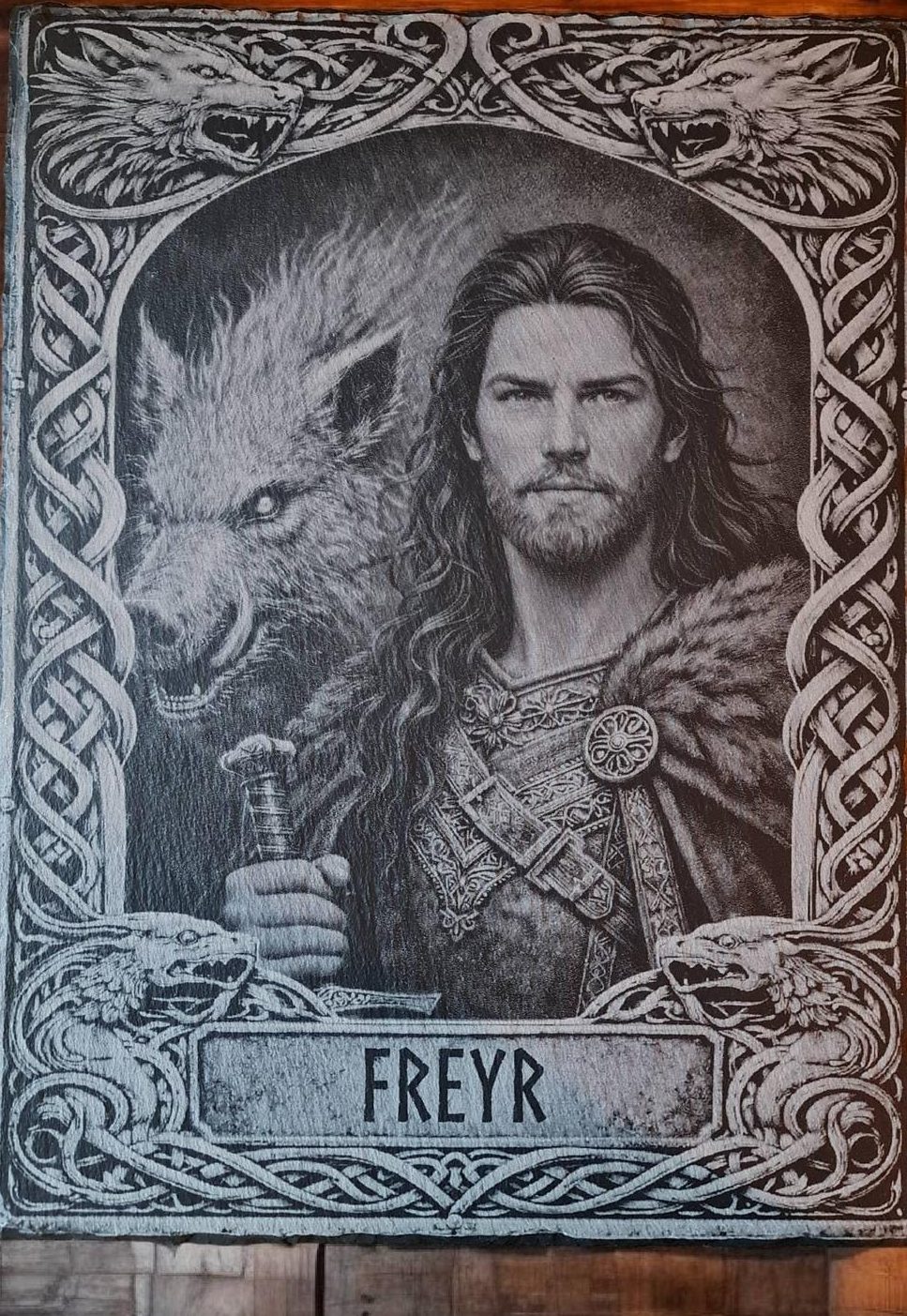
For us in the workshop, Freyr is a god who fits remarkably well into everyday life. He is not about victory and blood but about what you wish for a home: good years and peace. The old formula til árs ok friðar works beautifully on a slate plaque by the front door, a wooden sign in the kitchen or a lantern as a housewarming gift.
And since Adam of Bremen says people sacrificed to Fricco at weddings, Freyr suits wedding engravings too: a simple boar in Viking Age style, the folding ship Skíðblaðnir as a sign of a voyage taken together – or the line from Skírnismál about the long night of longing. What matters to us is that we tell you what is attested and what is interpretation. To us the Rällinge figure is "probably Freyr", not simply "Freyr".
What is Freyr the god of? Freyr is the Norse god of fertility, harvest, weather, prosperity and peace. According to Snorri he rules rain and sunshine, and people called on him "for a good year and peace".
What does the name Freyr mean? Freyr means "lord" and is more a title than a personal name. It is related to Gothic frauja and Old English frēa; another name of the god is Yngvi.
Are Freyr and Freyja siblings? Yes. Both are children of the Vanir god Njörðr. Their names form a pair: "lord" and "lady".
Why does Freyr have no sword at Ragnarök? He gave his self-fighting sword to his servant Skírnir as payment for wooing the giantess Gerðr on his behalf. At Ragnarök he therefore faces Surtr unarmed and falls.
What is the name of Freyr's boar? Freyr's boar is Gullinbursti, "Golden Bristles". He was forged by the dwarves Brokkr and Eitri, runs through air and water and shines in the dark.
Is the Rällinge statuette really Freyr? Possibly. The bronze figure from around AD 1000 is usually identified as Freyr because of its phallus, but it lacks his typical attributes. Other suggestions range from Thor to a gaming piece.
For courage. For remembrance. For legends that live on.
Freyja · The Vanir · Vanaheim · Ragnarök · The Norse pantheon.
All Gods & Goddesses articles →
Above all the goddesses of the Æsir stands one: Frigg, Odin’s wife and queen of Asgard. She knows the fate of all …
Read more →Heimdall is the watchman who never sleeps – the god who hears the grass grow and the wool sprout on the sheep. Born of …
Read more →Not every dead man came to Valhalla. Most people – all who died of sickness and age – went to Hel. She is the mistress …
Read more →Loki fits no box. Now he saves the gods with a trick, now he plunges them into ruin. It is exactly this doubleness that …
Read more →