Yes, the old gods really do survive in place names: Odense in Denmark comes from Óðins vé, “Odin’s sanctuary”, Torshälla in Sweden from a cult site of Thor, Ullevål in Oslo from the god Ullr, and Wednesbury in England from Woden. These theophoric place names are among the most valuable witnesses to pre-Christian religion, because they are older than almost any written text. But for every secure case there are ten bogus ones. Here are the solid examples, the doubtful ones and the legends – and how to tell them apart.
A road sign is a strange kind of archive. Thousands of people read it every day, and almost nobody understands it. Step off the train in Odense and you think of Hans Christian Andersen, not Odin. Drive to the Ullevål stadium in Oslo and you think of football, not of a god on skis. Yet these names have outlasted a thousand years of Christianity, Reformation and spelling reform.
Scholars call such names theophoric, literally “god-bearing”. They matter because they were not written down by Christian monks, like the Eddas and sagas, but coined by the people who lived and sacrificed in those places. At the same time, few corners of mythology are as overgrown with wishful thinking as the question of where “Woden” was once worshipped. So this article is two things at once: a tour of the divine map of the North, and a small toolkit for checking such claims yourself.
A theophoric place name usually has two parts: the god’s name in the genitive (the possessive form) and a generic element that says what kind of place is meant. Óðins vé means “Odin’s sanctuary”, Þórs hǫrgr “Thor’s cult site”, Ullar vǫllr “Ullr’s field”. The generic element is often the more revealing half, because it tells us how people imagined the place.
So the gods did not only own hills and sacred groves. They had fields and meadows too. A name like Torsåker speaks of farmers calling on their god while working the land, not of druids in the mist.
The textbook case is Odense. Denmark’s third-largest city is first mentioned in a charter of Emperor Otto III dated 18 March 988, already as the seat of a bishop; in 1988 the city duly celebrated its millennium. Linguistically the name is clear: Óðins vé, “Odin’s sanctuary”.
What we do not know is where exactly that sanctuary stood or what it looked like. What archaeology does show is the late Viking Age: from around 980 the ring fortress of Nonnebakken stood across the river, one of the Trelleborg-type forts of Harald Bluetooth’s time. That a bishopric grew up precisely at Odin’s place fits a familiar pattern: the Church liked to settle where people already gathered.
Odense is not alone. There are several places called Odensvi in Västmanland, Närke and Småland, Onsild, Onsved and Onsbjerg in Denmark, Odensåker in Västergötland. For the god behind them, see our portrait Odin – wisdom at any price.
Just before Eskilstuna, west of Stockholm, lies Torshälla. According to the usual interpretation the name goes back to Þórs hǫrgr, Swedish Tors harg: Thor’s cult site. The word probably meant an open-air stone altar. In the Eddic poem Hyndluljóð Freyja even boasts that her protégé Óttarr built her a hörgr of piled stones and reddened it with sacrificial blood – a late, poetic source, but one that fits the meaning of the word.
North of Stockholm lies Odensala, usually explained as Óðins hǫrgr, “Odin’s cult site”. The name has worn down so far that it now looks like “sala”, hall – and anyone who reads only the modern form will think of Valhalla. Only the older spellings reveal the harg underneath. That is one of the classic traps of place-name study.
Thor names are especially frequent in central Sweden: Torsåker, Torslunda, Torstuna and more. It was in Torslunda parish on Öland that the famous bronze dies with warrior scenes were found, which we discuss in the Torslunda plates. The god himself is in Thor – thunder over Midgard.
Far to the north, in Jämtland, the island of Frösön in Lake Storsjön bears the name of Freyr, Swedish Frö: “Freyr’s island”. Here place-name research, archaeology and runology meet, which is rare enough.
On the island stands the Frösö runestone, raised around 1030–1050 and the northernmost standing runestone in the world. Its inscription records that a man named Austmaðr had Jämtland christianised – a mission monument on the god’s own island.
Then there is the church. Excavations beneath the chancel of Frösö church in the 1980s uncovered the remains of a tree stump surrounded by animal bones, above all brown bear and pig, together with some human bones. The osteologists Ola Magnell and Elisabeth Iregren re-examined the material in 2010. Radiocarbon dates place the rituals in the late Viking Age, butchery marks point to feasting, and seasonal analysis suggests late autumn, spring and possibly midsummer. They are careful about the human bones: these may come from disturbed burials and need not mean human sacrifice.
Freyr names follow a striking pattern. The toponymist Stefan Brink counted 38 “certain” Frö names in Sweden. They cluster in two regions: around Lake Mälaren and in Viken around the Oslofjord. They are almost absent from Denmark and missing from Trøndelag and northern Norway. That Adam of Bremen describes an image of Fricco – Freyr – beside Thor and Wodan at Uppsala fits this distribution. More in Old Uppsala – temple and royal mounds and Freyr and the Vanir.
In the Eddas Ullr is a minor figure: Thor’s stepson, a fine archer, quick on skis, and little more. On the map he is remarkably present. According to the Store norske leksikon, Ullevål in Oslo contains Ullar, the genitive of the god’s name; the second element is either vǫllr (“field”, in the sense of cleared or burnt land) or hváll (“rise, hill”). Ullevi, “Ullr’s sanctuary”, is the name of the stadium in Gothenburg and of several places in Västergötland. Add Ultuna near Uppsala and, in Norway, Ullensaker and Ullensvang.
The Norwegian names show a variant, Ullinn instead of Ullr. Whether this reflects a divine pair like Freyr and Freyja or merely a by-form of the same god remains open.
A real stroke of luck is Lilla Ullevi near Bro in Uppland. An excavation in 2007 uncovered a Vendel-period stone setting there, and around it lay 65 iron amulet rings. A name meaning “Ullr’s sanctuary” and an archaeologically visible cult site in the same spot: you can hardly ask more of a place name.
Ullr names occur in only two areas, the provinces around Lake Mälaren and Viken; they are absent from Denmark, southern Sweden and Trøndelag. Brink’s conclusion: the cult of Ullr was never pan-Scandinavian. Our portrait Ullr – the god on skis tells what else we know.
The sea god Njörðr left traces too. In Norway old sources name an island Njarðey (today Nærøya) and a district Njarðarlǫg; Iceland has Njarðvík. More intriguing are the Swedish cases collected by the linguist Elof Hellquist as early as 1922: Nærdhæwi, now Nalavi in Närke; Njærdhavi, now Mjärdevi near Linköping; Nærdhælunda, now Närlunda; Nierdhatunum, now Närtuna in Uppland.
Once again we find sanctuary (vi), grove (lunda) and manor (tuna). Around AD 98 Tacitus describes a goddess Nerthus, whose name corresponds exactly to Norse Njörðr. A male god in the North, a goddess in Tacitus? Some scholars explain this grammatically; others suspect a brother–sister pair, as hinted at in Lokasenna with its reference to Njörðr’s unnamed sister. For some Swedish names it has therefore been suggested that a female deity, a “Njärd”, may lie behind them. A serious hypothesis – but a hypothesis.
Denmark has a focus of its own: Tyr. Tissø on Zealand, Tisvilde, Thisted and Tirslund are counted as sacral names containing Old Danish Tī, Tyr. On the shore of Tissø lies one of the most important magnate residences of the Viking Age, with a hall, a cult enclosure and offerings in the lake. Name scholars at the University of Copenhagen point out a catch, though. Because the second element begins with s, we cannot tell whether a genitive stood in front of it. Tissø can mean “Tyr’s lake”, but also “lake of a god” or “lake of the gods”, since tī was also a general word for “god”. The second element might even originally have been ø, “island”.
The distribution is telling. According to the same source the Tyr name occurs only once in Swedish place names and perhaps once in Norway. At least in the period the names come from, Tyr seems to have been above all a Danish god. More on the site in Tissø – the lake of the god Tyr, and on the deep linguistic background in Tiwaz: the forgotten high god.
In his 2001 doctoral thesis Gudarnas platser (“The places of the gods”), Per Vikstrand worked systematically through the pre-Christian sacral place names of the Mälaren provinces Uppland, Södermanland and Västmanland. His approach was to build a corpus of every possible candidate first and then assess each one against strict linguistic criteria. Plenty of popular “god sites” fail the test.
In a 2007 paper with the pointed title How uniform was the Old Norse religion?, Stefan Brink mapped the names containing Freyr, Odin, Thor and Ullr. His main findings:
Brink’s conclusion makes many books on “Viking religion” look dated: pre-Christian religion in Scandinavia was never homogeneous. Instead of a single pantheon as Snorri arranged it in the thirteenth century, there were regional emphases. Brink himself stresses that his maps are preliminary and that place names preserve only a fraction of the names once in use. But the direction is clear.
Notice who is missing: Iceland, home of the Eddic manuscripts, has hardly any genuine theophoric place names. The well-known Þórsnes owes its name, according to Eyrbyggja saga, to the high-seat pillars carved with Thor’s image that the settler Þórólfr let drift ashore there – a thirteenth-century saga tradition, not evidence from the settlement period.
The Anglo-Saxons wrote their gods into the landscape as well, in Old English form: Woden, Thunor, Tīw. In the 1970s the place-name scholar Margaret Gelling sifted the list critically and threw out more than she confirmed. What remains, however, is solid.
Wednesbury in the West Midlands is the classic case. The earliest secure spelling, Wodensbyri, appears on the back of a copy of the will of Wulfric Spot, dated 1004; Domesday Book (1086) has Wadnesberie. The meaning is Wōdnes burh, Woden’s fortification. A few miles away lies Wednesfield, “Woden’s field”. Add Woodnesborough in Kent and the Wansdyke, a huge earthwork in Wiltshire whose name is traced to Wōdnes dīc, “Woden’s dyke”.
Thundersley in Essex appears in Domesday Book as Thunreslea, Old English Þunres lēah, “Thunor’s clearing” or “grove”. The element lēah is typical: Gelling noticed how often English god-names are paired with words for woodland clearings or open land. Thunor names are known from Essex and Surrey, but not a single one from Mercia. For Thursley in Surrey, the word þyrs, “giant”, is also in play alongside Thunor.
The trickiest case is Tuesley near Godalming in Surrey. Domesday Book has Tiwesle, which looks like Tīwes lēah, “Tīw’s clearing”. Later forms, however, show a puzzling -r- (Tiwerlei 1220, Tewersle 1313). In 1973 Gelling took this as a serious problem and proposed an otherwise unrecorded personal name Tiwhere. In 2001 John Insley argued instead that the r is a later folk-etymological intrusion. The balance now tips towards Tīw, but it is not proven. Much the same applies to Tysoe in Warwickshire, “Tīw’s spur of land”, and Tyseley near Birmingham.
Alongside the god-names there are cult words without a god: hearg (compare hǫrgr) in Harrow, wēoh (compare vé) in Weeford. They mark cult sites but do not say to whom offerings were made. And the same gods meet you every week in the calendar: Wednesday, Thursday, Tuesday. How that works is explained in Germanic weekdays.
Now we are at home, and it gets awkward. In the German-speaking area surprisingly few names survive strict scrutiny as god-names – partly because many appear in writing only late.
The best candidate is Gudensberg in northern Hesse, in the heart of the old territory of the Chatti. Here we have a dense run of early forms: around 1119–1122 a Count Giso signs as count of Udenesberc; in 1123 it is Wothenesberc, in 1131 Wuodenesberg, in 1209 Wotensberg. That fits a “hill of Wōdan” well. In the district of Maden stands the Wotanstein, a large quartzite block first mentioned in 1408. One residual doubt: a genitive in -es could in theory belong to a personal name. So Gudensberg is a good “probably” – not a “certainly”.
Godesberg near Bonn, practically on our doorstep, is harder. Local histories cite early forms such as Wuodenesberg and Godenesberg and give 722 as the first mention, often adding that the hill was a “cult site of the Ubii”. Which document of 722 contains which name form is hard to trace in the popular literature, and the “Ubian cult site” is an inference from the name, not an archaeological finding. On the castle hill today stands St Michael’s chapel. The idea that the dragon-slaying archangel was deliberately placed on “Woden hills” is a popular theory, but there is no evidence for it at Godesberg. Our honest verdict: a Woden reading is possible, not proven.
For the Odenwald, most linguists reject any link with Odin. The Donnersberg in the Palatinate, the highest hill in the region and site of a large Celtic oppidum, is an open case. The name is usually connected with Donar, and in Latin texts the hill appears as mons Jovis, “Jupiter’s hill”. That matches the old equation Donar = Jupiter that also lies behind Thursday (dies Iovis). Celtic explanations have also been proposed. More on the god in Donar: the Germanic thunder god.
For his Deutsche Mythologie (1835) Jacob Grimm collected hundreds of names in which he suspected gods. Much of it was brilliant; some of it no longer holds.
Take Phol. The name occurs exactly once in the entire record, in the second Merseburg Charm: “Phol ende Uuodan” ride into the wood. Whether Phol is a god in his own right or another name for Balder is still unresolved. Even so, places such as Pholesbrunnen or Phulsborn in Thuringia were read as “Phol’s spring”. The problem: the German word Pfuhl (“pool, bog”) is a far more natural explanation for a spring name than a god attested once, and personal names are possible too. The same goes for supposed Balder places such as Baldersheim. Baldher and Baldo were ordinary early medieval personal names. A village named after a man called Baldher needs no god.
The Netherlands has similar cases. Woensel, now part of Eindhoven, was already linked to Wodan by Grimm; the linguist Jan van Loon considers an original Wodanslo and points out that Dutch woensdag lost its d as well. The oldest recorded form, however, is Gunsela, and the second element is disputed. An intriguing candidate, not a secure case.
What separates Odense from Phulsborn? Not the sound, but the method. Next time an information board tells you a hill was an “ancient Woden’s mount”, five questions will help you check.
First: what is the oldest recorded form? Modern spellings are the product of centuries of erosion and reinterpretation. Odensala looks like “Odin’s hall” but was a harg. Tuesley acquired an r that was not there originally.
Second: does the sound development work? Languages change by rules. Old High German Wōdanes can become Wuodenes and Wotens, but not just anything that starts with an O. In the case of the Odenwald, most specialists say the development does not fit.
Third: is there a simpler explanation? Personal names are the most common trap. Þórir, Þorsteinn, Grímr, Baldher: all contain divine names or by-names and were nevertheless everyday names for people. A “Thors-” or “Tors-” can just as easily go back to a farmer called Thorir. Then there are ordinary words like Pfuhl or Frau.
Fourth: what does the generic element say? A god-name combined with vé, hǫrgr, hof or lundr is far more convincing than one combined with -by or -torp, because villages belonged to people, not to gods. Vikstrand and Brink gave exactly such combinations greater weight.
Fifth: does the name stand alone? A single name is a hint; a cluster is a finding. When Frö, Ull and Njärd names sit side by side in one district, together with burial mounds, halls and offerings, as in Uppland, on Frösön or at Tissø, a guess becomes a robust picture. A lonely “Wotanstein” beside a hiking trail whose name first appears in the nineteenth century proves nothing at all.
These rules are not spoilsports. They are what make the genuine cases precious: Odense is a gem because it passes all five tests. And the fact that only a handful of candidates survive in the German-speaking area is itself a finding. Here the religion of earlier generations left other, quieter traces – in sacred trees and groves, in bog offerings, in charms and in the names of our weekdays.
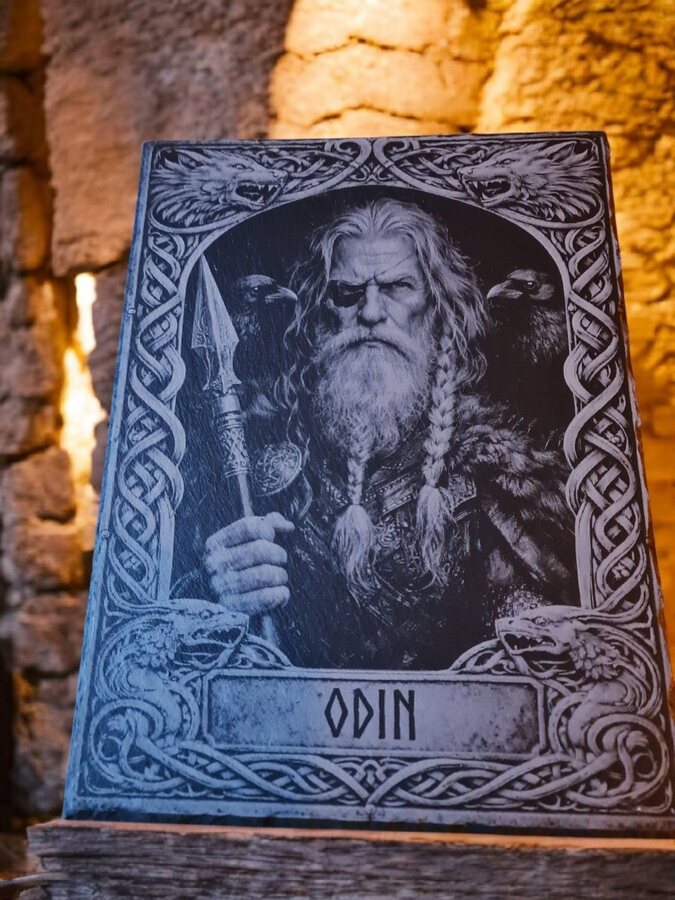
In our workshop in Alsdorf we like both: the certainty of a well-attested name and the suspense of an open case. When we engrave a god’s name in slate, we like it to come with the real story behind it.
Which places are named after Odin? The secure cases are mostly Scandinavian: Odense on Funen (Óðins vé, “Odin’s sanctuary”), Odensvi, Odensala and Odensåker in Sweden, Onsild and Onsved in Denmark. In England Wednesbury and Wednesfield are accepted Woden names; in Germany Gudensberg is the best candidate.
Is Bad Godesberg named after Woden? Possibly, but it is not established. Early forms like Wuodenesberg are cited, but the record is hard to verify, and the often-quoted “Ubian cult site” has no archaeological basis.
What does “vé” mean in place names? Old Norse vé means “consecrated, enclosed place, sanctuary” and is related to German weihen, “to consecrate”. In Sweden it usually appears as -vi, as in Ullevi or Odensvi.
Are there English places named after Thor? Yes, in the Old English form Thunor: Thundersley in Essex (Thunreslea in Domesday Book) is the clearest example. Thursley in Surrey is possible, but there “giant” is an alternative explanation.
How do you know whether a place name really contains a god? You check the oldest written forms, the sound development, personal names as an alternative, the generic element and the surroundings. A case usually becomes secure only when several names or archaeological finds point the same way.
For courage. For remembrance. For legends that live on.
Interpretatio Romana · Wodan, Donar & Ziu · Tiwaz · Donar · Germanic Religion.
All Festivals & Belief articles →
Between the years lies a time that ticks differently: the Rauhnächte, the Twelve Nights around the winter solstice. The …
Read more →Emperor Barbarossa sits in the Kyffhäuser, his head propped on the table, his beard grown through the stone slab …
Read more →The summer solstice is the longest day of the year – and was one of the great feasts of pagan Europe. Germanic peoples …
Read more →