Tiwaz (reconstructed Proto-Germanic *Tīwaz; continental Ziu/Tiu, Old Norse Týr) is probably the oldest god the Germanic peoples knew. His name goes back to the same Indo-European word as the Greek Zeus, the Roman Ju-piter (Diēspiter), the Latin deus ("god") and the Old Indian Dyaus – the root *dyeus means "(day-)sky, shining". Tiwaz was thus once a radiant sky god.
Hardly any other Germanic god can be traced back linguistically as far as Tiwaz. His name goes back to Proto-Germanic *Tīwaz, and that in turn to the Indo-European root *deiwós "the heavenly, the shining one" – derived from the sky father *Dyēus ph₂tḗr. That places Tiwaz in illustrious company: with the Greek Zeus, the Roman Jupiter (Diēspiter), the Old Indian Dyaus Pita and the Latin deus/dīvus ("god/divine").
The name lives on in all Germanic languages: Old Norse Týr, Old English Tīw/Tīg, Old High German Zîo/Ziu. Tellingly, the Old Norse word týr could also simply mean "god", and in the plural tívar "the gods". That is a strong clue: in the beginning Tiwaz was not one god among many, but the god – the shining lord of the sky.
Much suggests that Tiwaz originally stood at the head of the Germanic pantheon: lord of the sky, of order, of the oath and of the Thing – the legal and popular assembly. The French scholar of religion Georges Dumézil assigned him to the "first function": that of law and sacred sovereignty. Only gradually did Wodan/Odin take the top place, and Tiwaz moved into the role of the god of war and law, who watched over victory, treaty and oath.
That the Romans consistently equated him with their war god Mars (interpretatio Romana) fits exactly. In Tacitus, "Mars" appears as one of the highest gods of the Germani, to whom even human sacrifices are said to have been offered. War and law were no opposites in Germanic thought: victory gave the right, and the oath bound the warrior.
The most impressive archaeological evidence came from Germanic soldiers in Roman service. On Hadrian's Wall, at the fort of Housesteads (Vercovicium), votive stones for Mars Thingsus – "Mars of the Thing" – were found. They were set up by members of a Germanic unit who called themselves cives Tuihanti (from the Twente in today's Netherlands). Beside Mars Thingsus the stones name two goddesses, the Alaisiagae, on one stone with the names Beda and Fimmilena.
The byname Thingsus is Germanic (from Thing, "thing, assembly, court"). Here the Roman war god and the Germanic god of law and assembly merge into a single figure – a direct, datable find (2nd/3rd century) that Tiwaz was no mere battle god but the guardian of the legal order. More in our article on Mars Thingsus & the Alaisiagae.
"Deo Marti Thincso et duabus Alaisiagis Bede et Fimmilene" – "To the god Mars Thingsus and the two Alaisiagae, Beda and Fimmilena."votive inscription of Housesteads, RIB 1593 (public domain, own translation)
Beyond Hadrian's Wall Tiwaz is harder to grasp – but there are traces. On the Negau helmet B (a helmet of North Italic/Alpine origin whose inscription dates to the 2nd/1st century BC) one reads, in an early Germanic dialect, "harigasti teiwa". Whether teiwa here invokes the god Tiwaz or means "to the god" is disputed – but it could be the oldest Germanic god-attestation of all.
On the Rhine several votive stones to "Mars" carry Germanic bynames (such as Mars Halamardus, Mars Thincsus), pointing to local forms of the old sky and war god. Caution, by contrast, is due with the "Zisa of Augsburg": this allegedly female counterpart of Tiwaz comes from late-medieval chronicles and is regarded by scholarship as uncertain to invented.
Tiwaz is the only Germanic god whose name is also a rune name: the rune ᛏ is called *tīwaz (Old Norse Týr) – an upward-pointing arrow read as a sign of victory and battle. It appears already in the oldest complete futhark, on the Kylver stone (Gotland, around AD 400).
How closely rune and god were linked is shown by the Eddic poem Sigrdrífumál: whoever would secure victory in battle should carve "victory runes" and name Týr twice while doing so. Runes on weapons are thus no modern fantasy invention – the link of battle, victory and the Tiwaz rune is old.
"Victory runes you must know if you will have victory, / and cut them on the hilt of the sword … and name Týr twice."Sigrdrífumál 6, after Henry A. Bellows 1923 (public domain)
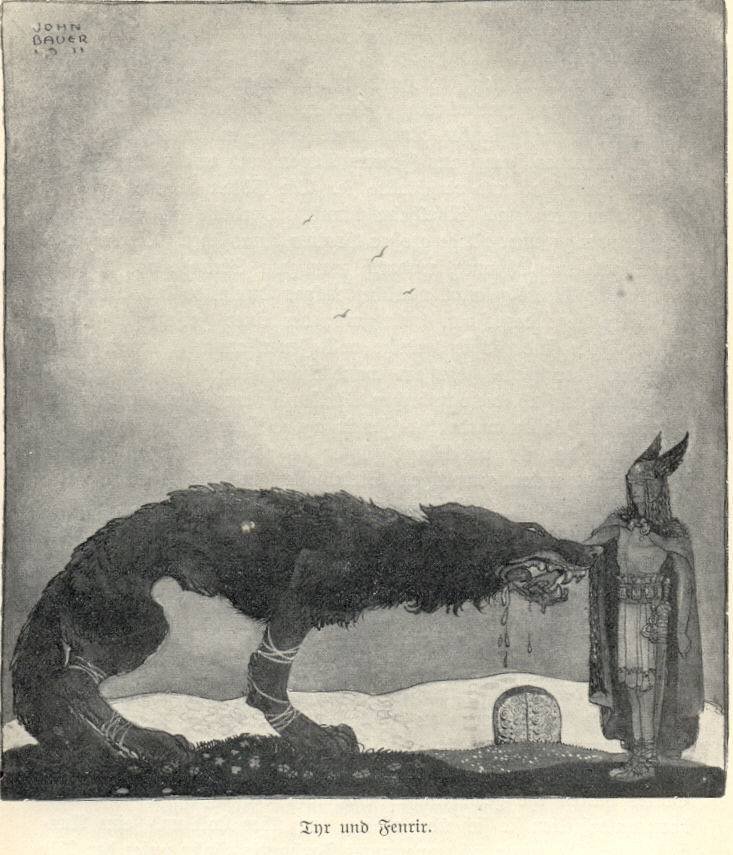
The most famous story of the god comes from the much later Norse tradition. When the gods wanted to bind the wolf Fenrir with the magic fetter Gleipnir, the monster grew suspicious and demanded a pledge: a god should lay his hand in its jaws. Only Týr dared. When the wolf realised it had been tricked, it bit down – and Týr lost his right hand, his oath hand. The god of law sacrifices, of all things, the hand with which one swears the oath, for the good of all. In the battle of Ragnarök Týr finally falls against the hound Garmr.
It is one of the strongest divine images of the north: the one-handed god who breaks his word so the world may last a while longer – and pledges his own body for it.
Most tangibly Tiwaz meets us every week: the Roman dies Martis (Mars's day) became among the Germani the day of Tiwaz/Ziu. From it came English Tuesday (Tīw's day) and, in the Alemannic-Swabian area, "Ziestag" → standard German Dienstag. The name form "Zîo" also echoes in old place names. Whoever says the weekday calls, without knowing it, upon the oldest Germanic god.
"Wits must he have who wanders wide, but all is easy at home."Hávamál 5, after Henry A. Bellows 1923 (public domain)
Tiwaz is the quiet giant of Germanic religion: the oldest god, whose name reaches into every Tuesday – and who shows that at the beginning stood not wrath, but law.
Wodan, Donar & Ziu · Interpretatio Romana · Týr – the god who gave his hand · Germanic Religion · Runes & their meaning.
All Gods & Goddesses articles →
Tyr is the god who knew what order costs – and was willing to pay it with his own hand. Once perhaps the highest …
Read more →He is one of the best-known “unknown” gods: everyone who studies the mythology knows his name – and yet Ullr scarcely …
Read more →Odin is the god who pays any price for knowledge – his eye, death on the tree, and nearly his head. In Vafþrúðnismál he …
Read more →Think of Norse gods and you think of the Aesir: Odin, Thor, Tyr. But the sources know a second divine family – the …
Read more →