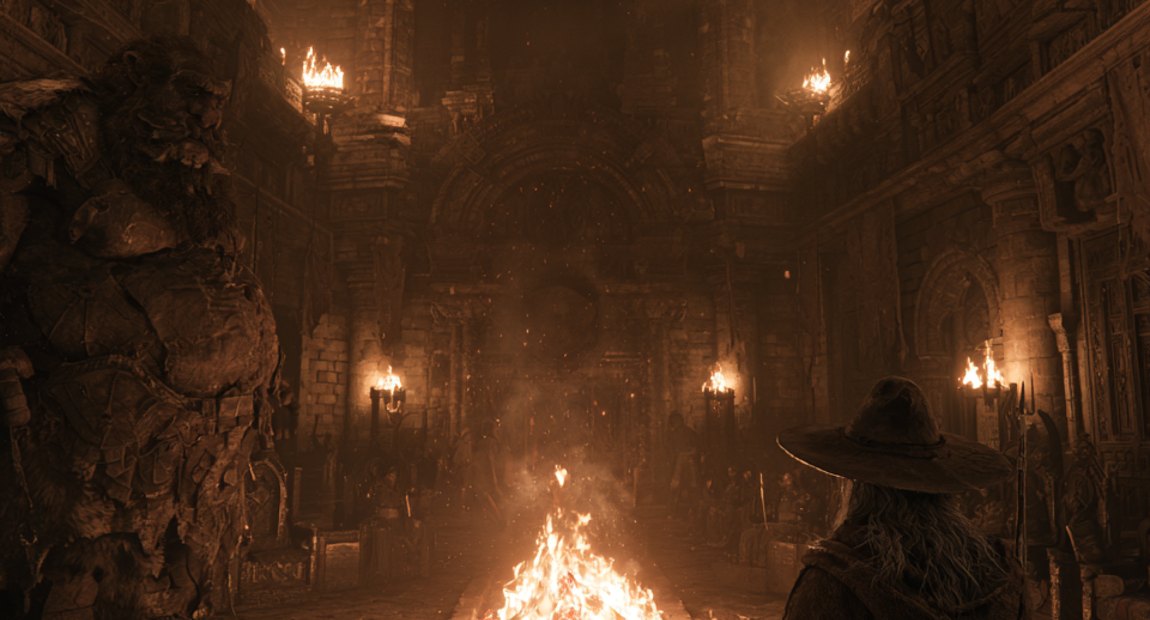
Odin is the god who pays any price for knowledge – his eye, death on the tree, and nearly his head. In Vafþrúðnismál he literally stakes it.
No god of the North is as obsessed with knowledge as Odin. He gives an eye at Mímir’s well, he hangs nine nights in the wind on Yggdrasil to win the runes, he drinks the mead of poetry. The Vafþrúðnismál, the „lay of the strong weaver of riddles", shows him on yet another journey after wisdom – only this time the stake is not a body part but his very head. That is exactly where the poem’s tension lies: with Odin, wisdom is never comfortable; it always costs him something.
The frame is told in a few lines, and is all the more charged for it. Odin means to test the wisest of all giants, the ancient Vafthrúdnir, who is said to know the fate of every being. His wife Frigg advises against it – the giant’s hall is dangerous, Vafthrúdnir the mightiest questioner of all. Odin goes anyway. A goddess who warns and a god who sets out regardless is an old Eddic pattern: it signals that something grave is at stake here.
Odin arrives under a false name, calling himself Gagnráðr („the contender", „the one who brings gain"). Vafthrúdnir does not exactly welcome the stranger – whoever enters his hall and fails the contest does not leave alive. So both their heads are the wager, and the exchange takes on the edge of a duel from the first word.
First the giant tests his guest with four questions about the pillars of the world: what is the horse that draws the day? What the one that brings the night? What is the river that divides the land of gods and giants? What the field on which the last battle is fought? Odin/Gagnráðr answers with ease – Skinfaxi and Hrímfaxi, the river Ífing, the field Vígríðr. With that he wins the right to ask in turn, and now the tables turn.
What follows is one of the densest summaries of the Norse world-view we have. Odin questions the giant on creation – how earth, mountains, sky and sea were made from the body of the primal giant Ymir, where the first giant came from, how day and night, summer and winter arose. He has the ending told to him: Ragnarök, the wolf devouring the sun, the survival of Líf and Lífthrasir through the world-fire, the sons who set the world in order after the fall. That is why, for us today, the poem reads almost like a mythological compendium: much of what we know about Norse cosmology stands in these stanzas.
As you read, you feel the knowledge passing back and forth between the two like between two masters of an ancient craft. The giant is no dull target – he answers with authority, knows the names of the streams, the winds, the wolves. That is precisely what makes Odin’s victory so remarkable: he does not beat a weaker opponent, but the wisest being beside himself.
Odin wins with a move that is at once unfair and brilliant. At the end, when every question about the world-order is exhausted, he leans forward and asks: „What did Odin himself whisper into the ear of his son Baldr before he was laid on the pyre?" No one can answer this but Odin – for he alone spoke it. In that instant Vafthrúdnir realises who truly stands in his hall, and knows he has lost the game and his head.
The beautiful, uncanny thing about it: the content of that whisper stays hidden forever. The poem never names it, no other source betrays it. So the great contest of wisdom ends on a secret – a blank at the very heart of the mythology that no learning will ever fill. It is exactly this mix of all-encompassing knowledge and one last, unsolvable riddle that gives the Vafþrúðnismál its power.
Odin wins here not with weapons but with a question – and that is no isolated case. The contest of knowledge and riddles is among the oldest forms of poetry there is. In the Grímnismál a king tortures the disguised Odin until he pours out his knowledge in a flood of names; in the Alvíssmál Thor keeps the dwarf Alvíss talking with questions until the sun turns him to stone; and in the Hervarar saga Odin defeats King Heiðrek with exactly the same „Baldr-in-the-ear" question with which he beats the giant here. In this world knowledge is power in the most literal sense – whoever knows more, survives.
It is telling that both opponents carry their names and titles into the duel. „Vafþrúðnir" means something like „the one strong in tangling (riddles)" – a speaking name for a master of the difficult word. The poem itself is thus a monument to how highly Norse culture prized the art of asking and answering: not as a game, but as a touchstone of wisdom and worth.
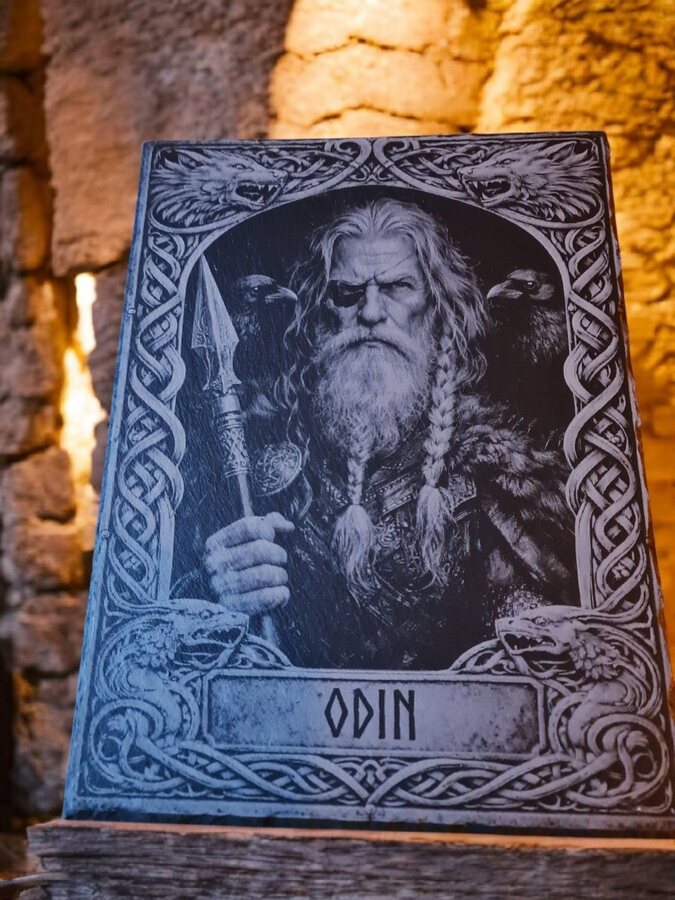
For us in the workshop Odin is the god who best fits what we do: a seeker willing to pay a price for a piece of insight. When we engrave the all-father with spear, ravens and the one waking eye into slate, we engrave that attitude too – curiosity, courage, the readiness to look the riddle in the face. The Vafþrúðnismál is the purest expression of it.
And it delivers what good mythology should: it gives us answers to great questions – origin, order, the end of the world – and at the same time deliberately leaves one question open. What Odin said into the dead Baldr’s ear, we may imagine for ourselves. Perhaps that is the true wisdom of the lay: that at the end of all knowledge stands a secret one cannot own, only honour.
„What did Othin speak in the ears of his son, ere in the bale-fire he burned?" – Vafþrúðnismál 54, after Bellows 1923
Odin · Ginnungagap · Ymir · Ragnarök.
Vafþrúðnismál (Poetic Edda); Karl Simrock, Die Edda (1851); Bellows (1923). Rudolf Simek, Dictionary of Northern Mythology.
All Gods & Goddesses articles →
Think of Norse gods and you think of the Aesir: Odin, Thor, Tyr. But the sources know a second divine family – the …
Read more →In Germanic thought vengeance was no blemish but a duty – and the North gave it two gods. Víðarr, the silent god who at …
Read more →For a seafaring people the sea was both: lifeline and maw. No wonder the North gave it a divine couple. Ægir, the vast …
Read more →For a seafaring people the sea was both at once: road and grave, riches and death. In the North this double nature took …
Read more →