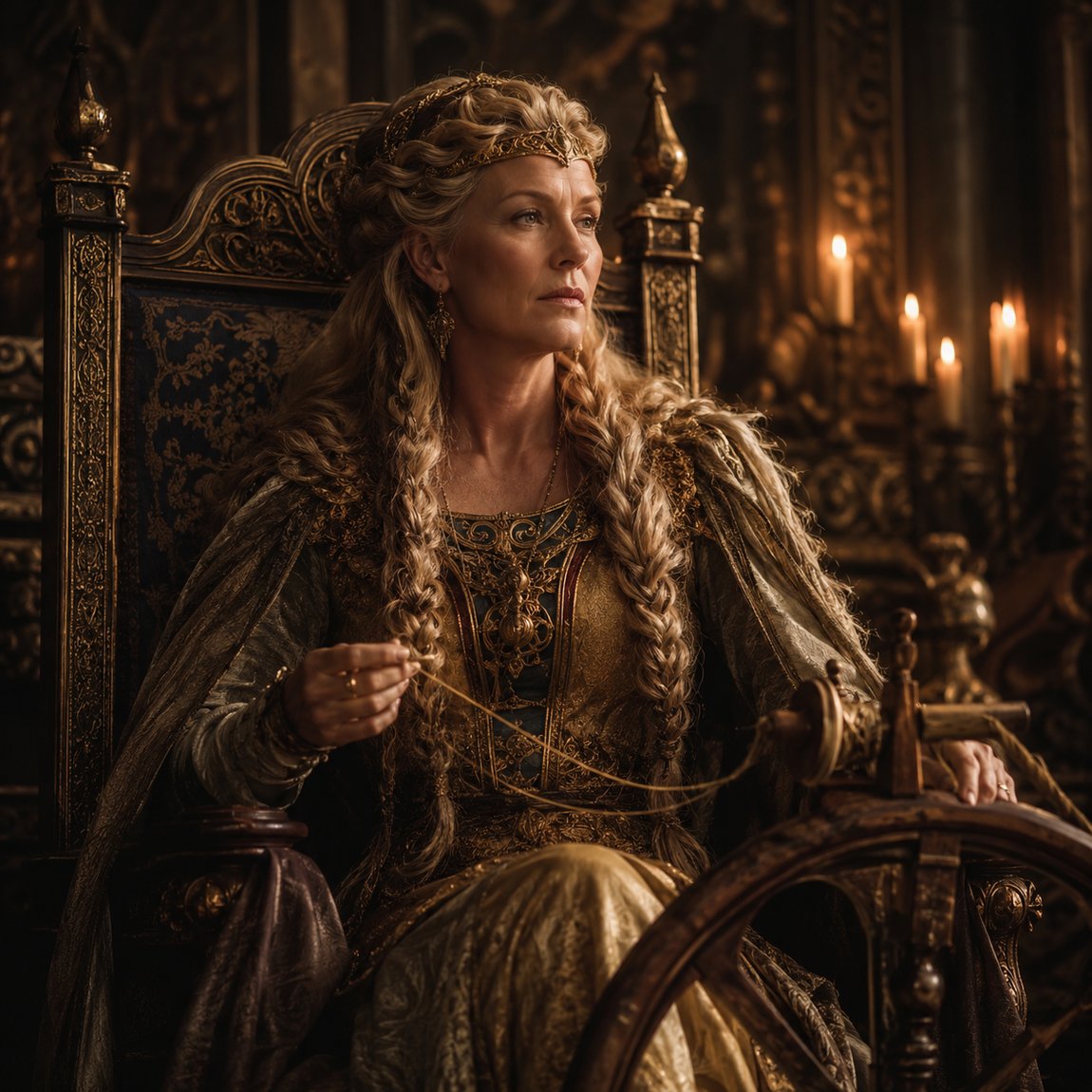
Frigg is Odin’s wife in Norse mythology, the mother of Baldr and, according to Snorri, the foremost of all the goddesses of the Æsir. Her name means “beloved”, Friday is her day, and her hall is called Fensalir. She knows the fate of every being – and keeps silent about it. She is attested long before the Edda: as Frea among the Lombards and as Friia in the Merseburg Charm. Here is what the sources really say about Odin’s wife, where they contradict each other, and why Frigg and Freyja are not the same.
Frigg is the quiet one. Odin hangs on the World Tree, Thor smashes giants’ skulls, Loki burns everything down – and Frigg sits in her hall, knows everything and says nothing. Look closer and you find a goddess attested earlier than most of her male colleagues, who outwits the Allfather and is broken by the greatest tragedy in Norse myth. We follow her from Lombard Italy via Merseburg to Snorri’s Iceland – keeping a clean line between what the sources say and what was added later.
In Old Norse she is Frigg, in Old High German Frīja, in Old English Frīg, among the Lombards Frea. Linguists trace all of these back to a Proto-Germanic *Frijjō, built on an Indo-European root meaning “dear, beloved”. Sanskrit priyā, “beloved woman, wife”, is a direct cousin. The same word family gives English friend, Gothic frijōn (“to love”) and, by a roundabout route, the word free – originally, it seems, “belonging to the loved ones, to one’s own kin”, as opposed to the unfree.
The name fits the role: Frigg is the wife par excellence. In every source she is married to the highest god – Wodan in the south, Odin in the north – from Lombard Italy to high-medieval Iceland.
The oldest full story about her comes from Italy. The Origo gentis Langobardorum, a short account of the Lombards’ origins, was written in the seventh century. In the late eighth century Paul the Deacon retold the legend in his History of the Lombards (Book I, ch. 8).
Here is the story, in our own condensed rendering. A small people called the Winnili live in the north, led by the brothers Ybor and Agio and their mother Gambara. The Vandals demand tribute; the Winnili refuse. The Vandals ask Godan – Wodan – for victory, and he answers: whoever I see first at sunrise shall have it. Gambara turns to Frea, Godan’s wife. Frea tells her to have the Winnili women come out at sunrise with their husbands, their loose hair arranged across their faces like beards. Then Frea turns the bed in which her husband sleeps so that he faces east, and wakes him. Godan looks out and asks: who are these long-beards? Frea replies: as you have given them a name, give them the victory too. Godan keeps his own rule, and the Winnili become the Langobardi, the “Long-Beards”.
More on the people in our article on the Lombards. For Frigg, the legend is gold: it shows her as Wodan’s wife centuries before the Edda, with the trait that returns in Iceland. She gets her way not by force but by cunning. She knows her husband’s rules – and uses them.
The second continental trace leads to Merseburg. In a manuscript of the cathedral library, two Old High German charms were added in the tenth century; Georg Waitz found them in 1841 and Jacob Grimm published them in 1842. The second heals a horse’s sprained leg: Phol and Wodan ride into the woods, Balder’s foal sprains its foot, and several goddesses charm it:
thu biguolen Sinthgunt, Sunna era suister;
thu biguolen Friia, Volla era suister;
thu biguolen Wodan, so he wola conda …
— Second Merseburg Charm, 10th-century manuscript. In sense: Then Sinthgunt charmed it, Sunna her sister; then Friia charmed it, Volla her sister; then Wodan charmed it, as well he knew how.
Friia is the Old High German form of her name. Beside her stands Volla – the Fulla whom Snorri, three centuries later, calls Frigg’s handmaid. Here she is her sister. The pairing is old and stable; the relationship drifts. And Frija is one of those who can heal. See our articles on the Merseburg Charms and on Frija.
The fullest portrait comes from Snorri Sturluson and his Prose Edda, written around 1220 in Christian Iceland. He preserves a great deal, but he also arranges and connects on his own account.
In Gylfaginning (“The Deluding of Gylfi”) we first learn that Odin’s wife is Frigg, daughter of Fjörgvinn, and that from them descends the race of the Æsir. A little later comes the sentence that sums her up best:
Frigg is his wife, and she knows all the fates of men, though she speaks no prophecy.
— Snorri Sturluson, Gylfaginning, ch. 20, trans. Arthur G. Brodeur (1916)
When the talk turns to the goddesses (ch. 35), Frigg heads the list: “Frigg is the foremost: she has that estate which is called Fensalir, and it is most glorious” (Brodeur). Fensalir means roughly “fen halls”. Some scholars think of the offerings placed in bogs over many centuries – but no link to Frigg can be proven.
Three of the goddesses listed in chapter 35 are tied directly to Frigg:
So Frigg has a confidante, a protector and a messenger. Hlín deserves a second look. In Völuspá, just before the end of the world, comes “Hlín’s second sorrow” – Odin’s death against the wolf. Here Hlín is plainly a by-name of Frigg herself; Snorri may have turned it into a separate goddess, typical of his habit of turning names from poems into figures.
Snorri’s Skáldskaparmál lists kennings for Frigg: wife of Odin, mother of Baldr, lady of the Æsir and Ásynjur, mistress of Fulla, of the falcon shape and of Fensalir. In that falcon shape Loki flies to the giant Geirröðr. Elsewhere in the Edda it is mostly Freyja who owns a feather cloak – remember that for later.
The most famous Frigg scene in the Poetic Edda is the cruellest. In Lokasenna, Loki crashes a feast and insults the gods one by one. He tells Frigg she took Odin’s brothers Vé and Vili into her arms. She strikes back: if a son like Baldr sat here, you would not leave alive. Loki answers that it was he who made sure she would never see Baldr ride home again.
Then Freyja speaks – not Frigg herself:
You are mad, Loki, to reckon up
the foul deeds you have done;
Frigg, I think, knows every fate,
though she herself says nothing.
— Lokasenna, st. 29 (our own rendering)
Snorri quotes the last two lines too, but puts them in Odin’s mouth – he handled his material freely. The core stays: Frigg sees what is coming and keeps it to herself. The Norns shape fate; Frigg knows it. The whole quarrel is in our article on Lokasenna.
No story shaped Frigg as deeply as the death of her son Baldr, told by Snorri in chapter 49 of Gylfaginning. Baldr dreams heavy, threatening dreams. The gods take counsel, and Frigg acts. In Brodeur’s translation she takes oaths that “fire and water should spare Baldr, likewise iron and metal of all kinds”, and then “stones, earth, trees, sicknesses, beasts, birds, venom, serpents”. After that, the gods turn it into a game to shoot and strike at Baldr – nothing harms him.
Loki does not like this. Disguised as a woman, he visits Frigg in Fensalir and asks casually whether really everything has sworn. Frigg answers without suspicion: “There grows a tree-sprout alone westward of Valhall: it is called Mistletoe” – it seemed too young to her to demand an oath from. Loki pulls up the mistletoe, goes to the assembly and puts it into the hand of blind Höðr. Höðr throws, and Baldr falls dead.
Snorri builds the scene tightly around Frigg: her care protects Baldr, her one blind spot kills him. The one who knows every fate is the one who gets pumped for information. Afterwards she asks who will win all her favour by riding to Hel to ransom Baldr. Hermóðr rides. Hel demands that everything weep for Baldr; only the giantess Þökk refuses – probably Loki himself.
An often overlooked detail: from Hel, Baldr’s wife Nanna sends a linen headdress for Frigg and a gold ring for Fulla. The full story is in Baldr’s Death.
The prose frame of Grímnismál shows a very different Frigg. King Hrauðungr’s sons Agnarr (ten) and Geirröðr (eight) are driven by a storm to a strange shore and winter with an old couple – Frigg fosters Agnarr, Odin Geirröðr. Coming home, Geirröðr, on Odin’s advice, shoves the boat with his brother back out to sea and becomes king.
Later Odin and Frigg sit on Hliðskjálf. Odin needles her: your foster son is begetting children with a giantess in a cave, mine is a king. Frigg replies that Geirröðr is so stingy he tortures guests if too many come. They wager. Then Frigg sends Fulla to warn Geirröðr against a sorcerer whom no dog will attack.
When Odin arrives as Grímnir, Geirröðr sets him between two fires for eight nights. Only the king’s son Agnarr brings him a horn. Odin reveals himself, and Geirröðr falls on his own sword.
Frigg wins the bet – with a little help. This is the Lombard Frea in Norse clothing. The passage also corrects a popular error: Frigg is not the only one allowed on Hliðskjálf beside Odin. In Skírnismál, Freyr climbs into the high seat too.
Saxo Grammaticus wrote his Latin Gesta Danorum around 1200 and turned the gods into human sorcerers. In Book 1, in summary:
The kings of the North sent a golden image of Odin to Byzantium. Frigga, wanting finer clothes, “called smiths, and had the gold stripped from the statue” (Elton, 1894). Odin hanged the smiths and made the statue speak when a mortal touched it. Frigga then “submitted herself to the embraces of one of her servants”, who broke the image so she could have the gold. Odin, wounded in image and bed alike, went into exile; a trickster named Mit-othin posed as a god. Only after Frigga’s death did Odin return.
This is not an older version but learned reinterpretation. Yet here too Frigg is wilful and accused of infidelity – as by Loki. Whether old tradition or Christian embroidery lies behind it, we cannot say.
Few questions about Norse goddesses come up as often: were Frigg and Freyja originally the same goddess? The debate is old and unresolved. Several observations are cited in favour of a common origin:
Just as much speaks against it. Freyja means “lady”, Frigg “beloved” – different words. Freyja is one of the Vanir, Frigg of the Æsir; Freyja stands for seiðr, the battle-dead and gold, Frigg for marriage and silent knowledge of fate. In Lokasenna both sit at the same feast, and Freyja even defends Frigg.
Perhaps one common Germanic goddess split in two in the North; perhaps two goddesses grew alike. Neither can be proven. We keep them apart, as the Edda does – see Freyja.
You meet Frigg at least once a week. When Germanic speakers adopted the seven-day week during the Roman imperial period, they translated the Roman gods’ names: dies Veneris, the day of Venus, became the day of the Germanic goddess who seemed the closest match. The result was Old English frīgedæg (modern Friday), Old High German frīatag (German Freitag) and Old Norse frjádagr. The Norse form is striking because it does not match the northern name Frigg; linguists therefore regard it as a borrowing from the south.
So is Friday Frigg’s day or Freyja’s? Linguistically almost certainly Frija/Frigg; a day of Freyja would have looked different in German. Details in Friday: named after Frigg or Freya? and in the Germanic days of the week. In modern Icelandic, Friday is föstudagur, “fast day” – there the Church drove the goddess out of the calendar.
Online you will often read that Frigg is “the goddess of spinning and weaving” who spins the clouds with her spindle. Caution is needed. Neither the Edda nor Snorri ever shows Frigg spinning. What does exist is a trace in folk tradition: in Sweden the three stars of Orion’s Belt were called Friggerock, “Frigg’s distaff” – the distaff being the staff that holds the unspun fibres. But the same stars are also recorded as Frejerock, “Freyja’s distaff”, so even here the two goddesses blur.
From such star names and the world of the spinning room, nineteenth-century scholars, Jacob Grimm above all, built the image of a spinning household goddess. That is interpretation, not Viking-Age myth. What is certain: spinning was central women’s work, spindle whorls are among the commonest finds, and fate could be imagined as a weave. That Frigg belonged in this world is plausible – attested only through the star name.
Frigg wins through knowledge, patience and the right word at the right moment – and learns that protection is not always enough. Many who come to our workshop in Alsdorf looking for a motif for a mother, grandmother or newborn are looking for exactly that mix.
When we engrave Frigg, we stick to what is attested. A few ideas we like to make:
What we will not do is dress Frigg up with invented “Frigg runes” or a spindle cult no source knows. If you have your own idea, send it to us as a custom engraving and we will cut it into slate, wood or glass.
Who is Frigg in Norse mythology? Frigg is Odin’s wife, Baldr’s mother and, according to Snorri, the foremost goddess of the Æsir. She knows the fate of all but does not speak it, and lives in the hall Fensalir.
Is Frigg Odin’s wife? Yes. In the seventh-century Lombard legend Frea is already the wife of Godan (Wodan), and throughout the Eddas and sagas Frigg is Odin’s wife. In Saxo she is called Frigga.
What does the name Frigg mean? It goes back to Proto-Germanic *Frijjō, “beloved”. It is related to Sanskrit priyā (“beloved”) and to English friend.
Are Frigg and Freyja the same goddess? In the surviving sources they are two different goddesses. Whether they go back to one older goddess is debated among scholars and cannot be proven.
Is Friday named after Frigg? Linguistically, yes: Friday, German Freitag and Old Norse frjádagr all go back to Frija/Frigg, as the Germanic rendering of the Roman day of Venus.
Why couldn’t Frigg prevent Baldr’s death? According to Snorri, she made all things swear not to harm Baldr but left out the young mistletoe. Loki found out and had Höðr kill Baldr with it.
For courage. For remembrance. For legends that live on.
The pantheon of the gods (Æsir & Vanir) · Freyja · Odin (Wotan) · Yggdrasil & the Norns · The Treasures of the Gods.
All Gods & Goddesses articles →
Heimdall is the watchman who never sleeps – the god who hears the grass grow and the wool sprout on the sheep. Born of …
Read more →Not every dead man came to Valhalla. Most people – all who died of sickness and age – went to Hel. She is the mistress …
Read more →Loki fits no box. Now he saves the gods with a trick, now he plunges them into ruin. It is exactly this doubleness that …
Read more →The strongest god has two sons: Magni („the mighty") and Modi („the brave / wrathful"). They are more than minor …
Read more →