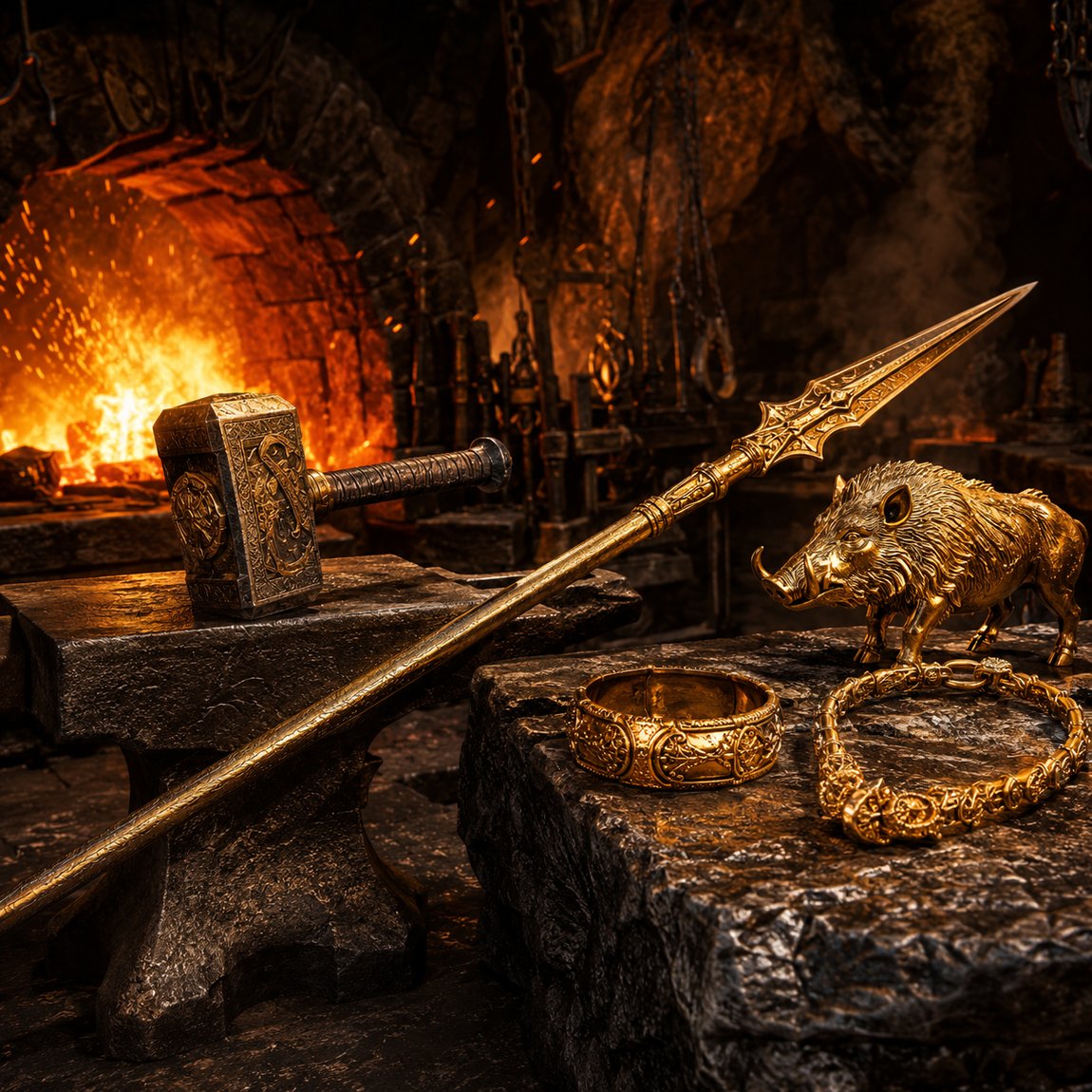
No god of the North is without his treasure: Thor without his hammer would be only an angry giant, Odin without spear and ring only a one-eyed wanderer. Almost all of these wonders come from one hand – that of the dwarves. This article presents the most important treasures of the Edda: their powers, their origin and the story that binds them all together.
Norse mythology is full of objects that make history: weapons that never miss, rings that multiply, ships that fit in a pocket. „Treasure“ (Old Norse gersemi, „precious thing“) is the old term for such costly wonders. Most of them arose during a smithing contest of the dwarves – and the blame for it lies, as so often, with Loki.
Out of pure spite, Loki cuts off the splendid golden hair of the goddess Sif, Thor’s wife. To escape Thor’s wrath, he must procure a replacement. He goes to the sons of Ivaldi, skilful dwarven smiths, and they craft three wonders: new, genuine gold hair for Sif that grows of its own accord; the ship Skidbladnir; and the spear Gungnir.
Loki then rashly wagers his own head with the dwarves Brokkr and Sindri (Eitri) that they could not forge anything better. Transformed into a fly, Loki tries to disturb them at their work – stinging them at the bellows. Even so, three further treasures arise: the golden-bristled boar Gullinborsti, the ring Draupnir and the hammer Mjöllnir – which turned out with a slightly too-short handle, because Loki’s sting struck Brokkr at the decisive moment. The gods declare Mjöllnir the most precious of all treasures; Loki loses the wager – but saves his head with a technicality (the neck was not part of the bet).
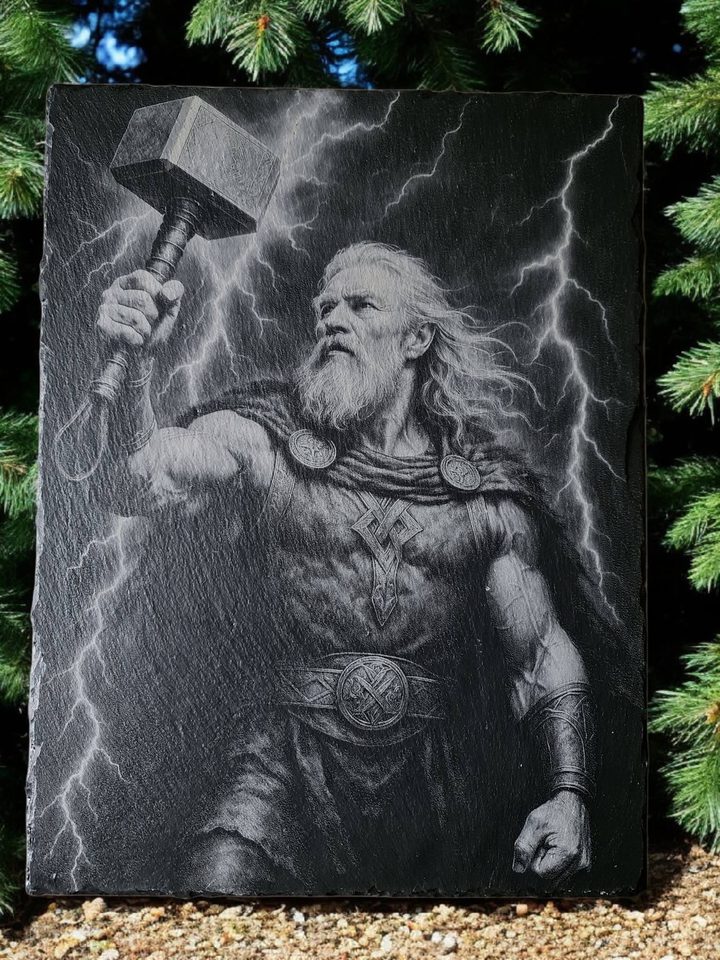
The mightiest treasure: the hammer Mjöllnir always strikes its target, returns to the hand when thrown and can be made small. It hallows marriages and pyres (it is weapon and instrument of blessing at once) and is the reason the giants fear the gods. Over a thousand Thor’s-hammer amulets are archaeologically attested. All about it in its own article: The Thor’s hammer Mjöllnir.
Gungnir („the Swaying One“) is Odin’s spear, forged by the sons of Ivaldi. Once thrown, it never misses its mark and returns. Sacred runes are carved onto its point. With the cast of Gungnir over a host, Odin consecrated his foes to death – so he opened the first war of the world. More in the article Gungnir.
Draupnir („the Dripper“) is a golden arm-ring of Odin, forged by Brokkr and Sindri. Every ninth night, eight golden rings of equal weight drip from it – an image of endless abundance and royal generosity. Odin laid Draupnir on the pyre of his dead son Baldr. More in the article Draupnir.
Brisingamen is the splendid necklace of the goddess Freyja, the fairest piece of jewellery in the world, made by four dwarves (the Brisingar). It is the emblem of Freyja’s beauty and power – and the occasion of many a tale in which Loki steals it. More in the article Brisingamen.
Skidbladnir belongs to the fertility god Freyr. It is the best of all ships: as soon as the sail is set, it always has a favourable wind, it holds all the gods with their armour – and yet can be folded up like a cloth and put in a pocket. A masterpiece of the sons of Ivaldi.
Gullinborsti („Golden Bristle“), also called Slidrugtanni, is Freyr’s boar of glowing gold, forged by Brokkr and Sindri. Its bristles shine and it runs faster than any horse through air and water, bright in the darkest night.
No ornament, but the most cunning treasure: Gleipnir, the silk-soft band that holds the wolf Fenrir. The dwarves made it from six impossible things – the sound of a cat, the beard of a woman, the roots of the mountain, the breath of fish, the spittle of a bird and the sinews of a bear. That is why these things no longer exist today.
Gjallarhorn („the loudly resounding“) is the horn of the watchman Heimdall, whose sound carries through all nine worlds. With it Heimdall heralds Ragnarök. It stands at the well of the wise Mimir – some traditions see in it the same vessel from which Odin once drank.
Besides the hammer, to Thor belong the belt Megingjörd, which doubles his divine strength, and the iron gloves Járngreipr, without which he could not even wield the glowing Mjöllnir.
Not every treasure is of metal: the golden apples of Idun preserve the gods’ youth. If they are stolen, even the immortals grow old – the most striking proof of how fragile the power of the Æsir is.
The most precious immaterial treasure is the mead of poetry (Óðrœrir), brewed from the blood of the wise Kvasir. Whoever drinks of it becomes a poet and a scholar. Odin won it back from the giants in one of his most cunning tales.
Further famous precious things round off the North’s hoard: Hlidskjalf, Odin’s high seat, from which he surveys all nine worlds; Sleipnir, Odin’s eight-legged steed (born of Loki), the swiftest of all horses; Andvaranaut, the cursed ring from the hoard of the dragon Fafnir (see Sigurd & Fafnir); and – as a grim counterpart – Naglfar, the death-ship made from the nails of the dead, which puts out to sea at Ragnarök.
Individual treasures: Mjöllnir · Gungnir · Draupnir · Brisingamen. The smiths behind them: The dwarves · Sindri & Brokkr · Ivaldi. Related: Idun’s apples · Heimdall & Gjallarhorn · Sigurd & the hoard.
Snorri Sturluson, Prose Edda (Skáldskaparmál: the six treasures; Gylfaginning: Gleipnir, Draupnir, Skidbladnir, Sleipnir), c. 1220. Poetic Edda: Völuspá, Grímnismál, Lokasenna. English public domain: Henry Adams Bellows (1923). Scholarship: Rudolf Simek, Dictionary of Northern Mythology; John Lindow, Norse Mythology (2001).
Where does poetry come from? The North had an uncannily beautiful answer to this: from the blood of a wise being …
Read more →A feast of the gods, ale in plenty – and a guest who exposes every single one of them. The Lokasenna („Loki’s flyting") …
Read more →Every misdeed has its price, and Loki’s bill is settled all at once. After the death of Baldr and his merciless mockery …
Read more →A stranger offers the gods an unbreachable wall around their stronghold - in a single winter. His price is outrageous …
Read more →