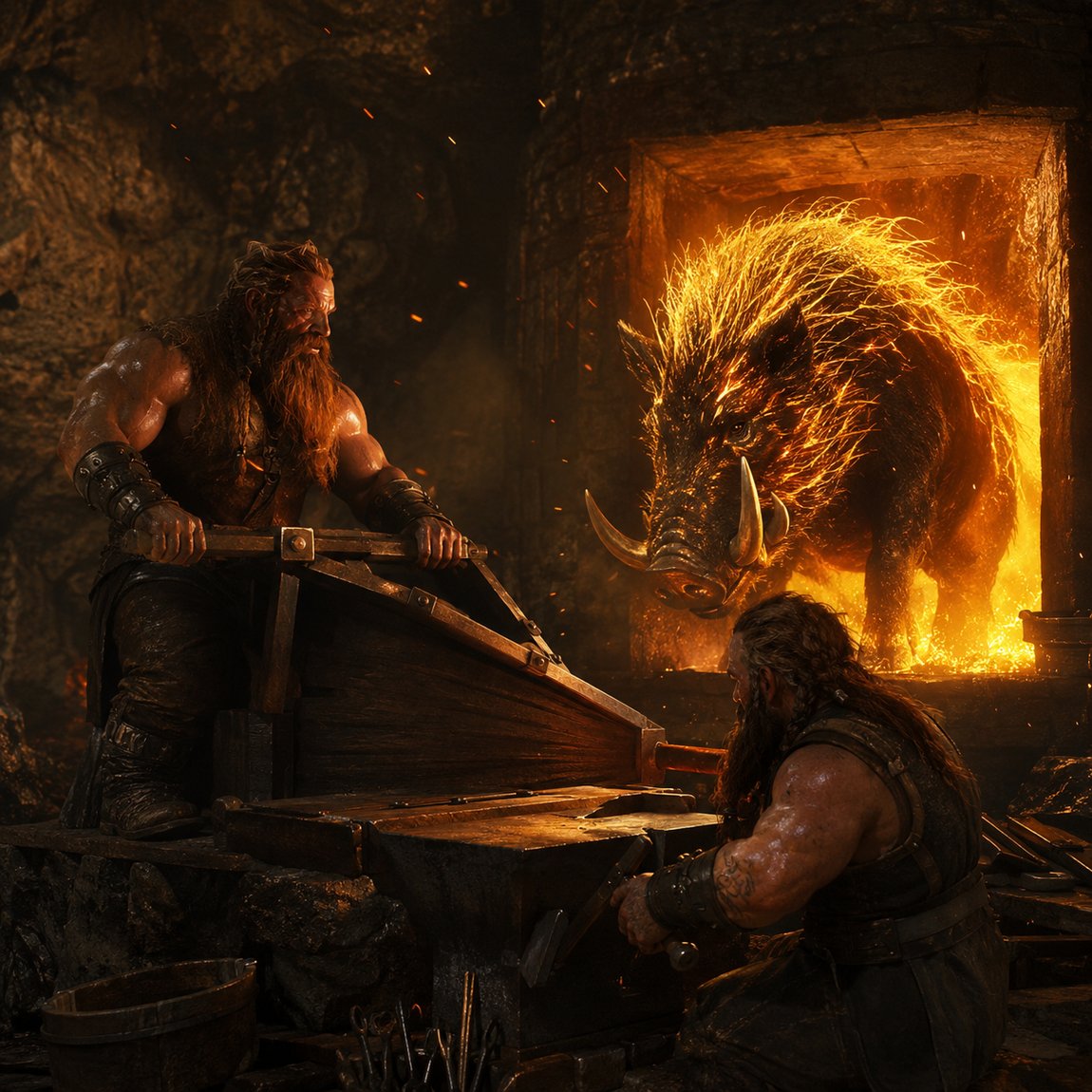
Sindri (called Eitri in some editions) and Brokkr are the dwarf brothers who, according to Snorri Sturluson's Skáldskaparmál, forged Thor's hammer Mjölnir – along with Freyr's golden-bristled boar and Odin's ring Draupnir. It all began with a bet: Loki staked his own head and then, as a fly, tried to sabotage the work at the bellows. Here is the story as closely as the source tells it, why the brothers' names wobble in the manuscripts, and what real Viking Age smithing finds add to the picture.
A dark workshop somewhere among the dwarves. Coals glow in the hearth. One brother lays a piece of pigskin in the fire and walks out. The other stands at the bellows with strict orders: keep pumping, whatever happens. Then a fly lands on his hand and bites. It is not an ordinary fly. It is Loki, and his head is on the line.
This one scene explains where Thor's hammer came from, why it has a flaw, and why Loki once went about with his mouth stitched shut. We will tell it straight from the source first – then look at the manuscripts, at a carved stone from Jutland and at the tool chest of a real Viking Age smith.
Sindri and Brokkr are two brothers of the dwarves, the small, often underground beings of Norse myth whose great talent is making things no god can make for himself. One brother is the master smith. The other, Brokkr, works the bellows, makes the bet with Loki and carries the finished treasures to Asgard.
The smith's name is a small headache. Older editions and translations call him Sindri; Anthony Faulkes's standard modern edition, and many English retellings that follow it, call him Eitri. Same dwarf, two names – more on that below.
No Eddic poem tells this wager, and no surviving skaldic verse alludes to it. The whole story lives in exactly one place: Skáldskaparmál, the second part of the Prose Edda written by Snorri Sturluson in Iceland around 1220. If you are talking about Sindri and Brokkr, you are talking about Snorri.
Snorri tucks the tale into a chapter that answers a very dry question: why do poets call gold "Sif's hair"? Skáldskaparmál is, at heart, a textbook for skalds, a handbook of poetic circumlocutions called kennings. In Faulkes's edition the passage is chapter 35; other editions number it differently.
The trigger is classic Loki. Out of sheer mischief he cuts off all the hair of Sif, Thor's wife. Thor grabs him and threatens to break every bone in his body. Loki buys his life with a promise: he will get the dark elves to make Sif a head of hair from gold that will grow like real hair.
Loki goes to the sons of Ivaldi, who make him not only the golden hair but also the ship Skíðblaðnir and the spear Gungnir. Those three works have their own article with us; for now it is enough to know that Loki is walking around with three masterpieces under his arm.
Snorri moves fast. Loki bets a dwarf named Brokkr his own head that Brokkr's brother cannot make three treasures as good as these three. How the two met, who provoked whom – the text does not say. Modern retellings love to fill that gap; the source stays terse.
A head as a stake is no casual joke. Norse poetry knows the motif elsewhere, most famously in the wisdom contest of Vafþrúðnismál, where Odin and a giant play for their heads. That Loki offers it so lightly tells you everything: he trusts himself to talk his way out at the end. He will be proved right – halfway.
Now the part that made this story famous. We follow Snorri as closely as we can (our own rendering from the Old Norse, not a word-for-word translation).
First work: the boar. The smith lays a pigskin in the hearth and tells Brokkr to blow and not to stop until he himself takes the work out again. As soon as he has gone, a fly settles on Brokkr's hand and bites. Brokkr keeps blowing. The smith returns and draws out a boar with bristles of gold. It is the beast Snorri elsewhere calls Gullinbursti, "Gold-Bristle".
Second work: the ring. Next the smith lays gold in the fire, with the same order to blow without pause. The fly is back, this time on Brokkr's neck, and it bites twice as hard. Brokkr holds on. Out comes a gold ring called Draupnir, "the Dripper".
Third work: the hammer. Finally the smith puts iron in the hearth and warns Brokkr that everything depends on him now, or the work will be spoiled. The fly settles between Brokkr's eyes and stings his eyelids, so that blood runs into his eyes and he cannot see. He lets go of the bellows for a moment to brush the fly away. The smith comes in and says it had come very close to everything in the hearth being ruined. Then he takes a hammer out of the fire.
The structure is beautifully built: hand, neck, eyelids. Each sting moves closer to the head that is at stake – and only at the last and most important piece does Brokkr falter. Snorri never says outright who the fly is, but the context leaves no doubt: Loki in animal form, as elsewhere he becomes a salmon, a mare or a seal.
"…it was a flaw in the hammer that the fore-haft was somewhat short."— Snorri, Skáldskaparmál, trans. Arthur Gilchrist Brodeur (1916)
Brokkr and Loki take the treasures to Asgard. The gods sit on their judgement seats, and it is agreed that the verdict of Odin, Thor and Freyr shall stand. Each judge receives two gifts – one from Loki, one from Brokkr – and each giver must explain what his piece can do.
Loki goes first. Odin gets the spear Gungnir, which never stops in its thrust. Thor gets the hair for Sif, which will take root as soon as it touches her head. Freyr gets Skíðblaðnir, a ship that always has a fair wind once the sail is raised and that can be folded up and carried in a pouch.
Then Brokkr steps up. To Odin he gives the ring: every ninth night, eight rings of equal weight will drip from it. Freyr gets the boar, which runs through air and over water, by night and by day, faster than any horse, and no night is ever so dark that its bristles do not give enough light. Thor receives the hammer. With it he can strike as hard as he likes and it will never fail; if he throws it, it will never miss and never fly so far that it does not return to his hand; and if he wishes, it becomes small enough to carry inside his shirt. Only – the haft was a little short.
The verdict is clear. The hammer is the best of all the treasures, because it is the strongest defence against the frost giants. The dwarf has won. Note the reasoning: not beauty, not the value of the gold, not magic for its own sake, but usefulness in defending the world of the gods. For what happens with the hammer afterwards, read our in-depth article on Thor's hammer Mjölnir; for the full overview of the gods' gifts, see The treasures of the gods.
Now it turns into a legal drama. Loki offers to redeem his head – to pay something else instead. The dwarf tells him there is no hope of that. "Catch me, then," says Loki, more or less – and he is gone. He owns shoes that let him run through the air and over water. So the dwarf asks Thor to catch him, and Thor does. Thor has just received the hammer, and he seems to enjoy grabbing Loki by the collar.
Brokkr goes to cut off Loki's head. But Loki objects: the head is Brokkr's, the neck is not. Take the head without touching the neck, if you can. It is the classic lawyer's trick, a distant cousin of Shylock's pound of flesh without a drop of blood.
Brokkr is not entirely beaten. He takes a thong and a knife and means to bore holes in Loki's lips and sew his mouth shut. But the knife will not bite. Then he says his brother's awl would be better here – and the moment he names it, the awl is there and pierces the lips. Brokkr stitches Loki's mouth together, and Loki later rips the thong out through the edges. Snorri ends with a proper dictionary entry: the thong with which Loki's mouth was sewn is called Vartari.
What Vartari means is not settled. A link with Old Norse vörr, "lip", has been suggested, but it remains a guess. That Snorri names the thong at all suits his handbook: poets need names.
Here Loki's humiliation ends with a scar. His final binding comes much later and is deadly serious – our article on Loki's punishment tells that story.
The Prose Edda does not survive in Snorri's own hand but in copies made decades after his death in 1241. The four main witnesses are the Codex Regius (GKS 2367 4to, first half of the 14th century), the Codex Wormianus (AM 242 fol, mid-14th century), the Codex Upsaliensis (DG 11, early 14th century) and the later Codex Trajectinus, a copy from around 1600 of a lost exemplar.
On our dwarves, these witnesses do not agree. According to the information given in Faulkes's edition, the brothers' names were not part of the original text in the main manuscript but were added there later, and other main witnesses lack them at this point. The French specialist site fafnir.fr describes the distribution differently: the names "Brokkr and Eitri" are said to be transmitted only by the Codex Wormianus, while "Brokkr and Sindri" were added later in the Codex Regius. Without examining the manuscripts ourselves we cannot settle which account is exact, and we would rather tell you so than pretend.
What is certain: both names have a basis in the manuscript tradition, and neither is securely Snorri's own choice. Older printed editions and Brodeur's public-domain English translation of 1916 have Sindri. Faulkes, whose edition is now the standard, prints Eitri, and many English handbooks follow him. That is why you meet both. Brokkr, at least, stays Brokkr either way.
The name Sindri turns up in one more, much older place – and there it is not even clear that it means a dwarf. In Völuspá, the great poem of the seeress in the Poetic Edda, stanza 37 (Codex Regius numbering) speaks of a hall of gold in the north, on Niðavellir, belonging to "Sindri's kin". In Bellows's public-domain translation of 1923: "Northward a hall in Nithavellir / Of gold there rose for Sindri's race".
"Sindri's race" sounds like dwarves, all the more because Niðavellir is often read as "dark fields", a fitting dwarf landscape. Bellows's note simply calls Sindri the great worker in gold among the dwarfs. Snorri reads the passage differently. In Gylfaginning, describing the world after Ragnarök, he mentions a good dwelling of red gold named Sindri, where good and righteous people will live. For him, Sindri is a hall, not a smith.
Scholars are divided. John Lindow leaves open whether a golden hall or the hall of a person called Sindri is meant. Andy Orchard considers that Snorri's hall may stem from a misreading of the Völuspá stanza. Rudolf Simek sees the halls of the blessed after the end of the world as a transposition of Christian ideas of heaven. Dwarf and hall share a name; whether anything more connects them is an open question. To explore the dwarves' world and its places, see our article on Svartalfheim.
Sindri belongs with Old Norse sindr, the slag and shower of sparks thrown off when the hammer hits glowing iron. It is related to the English word cinder. For a smith, it is almost too fitting.
Eitri recalls Old Norse eitr, "venom, poison". Whether the name really means "the venomous one" – perhaps because of the forge's fumes, perhaps for some other reason – is uncertain. There is no convincing, generally accepted explanation.
Brokkr is often glossed as "smith" in reference works. Behind this lies the idea that the name belongs with words for "lump, fragment" – someone who works with bits of metal; Old High German broccho is compared. Jan de Vries, in his Old Norse etymological dictionary, also wondered whether the name might allude to a jolting, stamping gait. In short: "smith" is a plausible reading, not a settled dictionary fact. The irony is that in the story it is precisely Brokkr who does not forge – he works the bellows.
In 1950 a flat, semicircular stone was found on the beach at Snaptun on Horsens Fjord in eastern Jutland. It is carved from soapstone that came from Norway. It shows a man's face with curling moustache ends – and across the mouth run lines that look like scars or stitches. It is dated to the Viking Age, usually around the year 1000.
What was it for? In 1959 the Danish archaeologist P. V. Glob answered that question in the journal Kuml: it is a forge stone or bellows shield (Danish avlsten). Such stones stood between the bellows and the fire. The bellows nozzle passed through a hole in the stone into the embers, and the stone protected the leather and wood of the bellows from the heat. Glob called the Snaptun stone the most beautifully fashioned forge-stone known.
Two years later, in 1961, the Icelandic archaeologist Gísli Gestsson identified the face in the same journal as Loki – with the lips that Brokkr stitched together. Gestsson also pointed to later folk belief in which Loki appears as a spirit of the hearth fire.
The reading is tempting. The stone comes from a smithy, the story is set in a smithy, the mouth is sewn – it fits remarkably well. But the stone carries no inscription and no name, and it is roughly two centuries older than Snorri's text. If the identification is right, the stone would show that the episode of the stitched lips was known around the year 1000 – and is not Snorri's invention. Where it is displayed today is reported differently: the Norwegian encyclopaedia Store norske leksikon names the Horsens Museum, other sources the Moesgaard Museum near Aarhus.
Snorri's scene is myth, but the craft behind it is very real, and his description is technically sound: one man forges, another keeps the fire at heat with the bellows, and whoever lets go of the bellows risks the workpiece spoiling at the wrong temperature.
The key find is the Mästermyr tool chest from Gotland. In October 1936 a farmer ploughing a drained mire near Sproge hit an oak chest about 90 centimetres long with iron fittings. Inside were more than 200 objects: smithing hammers, small anvils, tongs, files, nail-making irons, woodworking tools such as a broad axe, an adze, a saw and spoon augers, plus lock parts and half-finished pieces. It can only be dated broadly to the Viking Age. It probably belonged to a travelling craftsman who was both smith and carpenter. Today it is in the Swedish History Museum in Stockholm; the standard publication is by Greta Arwidsson and Gösta Berg (1983).
The chest holds no bellows – leather and wood rot away – but bellows stones like the one from Snaptun show how the bellows sat against the hearth.
Smiths were respected and a little uncanny in the Norse imagination – think of Völund of the Poetic Edda, whose revenge comes out of the forge. For techniques, iron-making and tools, read our article on the blacksmith's craft of the Vikings.
It pays to separate the evidence. Archaeologically, we have numerous Thor's hammer pendants from the late Viking Age, so Thor and his hammer were firmly part of belief long before Snorri. Older poetry knows the hammer well: Eddic poems such as Þrymskviða, Hymiskviða and Lokasenna tell of it, and skaldic verse celebrates Thor's fights. But none of these sources says who made it. Snorri's text of around 1220 is the only source for the wager, the fly and the brothers. And the Snaptun Stone might, if the interpretation holds, carry at least the motif of the stitched lips back to around 1000.
Snorri was a learned Christian who collected pagan tradition and shaped it into narrative. The neat symmetry – three gifts from Ivaldi's sons against three from Brokkr, judged by three gods – bears his signature. Whether he took the whole wager from older material or assembled it from fragments cannot be decided.
Beneath the comedy lies a clever tale. The mightiest tool of the gods is not made in peace but under disturbance and pain, and it keeps a trace of that. The short haft is not a design error by the master; it is the result of a single moment when Brokkr took his hand off the bellows. Anyone who makes things with their hands knows that moment.
Loki here is not the dark destroyer of the world's end but a gambler who plays too high, cheats, loses and escapes on a technicality. Sewing shut the mouth of a man whose weapon is talk is exactly the right punishment. And yet the gods owe their six greatest treasures to him.
And the dwarves? They are not servants of the gods but self-assured craftsmen who bet, bargain and collect what they are owed – with an awl if necessary.
For our workshop in Alsdorf this story is a gift, because it is so visual. A few motifs for slate, wood or glass:
The fly is a good reminder for anyone who works with their hands: good work can succeed under disturbance, and a small flaw does not make a piece any smaller.
Who forged Thor's hammer Mjölnir? According to Snorri's Skáldskaparmál, the dwarf Sindri (Eitri in other editions), while his brother Brokkr worked the bellows. No other source tells where the hammer came from.
Are Eitri and Sindri the same dwarf? Yes. They are name variants in the transmission of the Prose Edda; older editions print Sindri, Faulkes's standard edition Eitri.
Why is Mjölnir's handle too short? Because Loki, as a fly, stung Brokkr on the eyelids while the hammer was being forged. Brokkr let go of the bellows for a moment, and the work did not come out quite perfect.
Who judged Loki's wager? Odin, Thor and Freyr. They declared the hammer the most valuable treasure because it was the best defence against the frost giants.
Why was Loki's mouth sewn shut? Loki had wagered his head but argued that the neck was not part of the deal. Unable to take the head, Brokkr stitched his lips together with his brother's awl; the thong was called Vartari.
What does the Snaptun Stone show? A Viking Age soapstone bellows shield with a man's face whose mouth appears stitched. Since 1961 it has often been identified as Loki – plausible, but not provable.
For courage. For remembrance. For legends that live on.
Ívaldi & his sons · The dwarves · The treasures of the gods · Mjöllnir · Draupnir · Loki.
Some heroes set out with a sword. Svipdagr sets out with the protective charms of his dead mother – and with a task he …
Read more →Among all the gods, giants and dwarves there are two who are different: Thjálfi and Röskva, a pair of farmer's children …
Read more →This is the tale in which the immortal gods turn grey for the first and only time. An eagle on an ox, an extorted oath …
Read more →Before Thor is humbled in the stronghold of Utgard, he meets on the road a giant so vast that the gods spend the night …
Read more →