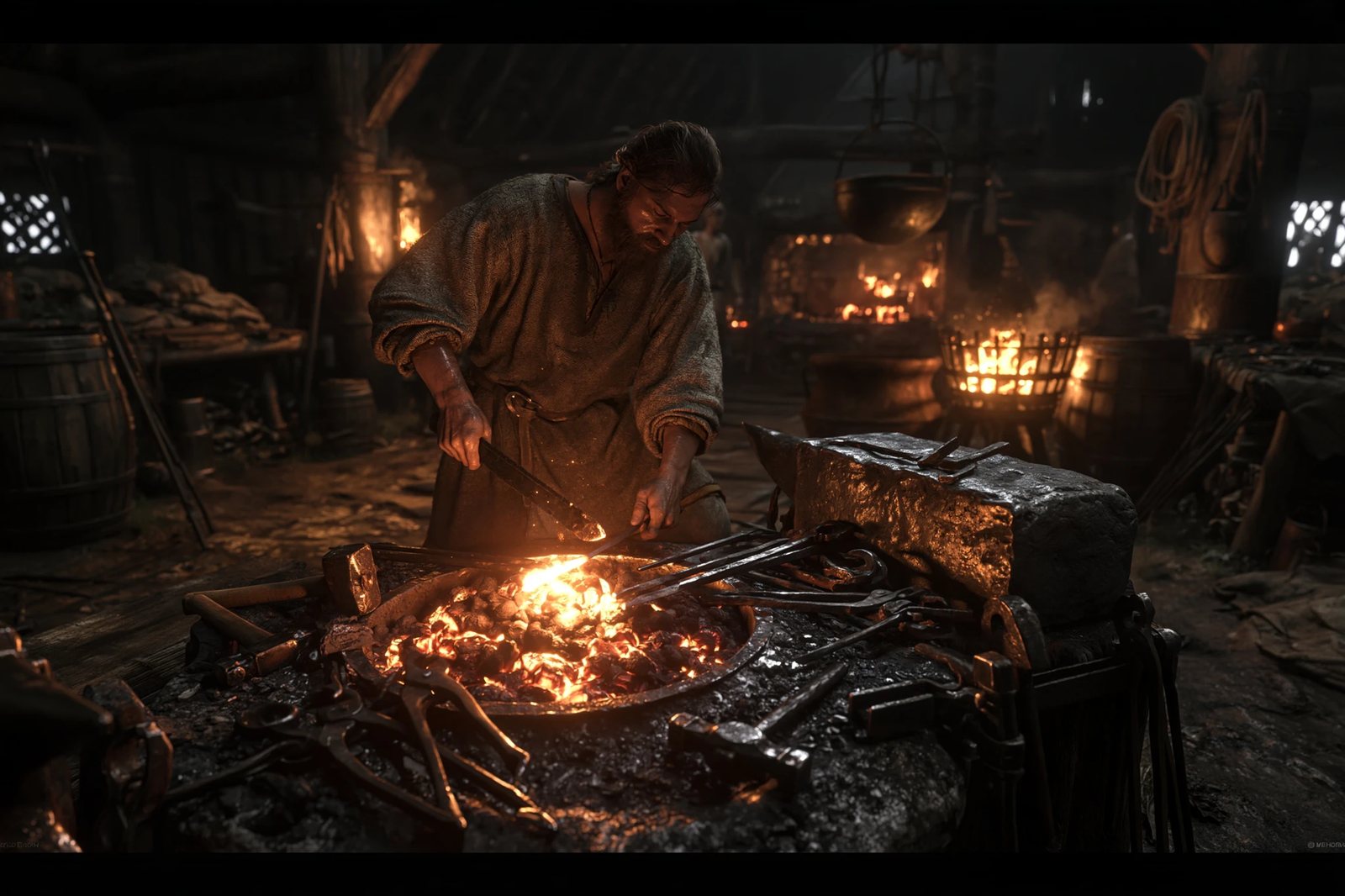
No longship would ever have put to sea, no sword ever been drawn, without the woman and man at the anvil. Ironworking was the quiet precondition of the entire Viking Age – and its craftsperson was at once a highly respected specialist and a half-mythical figure. Let us take an honest look into the fire: what is proven, what remains legend, and why no real blade ever needed a magic spell.
The North had no great ore mines like Roman Noricum. Put bluntly, its iron grew in the marshes. All across Scandinavia, bogs, lakes and wet meadows deposited so-called bog iron ore (close to what the sources call myrmalm) – knobbly, rust-red lumps of iron hydroxides formed by bacteria and iron-rich groundwater. People recognised them by the shimmering film on the water and dug them out with a spade. Modest as it sounds, this was a reliable, renewable resource: after a generation or two, a harvested bog had partly refilled itself.
This ore was worked in the bloomery, a low clay or stone shaft furnace. Dried and roasted ore was layered with charcoal, bellows drove in air, and at roughly 1100 to 1300 degrees Celsius the crucial thing happened: the iron oxide gave up its oxygen to the carbon monoxide of the fire. The iron did NOT melt completely – the temperature was not high enough – but gathered as a spongy, slag-riddled mass at the furnace bottom, the bloom. The smith then had to hammer, fold and forge-weld this porous lump again and again while glowing hot, to drive out the glassy slag and obtain usable, dense iron. A large charge of ore often yielded only a fist-sized piece of clean metal in the end.
To understand the Viking Age, think not only of ore but of wood. The true bottleneck of iron production was charcoal. Both smelting in the bloomery and later forging demanded vast quantities of it – estimates suggest that producing a single kilogram of finished wrought iron consumed many times its weight in wood, burned down in charcoal clamps. Charcoal burns hot and clean because its water and volatile parts have already been driven off; raw wood could never have brought the furnace to working temperature.
This made charcoal-burning a trade of its own, labour-intensive and essential. In many wooded parts of Scandinavia, smelting sites therefore lay where ore AND forest met, often away from the farms. On Iceland, where the birch woods vanished quickly, native iron became a rarity over time and people relied increasingly on imports. Iron was never truly cheap: behind every axe and every nail lay days in the forest, at the clamp and at the furnace.
In a world where one person could turn red bog earth into a blade that split armour, the smith was no ordinary craftsman. He stood high in esteem, for he mastered several arts at once: smelting, forging, welding, hardening and tempering steel. Smith burials, in which the dead were given their tools for the afterlife, show that this skill was regarded as part of the person – some of these graves contain both tools AND weapons, so the smith was often also a respected free man of standing.
At the same time something uncanny clung to the fire craft. Whoever could make metal flow and draw shapes from the glowing coals was credited with other powers too. In the sagas and lays, therefore, the great smiths are not nameless labourers but heroes, rivals of the gods, dwarves with enchanted hands. This double role – sober specialist here, half-mythical figure there – runs through the whole of Norse tradition.
Thanks to a stroke of luck from the bog, we know what such a workshop actually looked like. In October 1936 a farmer at Sproge in south-western Gotland ploughed a field that had once been marshland and struck a Viking Age tool chest. The chest, made of oak, about 90 centimetres long, with iron bands and a lock, contained together with its surroundings more than 200 objects – the largest coherent tool find of the period in Europe.
The contents read like the inventory of a well-equipped rural workshop: pliers, hammers and sledgehammers, anvil pieces and a set of files for metalwork, along with saws, drawknives, drills, rasps and axes for woodworking. There were even a cauldron and large bronze bells beside it. The striking thing is how modern many of these tools look; a pair of pliers or a hammer from Mästermyr would pass unnoticed in many a workshop today. The find shows a craftsman who mastered iron AND wood – an all-rounder, exactly what a farmstead or small settlement needed, mending brooches, repairing boats and re-forging his own tools.
The basic kit was modest and barely changed for centuries. The anvil – often a compact iron block driven into a wooden base – was the heart of the workshop. With tongs the smith gripped the glowing work from the fire; with hammers of varying weight he drove it into shape: the lighter hand hammer for forming, the heavy sledgehammer, often swung by a second pair of hands, for rough drawing-out. Files, rasps and whetstones did the fine work; chisels and swages the cutting and decorating.
The fire itself came from the hearth, whose coals a bellows brought to working heat – clay bellows nozzles, so-called tuyeres, are among the typical finds at forge sites. Hardening used water, sometimes oil; the subsequent tempering at a controlled lower heat took the brittleness out of the steel. This sequence – forge, harden, temper – rested on pure experience: the smith read the temperature from the colour of the glowing metal, long before anyone had invented a thermometer.
The most impressive technique of the Viking-age smith was pattern-welding. Because uniformly high-grade steel from the bloomery was rare and expensive, sword-smiths used a trick: they welded together several rods of iron and steel of differing carbon content, twisted them and forged them into a blade core. When the finished blade was ground and etched, the underlying structure emerged as a shimmering pattern – herringbones, waves, rings.
Pattern-welding was long seen mainly as a road to a better blade: alternating hard and tough layers were supposed to make the weapon both sharp and unbreakable. Today's research is more sober. Much suggests that the pattern in the core was DECORATION and a mark of status, while the real performer was the welded-on edge of better steel. That does not diminish the art – on the contrary: forging a good pattern-welded blade demanded dozens of precisely controlled forge-welds without a single flaw. Over the course of the Viking Age the elaborate twisted blade was increasingly replaced by simpler blades forged entirely from good steel, as soon as better steel became available.
No group of Viking-age weapons is more famous than the blades bearing the inlaid inscription +VLFBERH+T. For roughly two centuries such swords appear all across northern Europe, from Scandinavia to the Rhine. The name is Frankish, and everything points to the original workshops lying in the middle Rhineland – Ulfberht was evidently not a single smith but a workshop or brand name handed down over generations.
The metallurgical study by Alan Williams (Gladius, 2009) sharpened the picture. Of 44 Ulfberht blades examined, 33 carry the inscription in the form +VLFBERHT and 11 in the form +VLFBERH+T, with the cross BEFORE the T. Only these eleven were made of homogeneous, high-carbon crucible steel, with a carbon content around one percent and above – a steel that could not be produced at this purity in early medieval Europe and reached the North via long-distance trade from Central Asia and the Persian region. The remaining 33 blades of simpler bloomery steel are, according to Williams, IMITATIONS – presumably because the famous name boosted sales. One might say brand piracy already existed in the Viking Age.
People think of swords first when it comes to Viking iron – yet the greatest quantities of iron went into shipbuilding. A clinker-built longship was held together by thousands of hand-forged iron rivets, each clenched over a square washer, the rove. Reconstructions of large wrecks have shown that the rivets alone of a larger ship meant many kilograms of iron and countless hours at the anvil. Add to that anchors, chains, fittings and tools.
This made iron a strategic raw material. Bars and half-finished stock were traded, and anyone wanting to fit out a fleet needed not only timber and sailcloth but a reliable supply of iron. The humble nail is thus a better symbol of the smith's craft than the show sword: without the quiet, mass production of rivets, the famous voyages to England, Iceland or the Black Sea would never have happened.
By far the greater part of what a smith made day to day was simply tools and household goods: knives, sickles and scythes, axes and hatchets, nails and fittings, keys and locks, cauldron hooks, wire, needles, harness parts, arrowheads. Practically everyone carried a knife at the belt, and a large share of the iron finds from a Viking settlement consists of such unspectacular everyday things.
Fine-metalworking belonged to it too: non-ferrous craftspeople cast and filed brooches, pendants and mounts from bronze, silver and gold, often at the same trading places as Hedeby or Birka, where raw materials and buyers came together. The line between rough iron smith and fine metalworker was fluid – many mastered both, as the mixed contents of the Mästermyr chest suggest.
Where the real workshop ends, the myth begins – and in the North it has a name: Völund, on the continent Wayland the Smith. The Völundarkviða of the Poetic Edda and pictorial sources such as the Anglo-Saxon Franks Casket tell his dark story: the master smith Völund is captured by King Níðuð, crippled and forced to forge for him on an island. His revenge is cruel and famous – and in the end he escapes into the air on self-forged wings.
He sat, he slept not, but smote with his hammer; / a cunning device for Nithuth he wrought.Völundarkviða, st. 20; translation Henry Adams Bellows 1923 (public domain)
Wayland is the embodiment of the smith as a figure on the threshold: skilled enough to build wings, dangerous enough to take a bloody revenge. That his image appears on an eighth-century Anglo-Saxon casket just as it does in an Old Norse lay and on Gotlandic picture stones shows how deeply the figure was rooted throughout the Germanic world.
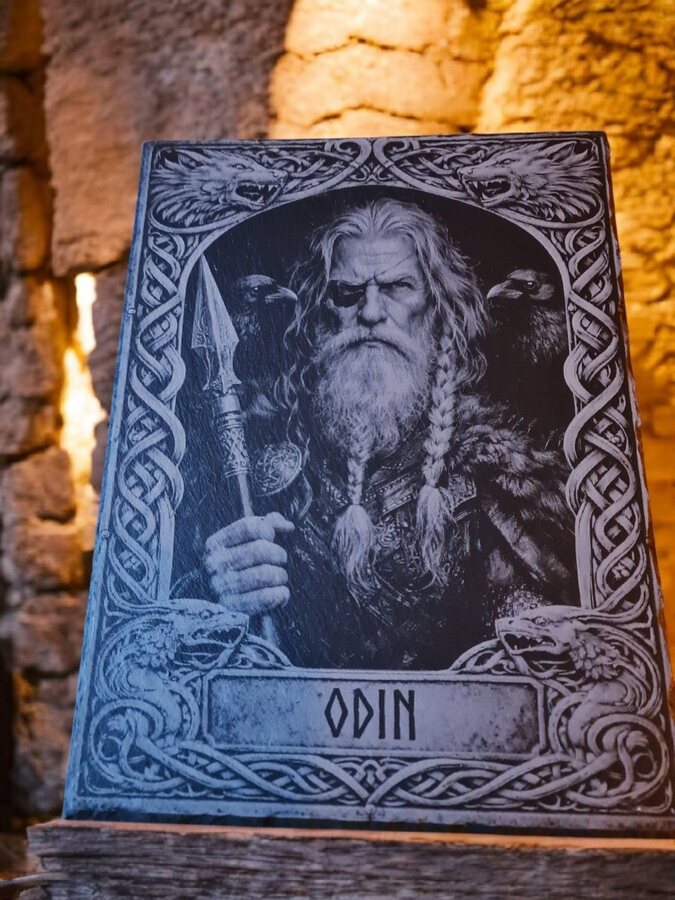
The greatest treasures of the world of the gods come not from the gods but from dwarvish smiths. In the Prose Edda the brothers Sindri (also called Eitri) and Brokkr forge, on a wager with Loki, three marvels: the boar Gullinbursti, the ring Draupnir and – despite Loki's sabotage as a stinging fly – the hammer Mjöllnir, whose short handle remains its only flaw. Odin's spear Gungnir and Sif's golden hair also come from dwarvish hands. And in the Völsung legend it is the smith Regin who forges for Sigurd the sword with which he slays the dragon Fáfnir.
In these stories the smith becomes a creative primal force: whatever power and splendour the world possesses came into being at the anvil. For a craft that turns raw material into value, that is a fitting, almost philosophical elevation.
Evidence: Bog-ore smelting in the bloomery and the origin of Norse iron are archaeologically secured by countless furnace and slag finds. The Mästermyr tool chest (Gotland, found 1936, more than 200 objects) is the largest tool find of the period and attests to combined iron- and woodworking. Alan Williams's metallurgical study (Gladius 39, 2009) demonstrated homogeneous crucible steel in 11 of 44 blades of the form +VLFBERH+T, whose purity points to imported raw steel; the 33 blades of the form +VLFBERHT made of simpler steel are regarded as imitations.
Myth check: The magic-wielding smith and the indestructible wonder-sword are motifs of LEGEND, not of the workshop. Pattern-welding was above all skill and decoration, not sorcery, and was replaced by better steel as soon as it became available. The blade inscriptions – +VLFBERH+T, INGELRII and the like – name WORKSHOP or personal names, not incantations. And a sword that splits anvil and rock without taking damage belongs in the heroic lay, not in metallurgy. The truth is impressive enough: driving a sharp, springy blade out of red bog mud.
The blacksmith's craft of the Vikings was less magic than mastery: patient roasting and smelting, days of charcoal-burning, the calm reading of the glowing colours, thousands of hammer blows for a single good blade. That is exactly where its greatness lies – and the reason why, in our workshop in Alsdorf, we approach material and craft with the same respect when we engrave Norse motifs into stone and wood. The fire has stayed; so has the craft.
The Ulfberht sword · The Mästermyr tool chest · The Viking Sword · The Viking Axe · Völund the Smith.
All Everyday Life & Craft articles →
There are tools that become legend. Among the Vikings it was a sword – or rather: a whole group of swords, all bearing …
Read more →The Viking ship was not merely a tool – it was a status symbol. And at its top there often gleamed a masterpiece of …
Read more →Matted hair, unwashed for years, reeking across the meadhall – that is the Viking of cliché. The finds tell another …
Read more →