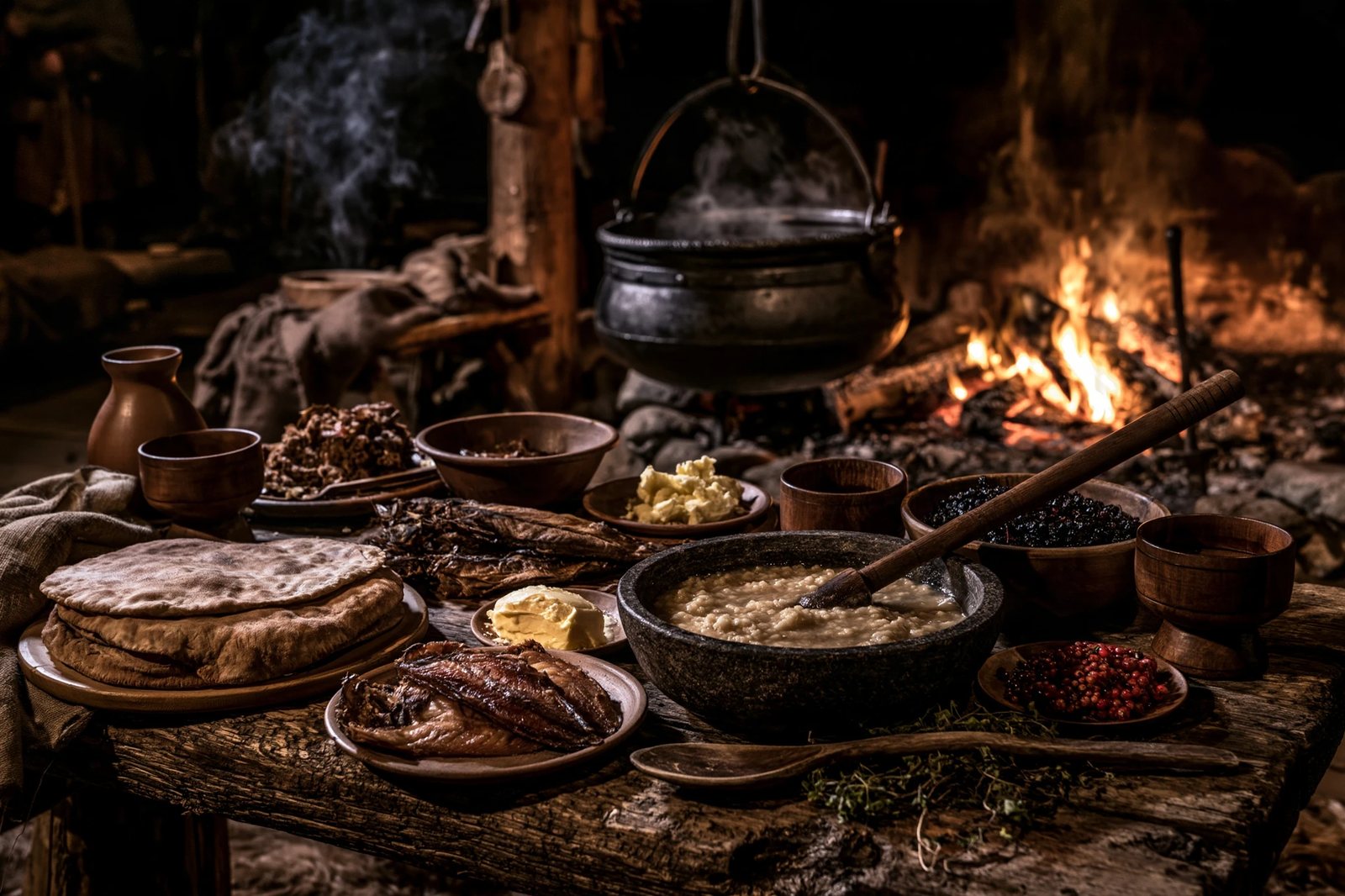
The Vikings mostly ate porridge and flatbread made from barley, together with dairy products such as skyr and butter, fish, some meat, peas, beans, cabbage, berries and nuts – usually in two meals a day – and they mainly drank ale, whey and water. The endless feast piled high with roasts did happen, but as the exception. Here is what excavations, isotope studies and written sources really tell us about Viking food, and how you can cook two simple dishes today.
Picture a farm on the west coast of Norway in late autumn. The cattle are back from the summer pastures, the barley is stacked in sheaves under the roof, and above the long-fire strips of meat and split fish hang in the smoke. The question that rules this household is not "What's for dinner?" but "Will it last until spring?" If you want to understand what the Vikings ate, you have to take that question seriously. Viking-Age cooking (roughly 793 to 1066) was down to earth, seasonal and essentially one long strategy of storage. That did not make it dull.
Our knowledge comes from three very different sources: archaeology (animal bones, fish bones, charred grain, pots and querns from sites such as Hedeby and Birka), scientific analysis of human skeletons, and texts – a handful of contemporary travellers' accounts and a great many Icelandic sagas written down in the 13th and 14th centuries, looking back on the Viking Age. We will tell you each time which kind of evidence is speaking.
Daily life usually revolved around two fixed meals. The Old Norse dagverðr means something like "day meal": it was eaten in the morning, once the first round of work – milking, feeding the animals, stoking the fire – was done. The sagas use the time marker dagmál for this, which is usually placed in the early to mid morning. The second meal was the náttverðr, the "night meal", eaten in the evening when work stopped. Exact times shifted with season and region.
People ate by the long-fire in the longhouse, often sitting on the raised benches along the walls, from wooden bowls and plates. Everyone carried a knife on the belt; spoons of wood, horn or bone completed the set. Forks had no place at the everyday table. Drink came in wooden cups and turned bowls, less often in pottery, and on special occasions in drinking horns – or, for the very wealthy, in imported glass beakers.
Fire he needs who with frozen knees / Has come from the cold without; / Food and clothes must the farer have, / The man from the mountains come.Hávamál, stanza 3 – translated by Henry Adams Bellows, 1923 (public domain)
This stanza from the Hávamál, the great wisdom poem of the Poetic Edda, shows how much food mattered in the North. Giving a frozen traveller fire, food and dry clothes could save a life. Hospitality was not mere politeness; it was a survival rule. The same poem also preaches moderation: the herds know when to leave the grass and go home, it says, but the foolish man never learns "his belly's measure" (stanza 21 in Bellows). Gluttony was no virtue, even then.
The backbone of the Viking diet was grain, and above all barley. It copes with short summers and poor soils and was grown far up the Norwegian coast and even, on a modest scale, in Iceland. Oats, which tolerate wet weather, came next. Rye grew in importance in southern Scandinavia and around the Baltic during the Viking Age, while wheat remained a crop for favourable spots and wealthier tables. Our article on Viking farming covers fields, crops and tools in more detail.
Crushed grain went into porridge, the foundation of nearly every meal. It could be as thin as soup or as stiff as a dumpling, enriched with peas, herbs or a little meat. Coarse flour became flatbread. Ovens were rare, so most bread was baked on hot stone slabs, on iron pans or in the embers. A large share of the barley never reached the pot at all – it went into the brewing vat, of which more below.
Every meal began with hard labour: grain had to be ground on a rotary hand quern, a daily, exhausting chore. The best millstones were valuable trade goods. Porous basalt lava from the quarries around Mayen in the German Eifel was shipped down the Rhine to the trading towns of the North, and such querns turn up in large numbers at Hedeby. A piece of the Rhineland, quite literally, sat in many a Viking kitchen – a thought we enjoy here in Alsdorf, not far from the Eifel.
That we know anything concrete about Viking bread at all is thanks to fire. In cremation graves at Birka, the trading town on Lake Mälaren, small, round, flat loaves were burned along with the dead and survived as charred lumps. The Swedish archaeobotanist Ann-Marie Hansson has studied and reviewed these and other prehistoric bread finds from Sweden; around 150 charred loaves are known from the country, most of them from the Migration, Vendel and Viking periods. The flour was mainly barley, sometimes wheat. Analyses of individual loaves by Hakon Hjelmqvist also point to seeds of other plants mixed in – whether to stretch scarce grain or on purpose is not always clear.
The context is striking. The Birka breads turn up more often than expected in richly furnished cremation graves, and some were threaded onto iron rings. That suggests deliberate offerings for the dead rather than stray leftovers. Bread was more than calories; it could be part of a farewell.
Dairy animals were worth their weight in silver – not for fresh milk, which spoiled quickly, but because milk could be turned into stores. Cows, sheep and goats gave plenty in summer and almost nothing in winter, so the summer surplus became butter, cheese, buttermilk and above all skyr, a thick, curd-like soured milk product. Skyr appears in Old Norse literature; in Egil's Saga, for example, the hero is served skyr at a farm. Whether Viking-Age skyr tasted like the Icelandic skyr in today's supermarkets, nobody knows – modern production is industrially standardised.
Perhaps even more important was the by-product: whey. Soured and stored (Icelandic sýra), it served both as a drink and as a preservative. Meat, offal and fish were laid down in it, and the acidity kept rot at bay. The practice is best known from Iceland and survives in the dishes of the Icelandic midwinter feast. One caveat: the modern Þorrablót with its platters of soured food is a 19th-century revival, and how much of it is genuinely Viking is a question we explore in our article on Þorrablót.
Meat appeared on the table less often than films suggest. Slaughtering an animal meant giving up its milk, wool, pulling power or offspring. Most slaughtering happened in autumn, once it was clear how many animals the stored hay could carry through the winter. The rest went under the knife and was smoked, dried, salted or pickled in whey.
Animal bones from settlements paint a clear picture: cattle, sheep and goats, and pigs supplied most of the meat, in proportions that varied by landscape. In the southern towns such as Hedeby, cattle and pigs played a large part; on the windswept islands of the North Atlantic, sheep dominated. Chickens and geese provided meat and eggs. Add game, seabirds and their eggs gathered on the cliffs, seals and the occasional whale.
Horses were a special case. Horse meat was eaten in pre-Christian times, apparently above all at sacrificial feasts – which is exactly why the Church objected to it. Snorri Sturluson's Heimskringla (13th century) tells how the Christian-raised King Hákon the Good was pressed by his pagan farmers at the sacrificial feast at Lade to eat horse meat. He dodged it by merely breathing in the steam over the cauldron – but at the following Yule feast at Mære he had to swallow a few bites of horse liver after all. And Ari Þorgilsson reports in his Íslendingabók (early 12th century) that when Iceland accepted Christianity around the year 1000, the eating of horse meat and the exposure of infants were at first explicitly still permitted; only later were these abolished too. Horse meat was a statement of faith on a plate.
Along the coasts, lakes and rivers, fish was at least as important as meat, and in many places more so. Herring, cod, haddock, salmon, eel and shellfish: the range from coastal settlements is wide. The traveller Ibrāhīm ibn Yaʿqūb from al-Andalus, who visited Hedeby in the 10th century, noted that its people lived mainly on fish, which was plentiful there. His account survives only in later excerpts, but it fits the finds well; read more in our article on Ibrāhīm ibn Yaʿqūb in Hedeby.
The real star is stockfish: cod dried without salt in the cold, dry air of northern Norway on wooden racks until it is as hard as a plank. It keeps for years. For a long time historians assumed that the great stockfish trade began only in the 12th century. Then a team led by Bastiaan Star and James Barrett analysed the DNA of cod bones from Hedeby. Their result, published in PNAS in 2017: fish from the period around 800 to 1066 came genetically from the Arctic cod stock that spawns off Lofoten – more than 1,500 kilometres away. The sample was small (five bones), and trade cannot be cleanly separated from ship's provisions. Still, dried cod from northern Norway had reached Hedeby long before the Hanseatic League.
Human bones tell the same story. In Orkney, a team led by James Barrett combined fish-bone evidence with carbon isotopes and found that marine food grew markedly more important during the Scandinavian settlement – the newcomers invested heavily in deep-sea fishing. How vital the ocean was further west is the subject of our article on the Vikings in the North Atlantic.
Perhaps the most honest witnesses to the Viking diet are the people themselves. Stable isotope analysis measures the ratios of certain carbon and nitrogen variants in bone collagen. Put simply, carbon shows whether protein came mainly from the sea or the land, and nitrogen shows how high up the food chain someone ate – plenty of meat, milk and fish pushes the value up. The results reflect several years of diet, not a single feast.
The results are more varied than any cliché. At Birka, Anna Linderholm and colleagues compared isotope values with grave goods in 2008: men buried with weapons showed a stronger marine signal, and a group of women linked to trade shared a strikingly similar diet. What you ate went hand in hand with your role and status. A finding from Flakstad in Lofoten is even starker. Multiple graves there held fully buried individuals alongside decapitated ones. The isotopes showed that the beheaded had eaten far more fish protein than the others, who received more meat and dairy from the land. Elise Naumann and her colleagues interpreted this in 2014 as a sign of very different social classes – possibly unfree people buried with their masters.
The lesson: there was no single "Viking diet". A farmer in inland Denmark ate differently from a fisherman in Lofoten, and a merchant's wife at Birka differently from an unfree labourer in the far north.
Plants were part of the diet too, even if they survive less well than bones. The waterlogged layers of Hedeby gave the archaeobotanist Karl-Ernst Behre a rich harvest, which he published in detail in 1983. Alongside barley, rye, oats and wheat there were peas and Celtic beans (a small-seeded form of the broad bean), flax and hemp, plus gathered and cultivated fruit and nuts. Dried peas and beans were storable sources of protein.
A second window opens at Oseberg in southern Norway, a ship burial made in 834. Besides a rich kitchen kit – including an iron cauldron with a tripod, a frying pan, stirring sticks, knives and a large wooden kneading trough – the grave contained food: a chest held grain and wild apples, and animal remains in the grave included an ox. The botanical study lists further useful and seasoning plants, such as cress seeds; which of them were actually meant as food is not always clear.
From gardens and field edges came cabbage, onions and leeks, along with wild plants such as orache and fat hen, whose leaves could be cooked like spinach. Seasoning was local: dill, caraway, mustard, juniper, horseradish, wild thyme. Many of these plants doubled as medicine – see our article on Viking herbs and healing.
Woods and hedges supplied whatever the season offered. Hazelnuts appear in settlement layers in large quantities; they were nourishing, rich in fat and easy to store. Walnuts barely grew in the North and were probably mostly imported. Then there were crab apples, sloes, plums and bullaces, raspberries, blackberries, bilberries, wild strawberries, elderberries and rosehips.
Sweetness came almost entirely from one source: honey from wild and kept bees. Sugar was unknown. Honey was precious, because it was also the raw material for the finest drink of the hall – and beeswax was needed for candles and casting moulds.
The everyday drink was ale, Old Norse öl. It was brewed from malted barley, often at home. The result was cloudy, nourishing and probably fairly weak – liquid food as much as an intoxicant. Most of it was not yet hopped. Brewers used herbs instead, above all bog myrtle (sweet gale, Myrica gale), a wetland shrub with a long brewing tradition in the North. Traces of hops have been found at several Viking-Age sites such as Hedeby, Birka and Ribe, but whether they were grown there, imported or used for brewing at all is an open question; the botanist Karl-Ernst Behre traced the history of these beer additives in 1999. We tell the full story in Viking beer and brewing.
Mead, fermented from honey (Old Norse mjöðr), was the prestige drink – expensive, because honey was expensive. In poetry gods and heroes drink mead; in real life it belonged in the chieftain's hall and at feasts, not on the everyday table. Wine was more exclusive still. It came from the Frankish realm, especially the Rhineland, and reached the trading towns in barrels and jugs. At Hedeby, used wine barrels made of silver fir – a tree that does not grow in the North – were recycled as well linings.
The real thirst-quenchers, though, were water, buttermilk and soured whey. And drinking carried weight in the North: at the sumbl, the ritual drinking feast, the horn went round, toasts were raised to gods and ancestors, and solemn vows were made.
The true key to Viking cooking is preservation. Without refrigeration, the only way through winter was to make the summer surplus last. Four methods stood out. Drying: stockfish, dried meat, berries, apples, peas and beans – the cold, dry northern wind was a free helper. Smoking: meat and fish hung in the smoke under the roof above the long-fire anyway, and deliberate smoking was added. Souring: pickling in whey, plus the lactic fermentation of skyr and cheese. Salting: salt was the most important seasoning and preservative. It was obtained by boiling seawater or from salt-rich peat – an energy-hungry business, so salt was never cheap.
That is how a short harvest summer became stores that lasted until spring – or did not. Late spring, when the old stores ran low and the new harvest was still far off, could be the hardest time of the year. A bad summer, a failed harvest or cattle disease meant hunger. A full storehouse was worth more than many a piece of silver.
Much of Viking cooking happened in a single vessel: the pot over the long-fire. In Norway and Shetland, pots were carved from soapstone, a soft, heat-resistant rock that holds warmth well. Soapstone vessels were exported widely, Hedeby included; in Denmark, by contrast, pottery dominated. Iron cauldrons hung from a chain or set on a tripod were valuable possessions. Spits, pans and baking plates completed the kit.
For large amounts of meat, people used cooking pits, Old Norse seyðir: a pit was filled with red-hot stones, the meat laid in, covered over and slowly cooked. Such pits have been found in huge numbers. Even the gods cooked this way. In Snorri's Edda (13th century), Odin, Loki and Hœnir slaughter an ox and put it in a seyðir – but the meat simply will not cook, because the giant Þjazi, in the shape of an eagle, is bewitching it. Anyone who has waited on a stubborn roast will sympathise.
The image of a Viking toasting the hall with a leg of mutton in his fist is not entirely wrong – it just describes the exception. At the blót, the sacrificial feast, animals were slaughtered and the meat shared in the hall; at Yule, weddings and funeral ales the beer flowed freely. Myth has its champion eaters too: in Hymiskviða, Thor devours two oxen in one evening at the giant Hymir's table. Precisely because feasting was rare, it mattered. Whoever could provide meat and ale for dozens of guests was investing in friendship, alliances and reputation. Food was politics.
Everyday life looked very different: two plain meals, lots of porridge, flatbread, soured milk, fish and not much meat. If you want to test more popular images against the evidence, try our myth-busting article on Viking clichés.
A frank word first: not a single recipe survives from the Viking Age. We know ingredients, cookware and techniques, but no quantities. The suggestions below are modern reconstructions based on attested ingredients and methods – nothing more, nothing less. For more one-pot ideas, see our article on Viking stew and everyday cooking.
1. Barley and pea flatbreads in the Birka style (modern reconstruction). Soak half a cup of dried yellow peas overnight, boil until soft and mash roughly. Knead with about 300 g of coarse barley flour, roughly 250 ml of water and a pinch of salt into a firm dough. Shape eight balls and press them into flatbreads about one centimetre thick. Bake on both sides in a dry cast-iron pan – or, if you want to go all in, on a hot, clean stone by the fire – until firm and lightly browned. They come out dense and nutty. Whether the Birka loaves contained peas is not attested, but barley combined with pulses matches the plant finds of the period. Serve with butter and a piece of smoked fish.
2. Farmhouse barley porridge with kale and bacon (modern reconstruction). Put 200 g of pearl barley or coarsely cracked barley on to boil with a good litre of water. Add a chopped onion or some leek and a handful of shredded kale, and season with salt, dill and a few crushed juniper berries. If you like, let a piece of smoked bacon simmer with it – in everyday life more a seasoning than the main event. Simmer gently for about an hour until thick, then stir in a knob of butter and a splash of buttermilk. It will never go viral, but it is closer to what actually bubbled over the long-fire than any "Viking grill platter".
What did Vikings eat most often? Grain, as porridge and flatbread, mostly from barley. Add dairy products such as skyr, butter and soured milk and, depending on the region, a lot of fish.
How many meals a day did Vikings eat? Usually two: the dagverðr in the morning after the first work and the náttverðr in the evening.
Did Vikings eat a lot of meat? Less than people think. Beef, mutton, goat and pork were mostly feast food or a flavouring in porridge, and isotope studies show big differences by region and social status.
What did Vikings drink? Every day: water, buttermilk, soured whey and home-brewed, mostly unhopped ale. Mead was an expensive feast drink, wine an imported luxury.
Did Vikings use spices? Yes, but local ones: salt, dill, caraway, mustard, juniper, onion and leek. Pepper and cinnamon are not attested for the Viking-Age North.
Are there authentic Viking recipes? No. Ingredients and cooking methods survive, but no recipes. Every "Viking recipe" is a modern reconstruction – at best a well-founded one.
For courage. For remembrance. For legends that live on.
Mead – the drink of gods · Everyday Viking life · The Viking Longhouse · Herbs & healing of the Vikings · Viking clothing & fashion.
All Everyday Life & Craft articles →
Matted hair, unwashed for years, reeking across the meadhall – that is the Viking of cliché. The finds tell another …
Read more →Coarse brown sacking, a shaggy fur collar, and of course the obligatory horned helmet – that is the Viking of film and …
Read more →Viking jewellery was rarely just decoration. A pair of brooches held the dress, an arm-ring was status symbol and …
Read more →