A stew leaves nothing behind. No recipe, no quantities, no cooking time. What it leaves behind is charred grain in a hearth floor, fish bones in harbour silt, cauldron fragments in a grave – and, with luck, the contents of a latrine. In York one such stroke of luck lies under glass: a twenty-centimetre piece of ninth-century human faeces. Finds like these tell us a surprising amount, and some things they cannot tell us at all. We show what is attested, and end with a stew in which every ingredient carries a label.
The basis was grain, in an order that repeats across almost every excavation. Barley first, usually hulled barley, because it ripens reliably on poor soils and in short summers. Then oats, which demand little and give much. Rye increases over the course of the Viking Age. Wheat remains the exception, because it needs warmth and good ground.
At Hedeby millet is added, and some wheat too. Two things were mainly made from all this: porridge and flatbread. Porridge is the real everyday food of the north, not the roast. People doing heavy work every day eat grain.
What was grown in Scandinavia, and how, we took apart in a separate article on Viking farming. Here we care about what went into the pot.
Beside the grain stand the pulses: pea and horse bean, both attested repeatedly in Viking Age layers. They are the second half of the stew; they fill you up and store dry.
Then there are oil plants. Flax was grown mainly for fibre, but its seeds also yield oil. Gold-of-pleasure, botanically Camelina sativa, is attested as an oil plant in southern Scandinavia from the Iron Age onwards, and its seeds turn up in the charred loaves from the graves at Birka. That cooking oil was regularly pressed from it is plausible – proven it is not, and cultivation drops off overall after the Roman Iron Age.
The garden plants are the part that surprises most people. A study of fourteen excavations in Denmark, Scania and Schleswig dated 775 to 1050 lists, among others, onion, carrot, cabbage, celery, pea, bean, hop, coriander, angelica and ground elder. At Hedeby, harbour silt and wells yield apple, damson, cherry, walnut and even grape pips. At the ring fortress of Fyrkat coriander seeds were found; in a woman's grave at the same site lay henbane seeds – a poisonous plant, not a kitchen herb.
It is worth saying how such remains get into the ground. In towns they survive waterlogged, in the silt of harbours, wells and cesspits. On farms they survive charred, because they fell into the fire. The two routes favour different plants. What is missing is therefore not necessarily missing from the table – it is missing from the soil.
On the coast fish was the main thing. In the bone refuse of Hedeby herring dominates, followed by perch, pike, cyprinids and flatfish. The traveller Ibrahim ibn Yaqub from al-Andalus, who was in the town around 965, fixed this in a sentence that has adorned every book about Hedeby since:
"The town is poor in goods and riches. The people eat mainly fish, for there is a great abundance of it there."Ibrahim ibn Yaqub on Hedeby, around 965; the account survives only in extracts quoted by later Arabic authors. English rendering our own, following the usual reading
For meat, cattle and pig are the main suppliers; sheep and goats were kept rather for milk, wool and hide. Game – red deer, roe deer, wild boar, wild birds – is rare in the food waste. The image of the Viking permanently roasting something comes from television, not from excavation. Meat was there, but not daily, and less often on a simple farm than in a hall. More on the town by the Schlei in our article on Hedeby.
Milk, by contrast, was everyday: as fresh milk, buttermilk, butter, cheese – and as skyr. Skyr is mentioned in several medieval Icelandic texts, among them Egils saga and Grettis saga. No precise description of how it was made has survived. Whether tenth-century skyr resembled today's, nobody knows. That soured, strained dairy products existed in the north is certain.
Cooking was done at the open hearth in the longhouse. The vessels are known to us mainly from graves. The Oseberg ship held two iron cauldrons, one with a tripod and chain, plus ladles, whisks, two kitchen axes, a milk strainer, troughs, bowls and a quern with its wooden lever still in place. That is a complete kitchen, given to the grave – and a mark of status, not an average household inventory. The ship itself and the two women in it are a chapter of their own: the Oseberg ship.
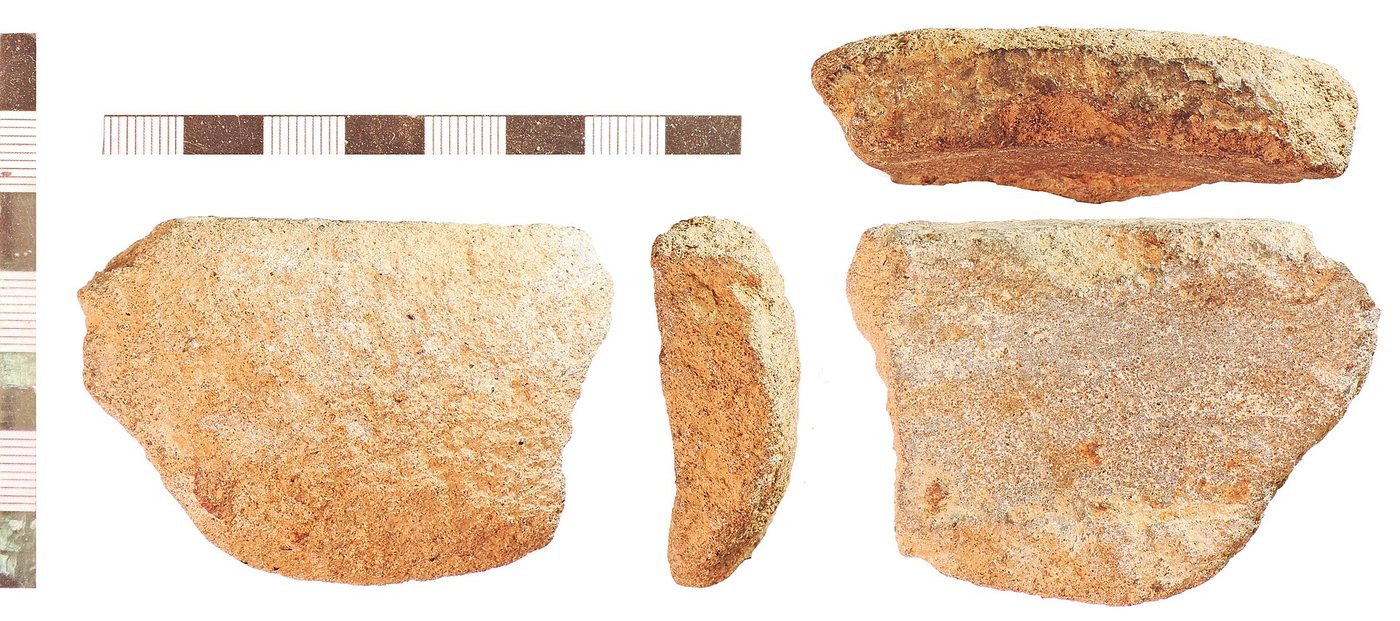
The north's other great cooking vessel is the soapstone pot. Soapstone can be cut from the rock with iron tools, it holds heat, it does not crack and it barely wears out. In Norway it was quarried on a large scale and traded both as raw material and as finished pots; soapstone fragments turn up in the trading places of the Baltic. In parts of Norway pottery disappears almost entirely in the course of the first millennium – soapstone and iron cauldrons replace it.
What should not be transferred to the Viking Age unexamined are cooking pits. These earth ovens filled with fire-cracked stones have been excavated in enormous numbers in Scandinavia, but their heyday lies in the Early Iron Age, roughly between 200 and 500, after which they decline sharply. For the Viking Age the hearth inside the house is the norm, not the pit in the yard.
Charred bread from the Viking Age does exist. The largest group comes from graves at Birka. They are small, flat loaves, and analysis shows that several different kinds were in circulation.
What the charred pieces do not reveal is the question everyone asks first: sourdough or not? A thin flatbread baked through looks much the same charred as an unleavened one. That Norse people could handle fermentation is beyond doubt – they brewed beer and mead. Direct archaeological proof of sourdough bread in the Viking Age is not known to us. Anyone selling an "original Viking Age sourdough loaf" today is selling a guess.
In 1972 archaeologists in York, digging beneath what later became a bank building, hit on a find that has made it into the permanent display of the Jorvik Viking Centre: a mineralised piece of ninth-century human faeces, some twenty centimetres long. Its contents showed a diet dominated by cereal bran and meat. They also contained several hundred eggs of intestinal parasites, whipworm and maw-worm. The person it came from was ill, and was not alone in that.
The cultural layers at Coppergate have yielded more: blackberries, wild strawberries, celery, coriander, lamb's lettuce, wild parsnip, along with cockles, periwinkles, oysters and the bones of domestic fowl, duck, goose and swan. Taken singly, each is one seed or one bone. Taken together, they are a menu.
Pollen can do less than people like to credit it with. It shows what grew in the landscape and how woodland, pasture and field shifted. What one family ate on one evening it does not show. For that question you need latrines, hearth floors, rubbish pits and isotope values from bone – and even those give dietary patterns, not meals.
From the Oseberg grave itself, plant remains are documented alongside the kitchen gear, among them wild apples and the seeds of herbs and wild plants. Whether they were provisions, offering or furnishing is interpretation.
What follows is expressly not an "original recipe". There is no such thing, because not a single recipe survives from the Viking Age. What we offer is a stew of attested ingredients, cooked with modern craft.
Attested: barley (whole, not polished into pearl barley), dried peas, horse beans, onion and leek, cabbage, carrot, celery, dill, coriander seed, ground elder and young nettle, a small amount of beef or pork, smoked or dried fish, butter, salt.
Modern is everything else: potato, tomato, sweet pepper, maize, beans of American origin. The orange carrot we buy in the shop is an early modern breed; the Viking Age one was small, woody and pale. Pepper, bay leaf and stock cubes stay out as well.
How we cook it: soak barley and peas overnight. Sweat onion and leek in butter, add the meat, pour on water, add barley and peas, and let it simmer gently for an hour and a half to two hours. Cabbage, carrot and celery go in for the last half hour. At the end, dill, a little crushed coriander seed, ground elder or nettle and a spoonful of oil. Salt. If you like, add the smoked fish only at the very end so it does not fall apart.
What is interpretation here: the quantities, the order, the cooking time, the combination of herbs – and the cooking oil: flax and gold-of-pleasure are attested as plants, the pressing of oil from them is our inference. Over a wood fire in an iron cauldron the same pot tastes different from an induction hob, and a tenth-century household would probably have cooked it thinner and longer, because fuel and time were distributed differently from ours. Further things to cook stand in our collection of Norse recipes, and the basics on ingredients and equipment in the Viking kitchen.
Archaeologically attested are the cereal species, pulses, oil and garden plants from settlement layers, latrines and wells; animal and fish bones from refuse deposits; cooking vessels of iron and soapstone; charred bread from Birka; intestinal parasites from York.
Contemporary written source is Ibrahim ibn Yaqub's report on Hedeby – transmitted at second hand, brief, and written by a visitor who measured what he saw against Córdoba.
Later tradition means the Icelandic texts of the thirteenth century with their mentions of skyr, porridge, ale and feasts. They report on a period three hundred years past.
Modern interpretation is everything that turns all this into a menu: quantities, recipes, cooking times, taste. Our stew included.
Being honest about it makes it no worse. A pot of barley with peas and a piece of smoked fish, eaten by the fire, is closer to the Viking Age than any fantasy recipe with a horned helmet on the label. For courage. For memory. For legends that live on.
Mead – the drink of gods · Hedeby · Viking Farming · The Oseberg ship & the two women · Viking Childhood · The Norse of Jórvík.

.jpg)