A kingdom whose kings were pagans and Christians, Danes and Irish, that submitted to the English twice and twice broke away again, that struck coins bearing the name of Saint Peter and a sword – and whose archbishop more than once stood on the side of the Norsemen. That was York between 866 and 954. Anglo-Saxon Eoforwic became Jórvík. Much of what is left of it lies in the damp ground, in layers up to nine metres deep, and it tells of everyday life, not of kings.
York was already an old city when the Norsemen came. The Romans had founded Eboracum here; the Anglo-Saxons turned it into Eoforwic, seat of the kings of Northumbria and of an archbishop, with a cathedral school and an international reputation. The Scandinavians heard the name and made their own sense of it: Jórvík, as though it contained the Norse word for a bay, vík. From this Jórvík, by a roundabout route, came today's York.
How the Great Heathen Army took the city in 866, and how the two rival kings of Northumbria fell before its walls in March 867, we have told elsewhere. According to Northumbrian tradition, written down by Symeon of Durham in the twelfth century, the city was taken on All Saints' Day, 1 November. The Anglo-Saxon Chronicle gives no day.
At first the army did not rule directly. It set up an Englishman called Ecgberht as king, who ruled north of the Tyne for as long as it suited the conquerors. In 872 the Northumbrians drove him out, and Archbishop Wulfhere with him; by the following year the archbishop was back. The church of York, as would become clear, had come to terms with the new masters.
The decisive break came in 876. Halfdan, one of the army's leaders, shared out the land of the Northumbrians among his men, and they began to plough and to provide for themselves. Warriors became landholders; a camp became a kingdom. The Scandinavian settlement of Northumbria thus belongs to the world of the Danelaw, but it remained politically separate. York was not one of the Five Boroughs; it was a royal seat.
The first Christian king of Jórvík we know of was Guthfrith, in Old English Guthred. He died in 895, and the chronicler Æthelweard notes that he was buried in York Minster – a Scandinavian king in the bishop's church.
How he became king is told by a source from the circle of the monks of Saint Cuthbert, the Historia de Sancto Cuthberto. The saint, it says, appeared to an abbot in a dream and ordered him to buy the freedom of a young Dane called Guthred, who had been sold as a slave to a widow, and to make him king. This was done, and Guthred showed his gratitude with land for Cuthbert's community.
That is a legend, written in the tenth or eleventh century by those who profited from it. But it shows something real: in Northumbria the new kings negotiated with the church, and the church with them. Each needed the other.
Around 895 something began in York that no other Viking realm in the British Isles did on this scale: the kings had coins struck. The earliest bear the names Siefred and Cnut, two kings we know almost only from these coins. Then there are pennies with the puzzling legend CVNNETTI, whose meaning is still disputed.
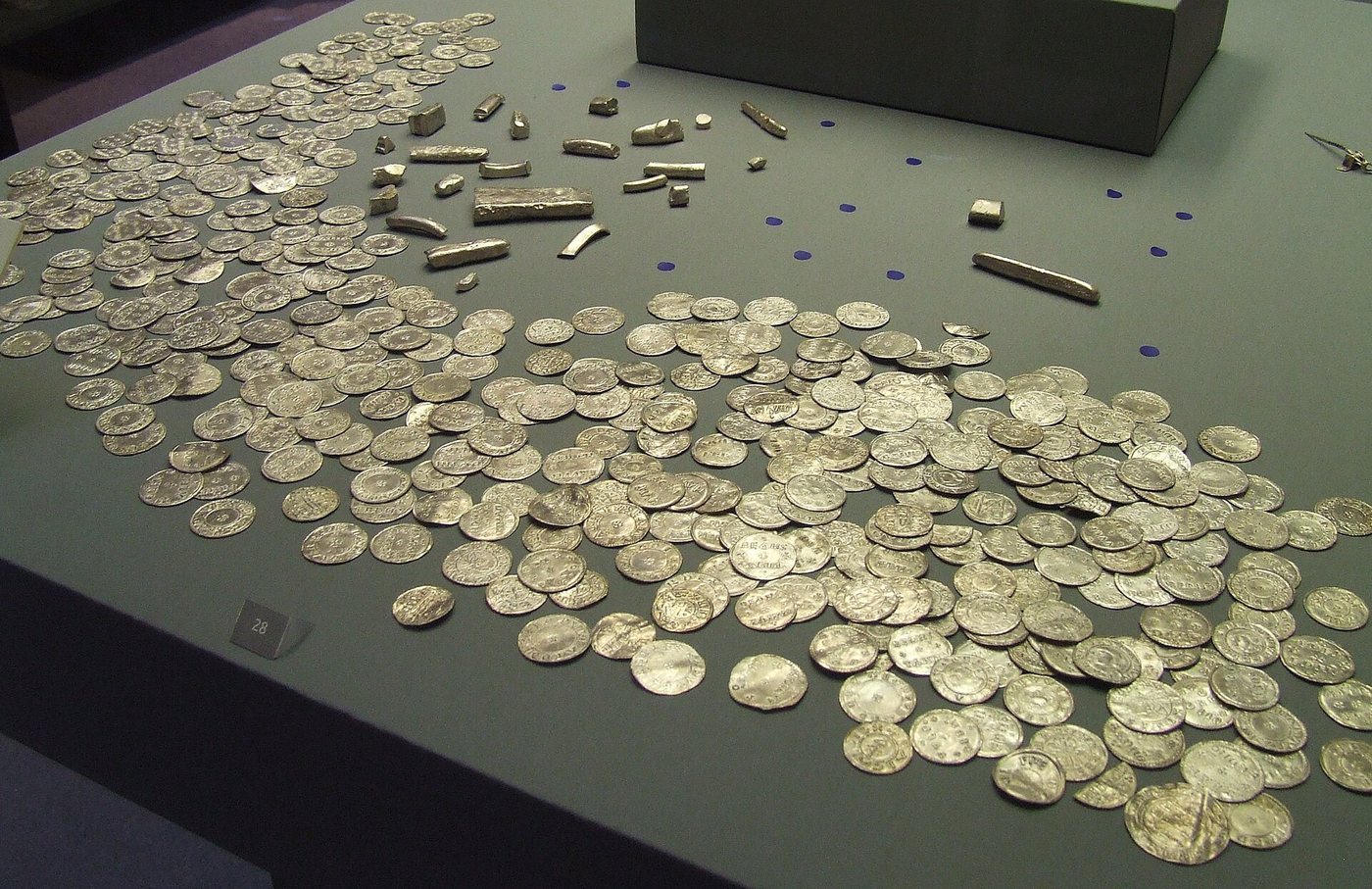
Thousands of these coins lay in the Cuerdale hoard on the Ribble in Lancashire, found in 1840: more than eight thousand pieces of silver, coins from York, the Frankish realm and the Arab world, together with hacksilver, buried around 905.
At about the same time the St Peter pennies appear. Instead of a king's name they carry the legend SCI PETRI MO, Sancti Petri moneta, money of Saint Peter – the patron of York's cathedral. In the 920s some of these coins add a sword, others a hammer that is often read as Thor's hammer. A Christian saint, a sword and perhaps a pagan sign on the same money: that is Jórvík in a single coin. Many numismatists suspect that the archbishop had a hand in the minting. That is not proven, but the saint's name on the money points that way.
Under Olaf Guthfrithsson around 940 the royal title even appears on the coin in Norse form: ANLAF CVNVNC, King Olaf, above a bird usually interpreted as a raven.
In the tenth century the kings of Jórvík came from a different direction: from Dublin. The grandsons of Ivar, the Uí Ímair of the Irish annals, ruled the Ostmen in Ireland and now reached across the Irish Sea for York.
Ragnall established himself in Northumbria after a battle at Corbridge in 918 and took York around 919. After his death in 921 came Sihtric, whom the Irish called Cáech, the one-eyed or squinting. Sihtric sought an understanding with the south: on 30 January 926 he married a sister of King Æthelstan at Tamworth. A year later he was dead, and Æthelstan took York himself in 927.
A find made near Harrogate in 2007 belongs to these years: the Vale of York Hoard, 617 coins and silver in a gilded silver cup from the Frankish realm, buried around 927/28. In it, coins of Æthelstan lie beside Arab dirhams and hacksilver – the moment of the takeover, sealed in a vessel.
Æthelstan's hold on York lasted as long as he lived. In 937 at Brunanburh he defeated an alliance of Scots, men of Strathclyde and the Dublin king Olaf Guthfrithsson. But when Æthelstan died in 939, Olaf came back, was accepted as king in York and even reached for the Five Boroughs in northern Mercia. He died in 941.
After that, rule changed hands in quick succession. Olaf Sihtricsson, son of Sihtric Cáech, ruled from 941, for a time alongside Ragnall Guthfrithsson; in 944 King Edmund drove both out. Then the Northumbrians took a king of quite different origin: Erik, whom posterity calls Bloodaxe. Between his two reigns Olaf Sihtricsson returned once more in 949. In 954 the Northumbrians drove Erik out, and King Eadred took over the land. The kingdom of Jórvík was at an end. From then on earls governed on behalf of the English kings.
One figure runs through these years: Wulfstan I, archbishop of York from 931 to 956. He stood with Olaf Guthfrithsson when Olaf invaded Mercia (the Chronicle enters it under 943; historians usually date it to 940), and negotiated the peace with him. In 947 the Northumbrians swore loyalty to King Eadred at Tanshelf and soon broke the oath. In 952 Eadred had the archbishop detained.
You can call Wulfstan a traitor, as the Chronicle's southern English viewpoint suggests. You can also see him as a man defending the independence of Northumbria and its church – against a distant king in the south, and together with whichever ruler happened to sit in York. Since Wulfhere the same pattern shows: the archbishops of York were not the Norsemen's victims but their most important negotiating partners.
We know about the kings from chronicles and coins. Almost everything we know about the people comes from the ground. In 1972 archaeologists found well-preserved Viking Age timber beneath a bank branch in York. Then, from 1976 to 1981, the York Archaeological Trust under Peter Addyman and Richard Hall excavated some thousand square metres on Coppergate.
The ground there is damp and starved of oxygen. Wood, leather, textiles and even plant remains have survived. The excavators uncovered house plots, narrow tenements running back from the street, with buildings of wattle and later of timber planks, whose walls in places still stood up to two metres high. Some twenty thousand individual finds were recorded, along with more than a quarter of a million pottery sherds and tonnes of animal bone.
What these finds show is a city of workshops: wood-turners making bowls and cups on the lathe – the street name Coppergate probably goes back to the cup-makers, Norse koppari, and gata, street – comb-makers, shoemakers, metalworkers, amber-workers. There are also things from far away, among them a silk cap whose fabric came from a long way off. Jórvík was a market town in the North Sea network and beyond. The dig gave rise to the Jorvik Viking Centre, opened in 1984.
Contemporary written sources are the Anglo-Saxon Chronicle, written from a southern English viewpoint, the chronicle of Æthelweard, the Irish annals for the Dublin kings, and charters. Much about Northumbria we know only from texts of the eleventh and twelfth centuries, such as those associated with Symeon of Durham.
Archaeologically and numismatically attested are the coinage from Siefred and Cnut to Olaf, the St Peter pennies, the Cuerdale and Vale of York hoards, and the houses and workshops of Coppergate.
Later tradition includes Guthred's elevation from slave to king at Cuthbert's command in a dream, and the sagas about Erik.
Modern interpretation includes the archbishops' role in the minting, the meaning of CVNNETTI and the Thor's hammer on the St Peter pennies.
Ninety years is short for a kingdom. But they have shaped York to this day: in the street names ending in -gate, in what lies beneath the city, and in a story in which pagans, Christians, Danes and Irish fought over the same city. For courage. For memory. For legends that live on.
The Great Heathen Army · The Danelaw · Erik Bloodaxe · The Ostmen · The England Voyagers · The Norse on the Isle of Man.

