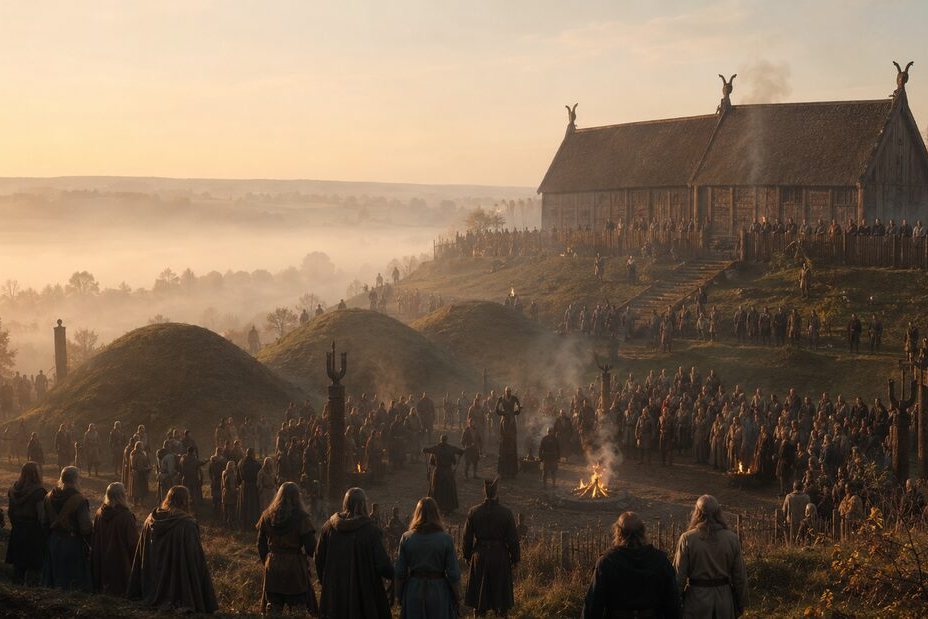
 In the Eastern Alps one of the earliest Slavic principalities arose: Carantania. Its unique ruler-installation ritual on the Prince's Stone is famous to this day.
The Carantanians were a Slavic people in the Eastern Alps, in the area of today's Carinthia, Styria and Slovenia. Their principality of Carantania (Latin Carantania) is among the earliest tangible Slavic states of all – and it left a heritage that lives on to this day in the name of Carinthia and in the history of the Slovenes. The Carantanians form, as it were, a fourth, Alpine branch of the South Slavs.
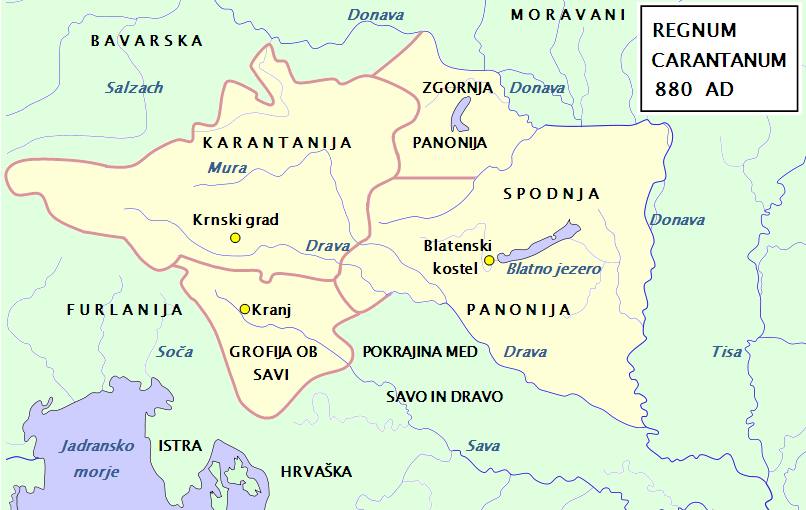
In the 6th century, in the course of the great Slavic migration, Slavic groups pushed also into the Eastern Alps – into a land that, after the withdrawal of Rome, was only thinly settled. They settled in the valleys of the Drava, Mur and Sava and mixed with the Romance-Celtic remnant population. Out of these Alpine Slavs the principality of Carantania formed in the 7th century, with a centre at the Zollfeld north of today's Klagenfurt.
The early Alpine Slavs stood under pressure from the Avars, a powerful horse people from the Hungarian plain. For a time they belonged to the realm of Samo, that Frankish merchant who around 623/24 led a first great Slavic tribal league against the Avars and Franks. After Samo's death this league fell apart again, but the Carantanians remained as an independent principality – freed from the Avar yoke, but now in the shadow of a new neighbour: the Bavarians.
In the 8th century the Carantanians under Prince Borut sought protection with the Bavarians against the Avars – and thereby fell into their dependence. Borut's son and nephew were raised as Christians at the Bavarian court. So the Carantanians came early and relatively peacefully under Frankish-Bavarian influence and became part of the Carolingian empire. Unlike many Slavic peoples they were not conquered but gradually integrated.
The Christianisation of the Carantanians proceeded from the bishopric of Salzburg. The most important source on this is the Conversio Bagoariorum et Carantanorum ("Conversion of the Bavarians and Carantanians"), written around 870 – a central document of early Alpine history. Bishop Virgil of Salzburg sent missionaries; there were also setbacks and pagan revolts. In the end, however, the Carantanians became Christian and remained so – an early success of the mission in the Slavic world.
The most famous thing the Carantanians left behind is their ruler-installation ritual. A new prince was installed on the Prince's Stone (the inverted capital of a Roman column) – in a ceremony in the Slovene language, in which a free peasant tested the prince and let him onto the stone only after symbolic questions. This ritual, which stressed the ruler's bond to the people, is unique in medieval Europe. It survived into the early modern period and is regarded as one of the earliest testimonies of a "contract-like" conception of rule.
Out of Carantania, within the Carolingian and later the East Frankish-German empire, grew the duchy of Carinthia – whose name goes back directly to the Carantanians. At the same time the Carantanians are an important reference point of Slovene history: the Slovenes see in Carantania and its Prince's Stone an early highpoint of their own state tradition. So the Alpine Slavs live on in two modern identities at once – the Austrian region of Carinthia and the nation of the Slovenes.
The Carantanians show that the Slavic migration led not only east (Rus), to the Elbe and Oder (West Slavs) and to the Balkans (Serbs, Croats), but also deep into the Alps. Linguistically they belong to the South Slavs but formed an Alpine branch of their own with its own history. For our picture of the Slavic world they close an important gap: the Alpine region, where Slavs, Romance-speakers and Germani (Bavarians) lived closely together for centuries.
No other early-Slavic people has as impressive a political heritage as the Carantanians: one of the first Slavic principalities, an early and lasting Christianisation and, in the Prince's Stone, a ruler-installation ritual unique in the world. Their history links Slavs, Bavarians and the ancient heritage (the Prince's Stone was a Roman spolia) into one of the most fascinating stories of the Alps. For an honest picture of the Slavs they are indispensable.
The central source is the Conversio Bagoariorum et Carantanorum (around 870), supplemented by Frankish annals and the later tradition of the Prince's Stone ritual. All early sources are Frankish-Bavarian and ecclesiastical and see the Carantanians from outside. The counterweight is provided by the archaeology of the Alpine Slavs (settlements and cemeteries at the Zollfeld and in Slovenia). The secure core – principality, Avar pressure, leaning on Bavaria, Christianisation by Salzburg – we separate from later, partly nationally charged interpretations of the Prince's Stone ritual.
The centre of Carantania lay at the Zollfeld (Slovene Gosposvetsko polje) north of Klagenfurt, around the castle hill of Karnburg/Krnski grad. Here stood the Prince's Stone, here lay the political heart of the principality. Archaeologically, early-Slavic settlements and cemeteries are attested in the region; the nearby ancient Virunum supplied Roman spolia such as the Prince's Stone. The place thus links Roman heritage and early Slavic history in one spot – a layered picture of Alpine history.
The Carantanian installation ritual outlasted the change to the duchy of Carinthia. The German dukes of Carinthia too were still installed until 1414 in parts of the old ceremonial, partly in the Slovene language – a unique survival. Beside the Prince's Stone stood the Duke's Chair at the Zollfeld, a double stone throne on which the homage of the land took place. That a ritual from early-Slavic Carantania was still alive in the late Middle Ages makes it one of the most remarkable testimonies of continuity in Europe.
For the Slovenes, Carantania is a founding myth of their nation – the proof that there was early on a Slavic state of their own in the Alps. The Prince's Stone adorns Slovene symbols to this day. Historically, caution is needed: Carantania was an early-medieval principality, not a modern nation-state, and its population was mixed. The later reading of the Prince's Stone ritual as "proto-democratic" is partly nationally exaggerated. We keep it honest: the principality and the ritual are real and important, but their modern charging is interpretation.
"The Bavarians, with the king's consent, made the Carantanians Christians and set priests over them."after the Conversio Bagoariorum et Carantanorum (public domain, own translation)

The Serbs · The Croats · The Sorbs.
All History & Finds articles →
Long before the Vikings they settled between the Eifel and the Danube, leaving behind gold hoards and princely graves …
Read more →