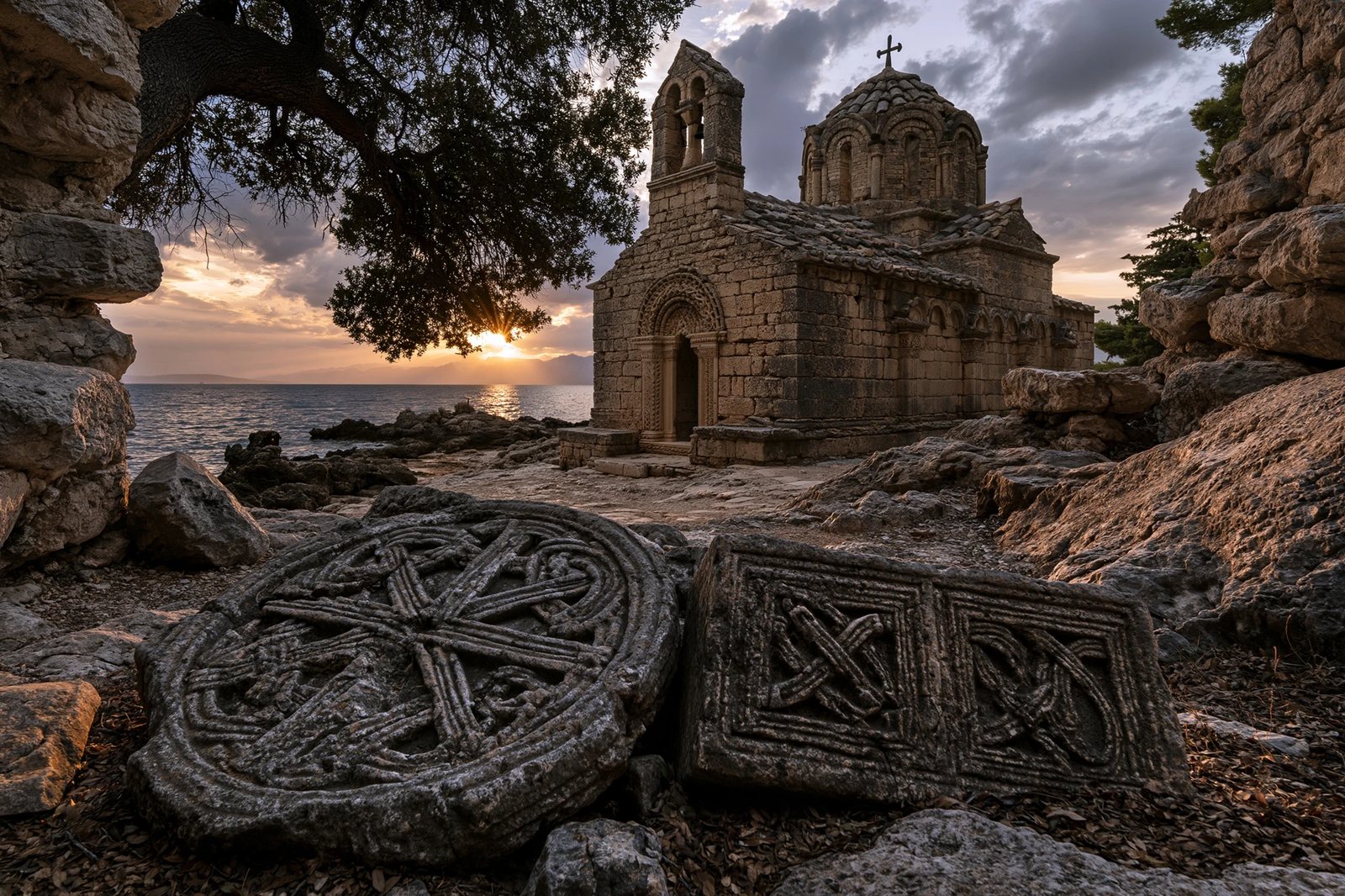
 Like the Serbs, the Croats too came from the north to the Balkans. But at an old frontier they chose a different path – and turned to the Latin West.
The Croats are the second great South Slavic tribe beside the Serbs – and their history runs astonishingly parallel and yet decisively different. Both, according to tradition, came from the north to the Balkans; both settled in the mountain land of the western Balkans; but while the Serbs turned to the Orthodox East, the Croats became part of the Latin West. In them one can read the most important switch-point of South Slavic history.
The main source is again the Byzantine emperor Constantine VII Porphyrogenitus, who around 950 also describes the origin of the Croats in his work De administrando imperio. He reports that they came from a land he calls "White Croatia" and which lay north of the Carpathians – in the area of today's southern Poland, Czechia or the western Ukraine. From there they moved south under their leaders. As with "White Serbia", "white" here, by Slavic colour symbolism, probably denotes a point of the compass.
According to Constantine's account, the Croats moved to the Balkans in the 7th century, in the time of Emperor Heraclius, and settled in Dalmatia and the Pannonian hinterland – in the area of today's Croatia and Bosnia. There they met the remnants of the Roman-Illyrian population and the decaying cities of the former province of Dalmatia. As with all Slavic migrations: the account is written some 250 years after the events and heavily simplified – but that Slavic groups pushed into the Balkans in the 6th/7th centuries is secure.
The new homeland of the Croats reached from the rugged Adriatic coast with its islands across the Dinaric mountains to the Pannonian plain. This diversity shaped their history: on the coast the old Roman cities (Zadar, Split with Diocletian's palace) and the influence of Venice and Rome held sway; in the interior Slavic princes ruled. Out of this field of tension arose a people closely bound to the Mediterranean.
The most important switch-point was faith. The Croats were Christianised in the 7th to 9th centuries – and turned, unlike the Serbs, to the Latin Christianity of Rome. This decision, shaped by proximity to the old Adriatic cities and to the Frankish empire, made the Croats part of the western, Catholic world. They wrote first with the Glagolitic script, later with the Latin alphabet. Thus the great border between the Western and Eastern churches ran right through the closely related South Slavs.
Out of the early principalities grew a Croatian realm in the 9th and 10th centuries. Prince Branimir received papal recognition around 879; under Tomislav the ruler took the royal title in the early 10th century. Thus the Croats belonged to the first South Slavs with a recognised Christian kingship – a clear contrast to the long-fragmented Serbian valley communities.
Besides "White Croatia" in the north, Constantine VII also knows the idea of a counterpart. This colour symbolism – "white", "red" and other colours for compass directions or subgroups – appears among several Slavic peoples and also in "White Russia" (Belarus) and "White Serbia". It is no coincidence but follows an old ordering system. What exactly "white" meant in each case, however, remains disputed – a fascinating but not fully explained detail of early Slavic history.
As with the Serbs, scholarship disputes how literally Constantine's origin tale should be taken. Some see in it the memory of a real elite migration from the Carpathian region, others a learned construction of the 10th century. The secure core is the same: Slavic groups came to the Balkans in the 6th/7th centuries, and out of them the South Slavic peoples formed over the centuries. Route, leaders' names and "White Croatia" remain interpretation.
Together with the Serbs the Croats complete the picture of the South Slavs. Their history shows the same great migration – but it leads to the other answer to the key question of the Balkans: West or East, Rome or Byzantium, Latin or Greek. That two so closely related peoples chose opposite paths has shaped the Balkans to this day. For our picture of the Slavic world the Croats are the proof that the faith-decisions of the early Middle Ages formed whole cultural spaces.
The central source is again Constantine VII, De administrando imperio (around 950), supplemented by Frankish and papal sources (Branimir, Tomislav) and the early Croatian inscriptions (such as the famous Branimir inscription). All Byzantine and Frankish sources see the Croats from outside. The counterweight is provided by the archaeology of the Slavic settlement of Dalmatia. The secure core – immigration, early realm-formation, Latin Christianisation – we separate from the legendary tale from "White Croatia".
A treasure of early Croatian history is the Glagolitic script (Glagolica), the oldest Slavic script, created in the circle of the Slavic apostles Cyril and Methodius. While most Catholic peoples wrote exclusively in Latin, the Croats preserved the Glagolica for their church language over centuries – a unique special path. The most famous testimony is the Baška tablet (around 1100) from the island of Krk, one of the oldest texts in the Croatian language. It shows how the Croats combined Latin faith and Slavic script.
Unlike the inland Slavic tribes, the Croats on the Adriatic met living ancient cities. In Split, people settled in the vast palace of Emperor Diocletian; Zadar, Trogir and other coastal cities preserved Roman town life, bishoprics and stone architecture. This proximity to Rome and later to Venice shaped Croatian culture deeply and bound it to the Mediterranean. While the Serbs went their own way in the mountains, the Croats grew into an Adriatic-Mediterranean world – another reason for their western orientation.
"The Croats at that time dwelt beyond Bavaria, where the Belochrovatoi (White Croats) now are."after Constantine VII, De administrando imperio 30 (public domain, own translation)
The Serbs · The Sorbs · The Abodrites.
All History & Finds articles →
Without their ships the Vikings would never have become Vikings. The longship was the high technology of its time …
Read more →It is not two centimetres tall and weighs nine grams – and yet it set off one of the most exciting debates in Norse …
Read more →