 Of all the Slavic peoples between Elbe and Oder, only one has survived to this day – with its own language, culture and a living heritage: the Sorbs of Lusatia.
Long after the mighty realm of the Abodrites and the Liutizi had perished, a Slavic people held on in the southeast – and does so to this day: the Sorbs (also Wends). In Lusatia, between the Spree and the Neisse, some 60,000 people speak a Slavic language. They are the last direct heirs of that world which once stretched from the Baltic to the Ore Mountains.
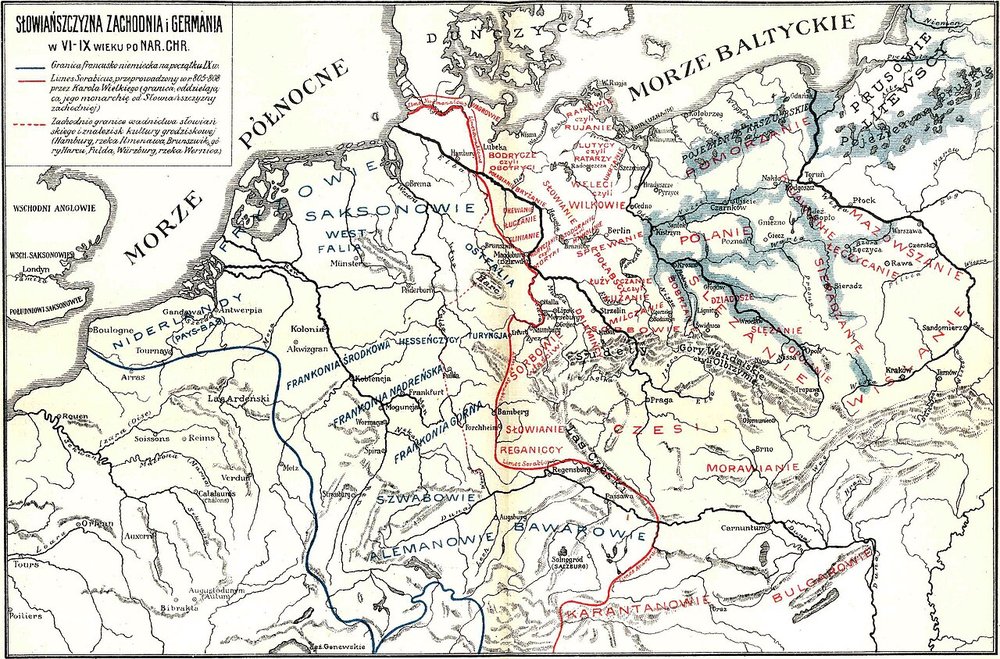
"Sorbs", like "Wends", is a collective name. Behind it stood many tribes between the Saale and the Neisse: the Milceni around Bautzen (Budyšin) in Upper Lusatia, the Lusici in Lower Lusatia (whose name passed to the whole land), the Daleminzi (Glomacze) on the Elbe near Meissen, plus Colodici, Siusli and others. They lived in small principalities, based on ringforts, farming and trade – a rural world without a unified realm, but with a common language and culture.
Charlemagne already set up a border zone against the Sorbs, the Limes Sorabicus – a line of frontier forts from the Elbe to the Main separating the Frankish empire from the Sorbian land. For centuries this land was contested. In the 10th century Henry I subdued the tribes systematically: in 929 the Daleminzi fort of Gana fell, and in the same year he founded Meissen as a bulwark. His son Otto I extended German rule with the marches and the bishopric of Meissen. The revolt of 983 that freed the Liutizi touched the Sorbs only partly – they remained largely under German control.
The Sorbs step early into the light of history. According to the Chronicle of Fredegar, around 631 the Sorbian prince Dervan joined the realm of the Frankish merchant Samo – the first known Slavic polity, which held its own against Franks and Avars. This early mention shows that the Sorbs were a political factor on the border of two worlds already in the 7th century. Later tradition traces their origin to a "White Serbia" in the north (Constantine VII) – a legend meant to explain a shared origin with the Balkan Serbs, but historically uncertain.
Like all Elbe Slavs, the Sorbs were long pagan. Thietmar of Merseburg tells of the sacred spring Glomuzi among the Daleminzi, from whose behaviour the future was read: if it bore wheat, oats and acorns, it promised a good year; if it brought blood and ashes, war threatened. Such sacred springs, groves and lot-oracles shaped Sorbian belief – much like among their Germanic neighbours. Here too we know it almost only from the pen of Christian opponents.
Unlike the Abodrites, Liutizi and Rani, the Sorbs were not wiped out or wholly assimilated. Several reasons combined: their land was conquered early but not with the harshness of a crusade; German eastward settlement reshaped the towns but left many villages Slavic; and in remote Lusatia the language could hold on in family and church. So arose the wonder that, in the middle of Germany, a West Slavic people still lives today – with bilingual place signs, its own costumes, customs like the Easter Riding and a rich literature.
Today the Sorbs are a recognised national minority under constitutional protection. Their language (Upper and Lower Sorbian) is nurtured, their place names mark Lusatia, and their heritage reminds us that "Germany" in the east stands on Slavic ground. For us they are living proof: the world of the Elbe Slavs is not mere archaeology but a culture still breathing today – a piece of the diversity that makes the north and east so rich.
The Sorbian world consisted of villages and ringforts, many of whose ramparts are still visible in the landscape today. They farmed the fertile soils of Lusatia and the Meissen region, kept livestock, fished the countless waters and traded along the rivers and old long-distance roads. The typical Slavic pottery and hacksilver finds show that the Sorbs too were part of the great central-European exchange, not an isolated fringe people. Their principalities were small but stubborn – and it was precisely this fragmentation that made a complete conquest so protracted.
After the conquest by Henry I and Otto I, the Sorbian land lay for centuries under the margraves of Meissen and later the Wettins. German settlers came into the land, yet across much of Lusatia the Sorbian language stayed alive – in the villages, on the fields, in the church. In the 19th century a Sorbian national consciousness awoke, with its own literature, newspapers and associations; in 1912 the umbrella body Domowina was founded. Despite persecution under the Nazis and resettlements for lignite mining, Sorbian culture endures to this day – a unique survival in the middle of Germany.
Nowhere is the Slavic past as tangible as in the customs of the Sorbs. The Easter Riding in Catholic Upper Lusatia, in which hundreds of riders in festive black carry the message of the Resurrection from village to village, is known far beyond the region. To this come the intricately decorated Sorbian Easter eggs, the "Bird Wedding" in January, the witch-burning and the colourful costumes. These customs are no folklore backdrop but lived identity – the clearest proof that a West Slavic people preserves its own culture in the middle of Germany to this day. For us as a workshop, the Slavic interlace and ornament patterns are a fascinating complement to the Norse world of forms: kindred roots, kindred beauty.
Almost all written sources on the Slavic history of the north come from their opponents: from German and Danish clerics such as Thietmar of Merseburg, Adam of Bremen, Helmold of Bosau or Saxo Grammaticus. They wrote from a Christian view about "pagans" – often at second hand, with a clear message. That is why archaeology matters so much: ringforts, pottery, silver hoards and grave finds correct and complement the skewed picture of the chronicles. Only both together give an honest picture. This source-criticism matters to us – we cleanly separate what is documented from what remains interpretation, and invent nothing.
"In the land of the Daleminzi there is a spring called Glomuzi … from it the people foretell what is to come."after Thietmar of Merseburg, Chronicle (public domain, own translation)
The Liutizi · The Hevelli · The Abodrites.
All History & Finds articles →
One late-summer day in 1066, a Norwegian army marched through northern England certain of victory – and a few hours …
Read more →Some lose a battle and thereby win everything. On 29 July 1030 the Norwegian king Olav Haraldsson fell at Stiklestad …
Read more →