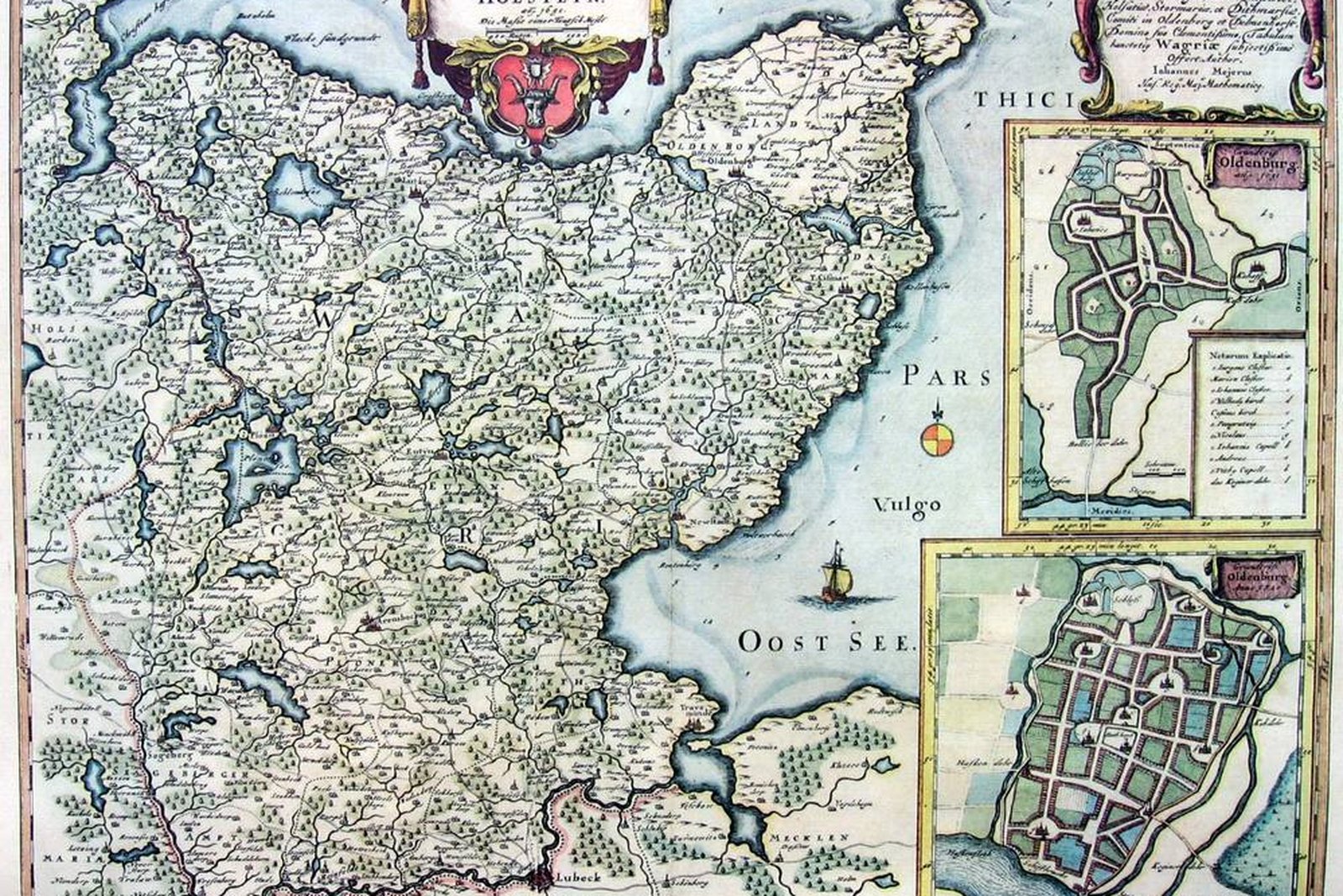
Starigard – Slavic for "old fortress" – was the chief stronghold of the Wagri, a branch of the Abodrite Slavs, from the late 7th to the 12th century, on the site of today's Oldenburg in Holstein. Its princes built halls on a Frankish model, the first bishopric in Abodrite lands was founded here around 968/972, and its church burned in the great uprisings of 983 and 1066. Here is what the excavations of 1973–1986 revealed, what Adam of Bremen and Helmold of Bosau tell us – and where it pays to read them against the grain.
Drive through Oldenburg in Holstein today and you find a pleasant little town between rapeseed fields and the Baltic. And right in the middle of it, a grassy rampart that looks nothing like the brick houses around it. That rampart is the reason the town has its name at all. "Oldenburg" is a translation. The people who lived here more than a thousand years ago called their fortress Starigard – the "old fortress". German chroniclers of the 11th and 12th centuries rendered it as Aldinburg or Aldenburg, and Low German smoothed that into Oldenburg.
So the name alone tells a story of contact and overlay. Starigard was not a Viking town and not a Saxon outpost. It was the most important stronghold of the Slavic Wagri in eastern Holstein, and one of the major seats of power anywhere on the West Slavic Baltic coast. Three worlds met here: Slavic, Danish-Scandinavian and Frankish-Saxon. Sometimes they traded, sometimes their ruling families intermarried, and sometimes they burned each other's houses down.
In this article we take a fresh look at the site, using the excavation results, the written sources and a critical eye on who actually told the story of the Wagri – because almost everything written about Starigard comes from the pens of their opponents.
Towards the end of the 7th century, Slavic-speaking groups moved into a largely empty eastern Holstein. The region later called Wagria covered roughly the east of Holstein as far as the river Trave, together with the island of Fehmarn. The Wagri were one of the sub-groups of the Abodrites (also spelled Obodrites), a confederation of West Slavic peoples between the Bay of Kiel and the river Warnow. The confederation also included the Abodrites proper in western Mecklenburg and the Polabians around Ratzeburg.
Frankish sources know the Abodrites from the late 8th century onwards, as allies of Charlemagne against the Saxons. Later the balance shifted. The Ottonian kings and the Saxon dukes of the Billung family demanded tribute and overlordship, while the Danish kings pressed in from the north. Abodrite princes had to manoeuvre between these powers, and they often did so with remarkable skill.
One thing matters for everything that follows: the Wagri were not a footnote. They had their own princely dynasty, their own capital and a dense network of smaller strongholds and villages. Their own language, however, survives only in place names and personal names.
According to current research, the first fortress was built towards the end of the 7th century, roughly between 680 and 700. That makes Starigard one of the oldest Slavic ringforts in Germany. It sat on a glacial ridge north of the Oldenburger Graben, a wet lowland that at the time offered a water connection to the Baltic. Whoever held this spot controlled routes by land and by water.
The rampart was built in classic Slavic fashion. Builders set up boxes of timber beams – so-called box constructions – side by side and filled them with earth and sand. The result was a massive yet flexible wall that could be topped with palisades and breastworks. When the timber burned during an attack, the wall slumped; it was then usually rebuilt higher and wider.
You can read exactly that history in Oldenburg. At first there was an oval main fortress in the west with an open settlement to the east. Over time the outer settlement was fortified too and joined to the main fort. At its greatest extent the complex measured a good 220 metres from west to east and about 100 metres across; some accounts give up to 260 metres in length, depending on which sections of rampart are counted. On the outside the ramparts rose up to 18 metres above the surrounding land in places. One shift is particularly striking: at some point the princely residence moved out of the old main fort into the eastern, formerly open part.
We owe most of what we know about Starigard to two periods of fieldwork. From 1953 to 1958 the Kiel archaeologist Karl Wilhelm Struve investigated the rampart with his first trenches and test pits. His results confirmed what the written sources hinted at: this had been a centre of power of the first rank.
The big campaigns followed between 1973 and 1986. Under the direction of Ingo Gabriel, excavation took place every year, with a break in the late 1970s – the seasons ran from 1973 to 1976 and from 1979 to 1986. The work was carried by the Institute of Pre- and Protohistory at Kiel University, and Michael Müller-Wille edited a first major overview in 1991. The detailed results appeared from 1984 onwards in the "Starigard/Oldenburg" series of the Offa-Bücher, and the publication is still not entirely finished: Ingo Gabriel and Torsten Kempke only presented the grave finds in a volume of their own in 2011.
The excavations concentrated on the interior of the fortress, above all the area of the princely court. What came to light there is among the most exciting finds of early medieval archaeology on Germany's Baltic coast.
In the 9th and 10th centuries the Wagrian princes built several large halls inside the fortress, each replacing the one before. The oldest was a two-aisled post-built hall with a long central hearth. Tool finds show that a fine smithy worked in the same courtyard; the princes kept their metalworkers right next door.
A second hall, dated to the middle and late 9th century, measured about 17 by 12 metres. Its core was an almost square room with a central post, surrounded by side aisles. A third hall from the early 10th century was about 18 by 6.5 metres, with external supporting posts along its long sides. Here, too, the diggers found crucibles, metal waste and a stone-lined flue – the traces of a workshop.
Here is the exciting part: the excavators see echoes of Carolingian palaces in the layout, the travelling residences of the Frankish kings. The Wagri did not live sealed off "in the forest". They knew the prestige architecture of their powerful neighbours and adopted what suited them. An unusually large number of bird-of-prey bones in the finds also points to falconry, hunting with trained falcons and hawks, an elite status sport all over Europe. The archaeozoologist Wietske Prummel devoted an entire volume to this evidence.
Around the middle of the 10th century something fundamental changed. On the site of the third hall a new post-built structure went up, again about 18 by 6.5 metres, with burials placed in front of its south wall. The excavators interpret it as a church. A later phase brought a building of about 16 by 6 metres on clay foundations, also read as a church, with numerous graves inside.
All the inhumations here are aligned west–east with the head to the west, a typical feature of Christian burial. Two graves lying side by side stand out. Known in the literature as graves 74 and 75, they lie west of an open space interpreted as the site of the altar. Grave 74 contained a sword, a box of gaming pieces, textiles with gold thread, small gold-sheet rattles and a gold filigree bead, perhaps from a reliquary pouch. Grave 75 held a bronze bowl and a spearhead. Whether the dead held court offices, as some researchers suggest, remains interpretation. What is certain is that a Christian elite was buried here, at the very heart of the princely fortress.
Other finds fit the picture: a small pectoral cross from a child's grave, the remains of a bell, fragments of two reliquary caskets. In the 10th century Starigard was not simply a "pagan fortress" visited by missionaries from outside. Parts of the Wagrian upper class had adopted Christianity – certainly with an eye to politics, but by their own choice.
The church in the fortress was more than a court chapel. Under Emperor Otto I, Oldenburg became the seat of a missionary bishopric, the first in the land of the Abodrites. Its founding year is disputed. The traditional date is 968, the year Otto set up the archbishopric of Magdeburg. More recent accounts, including the Oldenburg Wall Museum, give 972. We record both and say it plainly: the sources do not yield a precise founding date.
Its church province is clearer. Oldenburg came under the archbishopric of Hamburg-Bremen and Archbishop Adaldag, not under Magdeburg. Helmold of Bosau does report that Otto first intended to place it under Magdeburg, but that Hamburg won out. According to Helmold, the endowment included an annual levy from every plough in Wagria and the Abodrite lands. The church was dedicated to Saint John the Baptist.
The list of early bishops immediately shows a problem with the sources. Adam of Bremen names Egward (also Evagrius) as the first bishop, followed by Wago and Ezico. Helmold, writing about a century after Adam and drawing on him heavily, places a Bishop Marco at the head of the list, who supposedly baptised the Wagri and Abodrites. There is no independent confirmation for this Marco, and scholars treat him with great caution.
In 983 the Slavs between the Elbe and the Oder rose against Ottonian rule. The core of the revolt was the Liutizi, a league of tribes east of the Elbe. The Abodrites under their prince Mistivoj joined in and, according to Thietmar of Merseburg, even sacked Hamburg. The bishoprics of Havelberg and Brandenburg were lost, and in Oldenburg, too, the first Christian phase came to an end.
The archaeology shows it clearly. A fire destroyed the church and the cemetery inside the fortress. Then something remarkable happened. Exactly where the Christian altar had stood, the excavators found a stone base about two metres long with a posthole – probably the setting for an image of a god. Around it lay horse skulls and horse bones, most likely the remains of ritual meals. The Wall Museum displays a reconstruction of this cult post.
The find can be read as a sign of triumph: the old gods returning to the place the new religion had taken over. But the sources also suggest something else. The anger was aimed above all at priests and tax collectors, the visible agents of a foreign rule that demanded both tithe and tribute. Christian traders and craftsmen, as the museum puts it, were largely left alone. From a Slavic point of view, 983 was less a war "against Christianity" than a revolt against a double burden of dues.
After 983 Oldenburg remained a bishopric in name, but its bishops were often unable even to enter their diocese. A second burnt layer in the fortress, around the year 1000, has been tentatively linked to a further Abodrite uprising around 1018 – an interpretation the excavators themselves present as possible rather than certain.
In the middle of the 11th century a man came to power who embodies the region like few others: Gottschalk, son of an Abodrite prince, educated at a monastery in Lüneburg, later in the service of the Danish king Cnut, and finally back home as prince. Adam of Bremen describes him as a zealous Christian who personally translated the clergy's sermons into Slavic in church. He was married to a daughter of the Danish king Sven Estridsen. During his rule Archbishop Adalbert of Hamburg-Bremen divided the large diocese of Oldenburg: alongside Oldenburg, new bishoprics were created at Ratzeburg and Mecklenburg.
On 7 June 1066 Gottschalk was killed at Lenzen on the Elbe. The uprising that followed swept away the church organisation in Abodrite lands a second time. Adam reports that Bishop John of Mecklenburg was captured and killed and his head dedicated to the god Redigast at Rethra. In Oldenburg the church burned again. Power passed to Kruto, a prince who did not follow Christianity and who dominated the region until near the end of the century. For some eighty years Oldenburg had no bishop.
The church chroniclers saw this as a "relapse". For many Wagri it was a period in which their own religion and their own princes were back in charge – and the fortress remained in use.
Starigard was not only a fortress but also a harbour and trading place. In the second book of his history of the church of Hamburg, Adam of Bremen writes that anyone wanting to reach the great trading city of Jumne at the mouth of the Oder – today's Wolin – by sea should board a ship at Schleswig or Oldenburg. That is a remarkable sentence. It puts the Wagrian fortress on a level with the Danish long-distance trading centre on the Schlei, that is, with Hedeby and its successor Schleswig.
The finds back this up. Tools, weapons, jewellery and dress fittings came from many parts of Europe. Bronze mounts of the 10th century carry cosmological imagery. The bird-of-prey bones mentioned above have only a few parallels in the Baltic region: at Groß Strömkendorf (often identified with the trading place of Reric), at Hedeby and at Schleswig. The birds may have been imported from Scandinavia. Many of the early maritime trading places on the southern Baltic lost importance in the 10th century. Starigard held on.
The ruling families were intertwined as well. Mistivoj's daughter Tove became the wife of the Danish king Harald Bluetooth. We know this not from a chronicle but from a rune stone: on the Sønder Vissing stone in Jutland, Tófa, "Mistivoj's daughter", raised a memorial to her mother. Gottschalk in turn married into the Danish royal house. And in the 12th century the Danish prince Knud Lavard had himself granted lordship over the Abodrites by the emperor. The line between "Slavs" and "Vikings" was far more porous than many maps suggest.
To grasp how dense this network was, look at Starigard alongside other sites on the southern Baltic coast: Ralswiek on Rügen, Wolin, Reric. And alongside the Danevirke, the great Danish border rampart that guarded the southern frontier of the Danish realm only about 90 kilometres to the north-west as the crow flies. You will find more on this contact zone in our article on the Vikings in the Baltic and the land of the Wends.
Almost everything we know about Starigard from written sources comes from two clerics. Adam of Bremen wrote his Gesta Hammaburgensis ecclesiae pontificum, the history of the archbishops of Hamburg, around 1075/76. Helmold of Bosau, parish priest at Bosau on the Großer Plöner See, wrote his Chronica Slavorum from about 1163 to around 1172. For the early period Helmold copied Adam extensively; for his own day he was an eyewitness.
Both works are indispensable. Neither is a neutral report. Adam wrote to support his archdiocese's claims to the northern mission. Helmold was part of the colonisation of Wagria, a pupil of Vicelin and a companion of Bishop Gerold. When he describes temples, idols and priests, he writes from a missionary's perspective. Some of it rests on what he saw, some on hearsay or on literary patterns a Christian reader expected.
At the same time Helmold is more nuanced than he is often given credit for. He openly criticises the greed of Saxon princes and makes it clear that heavy taxation hindered the conversion of the Slavs. For source criticism this means: place names, sequences of events and people are often usable; numbers and judgements need caution, and descriptions of pagan cults even more so. Archaeology is a vital corrective here. It reveals, for instance, the early Christian elite that the chronicles barely mention.
In the 12th century the balance tipped for good. The counts of Holstein from the house of Schauenburg pushed into Wagria; in 1143 Count Adolf II refounded Lübeck, and in the following years settlers from Flanders, Holland, Westphalia and Holstein were brought into the land. The settlement on the rampart came to an end around 1149, and the focus of settlement moved west of today's market square.
In 1149 Archbishop Hartwig of Bremen consecrated the missionary Vicelin as bishop of Oldenburg, filling the see again after some eighty years. Vicelin died in 1154. His successor Gerold, a chaplain of Henry the Lion, was consecrated in Rome by Pope Hadrian IV in 1155. Helmold travelled with him, and his account of these years is among the most vivid passages of the chronicle.
According to Helmold, Gerold came to the old bishop's town in winter and met the Christian Wagrian prince Pribislav there. Helmold gives him a speech lamenting the harshness of the German princes: taxes and services weighed so heavily on his people that they hardly knew how to live. We cannot know how literal that speech is – Helmold shaped it the way classical historians shaped speeches. But the fact that he included it at all says a lot. On the same journey Gerold and his companions, Helmold among them, destroyed the sacred grove of the god Prove, "the god of the land of Aldenburg". The spot is often linked today with the Wienberg near Oldenburg, but that identification is not securely established.
Around 1156 work began in Oldenburg on St John's Church (St. Johannis), built of brick and one of the oldest brick churches in northern Europe. It was meant to be the cathedral. Things turned out differently. Around 1160 Henry the Lion, at Gerold's request, moved the see to Lübeck, which was flourishing as a trading town. In 1163 Gerold consecrated the first, still wooden cathedral there and died the same year. The bishopric of Oldenburg had become the bishopric of Lübeck.
The old rampart still had a role to play. After 1200 the Danish king Valdemar II used its remains for a new castle; after the battle of Bornhöved in 1227 it passed to the counts of Holstein. In 1261 it was besieged and destroyed, and a burnt layer marks the end. Since then, the Oldenburg rampart has above all been a monument.
Today the rampart sits right in the town centre, partly rebuilt and open to walk on. Next to it, the Oldenburger Wallmuseum displays the finds from the excavations. Its open-air area has reconstructed houses, a craftsmen's lane, a harbour settlement with ships and a replica cult site modelled on the temple at Groß Raden in Mecklenburg. Inside you can see the reconstructed cult post and a sculpture group showing the baptism of a prince.
The museum is usually open from April to October; in winter it opens only for pre-booked groups. Check current times before you go. If you are planning a trip along the Baltic coast, Starigard fits perfectly into a route with Hedeby and the Danevirke. You will find tips in our overview Experience the Vikings: museums and sites and in Viking traces in Germany.
What fascinates us about Starigard is that its history refuses to fit into boxes: Slavic princes feasting in halls built on a Frankish model, a church on top of the princely hall, an idol on the altar site, an Abodrite prince's daughter as queen of Denmark. Anyone who takes that complexity seriously will understand the Viking-Age Baltic far better than someone who only looks at longships.
What does Starigard mean? Starigard means "old fortress". German chroniclers translated it as Aldinburg or Aldenburg, which became the modern town name Oldenburg in Holstein.
Who lived at Starigard? The Slavic Wagri, a branch of the Abodrites. Starigard was their chief fortress and the seat of their princes from the late 7th to the 12th century.
When was the bishopric of Oldenburg founded? Under Otto I – traditionally in 968, according to more recent accounts in 972. It belonged to the archbishopric of Hamburg-Bremen and was moved to Lübeck around 1160.
Was Oldenburg in Holstein a Viking town? No. Starigard was a Slavic princely seat. It was, however, in close contact with Denmark and Hedeby, and the ruling families intermarried.
What happened at Oldenburg in 983 and 1066? In both great Slavic uprisings the church in the fortress was destroyed. After 983 the Wagri apparently set up an image of a god on the former altar site; after 1066 the bishopric stayed vacant for about 80 years.
Can you visit the Oldenburg rampart? Yes. The rampart is freely accessible in the town centre, and the Oldenburger Wallmuseum next to it shows finds and an open-air area with reconstructions.
For courage. For remembrance. For legends that live on.
Nordalbingia · Ralswiek on Rügen · Menzlin on the Peene · Wolin & Jomsborg · Viking traces in Germany.
All History & Finds articles →
Some lose a battle and thereby win everything. On 29 July 1030 the Norwegian king Olav Haraldsson fell at Stiklestad …
Read more →A whole royal ship, buried beneath a mound, full of gold and weapons – and a helmet that became the face of an entire …
Read more →Some Vikings raided, others had Danegeld paid to them – Sweyn Forkbeard did both and then reached for the crown itself …
Read more →