 On the lower Elbe, in today's Wendland, lived the westernmost Slavs of Germany. Their language, Polabian, outlasted almost a thousand years – into the 18th century.
The Polabians (from Slavic po Labe, "on the Elbe") were West Slavic tribes on the lower Elbe, in the border region of today's Lower Saxony, Mecklenburg and Holstein. To them in the wider sense belonged many Elbe Slavs; in the narrower sense one often means the group around the Drawehner in today's Wendland (district of Lüchow-Dannenberg). Their history is the most fascinating of all the Elbe Slavs – for their language survived longer than that of all other West Slavic tribes east of the Elbe.
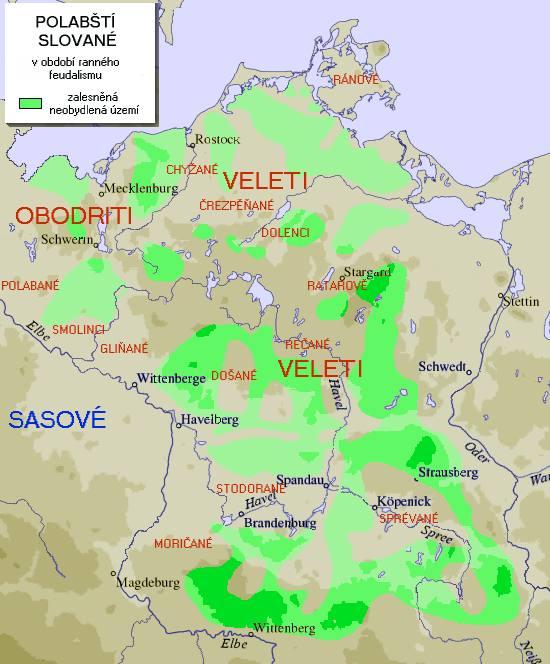
In the course of the Slavic migration, West Slavic groups settled the land east of the Elbe and partly west of it from the 6th/7th century – as far as the area around Lüneburg. The Elbe became the great border between the Germanic-Frankish and the Slavic worlds. The Polabians lived in villages and ramparts, practised farming, stock-raising and fishing and stood for centuries in the field of tension between Saxon, Frankish and later German neighbours and the Slavic principalities in the east.
While most Elbe Slavs merged linguistically and culturally in the High Middle Ages in the course of the German eastward settlement, a Slavic population held on especially long in the Hanoverian Wendland. In the round villages (Rundlinge) – settlements laid out in a circle around a village square, considered typically Slavic – lived the descendants of the Drawehner. The Wendland thus became a linguistic and cultural "island" preserving Slavic heritage deep into northern Germany.
The most remarkable thing is the Polabian language. It was the last living West Slavic language west of the Oder – and it survived in the Wendland into the 18th century. The last speakers died around 1750; the peasant woman Emerentz Schultze from Dolgow, who died in 1756, is regarded as one of the last. Thus a language died out that had been spoken on the Elbe for almost a thousand years – a quiet, late farewell to the Slavic world of northern Germany.
That we know Polabian at all we owe to a few enlightened collectors of the 17th and 18th centuries who sensed that a language was vanishing here. The peasant Johann Parum Schultze from Süthen wrote a chronicle and a word-list of his dying mother tongue; other scholars compiled word-lists and even a Lord's Prayer in Polabian. These records are a treasure: they preserve the last voice of the Elbe Slavs and make Polabian one of the best-documented extinct languages of Europe.
The Slavic heritage is visible in the Wendland to this day. The round villages with their characteristic layouts, countless place names ending in -ow, -itz and -in (such as Lüchow, Clenze, Gartow) and field names testify to the Slavic past. The name "Wendland" itself derives from the Wends, as the Germans called the Slavs. Whoever drives through the Wendland today moves through one of the last Slavic cultural landscapes of Germany.
The Polabians were not the only West Slavs in Germany. They are related to the Sorbs in Lusatia – the only West Slavic people whose language is still alive in Germany today. While Polabian died out in the Wendland, Sorbian survived in the southeast. Together both show that Germany has a deeply Slavic layer: from the Baltic to Lusatia, from the Elbe to the Oder, wide parts of the land were once Slavic-settled.
The Polabians and Drawehner are the most moving case of the Elbe Slavs: not a people that perished through war, but a language and culture that slowly, over centuries, faded away – and whose last voices we can still hear thanks to a few far-sighted collectors. For our picture of the Slavic world they are a strong regional hook: Slavic heritage not far away in the east, but in the middle of Lower Saxony, in the Wendland, which carries its name with pride to this day.
The sources are unusual: besides medieval chronicles (Helmold of Bosau and others) stand the early-modern language records of the 17th/18th centuries (Johann Parum Schultze, Christian Hennig von Jessen and others) that captured dying Polabian. To this are added place-name research and the archaeology of the Slavic ramparts and round villages. We keep evidence and interpretation apart: language, round villages and name-traces are very well attested; the exact tribal division of the early Polabians is uncertain in detail.
The most impressive visible heritage of the Polabians are the round villages (Rundlinge) of the Wendland. These villages are laid out in a circle around a central square, from which the farms point outward like slices of a cake; only a single access leads in. Over a hundred such Rundlinge have survived in the Wendland – a density unique in Europe. Whether the form is purely Slavic or arose in the German-Slavic contact zone of the High Middle Ages is debated; what is sure is that these villages shape the face of the landscape to this day and are seeking recognition as UNESCO World Heritage.
The decline of Polabian was not sudden but slow. For centuries Slavic and German populations lived side by side in the Wendland; German became the language of church, law and administration, Polabian remained the language of peasant everyday life. Gradually the speakers withdrew, Slavic was considered rustic and backward, and the children learned only German. Around 1750 the chain had broken. The case of the Polabians shows how a language dies: not through violence, but through the quiet pressure of prestige and everyday life.
The Polabians are the westernmost witness of a truth many are scarcely aware of: wide parts of eastern and northern Germany were once Slavic-settled. Berlin, Leipzig, Rostock, Chemnitz, the Lübeck area – countless place and river names are of Slavic origin. From the Sorbs of Lusatia through the Abodrites of Mecklenburg to the Polabians of the Wendland runs a Slavic base layer through German history. To acknowledge it makes the picture richer – and shows that "German" and "Slavic" were never cleanly separated worlds.
"The Slavs whom one calls Wends inhabit the land on the Elbe far into the land of the Saxons."after Helmold of Bosau, Chronica Slavorum (public domain, own translation)
The Sorbs · The Abodrites · The Drevlians.
All History & Finds articles →
Long before there were Germanic peoples – some 4,300 years ago – people in today’s Saxony-Anhalt raised a vast ring of …
Read more →