 In the year 1000 an emperor walked barefoot into Gniezno – and a few weeks later opened the tomb of Charlemagne in Aachen. Between the two lies the story of a West Slavic federation whose name became the name of an entire country.
There are peoples whose name is older than their state. And there are those for whom it may have been the other way round. The Polans belong to the second sort – and that is exactly what makes them instructive. Their name survives in the word "Poland", derived from the Slavic polje, "field": the people who live on the open field. Only: before the Piast state arose, almost nobody mentioned them.
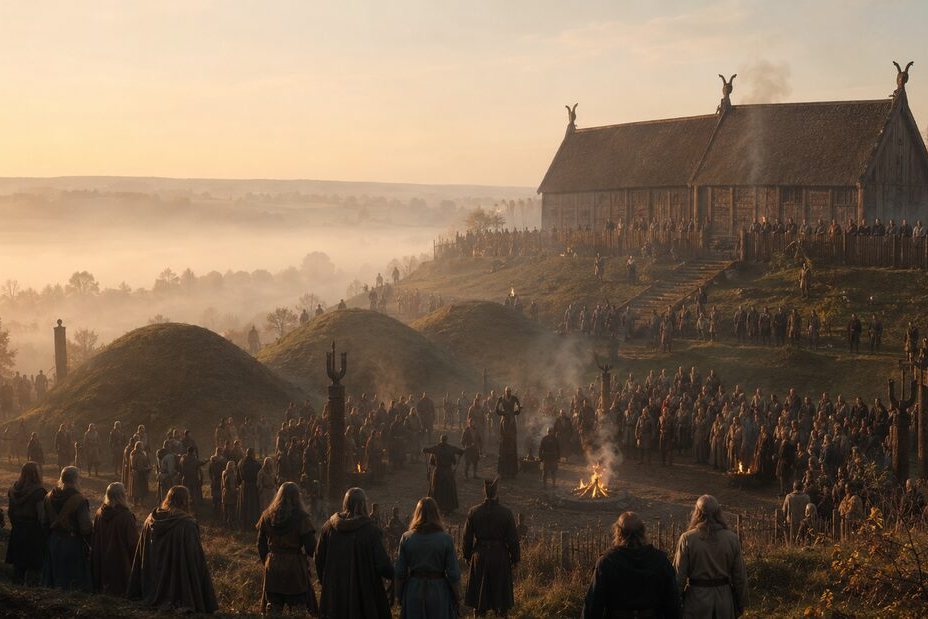
The core region lay in Greater Poland, on both sides of the middle Warta. The names on which everything hangs still stand there today: Gniezno, Poznań, Ostrów Lednicki on its island, Giecz and, recently in the spotlight, Grzybowo. These are not villages but enormous strongholds: Grzybowo covered 4.4 hectares, its rampart ran up to 680 metres, its dry ditch was thirteen to fourteen metres wide.
What makes these strongholds so exciting is dendrochronology. For Grzybowo 246 dated oak samples are available – the first phase arose between 919 and 923, an extension in 929 to 935, the great fort in the early 940s. A study in the journal Antiquity (2025) calls the site one of the best dendro-dated medieval stronghold remains in central Europe. Gniezno arose around 940, Ostrów Lednicki around 930/940, Poznań somewhere between 900 and 940. Giecz is the outlier: on more recent dating it reaches back into the 860s.
The picture that emerges is unusually sharp. Within two or three decades a dense network of large strongholds was thrown up, with older centres partly destroyed in the process. This is not a slowly growing tribal landscape; it is an aggressive, resource-hungry formation of lordship – somebody built a state here at enormous cost.
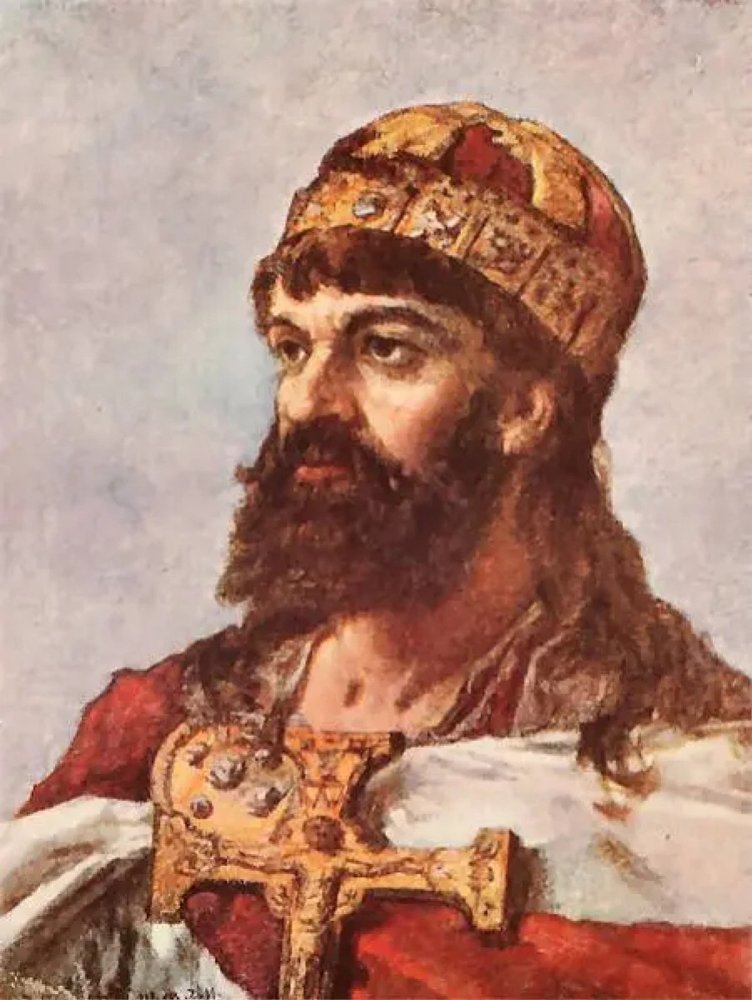
That somebody steps into the light of written sources in 963, and from the unflattering side. Widukind of Corvey reports how the Saxon rebel Wichmann twice defeated the prince Misaca – Mieszko – killed his brother and extorted great booty.
He twice defeated King Misaca, under whose rule stood the Slavs called Licicaviki, killed his brother and extorted great booty from him.Widukind of Corvey, Res gestae Saxonicae III (public domain, own translation)
Note what Widukind calls the people: Licicaviki. Not Polans. That is no accident. Two years later the Andalusian-Jewish traveller Ibrahim ibn Ya'qub, who stayed at Otto I's court in Magdeburg in 965/966, describes Mieszko's realm as the largest Slavic state, with three thousand armoured warriors whom the prince maintained entirely – pay, equipment and even the upkeep of their children. The figure comes to us at second and third hand and should be read as an order of magnitude, not a census. But it says something about the impression this realm made.
In 965 Mieszko married Dobrawa, a Bohemian Přemyslid. In 966 he was baptised – the Chrzest Polski, the baptism of Poland, traditionally dated to Holy Saturday. The place remains unknown to this day; Ostrów Lednicki, Gniezno, Poznań and even Regensburg are discussed. In 968 the bishopric of Poznań followed under Bishop Jordan. And around 991, in the puzzling document Dagome iudex, Mieszko placed his land under the protection of the Apostolic See.
Here things become methodologically interesting. There is no older Saxon or Slavic source that speaks of "Polans". Western historiography uses Polenia, Polonia and polani only from about the year 1000 – that is, after the Congress of Gniezno. The first attestations stand in the Life of St Adalbert, in the Hildesheim annals and in Thietmar of Merseburg; to these may be added a denarius of Bolesław with the legend PRINCEPS POLONIE. The Primary Chronicle tells the origin of the Polyane only a good hundred years later, and in legendary form.
Part of the scholarship concludes from this that the name is not the origin but the result of state formation. The Saxon chroniclers needed a term for the land and people with whom their emperor was suddenly making agreements – and coined or popularised it. Archaeologically no distinct "Polanian" material culture can be delimited anyway; the old equation of archaeological culture with people has long been abandoned. Anyone speaking of "the tribe of the Polans" is therefore speaking more comfortably than the sources allow.
On 23 April 997 Adalbert of Prague was slain by pagan Prussians. Bolesław Chrobry, Mieszko's son, bought back the body – a scene later shown on the famous bronze door of Gniezno. And in February or March 1000 the emperor Otto III came in person. He entered Gniezno barefoot and was led to Adalbert's grave. The outcome was a church province of Gniezno of its own, with the bishoprics of Kołobrzeg, Kraków and Wrocław. Otto gave a copy of the Holy Lance, Bolesław an arm relic of Adalbert. Thietmar of Merseburg, writing all this down some fifteen years later, commented drily on the founding of the archbishopric with the words "lawfully, as I hope".
And now comes the part that concerns us here on the Rhine. From Gniezno Otto travelled back via Magdeburg and Quedlinburg and celebrated Pentecost 1000 in Aachen – on 19 May. There he had the tomb of Charlemagne opened. Bolesław demonstrably accompanied him as far as Aachen; according to one tradition Otto even gave him a chair from Charlemagne's tomb. The Aachen scene is therefore not the prelude to the Polish journey but its closing image: Gniezno first, Aachen after. Both belong to the same idea of renewing the empire – and both happened within a few months.
About the opening of the tomb itself one must speak honestly. Thietmar reports soberly: Otto, uncertain where the bones lay, had the floor secretly broken open, found Charlemagne in solio regio, on a royal seat, took the golden cross from his neck and undecayed parts of his garments, and had the rest reverently laid to rest again. The better-known version – Charlemagne sitting upright on his throne like a living man, with crown and sceptre, his fingernails grown through his gloves, Otto taking one of his teeth – stands solely in the Chronicle of Novalesa, an Italian monastic work of about 1048 written some fifty years later and regarded in scholarship as unreliable. And one more thing belongs here: in the year 1000 Charlemagne was not a saint. His elevation followed only in 1165, under Frederick Barbarossa. Contemporaries partly regarded Otto's act as desecration, and his early death in 1002 was read as a punishment.
One last thread leads back into the Viking world. At Bodzia in Kuyavia, a few kilometres from the Vistula, a cemetery of 58 chamber graves has been excavated, dated to roughly 980 to 1035 – unique in this form in early medieval Europe. The grave goods, silver coins, weapons and jewellery, point to Scandinavia and to the Rus. The same holds for Ciepłe on the lower Vistula. The most plausible reading is that of a retinue and frontier elite in Piast service – men from the north who fought for a Slavic prince.
What cannot be made of this, however, is what people like to make of it. On the territory of the early Piast state not a single certain Scandinavian find is attested before the late 10th century. A Scandinavian origin of the Piasts is unproven and archaeologically rather refuted. Mieszko's famous daughter who married Sweyn Forkbeard is another model case: the contemporary chroniclers Thietmar and Adam of Bremen know her without a name; the name Świętosława is a later attribution, and the Icelandic saga figure "Sigrid the Haughty" is not identical with her – her historicity is disputed in any case. Saga and chronicle tell two different things, and whoever stirs them together gets a novel.
In 1025 Bolesław I Chrobry placed the crown on his head and died a few weeks later. The federation on the Warta had become a kingdom. And the Piast legend written down by Gallus Anonymus around 1113 – of the wicked prince Popiel and the poor farmer Piast, who feeds two foreign guests while the ruler turns them away – is exactly what such legends always are: a story of legitimacy explaining why the right people rule.
The Pomeranians · Wolin & Jomsborg · The Liutizi · The Abodrites · The Jomsvikings.
All History & Finds articles →
Long before there were Germanic peoples – some 4,300 years ago – people in today’s Saxony-Anhalt raised a vast ring of …
Read more →