Long before there were Germanic peoples – some 4,300 years ago – people in today’s Saxony-Anhalt raised a vast ring of earth and wood: the ring sanctuary of Pömmelte, often called the „German Stonehenge". A place of the sun, of ritual – and of grim finds.
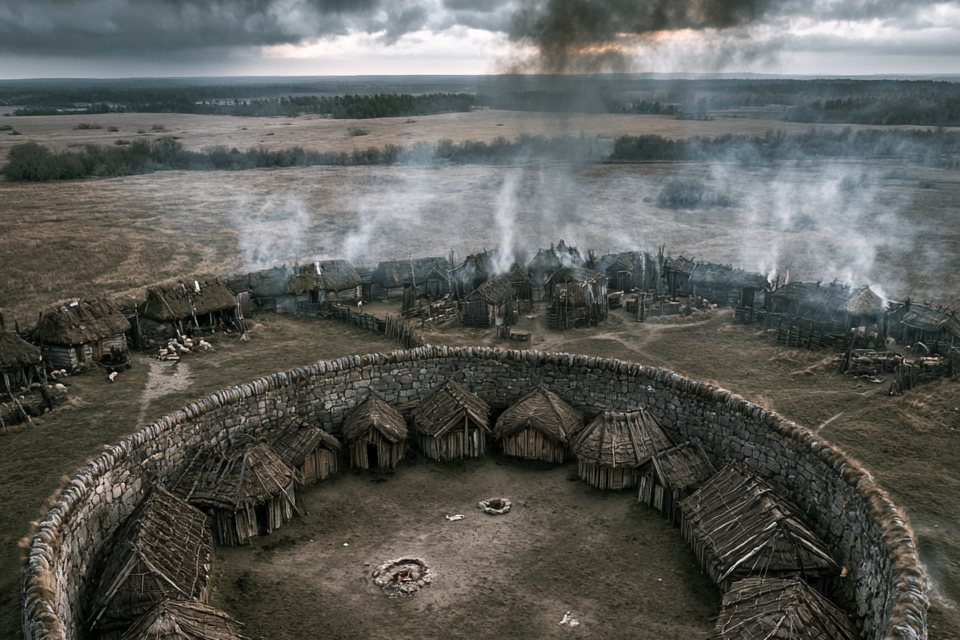
The ring sanctuary of Pömmelte lies on the Elbe south of Magdeburg. It consists of several concentric rings of ditches, banks and wooden posts, about 115 metres across, built around 2300 BC – contemporary with the later building phases of English Stonehenge.
Like its English model, the monument is astronomically aligned: its gates and axes refer to marked points in the sun’s course, such as the solstices. Pömmelte was an assembly and cult place of an Early Bronze Age community – a place where sky, time and community came together.
In the ditches and shaft-pits archaeologists found deliberate deposits: smashed pottery, animal bones, stone axes, grinding stones – and the remains of humans, mostly women and children, some with injuries. Whether these are sacrifices, burials or ritual deposits is still disputed. What is certain: here people did not only feast, but also enacted something grave.
Pömmelte belongs to the same Early Bronze Age world as the Nebra Sky Disc. Nearby lay a contemporary settlement and a second ring (Schönebeck) – together a whole ritual landscape. In 2016 the monument was reconstructed on the original site and is freely accessible today.
The ring sanctuary of Pömmelte in Saxony-Anhalt is often called the "German Stonehenge". It is a circular cult site of wood and earth laid out around 4,300 years ago – a monumental sanctuary of the Bronze Age.
The complex consisted of concentric circles of ditches, ramparts and wooden post rows, aligned to the course of the sun. A place for festivals, rituals and the observation of the year's cycle – expression of a highly developed worldview.
In the pits of the complex pottery, animal bones, tools and human remains were found – testimonies of rituals whose exact meaning we can only guess. Nearby lay an associated settlement.
Pömmelte shows that long before Germani and Vikings there were already monumental sanctuaries in central Germany. Today the complex is reconstructed and walkable again – an impressive testimony of the early cult landscape.
The Únětice Culture & Nebra · The Externsteine · Donar’s Oak.
State Office for Heritage and Archaeology of Saxony-Anhalt (Pömmelte, Schönebeck). Harald Meller (ed.), publications on the Early Bronze Age of Central Germany; Der geschmiedete Himmel (2004).
All History & Finds articles →
King Hákon the Good, a son of Harald Fairhair, fought all his life against the sons of his brother Eric Bloodaxe. Two …
Read more →Long before there were Vikings in the sense of the sagas, there was already a town in south-west Jutland: Ribe, founded …
Read more →The Viking battle was no wild scramble but a hard struggle shield to shield. A look at tactics and weapons beyond the …
Read more →Long before the Viking Age and before the Icelandic Edda there was Germanic cult – and one of the most striking stood …
Read more →