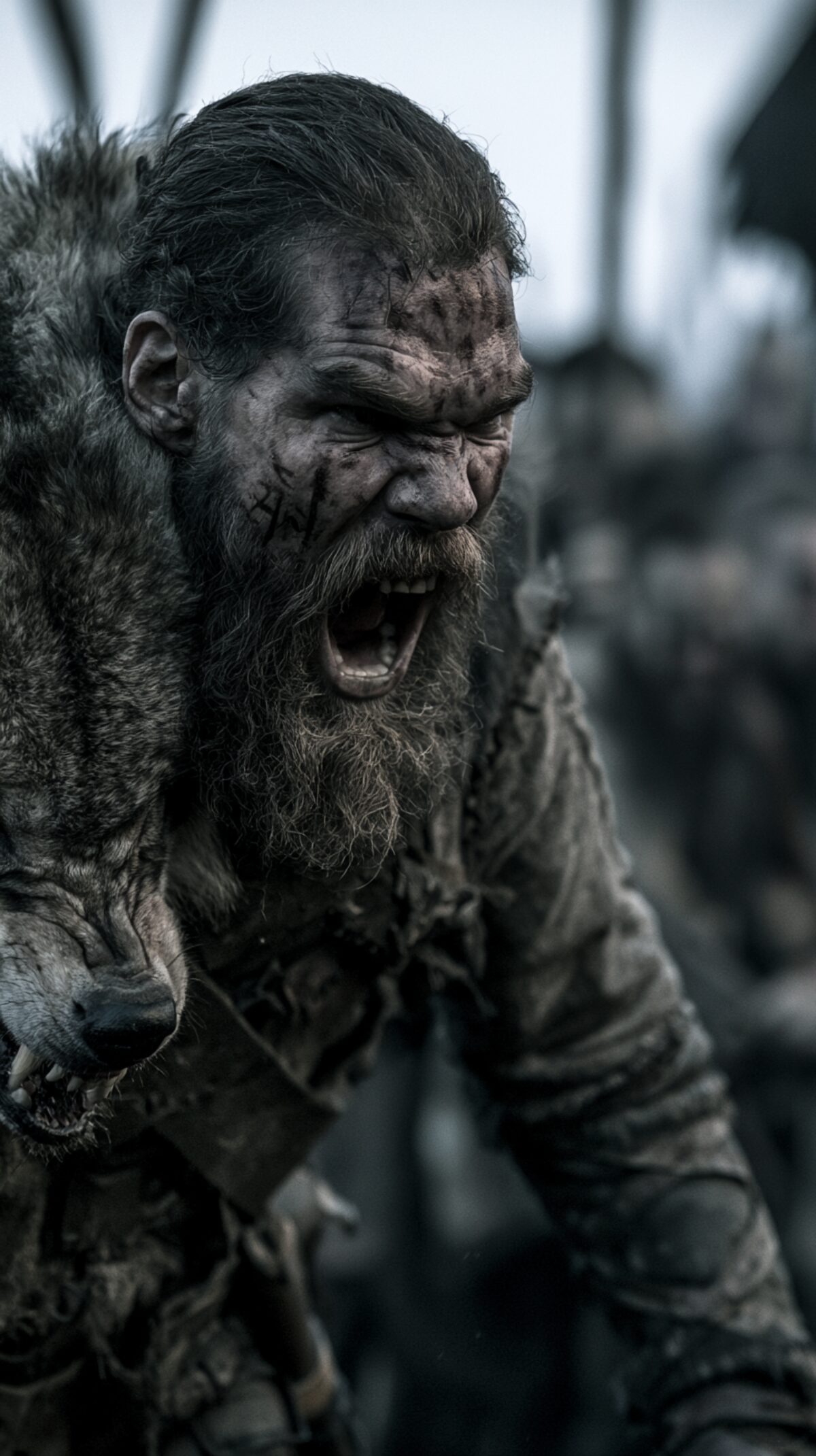
The Jomsvikings were, according to the Icelandic Jómsvíkinga saga, a brotherhood of professional warriors who operated from a sea fortress called Jomsborg on the southern Baltic coast, lived by strict laws and were destroyed around 986 in the sea battle of Hjörungavágr against Hákon Jarl of Norway. Whether the brotherhood ever existed in that form is an open question: the saga was written down some two centuries later, and the fortress has never been identified on the ground. Here is what stands on solid rock and what is superb storytelling.
Picture a line of bound men on a cold Norwegian shore, tied together on a single rope. In front of them, a man with an axe. One by one they are beheaded – and one by one they crack a joke, set a condition or run an experiment. Few scenes in saga literature are as famous, as often retold or as often taken at face value. It belongs to the Jomsvikings, and it tells us a great deal about how Icelanders around 1200 told stories about honour, death and nerve. Whether it tells us much about the year 986 is another matter entirely.
Almost everything you have ever heard about the Jomsvikings comes from one text: the Jómsvíkinga saga, the "Saga of the Jomsvikings". Its author is anonymous and it was written in Iceland. Store norske leksikon, Norway's national encyclopaedia, places its writing around 1200, after roughly two hundred years of oral transmission.
There is no single saga, either. It survives in several versions that differ markedly: AM 291 4to (late 13th century, incomplete), the shorter Stockholm manuscript Holm perg 7 4to (14th century), AM 510 4to (15th century, with much extra material) and the great Flateyjarbók, which weaves the story into its saga of Olaf Tryggvason. Whenever someone says "the saga says", the honest follow-up is: which one?
Other works tell parts of the story too, often drawing on the same tradition: the Norwegian kings' sagas Fagrskinna and Snorri Sturluson's Heimskringla (both early 13th century), the Danish Knýtlinga saga and Saxo Grammaticus in his Gesta Danorum.
The saga does not open with warriors but with Danish royal family politics. King Harald Bluetooth has a son, Sweyn, whom he refuses to acknowledge. A wealthy farmer from Funen named Pálnatóki takes the boy under his wing. When Sweyn turns against his father, the saga has Pálnatóki himself kill the king with an arrow. Adam of Bremen knows nothing of this; in his account Harald dies of wounds received in the fight against his son.
Pálnatóki then goes to Wendland, the Slavic lands on the southern Baltic coast. The Wendish king, whom the saga calls Búrizleifr, grants him land to defend against enemies. There Pálnatóki builds Jomsborg, a fortress with a harbour large enough for a great fleet of longships, its entrance closed by a gate. Store norske leksikon gives the saga's founding date as 960. That is saga chronology, not a documented year.
Tellingly, other sources tell the founding differently. Fagrskinna, Knýtlinga saga and Saxo credit Harald Bluetooth himself with building Jomsborg. In Saxo the hero is called Toki, and the king forces him to shoot an apple off his own son's head – the very tale that later became famous in Switzerland as William Tell's.
The heart of the Jomsviking legend is its laws. The saga lists them as if reading from a charter. In summary, across the common versions:
It sounds like a military order in Viking dress, and that is exactly where you should prick up your ears. The neat, systematic list reads like literature rather than a copied law of the tenth century. Store norske leksikon also suggests that the saga author may have modelled his fortress on Danish ring forts of the Trelleborg type.
At the same time, the individual rules are not plucked from thin air. The duty of revenge, shared booty and the ban on flight fit well with what we know of Viking-age retinues and war bands. For how such groups were actually organised, see our piece on lið, hird and leiðangr. The Jomsborg code is best read as a sharpened, idealised version of real warrior values.
After Pálnatóki's death, Sigvaldi, son of the Scanian jarl Strút-Haraldr, takes command. In the saga this cunning schemer even kidnaps the Danish king Sweyn and forces him into a marriage alliance with the Wendish royal house. We tell Sweyn's side of the story in our article on Sweyn Forkbeard.
Then comes the scene that sets everything in motion. Sweyn holds a funeral ale – the great memorial feast at which an heir takes up his inheritance and vows are sworn. The Jomsvikings attend, the drink flows, and Sweyn exploits the mood. The men make heitstrenging, solemn boasting vows over the cup that cannot be taken back without losing honour. In Snorri's account Sigvaldi swears to sail to Norway within three winters and kill Hákon Jarl or drive him from the land. His brother Thorkell the Tall swears to follow him. Búi the Stout swears not to flee. And Vagn Ákason swears to kill Þorkell leira and to bed his daughter Ingibjörg without asking her kin.
Behind the story lies a real conflict. Hákon Sigurðarson, jarl of Lade, had ruled Norway under Danish overlordship and then broken away from Harald Bluetooth. A Danish punitive expedition against the rebellious jarl is entirely plausible. More on Hákon and his dynasty in our article on the jarls of Lade.
The fleet sails north and meets Hákon and his son Eiríkr off Sunnmøre in western Norway. Fagrskinna gives the Jomsvikings 60 ships against a Norwegian fleet three times that size. The battle site, Hjörungavágr, has never been securely identified. As Store norske leksikon points out, the village of Liavåg in Hareid only received the name Hjørungavåg in 1897. The date is uncertain too: most scholars place the battle around 986, based on its link with Harald's death and Sweyn's funeral feast.
At first the attackers gain the upper hand. Then, the Jómsvíkinga saga tells us, Hákon goes ashore and calls on his patron goddess Þorgerðr Hölgabrúðr, a female figure closely bound to his family. She refuses every offering until Hákon gives her his seven-year-old son Erlingr. The boy is killed. Soon after, a storm blows up from the north, hail lashes the Jomsvikings in the face, and some of them see a woman – later two, Þorgerðr and her sister Irpa – with arrows flying from their fingers. After the battle, it is said, Hákon's men weighed the hailstones to gauge the sisters' power.
This sacrifice scene is saga, not report. Snorri's Heimskringla mentions the heavy hailstorm but says nothing of a child sacrifice. Store norske leksikon explicitly rates the storm and the human sacrifice as probably mythical elements. The historian of religion Gro Steinsland, among others, has suggested the story may reflect a cult of an ancestral mother of the Lade jarls. That is an interpretation, not evidence of a real sacrifice. For what the sources say about sacrifice more generally, see our article on Germanic sacrifice and sanctuaries.
As the tide turns, Sigvaldi pulls his ships out. He swore to fight men, the saga has him say, not troll-women. Vagn hurls a spear after him and misses. Búi the Stout keeps his word and does not flee. Badly wounded, according to Snorri, he picks up two chests of gold, shouts "Overboard, all Búi's men!" and leaps into the sea. His men follow or fall on deck.
Now for the famous scene. Vagn and about thirty of his men are captured, tied to a rope and brought ashore. Snorri gives the tally: eighteen executed, twelve spared. The executioner is Þorkell leira – the very man Vagn swore to kill. "You vowed to kill me, Vagn," he taunts, in substance, "but now it looks more likely that I will kill you."
One prisoner wants to settle the old question of whether a man knows anything once his head is off. He holds a cloak-pin; in other versions it is a knife. If he still has his wits, he says, he will stick it into the ground. The blow falls, and so does the pin. Another is a young man with long, fine hair who asks only that it not be bloodied. One of Eiríkr's men twists the hair round his hands, Þorkell swings, the prisoner jerks his head back, and the axe takes off the hands of the man holding the hair. Eiríkr asks who he is: Sigurðr, son of Búi. Offered his life, Sigurðr replies that it depends on who is offering. From the jarl himself he accepts it.
Then it is Vagn's turn. Þorkell leira charges with his axe raised, but a fellow prisoner, called Skarði in Snorri, throws himself at his feet. Þorkell trips, Vagn seizes the axe – and kills his executioner. Half his vow is fulfilled. Eiríkr asks whether he will take his life. "Yes," says Vagn, in substance, "if you give it to all of us." Eiríkr grants it. According to the saga, Vagn later does marry Ingibjörg, the dead man's daughter, so the second half of his vow comes true as well, though with consent rather than against it.
Read the scene for what it is: a showpiece of Icelandic storytelling. It turns on the "good death", on wit and composure in the final moment, and it rewards bearing with life itself. How the North thought about death and the hereafter more broadly is the subject of our article on Viking ideas of death.
The Eddic poems know the same attitude. The Hávamál warns, in paraphrase, that the coward thinks he will live for ever if he shuns the fight, yet old age grants him no peace even if spears spare him (stanza 16, our own rendering). The Jomsviking execution scene is that stanza turned into a story.
Is there anything from the time itself? Yes: skaldic verse, the intricate praise poetry of court poets. Because its stanzas are metrically locked, it is thought to have been transmitted fairly stably, even though it was only written down in thirteenth-century sagas.
Three names matter for Hjörungavágr. Tindr Hallkelsson, an Icelander and court poet of Hákon Jarl, is said to have fought in the battle himself. One stanza of his Hákonardrápa about the battle is quoted in several works: the jarl flung his carefully sewn mail shirt, which could no longer withstand the iron hail of arrows, onto the wet deck, and part of it fell into the sea. Snorri frames the stanza with the story that so many spears struck Hákon that his mail was torn apart. Einarr skálaglamm ("tinkle of scales") mentions the battle in his Vellekla, the great praise poem for Hákon; read more in our article on the Vellekla. And Þórðr Kolbeinsson refers to it in his Eiríksdrápa for Hákon's son.
These stanzas bear witness to a victory by Hákon and Eiríkr in a sea battle against a fleet from the south. They do not bear witness to the Jomsborg code, to Pálnatóki, to the child sacrifice or to the punchlines of the executions. That is the decisive difference between contemporary poetry and later saga.
Later, poems were composed about the Jomsvikings themselves, but they are not contemporary witnesses. The best known is the Jómsvíkingadrápa of Bjarni Kolbeinsson, bishop of Orkney (died 1222). It honours the fallen and is, oddly, also a love lament: the bishop keeps interrupting his battle narrative to complain of a woman he cannot have. The Jomsvikings were already entertainment by then.
The key witness for the location is not a Scandinavian but a canon of Bremen. Writing around 1075, in the second book of his history of the archbishops of Hamburg, Adam of Bremen describes a town called Jumne at the mouth of the Oder. He calls it the largest of all the cities Europe contains, inhabited by Slavs and other peoples, "Greeks and barbarians". Saxon merchants could live there as long as they did not openly profess Christianity. He even mentions a fire the locals called "Greek fire". And he reports that Harald Bluetooth, defeated by his son, fled to Jumne and died there of his wounds.
Adam's superlative is surely exaggerated, and he knew the town only by hearsay. But one thing is clear: he is describing a trading town, not a warrior stronghold. Variant spellings in the manuscripts (uimne, iumne) later gave rise to the legend of "Vineta". Since the 1930s, scholars have generally identified Jumne, the Julin of later sources and the "Jóm" of the sagas with Wolin.
Wolin really was a major early and high medieval port and trading town with a Slavic population and Scandinavian contacts. We have gathered the excavation results in our article on Wolin and Jomsborg. A fortress with a ship gate, as described in the saga, has not been found there. Store norske leksikon puts it plainly: Jomsborg has never been archaeologically confirmed, and the finds at Wolin do not fit the saga description well.
New momentum came in 2023 with a hypothesis by the Polish archaeologist Wojciech Filipowiak of the Polish Academy of Sciences. During excavations in 2021 and 2022 on Hangman's Hill (Wzgórze Wisielców) south of Wolin, a large early medieval cemetery, his team found a ring-shaped feature with two embankments and a linear bank with burn traces and fragments of wood. Filipowiak suggests the fortress could have stood there, with the town of Jóm at its foot. He himself stresses that it is a hypothesis which larger excavations still need to test.
Then there are finds of doubtful provenance. In 2014 the so-called Curmsun Disc was presented, a small gold disc with an inscription naming Harald Gormsson, allegedly from a hoard found near Wolin in 1841. Later an alleged medieval chronicle surfaced that places Jomsborg near Paprotno. Scholars such as Kurt Villads Jensen and Wojtek Jezierski regard both as forgeries. Neither can serve as proof.
No runestone uses the word "Jomsvikings". There are, however, stones linked to a campaign in which the sagas give the Jomsvikings a part: the battle of Fýrisvellir near Uppsala in the 980s, where the Swedish king Eric the Victorious defeated his nephew Styrbjörn the Strong.
The Sjörup stone in Scania (DR 279), from around 1000, commemorates one Ásbjörn. Saxi raised it for his comrade, and the inscription says, in substance: he did not flee at Uppsala, but fought as long as he had a weapon. A stone at Hällestad (DR 295) honours Tóki, son of Gormr, with the same formula: he did not flee at Uppsala. The Högby stone in Östergötland names an Ásmundr who fell at Fýri.
That is striking, because not fleeing is precisely the core of the Jomsborg code. But careful: the link between these men and the Jomsvikings runs only through the sagas, which make Styrbjörn a Jomsviking leader. The dating of the stones and the course of the battle are both disputed. The stones show a warrior ideal that was real – and which the saga later condensed into the rule of an order.
After Hjörungavágr the Jomsvikings do not vanish from the sagas at once. Sigvaldi reappears in a role that suits his reputation: at the sea battle of Svolder around the year 1000, tradition says, he lures King Olaf Tryggvason into his enemies' trap. Whether Sigvaldi was a historical figure at all has itself been questioned.
The ground is firmer with Thorkell the Tall, Sigvaldi's brother according to the sagas. The Anglo-Saxon Chronicle knows him from 1009 as leader of a Danish army that ravaged southern England, took Canterbury in 1011 and then entered Æthelred's service. The Chronicle does not call him a Jomsviking; that connection is made only by the Scandinavian sources.
The end comes, according to Snorri, in 1043. King Magnus the Good of Norway and Denmark sails to Wendland, takes Jomsborg, burns it and kills many of its inhabitants. Knýtlinga saga and Saxo also report a Danish campaign in the region under Valdemar I around 1170. Whether a real fortress fell in 1043, or whether the sack of a Wendish trading town is being told in saga language, we do not know.
In the twentieth century novelists seized on the material. Frans G. Bengtsson retells the episode of the defiant captives in The Long Ships, and E. R. Eddison wrote Styrbiorn the Strong. In Makoto Yukimura's manga Vinland Saga, Jomsviking characters such as Thorkell play major roles. The metal band Amon Amarth released a whole concept album titled Jomsviking in 2016, and the series Vikings: Valhalla shows a Jomsborg in Pomerania.
The most tangible afterlife is in Wolin itself. Every year the town hosts the Festival of Slavs and Vikings, one of Europe's largest re-enactment gatherings, with combat displays, crafts and markets on the reconstructed settlement site. Dates, travel tips and the programme are in our article on the Wolin festival.
So what is left once you strip all that away? A real sea battle against Hákon Jarl, a real trading town at the mouth of the Oder, real warriors whose comrades carved on runestones that they did not flee. And a saga that forged those splinters into a brotherhood that has refused to leave our imaginations for eight hundred years. That is no small thing.
Who were the Jomsvikings? According to the Jómsvíkinga saga, a brotherhood of professional warriors based at Jomsborg on the southern Baltic coast who lived by strict rules. The brotherhood cannot be proven historically in that form; what is attested is a core of warriors in the Danish-Wendish world of the late tenth century.
Where was Jomsborg located? It is usually linked with Wolin at the mouth of the Oder in Poland, which Adam of Bremen knew as the trading town of Jumne. A fortress like the one in the saga has not been found; since 2023 Hangman's Hill near Wolin has been discussed as a possible site.
What were the laws of the Jomsvikings? According to the saga: members aged 18 to 50 only, no flight from an equal enemy, a duty of revenge, shared plunder, no women in the fortress and no more than three nights' absence without leave. The list comes from a saga of around 1200, not from the tenth century.
When was the Battle of Hjörungavágr? It is usually dated to around 986. Neither site nor year is certain; the modern place name Hjørungavåg in Hareid was only given in 1897.
Were the Jomsvikings real? There were warriors, sea battles and an important town at the mouth of the Oder. Whether there was a closed brotherhood with a fortress and a code is open, and many scholars doubt it.
What happened to Vagn Ákason? According to the sagas he was captured at Hjörungavágr, killed his executioner Þorkell leira and was pardoned by Eiríkr Hákonarson. He is said to have later married Þorkell's daughter Ingibjörg.
For courage. For remembrance. For legends that live on.
Ragnar Lodbrok · The shield wall · Berserkers · The longships · Thyra Danebod – Denmark's mightiest woman.
No god of the North is without his treasure: Thor without his hammer would be only an angry giant, Odin without spear …
Read more →Where does poetry come from? The North had an uncannily beautiful answer to this: from the blood of a wise being …
Read more →A feast of the gods, ale in plenty – and a guest who exposes every single one of them. The Lokasenna („Loki’s flyting") …
Read more →Every misdeed has its price, and Loki’s bill is settled all at once. After the death of Baldr and his merciless mockery …
Read more →