A Viking army had no national flag, no passport and no uniform. It was made up of men who had joined a leader and men who owed each other something. The runestones call them by name: partner, retainer, good fellow. Anyone who wants to know how Vikings organised themselves has to read those words – and must not simply backdate the laws of the thirteenth century by three hundred years. For a long time, that is exactly what happened.
"The Vikings" were not a people. In Old Norse a víkingr was a man who went raiding or campaigning; fara í víking was something you did. So when we ask how "the Vikings" were organised, the real question is: how did a ship's crew come together? Who led, who followed, who shared out the spoils?
The answer comes not from the sagas but from the runestones of the late tenth and eleventh centuries. They are contemporary, they are short, and they use a small but precise vocabulary for human bonds. Four sets of terms carry the picture: félagi, the partner; drengr and þegn, two titles of honour; dróttinn and heimþegi, lord and retainer; and lið, the troop. Two further words, hirð and leiðangr, we know mainly from later sources. With those, extra care is needed.
The word félagi is transparent. It contains fé, cattle, property, money, and a word for "to lay". A félag was a fellowship into which property was laid: a partnership. Through Old English it gave us the word fellow; in Danish it survives as fælle.
The félagi appears on some twenty runestones, most often in Denmark. At Aarhus four men – Gunnulfr, Øgotr, Áslákr and Hrólfr – raised a stone for Fúl, "their partner, who died when kings fought" (DR 66). Which battle is meant the stone does not say. Another Aarhus stone (DR 68) was raised by three men for Ozurr Saxi, likewise "their partner". The pattern is striking: here it is not the family that raises the stone but the companions.
A small stone from the island of Berezan, at the mouth of the Dnieper on the Black Sea, excavated in 1905, takes us further still. A man called Grani had a memorial made there for Karl, his félagi. Two partners on the way south; one did not arrive.
Was the félagi a comrade in arms or a business partner? Probably the wrong question. A voyage east or west was both at once: men pooled money, goods, weapons and labour and at the end divided what came of it. Judith Jesch has shown that in Danish inscriptions the word often stands in a military context, in Swedish ones more often in a mercantile one. The two do not exclude each other.
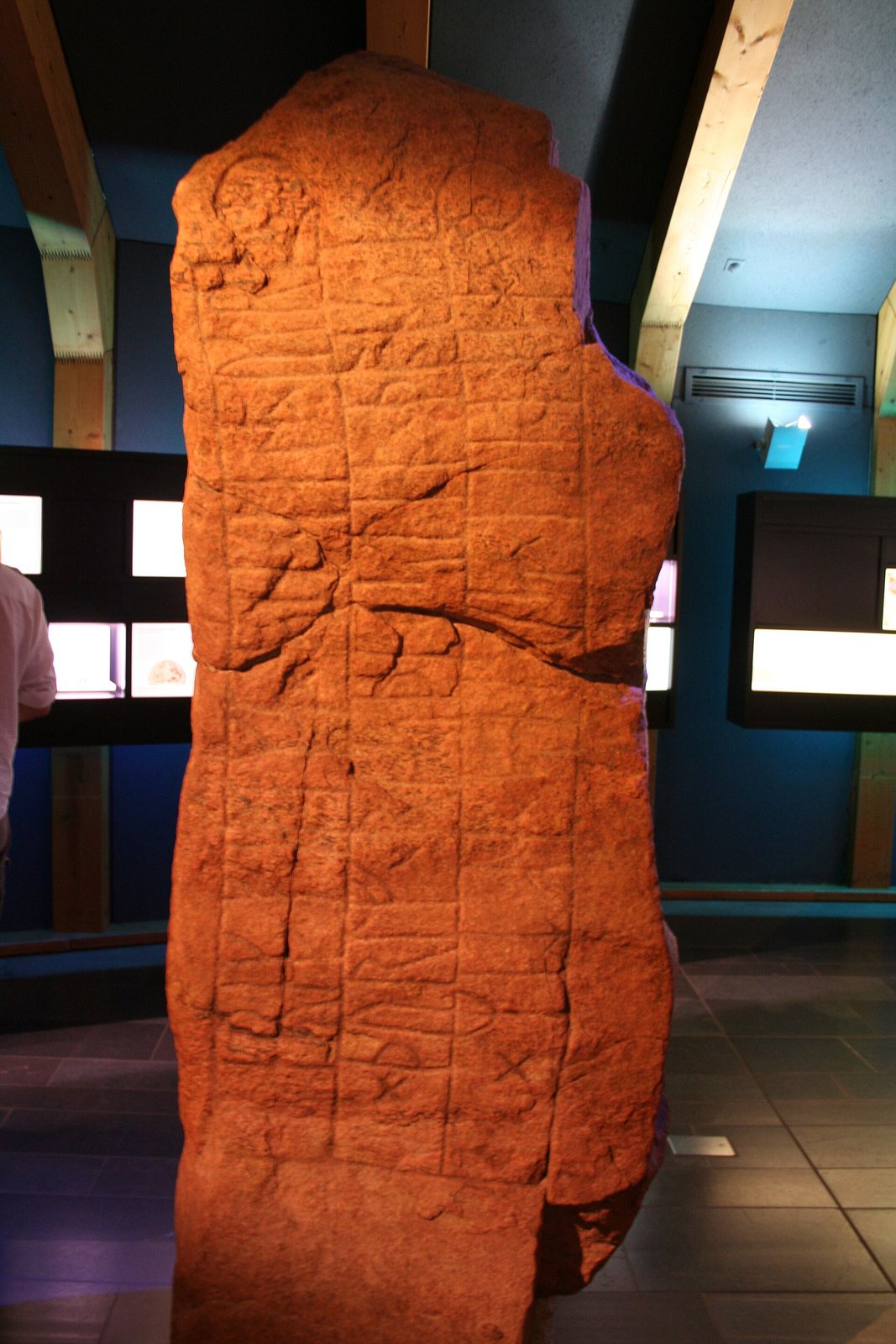
Perhaps the densest stone on the subject now stands in Schleswig. It was found at the Danevirke in 1796 and is catalogued as DR 1:
Þorulfʀ resþi sten þænsi, hemþægi Swens, æftiʀ Erik, felaga sin, æs warþ døþr, þa drængiaʀ satu um Heþaby; æn han was styrimannr, drængʀ harþa goþr.
"Thorulf, Svein's retainer, raised this stone after Erik, his partner, who died when brave men besieged Hedeby. And he was a steersman, a very good drengr."Runestone DR 1 (the "Erik Stone"), Hedeby/Schleswig; normalised reading after the Samnordisk runtextdatabas, English rendering our own
One sentence holds four roles. Thorulf is the heimþegi of a King Svein, probably Sweyn Forkbeard. Erik is his félagi. Erik was a styrimaðr, a steersman, in other words the master of a ship. And he was a drengr. Which siege of Hedeby is meant is disputed; the late tenth century is the usual guess.
Drengr probably meant simply "young man" at first. On the stones it is praise: drengr harða góðr, a very good fellow, appears on dozens of stones in Denmark and Sweden. The same goes for þegn, found on around fifty stones. Birgit Sawyer and Judith Jesch have considered whether both words first denoted men in the service of Danish kings and later wore down into general terms of honour. What is certain is that people carved them because they meant something.
Partnership is one axis, lordship the other. At Hällestad in Scania stands a stone raised by Áskell for Tóki, son of Gormr, "to him a loyal lord" (DR 295). The word is dróttinn, derived from drótt, a retinue: the lord is the one a band follows. Tóki, the text goes on, "did not flee at Uppsala", and his drengir set up the stone. A second stone at the same place (DR 296) names an Erra who was "Tóki's heimþegi".
A heimþegi is literally one who receives a home: the lord gives lodging, keep and gifts, the man gives service and loyalty. King Svein himself had a stone raised at Hedeby for Skarði, "his heimþegi, who had gone west" and died at Hedeby (DR 3).
Not far from Hällestad, at Sjörup, another stone uses the same phrase. Saxi raised it for Ásbjörn, his félagi: he "did not flee at Uppsala, but fought as long as he had a weapon" (DR 279). Scholars usually link these stones with the battle of Fýrisvellir in the 980s – an identification that rests on later sagas, not on the stones themselves.
Lið means band, crew, help. It is the word for a troop gathered by a leader. On stone U 668 at Kålsta two brothers honour their father Geiri, who "sat in the þingalið in the west" – the paid troop of England's Danish kings. More on these men in our article on the England voyagers.
Around 1016 a poem was composed that calls itself Liðsmannaflokkr, "the troop-men's poem". It celebrates the fighting around London in Cnut's army. Knýtlinga saga attributes it to the men of the army themselves, Óláfs saga helga to King Olaf. Russell Poole finds the first attribution more credible. If he is right, we have the rare voice of the ordinary fighting man rather than the court poet.
The word even travelled into English. Under 1036 the Anglo-Saxon Chronicle names the liðsmen in London, the fleet crews, as a political force in the choice of a king.
The Danish historian Niels Lund built a thesis on this that is still debated: the armies of Sweyn Forkbeard and Cnut were lið – retinues and recruited troops of kings and magnates, held together by pay, plunder and loyalty. Not a general levy. That fits the runestones, which almost never speak of obligation but often of partnership and service.
Hirð is the word associated with the royal following of Norway. It is, to many people's surprise, not an old native word but a loan from Old English hīred, household, retinue – probably from the close contacts of the eleventh century. The role of the húskarlar, the housecarls who served as a royal core troop under Cnut and turn up in England too, carries the same English stamp.
How a hirð was actually structured is described only in the Hirðskrá, the law of the royal household written down under Magnus the Lawmender between 1273 and 1277. There we find ranks: the hirdmen proper, the gestir on half pay with police duties, the young kertisveinar. There is an initiation ritual, the handgang, with kneeling, hands placed in the king's and the royal sword. And there are duties among the members, as in a brotherhood: nursing the sick, ransoming prisoners, burying the dead.
That is a thirteenth-century court shaped by European chivalry. Transfer it one-to-one to the year 900 and you build a Viking king who never existed. The core – a lord who feeds men at his table and men who follow him in return – is old. The order built around it is young.
Hardest of all is the leiðangr, Danish leding. It means a naval levy: the land is divided into districts, and each district provides a manned and equipped ship. In Norway such a district is a skipreiða. The farmers carry the burden, the king leads.
That is how the provincial laws describe it: the Norwegian Gulathing and Frostathing laws in thirteenth-century manuscripts, the Jutland Law of 1241, the Uppland Law of 1296. A testament of Magnus the Lawmender of 1277 assumes 279 ship districts for Norway. By then, though, the leiðangr had in many places ceased to be a campaign and become chiefly a tax.
The question is: did any of this exist in the Viking Age? Snorri Sturluson credits King Hákon the Good in the tenth century with introducing it. But that is Snorri's thirteenth-century view, and historians regard his fixed districts as a projection backwards. The word itself occurs in verses by the skald Þjóðólfr Arnórsson, who composed for Harald Hardrada and died in 1066 – he says nothing about its organisation. In Denmark a charter of Cnut the Holy for Lund in 1085 mentions fines for neglected expeditio.
Niels Lund argues that a true leding existed in Denmark only from about 1170; before that, kings fought with lið. Sverre Bagge and others disagree, pointing to earlier references and archaeological evidence. The matter remains open. Put honestly: a peasant naval levy in the form the laws describe is not attested for the Viking Age. That kings already demanded ships from their people is quite possible.
The best-known "organisation" of the Viking Age is an invention – at least in the form in which it is told. The Jomsvikings, with their fortress, their admission rules and their ban on women, come to us from Jómsvíkinga saga of the late twelfth or early thirteenth century. Contemporary runestones and chronicles know no such brotherhood.
The runestones show something more sober: men who entered partnerships, followed a lord, formed a crew and dispersed when the voyage was over. The Great Heathen Army was probably also such an alliance of many groups under several kings and jarls.
Contemporary evidence is the words félagi, drengr, þegn, dróttinn, heimþegi, styrimaðr and lið on runestones of the late tenth and eleventh centuries, together with skaldic verse such as the Liðsmannaflokkr – even if it survives only in manuscripts of the thirteenth and fourteenth centuries.
Later tradition is the elaborate hirð of the Hirðskrá (1270s), the regulated leiðangr of the provincial laws, Snorri's Hákon as the inventor of the levy, and the Jomsvikings of the saga.
Modern interpretation is the question of when retinues turned into a public levy, and how far words like drengr and þegn still denoted offices or had become mere praise.
What remains is a picture more human than any legend: men who called one another partner and had it carved in stone. For courage. For memory. For legends that live on.
The Jomsvikings · The England Voyagers · The Ingvar Expedition · The Great Heathen Army · Miklagard and the Varangians · The longships · Danes, Swedes, Norwegians.