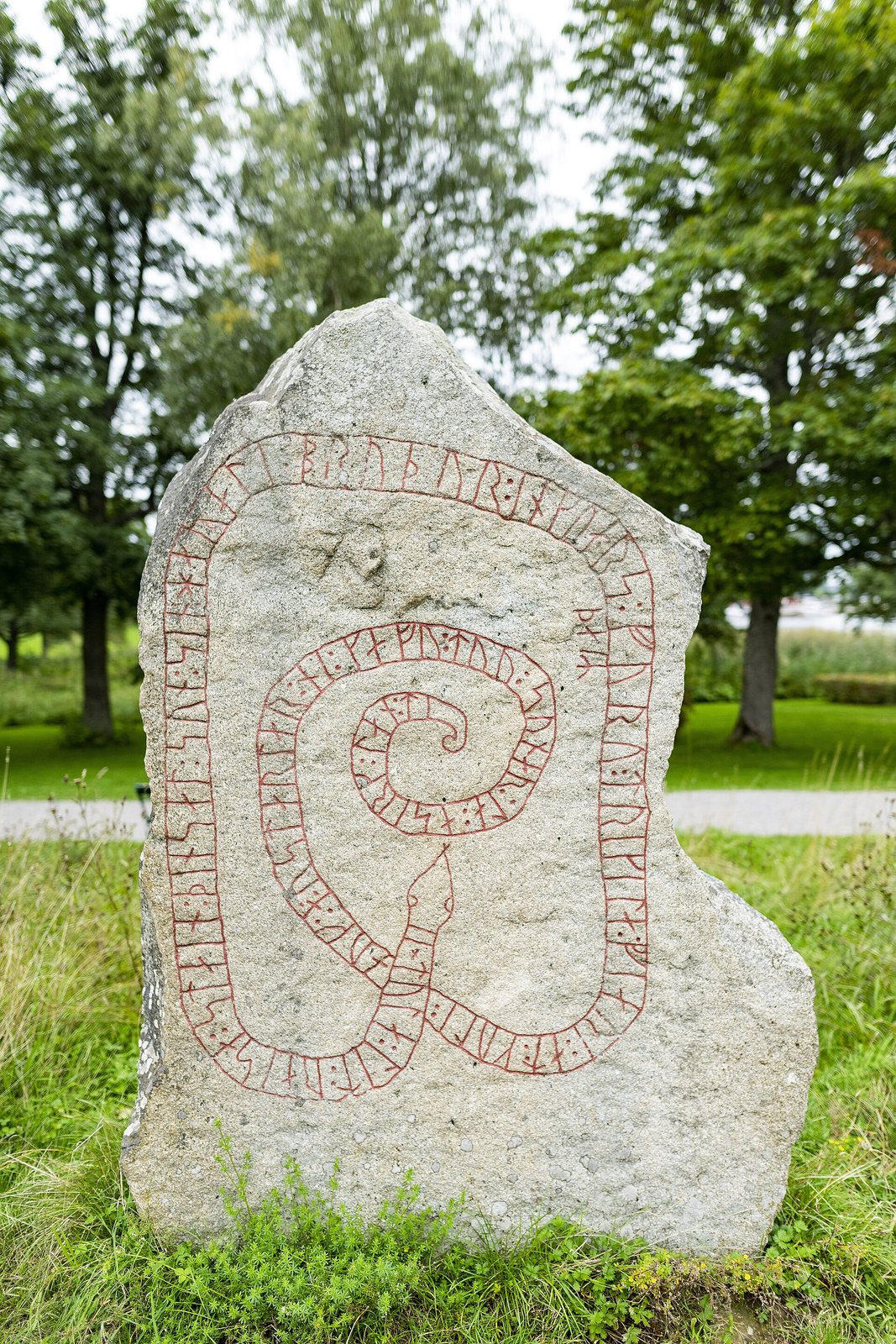
The Ingvar runestones are a group of about 26 runestones raised by families in central Sweden for men who went east around 1040 with a leader called Ingvar and never came home. Almost all of them stand around Lake Mälaren, in Södermanland and Uppland. Icelandic annals place Ingvar's death in 1041; a much later saga calls him "the Far-Travelled". Here is what the stones actually say, where the voyage probably went, what the saga added, and why a single failed expedition left behind so much carved stone.
Picture a farm on the shores of Lake Mälaren some time in the 1040s. For years the family has been waiting for news. When it finally arrives, perhaps with one of the few men who made it back, perhaps only as a rumour passed on by traders from the east, it is the news nobody wanted: the son is not coming home. There is no grave, no body, nowhere to stand and grieve. So the family has a stone cut, sets it up beside the road, the bridge or the assembly place, and carves on it what they know. He went with Ingvar. He died in the east.
That, in a sentence, is the story of the Ingvar runestones. Yet there is far more packed into them: one of the last great eastern voyages of the Viking Age, a region that lost a share of its young men, a society already Christian enough to mourn its dead with crosses and prayers, and an Icelandic saga that, two centuries later, turned the whole affair into a tale of dragons and giants. We will take it in order: first the stones, then the interpretation, then the legend.
The best-known Ingvar stone now stands at Gripsholm Castle in Mariefred, Södermanland. Its catalogue number is Sö 179, the signum used by the Swedish corpus of runic inscriptions (Sö for Södermanland, U for Uppland, Ög for Östergötland, Vs for Västmanland). A woman named Tola had it raised for her son Harald. Then the inscription shifts into verse, in the old metre that rune carvers kept for their most solemn lines:
Tōla lēt ræisa stæin þennsa at sun sinn Harald, brōður Ingvars. Þæiʀ fōru drængila fiarri at gulli ok austarla ærni gāfu, dōu sunnarla ā Særklandi.
"Tola had this stone raised for her son Harald, Ingvar's brother. They fared like men, far for gold, and in the east they gave the eagle food; they died in the south, in Serkland."Runestone Sö 179, Gripsholm; normalised reading after the Scandinavian Runic-text Database, English rendering our own
Three movements in a handful of words: far away, to the east, to the south. It is not a map, but it is a remarkably good sense of the route: across the Baltic, into the lands of the Rus, then down towards the countries that had sent silver north for generations.
"Giving the eagle food" is a poetic formula of the kind skalds loved: whoever kills enemies feeds the carrion birds. It has nothing to do with the notorious blood eagle; it is simply the poetic way of saying there was fighting and killing. And the goal is stated without embarrassment: gold. No Ingvar stone talks about mission, crusade or glory for its own sake. Drængila, "in the manner of a proper young warrior", is the highest praise the stone gives.
One small detail stands out. Harald is "Ingvar's brother", and the stone assumes everyone in the district knew which Ingvar was meant. No stone tells us anything more about Ingvar's family: no father, no mother, no farm. Keep that in mind for later, when the saga arrives with a family tree.
The usual figure is about 26. The "about" matters: some stones survive only as fragments or are lost and known from old drawings, and for one or two fragments the link to Ingvar's expedition is a reconstruction. The standard list breaks down roughly like this: around fifteen stones in Södermanland, eight in Uppland, one in Västmanland and two in Östergötland. Nearly all of them therefore lie in the Mälaren basin, the old heartland of the Svear, the region of Birka and later Sigtuna.
That makes the Ingvar stones the largest group of runestones tied to a single undertaking under a named leader. The only larger groups are the broad destination categories: the so-called Greece runestones for men who had been to Byzantium, and the England runestones for those who took part in the campaigns and tribute payments in England, which we cover under the England-farers. Those, however, are spread across many voyages over decades. Ingvar's stones belong to one expedition, one leader, one generation.
The latest addition to the group is a stone that came to light during building work in Uppland in 1990 and now stands in the domestic terminal at Stockholm Arlanda Airport (signum U Fv1992;157). If you catch a domestic flight from Stockholm, you may well walk past an Ingvar stone without noticing.
Read side by side, the inscriptions build up a surprisingly dense picture, not of Ingvar himself, but of the men around him. A few examples, each in our own free rendering based on the readings in the Rundata database:
Sö 131, Lundby (Södermanland). Two brothers, Spjóti and Halfdan, raised it for their brother Skarði. Then comes a line of verse: "He went east from here with Ingvar. In Serkland lies Eyvind's son." It is devastating in its simplicity. It names the place of a grave that nobody at home would ever see. A ship setting, a stone outline in the shape of a ship, once lay beside the runestone; the antiquarian Richard Dybeck still saw it in the nineteenth century, but nothing of it survives today. You can read more about that kind of monument under stone ships.
U 644, Ekilla bro, and U 654, Varpsund (Uppland). The same five sons raised two stones for their father Gunnleif, only a few kilometres apart: Andvätt, Kár, Blesi, Djarf and a fifth whose name cannot be read with certainty. In essence: "He fell in the east with Ingvar. May God help his soul." The Varpsund stone, as Rundata reads it, also praises his skill at steering a cargo ship. Two stones for one dead man shows how much the family wanted his memory visible in more than one place, presumably along roads or crossings where many people passed.
U 778, Svinnegarn (Uppland). A married couple, Þjalfi and Holmlaug, honour their son Banki. He, the stone says, owned a ship on his own and steered it east in Ingvar's host. Here we catch a glimpse of how the expedition was organised: it was made up of ships whose owners and steersmen came from well-off families and brought their own crews. We explain how such war bands and ship fellowships worked in Lið, Hird and Leiðangr; the word lið, host or retinue, appears on several Ingvar stones.
U 439, Steninge (Uppland, now lost). Two children raised it for their father Sæbjörn, who "steered a ship east with Ingvar". The rest of the inscription is damaged and its interpretation is disputed.
Sö 173, Tystberga (Södermanland). This stone commemorates two men, Holmstein and Hróðgeir. Of Holmstein it says that he had long been in the west, and then he died in the east with Ingvar. On runestones "the west" nearly always means England. Holmstein belonged to the generation that first fetched English silver, in the service of Cnut the Great or his predecessors, and then, when that was over, set out once more in the opposite direction. One sentence linking two worlds.
Sö 335, Ärja (Södermanland). A man named Ósníkinn went east with Ingvar; the stone calls him the shipmate of a Holmstein. Whether this is the same Holmstein as on the Tystberga stone is possible but cannot be proved. Cross-links like this are what make the group so attractive to scholars, and so risky for over-bold reconstructions.
Ög 155, Sylten (Östergötland). The southernmost stone in the group names a Gauti who met his end in Ingvar's host. The expedition drew men from beyond the Mälaren valley too.
The stones carry no dates. There are three ways of dating the expedition, and only together do they give a stable picture.
First, the Icelandic annals. Several medieval annals, among them the so-called Royal Annals (Annales regii), record the death of Ingvar the Far-Travelled under the year 1041. These annals were written down in the late thirteenth and fourteenth centuries and probably go back to shared older exemplars. They are no eyewitness account, but they are a tradition separate from the saga.
Second, the ornament. The archaeologist Anne-Sofie Gräslund developed a stylistic chronology for the rune-animal designs of central Swedish runestones. Most Ingvar stones belong to style groups dated to the first half of the eleventh century, especially the so-called bird's-eye-view style (Fp), in which the head of the rune animal is shown as if seen from above. That fits a voyage around 1040 well.
Third, the saga, which has Ingvar die in 1041 at the age of 25. Since it probably draws that date from the same tradition as the annals, it is not an independent witness. The Swedish archaeologist Mats G. Larsson, in his 1990 book on "an ill-fated Viking expedition", narrowed the voyage to 1036–1041. That span has become widely accepted, but it remains a reconstruction.
For context: this is the very period when runestones were being raised in huge numbers in Uppland and Södermanland and when the Mälaren region was turning Christian. Many Ingvar stones bear a cross, and several close with a prayer that God help the dead man's soul. The men who left to go "far for gold" were already mourned at home as Christians. We look at this gradual shift in our piece on Christianisation.
The key word on the stones is Serkland. Four runestones in Södermanland mention it, several of them in connection with Ingvar. The most common explanation derives the name from "Saracens", i.e. Muslims, so that Serkland is simply the land of the Muslim rulers to the south and south-east. A second explanation links it with Old Norse serkr, a shirt or garment, and thinks of the silk that came from the East. The two are not mutually exclusive. What is clear is that Serkland was a wide, vague term, not a state with borders.
The way there led across the Baltic and down the great rivers of Eastern Europe, the routes we describe in the Varangian route and in our article on the Rus. The Volga led to the Caspian Sea and the lands on its southern shore, the Dnieper to the Black Sea and Byzantium. Which route Ingvar took, no stone says.
Two hypotheses dominate. One places the goal on the Caspian Sea, in lands known from earlier Rus expeditions; Scandinavian warriors had already raided there in the tenth century, and it was from there, up the Volga, that the silver had come which travellers such as Ibn Fadlan saw among the Rus. The other, worked out by Mats G. Larsson, places the goal in the Caucasus, specifically Georgia.
Larsson relies on a Georgian chronicle, the Matiane Kartlisa, part of the great Georgian historical compilation Kartlis tskhovreba. It reports that in the 1040s Varangians came to Georgia, their number given as about 3,000, and that some of them became involved in the struggle between King Bagrat IV and the rebel lord Liparit. This is the context of the Battle of Sasireti, usually dated to 1042. On a widely held reading, some 700 Varangians fought there.
The timing fits strikingly well. But be careful: the Georgian source names no Ingvar, and the stones name no Georgia. Equating the two requires selective reading, which is why some scholars regard the link as possible but unproven. The precise dating of the Georgian events is not entirely sharp either. Our position: Georgia is a well-argued hypothesis, the Caspian another, and both are compatible with "Serkland" and "in the south".
Ingvar's men were Varangians, the name Byzantines, Rus and Arabs gave to the Scandinavians who appeared in the East as traders, mercenaries and warriors. How that differs from "Vikings", "Normans" or "Rus" we unpick in a separate article: Vikings, Normans, Norsemen, Varangians, Rus.
For the generation of 1040, the East was not unknown territory. Yaroslav the Wise ruled in Kyiv and had close ties to Sweden; he was married to Ingegerd, a daughter of the Swedish king Olof Skötkonung. Scandinavian retainers served at the Kyivan court, others went on to Constantinople, where the Varangian Guard protected the emperor; we tell that story in Miklagard and the Varangian Guard. A leader from the Mälaren region setting off east with a few dozen ships was moving within a dense web of kinship, service and trade.
At the same time, things had changed. In the ninth and tenth centuries hundreds of thousands of Arabic silver coins, dirhams, had flowed north; the hoards of Gotland and the mainland are full of them. Around the turn of the millennium that flow largely dried up, for reasons still debated, among them crises at the mints of Central Asia. There is more on this in our article on Viking trade. An expedition like Ingvar's can be read as an attempt to reach those old sources of wealth directly, not as traders but under arms. "Far for gold" fits that reading. The motive itself, however, is not attested; it is a plausible interpretation.
The obvious answer is a bitter one: because so many did not come back. But that alone does not explain the number. Other costly voyages left no comparable groups of stones. Several factors work together.
Place and time. Uppland and Södermanland are the richest runestone landscapes in the world; Uppland alone has well over a thousand. The great fashion for memorial stones peaked in exactly the first half of the eleventh century. Ingvar set out from the right region at the right time to be remembered in stone.
No grave. Whoever died abroad had no grave at home. The stone replaced it. It was a place of remembrance, a place of prayer and, quite soberly, a public document: whoever raised it presented themselves as the rightful heir. The historian Birgit Sawyer has shown how important this inheritance aspect of runestones was. For men who simply vanished, a public record of their death mattered all the more.
Christian piety. Many Ingvar stones ask for God's help for the soul. Raising a stone, and sometimes building a bridge or a road, was considered a good work for the soul of the dead. The Arlanda stone, for example, also records the building of a bridge.
Status. Ingvar's men came from families that could fit out ships. A runestone was expensive: it needed a trained carver and a suitable block. The stones are also the markers of an elite that wanted it known that its sons had served in a great enterprise.
And perhaps something else was at work that cannot be measured: the sense of a shared disaster. When several families in one valley lost sons at the same time, a stone by the road reminded the neighbours not of one dead man but of all of them. The Ingvar stones are something like a scattered war memorial for an entire region, a thousand years before the idea existed.
The nickname "the Far-Travelled", Old Norse víðförli, does not come from the stones but from Yngvars saga víðförla. The saga was composed in Iceland, probably around 1200 or soon after, and presents itself as based on a Latin version by the monk Oddr Snorrason of the monastery of Þingeyrar. Whether that is true is disputed, though the attribution has gained support in recent decades. The saga survives only in much later manuscripts, the oldest from the early fifteenth century. The gap to the events is at least a century and a half.
The saga makes Ingvar the son of one Eymund, a man of the Swedish royal house, and tells how after a quarrel with the king he goes to Gardariki, the land of the Rus, and from there sails down a great river with thirty ships. What follows is an adventure romance: giants, a dragon lying on gold, a wise queen named Silkisif, women who seduce the men and so bring a deadly plague upon them. Ingvar dies of the sickness aged 25, and only one ship returns. A second part tells of Ingvar's son Sveinn, who repeats the voyage, marries Silkisif and converts her land.
Scholars have shown that the saga draws on learned sources such as medieval natural lore and devotional literature. Above all it is a Christian mission story in adventure dress. As a guide to the actual course of the voyage it is of little use. It still has value: it shows that Ingvar was remembered in Iceland generations later, and some of its broad strokes, the failed expedition, death by disease, the handful of survivors, fit remarkably well with what the stones let us guess.
Archaeologically and epigraphically attested are about 26 eleventh-century runestones, mostly from the Mälaren region, honouring men who went east with Ingvar, some as ship owners and steersmen, and naming Serkland several times as the place of death.
Later written tradition comprises the Icelandic annals with the year 1041 and the saga with its family tree, thirty ships, dragons, Silkisif and the son Sveinn.
A contemporary foreign source is the Georgian chronicle with Varangians in the 1040s, whose connection to Ingvar is, however, not secure.
Modern interpretation covers the exact destination, the years 1036–1041, the number of participants and the motive of finding the vanished silver of the South.
Why does an engraving workshop write about runestones for the dead? Because these stones can do something many modern gravestones have forgotten: they tell a story. The formula is always built the same way, and that is its strength. First who raised the stone, then for whom, then the relationship, then one line about the life or the death, often a blessing at the end. "Tola had this stone raised for Harald, her son."
We use exactly that structure when customers ask us for a memorial plaque, for a person but also for a dog, a farm or a workshop: a piece of slate, one sentence in the old form, if you like in the runes of the Younger Futhark, just as on the Ingvar stones. Which characters were actually used then, and why they look different from the familiar older rune row, we explain in our Futhark comparison. And if you would rather have a sign than a sentence, our article on runes for protection, strength and courage gives an honest account of what the finds actually support.
A note from the workshop: we do not swap a modern sentence letter by letter into runes. If you want a real runic memorial formula, we first put it into a form close to Old Norse and then transcribe it. It takes more work, but it is the difference between decoration and remembrance.
How many Ingvar runestones are there? Scholars count about 26 runestones referring to Ingvar's voyage, most in Södermanland and Uppland, with single examples in Västmanland and Östergötland. Some survive only as fragments or are known from old drawings.
Who was Ingvar the Far-Travelled? A Swedish leader who led a large expedition east around 1040 and died on it; Icelandic annals give 1041 as the year of his death. His origins are unclear: the saga makes him the son of an Eymund, while the stones name only his brother Harald.
What does Serkland mean? Serkland is the Old Norse name for the lands to the south and south-east, usually interpreted as "land of the Saracens", i.e. the Muslim world. It most likely refers to the region around the Caspian Sea and the Caucasus.
Did Ingvar die in Georgia? Possibly, but it is not proven. A Georgian chronicle mentions Varangians in the 1040s but names no Ingvar, and the runestones do not mention Georgia.
Where can I see an Ingvar runestone? The best known stands at Gripsholm Castle in Mariefred (Sö 179); others stand by churches and old roads around Lake Mälaren, and one is even in the domestic terminal at Arlanda Airport.
Is Yngvars saga a reliable historical source? Only to a very limited extent. It was written about 150 years after the voyage, is heavily legendary and is mainly a Christian edifying tale; for the course of the voyage the stones are the better guide.
For courage. For remembrance. For legends that live on.
The Varangian route · The Rus (Kiev) · Miklagard and the Varangians · The Vikings in the East – Varangians, the Rus & Byzantium · The England Voyagers · Lið, Hird & Leiðangr · Birka – the trading hub · The Suiones.
All Runes & Writing articles →
When one thinks of Vikings, one thinks of England and the North Sea. But the way of the Swedes led east – and the …
Read more →Not every runic text honours a dead man. Some tell of a flight. The Oklunda inscription in Östergötland is a rare legal …
Read more →A granite block nearly four metres tall, densely covered on all five faces with around 760 characters: the Rök Stone …
Read more →