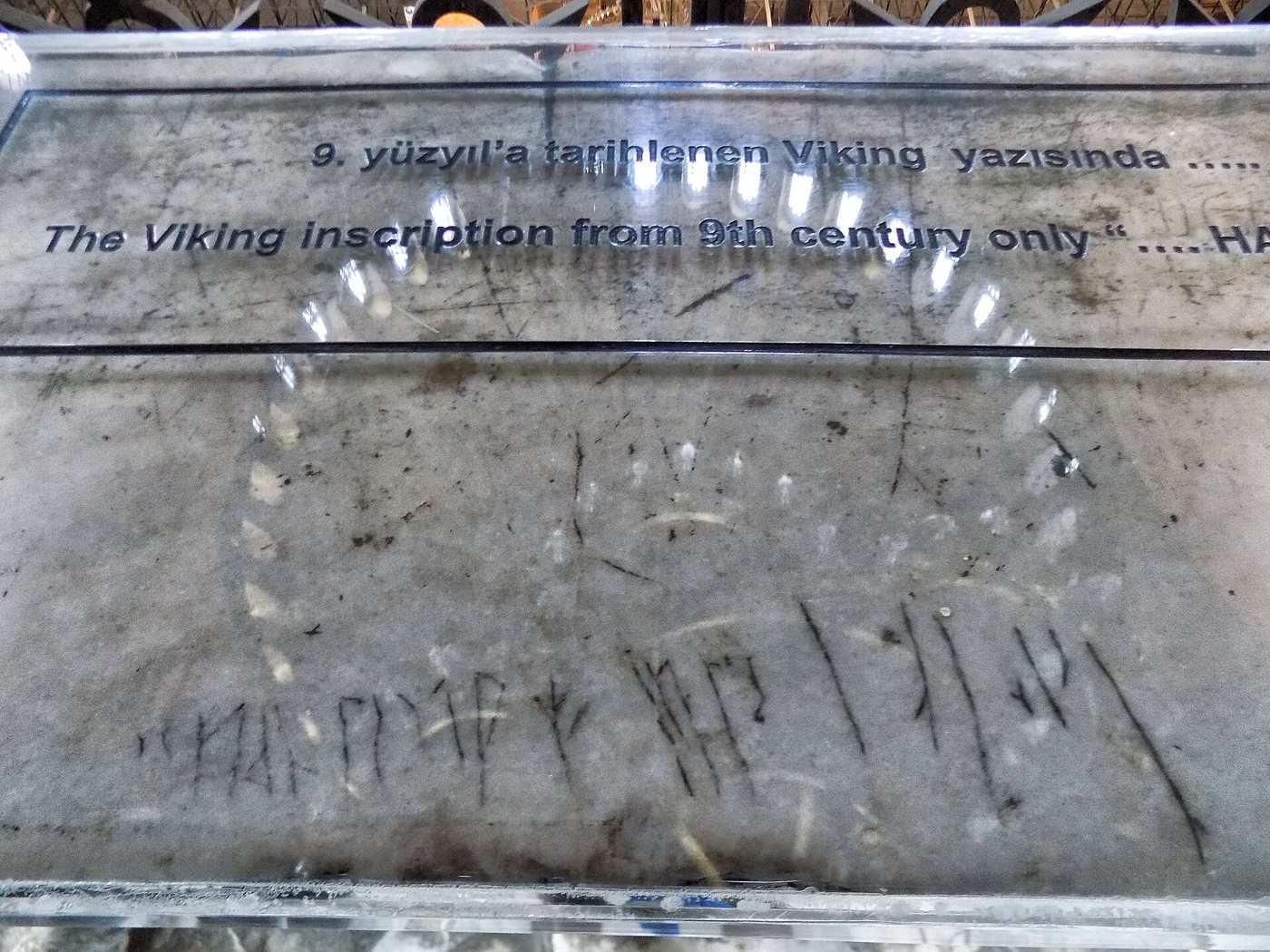
The short answer: "Viking" was never the name of a people but of an activity, sailing overseas to raid. Northmen, Danes, Gaill or Majus were what Franks, Irish and Arabs called Scandinavians from the outside. Normans were the French-speaking people of Normandy who grew out of those settlers. Rus and Varangians were Scandinavians in the east, between Kyiv and Constantinople. Here is who used which name and when, which runestones carry the word víking, and why the victors of 1066 were no longer Vikings.
Picture a farmer from Uppland around the year 1000. One summer he rows east with his neighbours; that winter he is back home mending fences. In Constantinople he is a Varangian. In Kyiv he is one of the Rus. A Frankish monk would call him a Northman, an Irish annalist a Gall, a scholar in Córdoba one of the Majus. He would call himself a man of his district, perhaps a Swede. He was a "Viking" only for the weeks he was actually out raiding. This article unpicks that tangle: who used which word, when, and what the sources really say.
Old Norse has two related words. Víkingr (masculine) is a person: a sea-raider or pirate. Víking (feminine) is the activity: an expedition overseas to raid, trade, or both. The phrase fara í víking means roughly "to go a-viking". Whoever went was a víkingr for the duration; whoever stayed home was a farmer, a smith or a merchant. The word describes a temporary occupation, not a nation.
This is not something invented by the saga writers of the thirteenth century. It is carved into stones raised by people who lived through it. Runologists cite these stones by catalogue codes: DR stands for Danmarks Runeindskrifter, U for the Uppland volumes of Sveriges runinskrifter. Three examples you can check yourself:
That last stone is precious: to Scandinavians themselves, vikings could be a threat to guard the coast against. Compare the memorials of the Ingvar expedition or the England travellers, which proudly record voyages, often without the word víking.
The etymology is unresolved. There are several serious proposals and none is proven, so treat each one as a hypothesis.
Theory 1: vík, "bay". Old Norse vík means a bay or inlet. A víkingr would be someone who lurks in bays or sails out from them. Plausible, but vague: bays are everywhere.
Theory 2: Viken, the region. In the Middle Ages Víkin was the name of the area around the Oslofjord. A víkingr would originally be "a man from Viken". The difficulty is explaining why the word was just as common in Sweden and Denmark.
Theory 3: vika, the rowing shift. Besides "week", Old Norse vika could mean a stretch of sea after which rowers were relieved, a kind of nautical mile. In 2005 the Norwegian philologist Eldar Heide suggested that víking originally meant a voyage with alternating rowing shifts, in other words a long-distance rowing trip. It fits a word for an activity nicely, but it remains a hypothesis.
A link with Old English wīc (from Latin vicus, a trading settlement) has also been proposed. Most linguists now consider it less likely.
Here is the puzzle: the word turns up in English texts, some possibly older than the first big raids. The Old English poem Widsith mentions wicinga cynn, a "race of vikings", and the biblical poem Exodus has sǣwīcingas, "sea-vikings". The poems are hard to date, but wīcing clearly meant pirate in general, with no ethnic label.
What the English actually wrote in their histories is just as telling. The Anglo-Saxon Chronicle nearly always calls the raiders Dene, Danes, or the hǣþen here, the "heathen army". Wīcing appears only occasionally. To the people of Wessex, the attackers were first and foremost Danes and pagans. Our piece on the Vikings in England follows that story.
The modern habit of calling every Scandinavian between roughly 790 and 1066 a Viking is a nineteenth-century creation. Scandinavian scholars and poets of the Romantic era revived the old word and turned it into the label for an entire period, the Viking Age.
Scandinavia wrote almost no history during the Viking Age. Nearly every narrative comes from those the Scandinavians visited, robbed or traded with, each with its own vocabulary.
The Franks: Nordmanni and Dani. Frankish annals speak of Nordmanni or Normanni, literally "north men". That is a compass direction, not an ethnic name. Alongside it stands Dani, "Danes", often used loosely for all northern raiders even when Norwegians or Swedes were involved. Churchmen also wrote pagani or gentiles, "heathens".
The Irish: Gaill, Lochlannaig, Finngaill and Dubgaill. Irish annals usually call them Gaill, "foreigners", or gennti, "heathens". There is also Lochlannaig, "people of Lochlann"; where Lochlann (earlier Laithlind) lay, whether in Norway or in the Scottish isles, is debated. From the mid-ninth century the Annals of Ulster distinguish Finngaill, "fair foreigners", from Dubgaill, "dark foreigners". The traditional reading was fair equals Norwegian, dark equals Danish. More recent scholars such as Clare Downham find that too neat and suggest the terms separated older and newer groups of arrivals.
The Arabs: al-Majus and al-Rus. Writers in al-Andalus called the raiders who attacked Seville in 844 al-Majus. The word originally meant the Zoroastrian fire-priests of Persia and came to mean heathens in general. More on the Majus. In the eastern Islamic world, geographers and travellers spoke of the Rus. The ninth-century geographer Ibn Khordadbeh describes Rus merchants reaching Baghdad, and Ibn Fadlan met a group he calls the Rusiyya on the Volga in 921/922.
The Byzantines: Rhos and Varangoi. Greek texts first speak of the Rhos. Later, in the eleventh century, the term Varangoi appears, above all for the Scandinavian mercenaries in imperial service. The Slavs: Varjagi. East Slavic chroniclers call the same people Varjagi, which is where English "Varangians" ultimately comes from.
The Normans show how an outsider's label becomes a people's name: the Normanni of the annals became the inhabitants of Normandy.
At the centre stands Rollo, a Scandinavian leader who settled with his followers on the lower Seine. According to tradition, King Charles the Simple concluded the Treaty of Saint-Clair-sur-Epte with him in 911: land in exchange for baptism, loyalty and defence of the realm against other raiders. The catch is that no treaty text survives. The detailed account comes from Dudo of Saint-Quentin, who wrote around 1015 for the Norman dukes, a century after the event and with every reason to flatter the dynasty. Historians regard Dudo as heavily stylised; the place, the procedure and the famous anecdote of the foot-kissing cannot be verified.
Rollo's men married local women, became Christians and took over Frankish administration. Place names ending in -tot (from Old Norse topt, a house plot) or -bec (from bekkr, a stream) still mark Norse settlement today. The language, however, changed. Dudo claims that Duke Richard I sent his son to Bayeux to learn Danish because it was hardly spoken in Rouen any more. True or not, it implies the elite spoke mainly French by about 1000.
When William, Duke of Normandy, crossed to England in 1066 he was a French-speaking Christian prince with a Frankish-style army and mounted knights. The irony is that his rival of three weeks earlier had been a genuine Northman: Harald Hardrada, King of Norway and former Varangian, who fell at Stamford Bridge. More in our article on the Battle of Hastings.
Further still from the Viking image are the Normans in southern Italy and Sicily. From around 1017 mercenaries from Normandy arrived in Apulia, later followed by the sons of Tancred of Hauteville. Robert Guiscard conquered southern Italy, his brother Roger I took Sicily from 1061, and Roger II became king in 1130. These men were French in language and culture, Latin Christians, ruling over Greeks, Arabs and Lombards.
In the east, the story ran differently, and it is where the debate gets political. The key narrative source is the Russian Primary Chronicle, also known as the Chronicle of Nestor or Povest' vremennykh let ("Tale of Bygone Years"). It was compiled in Kyiv in the early twelfth century, some 250 years after the ninth-century events it describes.
Under the year 862 the chronicle says that the northern tribes drove out the Varangians, then fell to quarrelling among themselves and finally sent messengers overseas: our land is great and rich, but there is no order in it; come and rule over us. Three brothers came, Rurik, Sineus and Truvor, and from these Varangians the land of the Rus took its name. The chronicle presents the Rus as one group of Varangians, like the Swedes or Angles.
The chronicle's dates were constructed after the fact; the invitation story follows a pattern found elsewhere (Widukind of Corvey has the Britons invite the Saxons in much the same way); and the text served to legitimise the Rurikid dynasty that traced itself back to Rurik. Many doubt that Sineus and Truvor existed. Whether Rurik himself was historical is open; identifying him with Rorik of Dorestad, a Danish leader in Frisia, has been suggested but cannot be proven.
Independent and earlier evidence does exist. The Frankish Annals of Saint-Bertin record that in 839 a Byzantine embassy arrived at the court of Louis the Pious at Ingelheim accompanied by men who called themselves Rhos. The emperor found they were Sueones, Swedes, and suspected them of spying. In the tenth century Liudprand of Cremona wrote that the Rusios were otherwise called Nordmanni. And Emperor Constantine VII, in De administrando imperio, lists the names of the Dnieper rapids in a "Rus" and a "Slavic" form; most of the "Rus" names can be explained from Old Norse.
The origin of the name Rus is again a hypothesis, though a well-supported one. Finnish Ruotsi still means "Sweden", and many linguists derive it from an Old Norse root connected with rowing, related to Roslagen on the Swedish coast. The Rus would then originally have been "the rowers".
Since the eighteenth century scholars have argued about how much Scandinavians contributed to the founding of the Kyivan state. German academics at the St Petersburg Academy, notably Gottlieb Siegfried Bayer and Gerhard Friedrich Müller, stressed the Scandinavian origin of the Rus. Mikhail Lomonosov fiercely disagreed. Two camps formed, "Normanists" and "anti-Normanists"; in the Soviet period an emphasis on Slavic self-reliance was long the politically preferred line.
Current research has largely moved past that stand-off. Excavations at Staraya Ladoga, Gnezdovo and Ryurikovo Gorodishche near Novgorod clearly show Scandinavian jewellery and burials. Equally clear is that the Rus were quickly absorbed into a Slavic, Finnic and Baltic environment. The princes soon took Slavic names: Oleg (Helgi) and Igor (Ingvar) still bore Norse ones, but Igor's son was Sviatoslav. A Scandinavian elite helped shape the state; it did not build it alone. See also the Kyivan Rus and the route to the Greeks.
Some of the best evidence comes from the treaties between the Rus and Byzantium preserved in the Primary Chronicle. For 907 the chronicle reports a treaty after Oleg's campaign against Constantinople; its authenticity is much disputed, and no Greek source mentions the campaign. The treaties of 911 and 944, by contrast, are generally regarded as genuine at their core, because they contain Byzantine diplomatic formulas.
The 911 treaty names men such as Karl, Farlof, Vermud, Rulav and Stemid, readily interpreted as Karl, Farulfr, Vermundr, Hróðleifr and Steinviðr. The 944 list is longer and already includes some Slavic names. In one generation you watch an elite growing into a new world. Our article on the men of the Rus treaties goes through the lists name by name.
"Varangian" has a slightly different ring from "Rus". It is often traced to Old Norse væringi, linked with várar, "pledge, oath": a Varangian as a man bound by sworn loyalty. Common, but not certain.
In 988 Grand Prince Vladimir of Kyiv sent Emperor Basil II a force of about 6,000 men to help put down a rebellion. From that contingent grew the Varangian Guard, the elite bodyguard of the Byzantine emperors, known for their axes and their well-paid loyalty. Swedish runestones commemorate men who died "in Greece", and Icelandic sagas call the destination Miklagarðr, "the great city". After 1066 more and more Anglo-Saxons joined the Guard, so by the end "Varangian" no longer necessarily meant Scandinavian. The full story is in our article on Miklagard and the Varangian Guard.
The longer Scandinavians lived somewhere, the more local their names became. In Ireland they founded fortified towns such as Dublin, Waterford and Limerick. After the Anglo-Norman invasion from 1169, English sources call their mixed Norse-Irish population Ostmanni, the Ostmen, literally "men from the east". One of the early leaders of Dublin was Olaf the White. In Scotland and the Hebrides we meet the Gall-Goídil, "foreign Gaels": people of mixed descent who spoke Gaelic and fought like Norsemen.
In England the region under Scandinavian law was later called Dena lagu, "the law of the Danes", which gives us Danelaw. Within a few generations its people were Christians and subjects of English kings. Their legacy: place names ending in -by and -thorpe, and loanwords such as sky, egg and they.
And the Icelanders? They called themselves Íslendingar. Their language was dǫnsk tunga, "the Danish tongue", a collective name for Old Norse. In the sagas they often call Norwegians austmenn, "eastmen", because Norway lies east of Iceland. Same word, different people.
| Term | Who it means | When | Who used it |
|---|---|---|---|
| víkingr / víking | sea-raider, or the raid itself | runestones 10th–11th c., sagas 13th c. | Scandinavians themselves |
| wīcing | pirates in general | Old English poetry and glosses | Anglo-Saxons |
| Dene / Dani | Danes, often all northerners | 8th–11th c. | Anglo-Saxons, Franks |
| Nordmanni / Normanni | northerners in general, later people of Normandy | from the 9th c. | Frankish annals, later the Normans themselves |
| pagani / gentiles / gennti | the heathens | 9th–10th c. | church writers, Irish annals |
| Gaill, Lochlannaig, Finngaill, Dubgaill | northern foreigners and subgroups | from the 9th c. | Irish annals |
| al-Majus | raiders from the north | from 844 | writers in al-Andalus |
| Rus / Rhos | Scandinavian-led ruling and trading group in the east | from 839 | Franks, Byzantines, Arabs, Slavs |
| Varjagi / Varangoi | Scandinavians in the east, mercenaries, the Guard | chronicle 12th c., Byzantium 11th c. | East Slavs, Byzantines |
| Normans | people of Normandy and their descendants | 10th–12th c. | self-designation and outsiders |
| Ostmanni / austmenn | Hiberno-Norse in Ireland / Norwegians seen from Iceland | 12th–13th c. | Anglo-Normans / Icelanders |
Behind the single word "Viking" stand dozens of different lives: the farmer on a summer voyage, the duke in Rouen, the guardsman in Constantinople, the merchant in Dublin.
What is the difference between Vikings and Normans? Vikings were Scandinavian seafaring raiders of roughly 790 to 1066. The Normans were the people of Normandy, who emerged after about 911 from Scandinavian settlers and Franks and were speaking French by around 1000.
Were the Varangians Vikings? The Varangians were Scandinavians active in the east, in what is now Russia, Ukraine and Byzantium. Many came as traders or mercenaries rather than raiders, and later the Varangian Guard also recruited Anglo-Saxons.
Where does the word Viking come from? Nobody knows for certain. Proposals include Old Norse vík (bay), the region of Viken around the Oslofjord and vika (a rowing stretch). What is certain is that víking meant an expedition.
Were the Rus Swedish? Written sources and archaeology indicate that much of the early Rus elite came from what is now Sweden. But the Rus were quickly absorbed by the Slavic population, and Rus became the name of a state in its own right.
Were Vikings a separate ethnic group? No. Viking was an activity, not an ethnicity. People saw themselves as Danes, Norwegians, Swedes or members of their home region.
For courage. For remembrance. For legends that live on.

Rollo of Normandy · The Normans in Southern Italy · Miklagard and the Varangians · The Rus (Kiev) · The Madjus in al-Andalus · The Gall-Goídil.
All History & Finds articles →
When we picture Vikings, we usually see longships off English monastery coasts and sails over the North Sea. But an …
Read more →Anyone who knows the Viking Age only as a string of raids on monastic coastlines has not yet seen the Baltic. Between …
Read more →Sword and axe get the glory, yet the most common kit of the Viking warrior was round, wooden and surprisingly light …
Read more →If the axe was the weapon of the common man, the sword was its opposite: costly, rare, inherited and often given its …
Read more →
