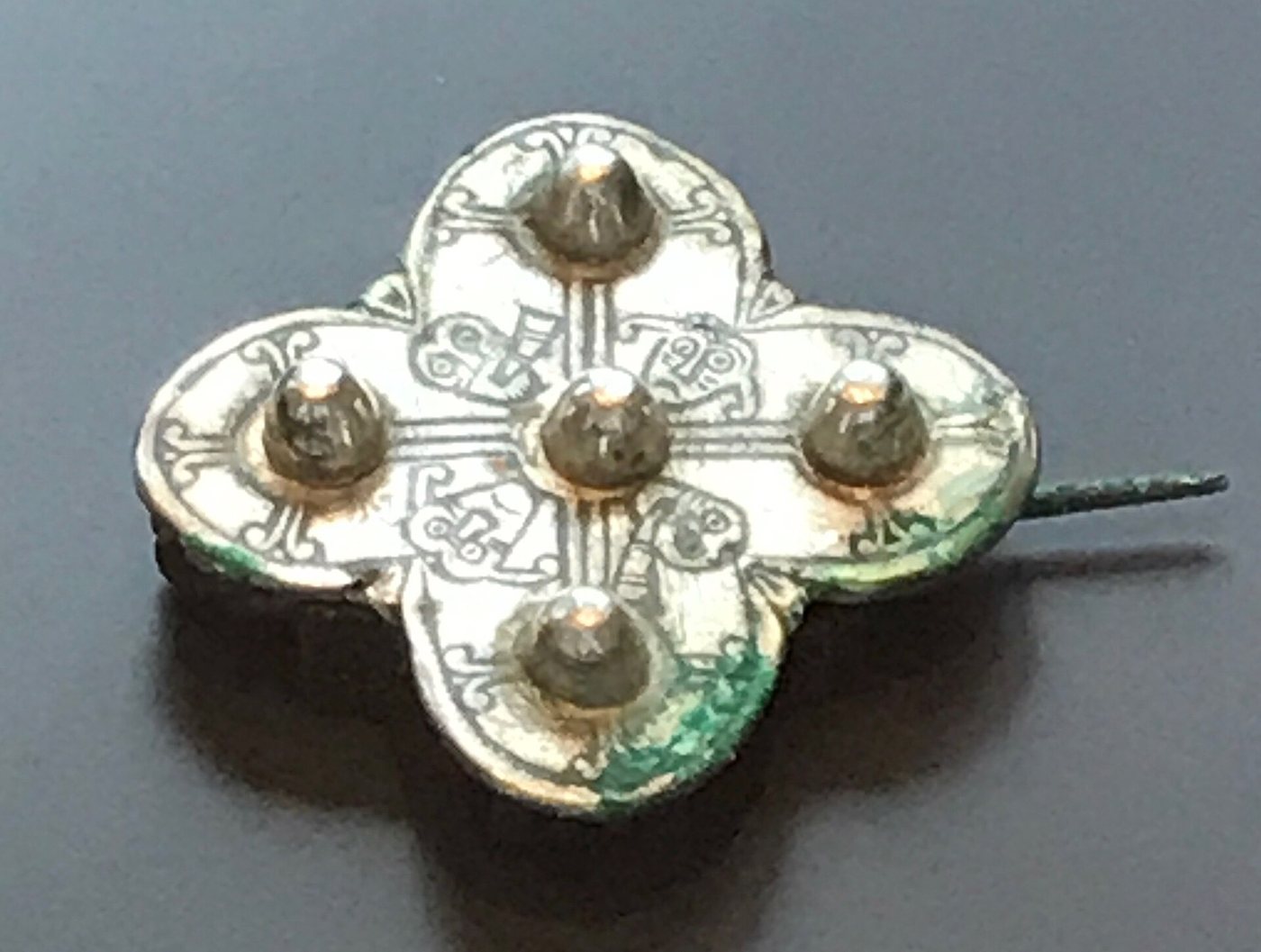
The Irish monks had a simple word for the men from the north: Gaill, the foreigners. For themselves they had another: Goídil, the Gaels. In 856 they wrote the two together for the first time. Gall-Goídil – foreign Gaels. The word describes warriors who fitted no pattern: Irishmen who lived like Norsemen, or Norsemen who spoke Irish, or both. For three years they appear in the annals, then they vanish for almost two centuries. What they left behind is the name of a region in Scotland.
Irish annalists were careful people when it came to names. They distinguished heathens from Christians, "fair" from "dark" foreigners, the men of Dublin from those of elsewhere. If they coined a word of its own for a group, it means the group struck them as something distinct.
The word is transparent. Gall is the foreigner – originally the Gaul, from the ninth century above all the Scandinavian. Goídel is the Gael, the Irishman or Gaelic-speaking Scot. Put together they make a paradox: a foreigner who is a Gael, or a Gael who has turned foreign. Scholars usually translate "foreign Gaels" or Norse-Gaels. Both are interpretations. What the word meant must be read from the handful of passages where it occurs.
The Annals of Ulster first name the Gall-Goídil under 856, and twice at that. Once there is "great warfare between the heathens and Máel Sechnaill", the most powerful king in the north of Ireland – and the Gall-Goídil are on his side. A few lines further on Áed mac Néill, a king in the north-west, inflicts a heavy defeat on the Gall-Goídil at Glenn Foichle. Already this shows that these people did not fight for "the Vikings" but for whoever needed them.
Under 857 comes the entry that names a leader:
Roiniudh re n-Imar & re n-Amlaiph for Caittil Find cona Gall-Gaedelaibh h-i tiribh Muman.
"A rout by Ímar and Amlaíb over Caittil the Fair and his Gall-Goídil in the lands of Munster."Annals of Ulster, entry for 857; our rendering
Ímar and Amlaíb are the two great Viking kings of the day; Amlaíb is Olaf the White of Dublin. So the Gall-Goídil fought against Norsemen too. The Chronicon Scotorum adds for 858 a defeat of the Gall-Goídil by Cerball of Osraige and Ímar, with a figure of 6,400 men that should not be taken literally. After that the word disappears from the annals – for some 175 years.
The so-called Fragmentary Annals of Ireland are more explicit than the terse annals. They survive only in a seventeenth-century copy and tell their story at greater length, with speeches and anecdotes; their text is clearly later than the events. Twice they explain who the Gall-Goídil were. At the fight against Áed they say, in substance, that they were Irish and foster-children of the Norse, and that they were sometimes called Norsemen themselves. And under 858, when Máel Sechnaill marched on Munster, they say it had been worth coming just to kill the Gall-Goídil who fell there: people who had forsaken their baptism, taken on the customs of the Norse and grown up among them – and who, bad as the original Norsemen had been to the churches, were worse still.
That is a verdict from the Church, not a neutral finding. But it says something important: the writers saw the Gall-Goídil not as Scandinavians but as natives who had changed sides. Renegades. Fosterage – raising children in another family to seal alliances – was an old Irish custom. That Irish children grew up in Norse households and vice versa is easy to imagine. For this case it is attested only by this one late text.
Caittil Find is the only leader of the early Gall-Goídil we know by name. Caittil is the Irish form of Norse Ketill; find means "white, fair". A Norseman, then, or someone with a Norse name.
A tempting identification has long been on offer: with Ketill Flatnefr, Ketill Flatnose, whom the Icelandic sources of the twelfth and thirteenth centuries – the Book of Settlements and Laxdæla saga – know as lord of the Hebrides. Ketill was the father of Aud the Deep-Minded, and according to the same sources Aud was married to Olaf the White. In 2009 Andrew Jennings and Arne Kruse argued that Caittil and Ketill were one and the same man.
Alex Woolf disagrees, and his objections are solid. The nickname does not fit: "fair" is not "flat-nosed". The Icelandic sources know nothing of a Ketill in Ireland. And if Caittil was Ketill, Olaf would have fought his own father-in-law in 857. That is not impossible – in this world kinsmen fought each other often enough. Nor is it provable. Clare Downham likewise finds the identification insufficiently supported. So do we.
The sources do not say. Scholars offer several answers, which need not exclude one another.
The first follows the Fragmentary Annals: the Gall-Goídil were Irishmen who had joined the Norse. The second looks for their home in western Scotland. There, in the old kingdom of Dál Riata, on Bute, Kintyre and the Hebrides, Scandinavians had settled from the early ninth century; Gaelic and Norse populations lived together there earlier and more closely than in Ireland. Jennings and Kruse see the Gall-Goídil as men from this region, and Woolf thinks along similar lines. Thomas Clancy has pointed out that a note to an Irish calendar of saints places the church of Kingarth on Bute "among the Gall-Goídil" – though how old that note is cannot be said for certain.
Clare Downham has made a more fundamental point. In her reading the Irish terms for foreigners – Finngaill, Dubgaill, Gall-Goídil – described how much contact a group had with the Gaels rather than where it came from. Modern divisions into "Danes" and "Norwegians" she regards as a nineteenth-century invention. Anyone who turns the Gall-Goídil into a people with a fixed origin makes the same mistake: the word was a label applied from outside, and labels can change their content over decades.
In 1034 the word returns. The Annals of Ulster and of Tigernach report the death of one Suibne mac Cináeda, rí Gall-Gaidhel, king of the Gall-Goídil. Where he ruled they do not say. Clancy and others place his territory in south-west Scotland around the Firth of Clyde – not yet confined to today's Galloway.
Only in the twelfth century does the name shrink to the land between the Firth of Clyde and the Solway. From the Gaelic i nGall-Gaidhealaib, "among the Gall-Goídil", comes Galloway. Orkneyinga saga calls the inhabitants Gaddgeðlar – the same word, heard through Norse ears. At the Battle of the Standard in 1138 men of Galloway fought in the army of the Scottish king David I; English chroniclers described them as especially savage. That says more about the chroniclers than about the Galwegians.
Galloway's place-names are a mixed finding too. Names like Kirkcudbright, "church of Cuthbert", join a word for church that may be Norse or northern English with Gaelic word order, where the saint comes last. Whether such names go back to the Gall-Goídil is disputed. That they show a mixed linguistic landscape is not.
How mixed this world was is shown by a find that carries no mention of the Gall-Goídil at all. In September 2014 a metal detectorist near Balmaghie in Kirkcudbrightshire found the Galloway Hoard, buried around 900: silver arm-rings, ingots, an early Christian cross, a silver vessel from western Asia, silk, rock crystal. Several arm-rings bear Anglo-Saxon runes. In 2025 one of them was read as Old English feoh higna – roughly "the community's wealth", perhaps that of a religious community.
Who buried the treasure is open: Norsemen, Anglo-Saxons, people in between. One could assign it to the Gall-Goídil, and some newspaper articles have done so. It cannot be proven. The hoard shows the world the Gall-Goídil lived in. It does not show the Gall-Goídil themselves.
The Hebrides and the Isle of Man were called Innse Gall in Irish, the islands of the foreigners. From the late eleventh into the thirteenth century they were ruled by kings of a Norse-Gaelic mixed culture: in 1079 Godred Crovan made himself master of Man; in the twelfth century Somerled rose, whose name was Norse and whose descendants were Gaelic clan lords. Only in 1266, by the Treaty of Perth, did Norway cede the islands to Scotland. More in our overview of the Vikings in Ireland, Scotland and the Isles.
Is this island kingdom the continuation of the Gall-Goídil of 856? It is often told that way. But the sources offer no straight line from Caittil Find to Somerled. There is a mixed culture that lasted three centuries, and a word that meant different things over those three centuries. The world of the Ostmen in the Irish towns was similarly mixed.
The strength of the evidence is mixed, and we say so openly.
Contemporary evidence is the word itself: in the Annals of Ulster under 856 and 857, as a band of warriors with a leader called Caittil Find, once with and once against Irish kings, once against Ímar and Olaf. Add in 1034 a king of the Gall-Goídil.
Archaeological evidence shows a mixed Norse, Gaelic and Anglo-Saxon world in south-west Scotland and the Isles, for instance in the Galloway Hoard. No find can be assigned to the Gall-Goídil themselves.
Later tradition is the explanation of the Fragmentary Annals – Irishmen who forsook their baptism – and Ketill Flatnose in the Icelandic sources.
Modern interpretation covers an origin in Dál Riata or the Hebrides, the identification of Caittil with Ketill, and the straight line to the kings of the Isles. The one certainty is the name that remained: Galloway. For courage. For memory. For legends that live on.
The Vikings in Ireland, Scotland & the Isles · The Ostmen · The Earls of Orkney · Olaf the White · The Faroese · The Icelanders.

