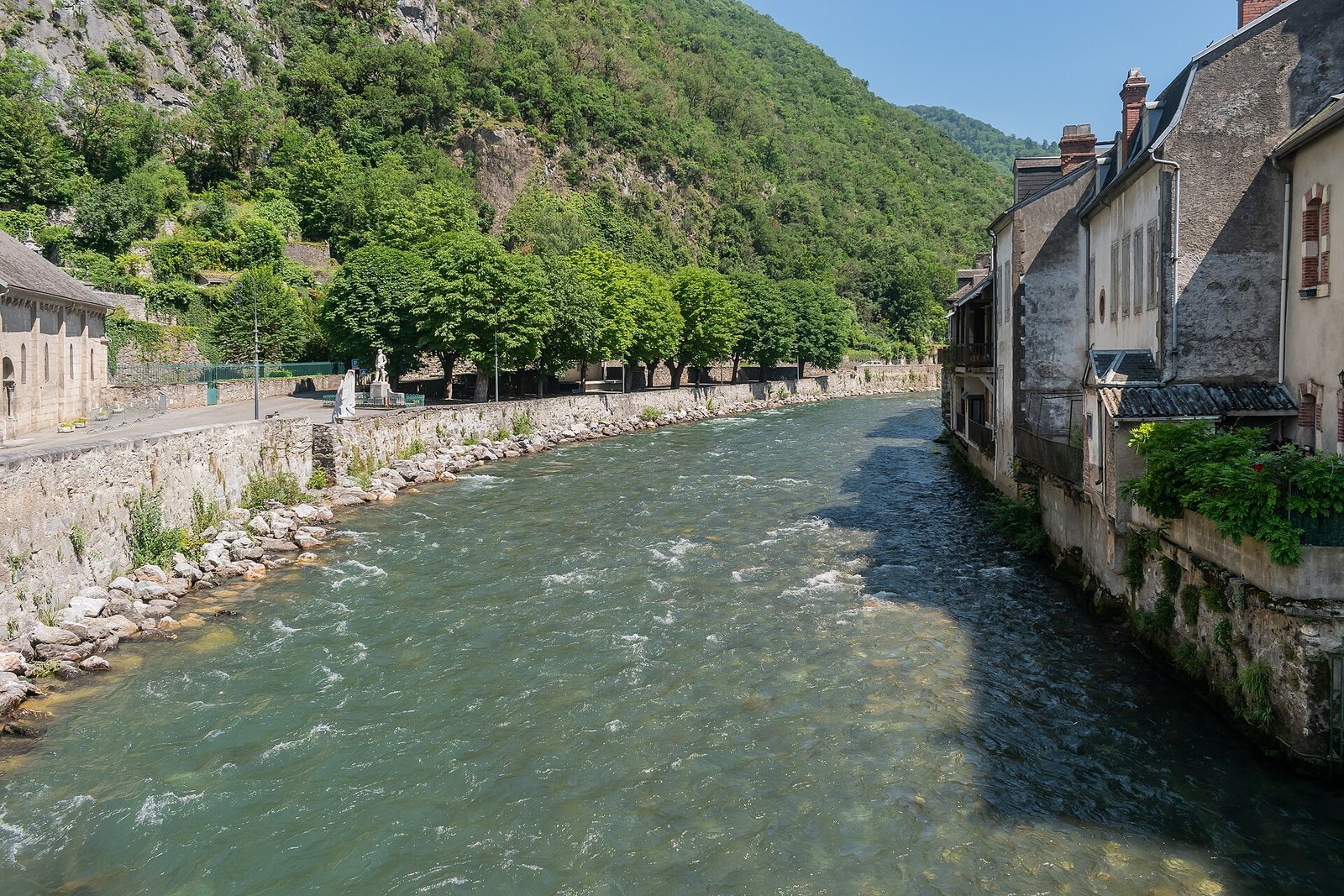
Some peoples leave us a history. Some leave us a place. And some leave us nothing but a name – a name that actually belongs to a river. The Garumni are one of those. They stand ninth in a list of eleven names, inside a single sentence of Caesar's, and after that the record falls silent. What remains is the question they pose: which came first, the water or the people?
The Garumni are named like the Garumna, the Garonne. That is not a guess or a folk etymology but the plain observation that the same word stem appears twice: once as the name of a river, once as the name of a people. Scholarship keeps the two apart. A hydronym is the name of a body of water – a river, a stream, a lake. An ethnonym is the name of a people. With the Garumni the two coincide, and that is exactly what makes them worth a closer look. The order is not trivial. A people can take its name from its river. A river can be named after the people on its banks. Both happen, and in most individual cases the direction can no longer be determined. Here, however, there is a strong hint – and it lies in the age of the names.
The entire ancient record for this people consists of one word in a list. In the third book of the Gallic War, chapter 27, Caesar reports that after the decisive battle the greater part of Aquitania surrendered to his commander Publius Licinius Crassus and sent hostages of its own accord. Then comes the list: Tarbelli, Bigerriones, Ptianii, Vocates, Tarusates, Elusates, Gates, Ausci, Garumni, Sibusates, Cocosates. Eleven names, the Garumni ninth. The sentence closes with the remark that a few very distant peoples, trusting in the lateness of the season, failed to do the same – winter was near. That is all. No place, no number, no action, no leader. The manuscripts, moreover, waver between Garumni and Garunni; both forms appear in the editions, and both lead back to the same river name.
The setting is the Aquitanian campaign of 56 BC. Caesar sent the young Crassus south with twelve legionary cohorts and a strong body of cavalry, so that no auxiliaries from that quarter would reach the rest of Gaul. The campaign opened against the Sotiates, with siege sheds, countermining and that famous scene of the six hundred soldurii. Crassus then moved against the Vocates and Tarusates, who called in reinforcements from Hither Spain – commanders who had served under Sertorius and knew how to fortify a camp in the Roman manner. The Aquitanian coalition collapsed in front of its own camp. Only that collapse produced the hostages, and only the hostages produced the list in which the Garumni appear. Their name is thus a by-product of Roman administration: whoever hands over hostages has to be recorded. Without that bureaucratic act we would know nothing of them at all.
The same author who gives us the name of the people also drew the line along which that people lived. The opening sentence of the Gallic War is one of the best-known sentences in Latin literature, and at heart it is a map: three parts, three groups, three rivers as dividing lines. The Garonne separates the Gauls from the Aquitanians. Anyone reading that sentence is reading the very place from which the Garumni took their name – only without them in it.
Gallia est omnis divisa in partes tres, quarum unam incolunt Belgae, aliam Aquitani, tertiam qui ipsorum lingua Celtae, nostra Galli appellantur. Hi omnes lingua, institutis, legibus inter se differunt. Gallos ab Aquitanis Garumna flumen, a Belgis Matrona et Sequana dividit.
"Gaul as a whole is divided into three parts. One of them is inhabited by the Belgae, another by the Aquitani, the third by those who in their own tongue are called Celts, in ours Gauls. All of these differ from one another in language, in institutions and in law. The river Garonne separates the Gauls from the Aquitani; the Marne and the Seine separate them from the Belgae."
Caesar, Bellum Gallicum I,1; translation: Glanz und Gravur
It repays careful reading. Caesar does not claim that everyone on the right bank is a Gaul and everyone on the left an Aquitanian. He claims that a river separates the two groups – which is a statement of order, not a piece of fieldwork. The sentence opens a campaign report written for Roman readers. Its job is to make a confusing country intelligible: three parts, three names, three lines. Such opening schemes are standard in ancient geography. They are useful and they are crude. Caesar does concede in the same breath that the three groups differ in language, institutions and law – a remarkably modern observation, which he then never develops. When he wrote those lines he had never set foot in Aquitania himself; he made good on that only in 51/50 BC.
The etymology of the river name is the real knot. The most widely held reading splits Garumna in two: a stem gar- or kar(r)- meaning "stone, rock", and a second element -onna for "spring, river". That would give "the stony river" – which suits a Pyrenean stream with a gravel bed rather well. Albert Dauzat argued for this reading, Charles Rostaing and Ernest Nègre followed him, and it is the standard entry in the French name dictionaries today. The stem kar(r)- has a striking counterpart in Basque: harri "stone", older karri. It sounds tidy – and it is still not settled knowledge. The argument begins with the second element: -onna is classified sometimes as Gaulish, sometimes as pre-Indo-European. And an entirely different possibility stands alongside it.
The alternative starts from a Proto-Celtic word *garwos "rough, coarse", which survives in Welsh garw. A "rough river" is factually just as plausible as a "stony" one. The trouble is that both readings reach for the same initial syllable, and that the river name is too old for its form alone to settle the matter. One further detail tends to be overlooked: antiquity did not spell the name consistently. Caesar has Garumna; Pliny, describing Gaul, writes the accusative Garunnam, and Tibullus, composing around 27 BC for Messalla's triumph over Aquitania, names "great Garunna" in his catalogue of rivers. Two nasals, two spellings, one river. Anyone who wants to extract a fixed meaning from so unstable a form should write the question mark along with it.
A larger concept stands behind the question. In his book of 1964 the Tübingen linguist Hans Krahe gathered a stratum of very ancient European river names under the heading Old European hydronymy: names that can no longer be explained from the historical individual languages, that nevertheless resemble one another across Europe, and that almost always name the water itself – not people, not culture. River names are the toughest layer of any naming landscape; they outlive language shifts, peoples and empires. Krahe's model shaped the field, but it has a blind spot, and it lies precisely here: he worked consistently with Indo-European roots and left Basque out altogether. Southern France and northern Spain were, to him, latecomers into which Old European names had migrated only secondarily. On the lower Garonne that may pass. On the upper course, in the middle of the Aquitanian-Vasconic language area, it is an assumption, not a finding.
One circumstance undercuts Caesar's line of order still further, and it is purely geographical. The Garonne does not rise in Gaul. Its headwaters lie in the Val d'Aran high in the central Pyrenees, on the Pla de Beret at roughly 1,860 metres – today Spanish territory, in the Catalan province of Lleida. From there it runs some 647 kilometres north-west to the Atlantic. The valley itself carries a fitting name: Aran goes back to Basque haran "valley", and the language spoken there to this day is Aranese, a variety of Gascon Occitan. The river that a Roman commander declared to be the dividing line between two groups of peoples therefore comes out of a valley with a Basque name on the far side of the mountains. Tellingly, the Romans themselves reckoned that valley to Aquitania rather than to Spain.
Since no ancient text names a place, their location is inferred from the name. That is legitimate, but it remains an inference. Scholarship generally places the Garumni on the upper Garonne, that is, in the south of the modern département of Haute-Garonne and in the Val d'Aran. Raymond Lizop, who worked closely on Comminges and Couserans before Roman rule in the 1930s, thought of the upper valley with a centre near Salardú in the Aran. Others settle them further downstream around Saint-Bertrand-de-Comminges. Both proposals rest on the same thin foundation. There is no inscription naming this people, no site that can be assigned to them, no coin, no place name. What there is, is one word and a watercourse.
Another people sits in the same stretch of valley, one we know incomparably more about – which is exactly why the distinction is worth drawing. The Convenae are not an organically grown people but the product of a Roman administrative act: Pompey is said to have gathered scattered men around 72 BC and settled them, out of which Rome made a civitas with the town of Lugdunum Convenarum. The name reads like a programme if one takes it as Latin – convenae, "those who came together". The Garumni, by contrast, carry a name drawn from the landscape itself. One name comes from a Roman chancery, the other from the water outside the door. The Garumni presumably were absorbed into the civitas of the Convenae after the conquest – that is the common assumption, because they are never mentioned again. No evidence for it exists.
With peoples this small, the silence of the sources is itself information. In the fourth book of his Geography, Strabo enumerates the Aquitanians and remarks that there are more than twenty tribes, but that they are small and without repute – he does not name the Garumni. Pliny the Elder gives a long catalogue of Aquitanian peoples in his Natural History: Convenae, Begerri, Tarbelli Quattuorsignani, Cocosates, Ausci, Elusates, Sotiates and many more. The Garumni are absent. Ptolemy does not name them either. Ammianus Marcellinus repeats Caesar's threefold division in the fourth century, but he is copying and is no independent witness. So much is certain: the Garumni are a hapax of Latin literature – a name that occurs exactly once. Anyone who reads online that they were "one of the important tribes of Aquitania" is reading a modern promotion, not a statement from a source.
The picture becomes sharpest in late antiquity. The south-western part of Aquitania became the province of Novempopulana, the "land of the nine peoples". The Notitia Galliarum, the late Roman register of cities, lists twelve civitates for it: Auch, Dax, Lectoure, Comminges, Couserans, Buch and Born, Béarn, Aire-sur-l'Adour, Bazas, Tarbes, Oloron, Eauze. Twelve units for a region whose name promised nine peoples – the administrative order had long since come loose from the ethnic one. And in that list there is no civitas Garumnorum. Whoever failed to get a civitas in the provincial order lost his name. It is a good place to study what Roman administration does with the names of peoples: it preserves the ones it needs and drops the ones it does not.
Caesar's remark that the three parts of Gaul differed in language is, exceptionally, testable – and it holds. Aquitanian was not a Celtic language. It survives almost entirely through names: through some four hundred personal names and about seventy divine names preserved in Latin inscriptions of the first to third centuries on votive and funerary stones. Luis Michelena began the systematic analysis in 1954; Joaquín Gorrochategui published the standard monograph in 1984. Some of the parallels with Basque are startling: Cison beside Basque gizon "man", Sembe beside seme "son", Andere beside andere "lady, woman", Nescato beside neskato "girl". Aquitanian is therefore regarded as an ancestor or close relative of Basque. It remains the single strongest piece of evidence that Caesar's line marked a real gradient – just not a sharp one.
Here the evidence turns awkward. If the language was not Celtic, why do so many Aquitanian people-names look Celtic? The Tarbelli on the Bay of Biscay carry a name best explained through Gaulish tarvos "bull". The name of the Ausci in the east is etymologically unresolved, yet their chief town was called Elimberris, which is Aquitanian-Basque for "new town". For the Convenae, Henri Gavel and after him Jean-Claude Dinguirard proposed, on phonological grounds, a native tribal name *Komben- behind the Latin-sounding form. The picture that emerges is untidy and therefore probably right: a border region speaks more than one language, names travel across language boundaries, and a Celtic-looking label does not make its bearers Celts. For the Garumni this means their name tells us which river they lived on, and nothing else.
On the upper Garonne this second, non-Celtic layer is unusually well attested. The altars of the region bear divine names that sound neither Latin nor Gaulish. At Ardiège, barely ten kilometres from Saint-Bertrand-de-Comminges, more than twenty votive stones to Mars Leherennus have come to light – a local god to whom the Romans attached their own war god. Abellio is attested only among the Aquitanians and clusters in the Comminges; whether he was a god of apple trees or of the sun is open. At Luchon, by the hot springs that Strabo already praised as "most beautiful springs of most potable waters", Ilixo appears, and in the neighbouring valleys Ilunnus and Ilunus. These names belong to the same linguistic world as Cison and Andere. They are the reason one must not simply extend Celtic religion across the Pyrenees.
The upper Garonne valley did supply the Roman world with something, and it was nothing military. At Saint-Béat, a few kilometres upstream from Saint-Bertrand, lie marble quarries that count among the best known in Roman Gaul: white, grey and banded marble, worked for architectural decoration, altars, sarcophagi and sculpture. The stone travelled down the river, as timber and wine would later. For the question of the Garumni that is instructive, even though no source connects the two: the upper course was no remote corner but a supplier of raw material with access to a waterway. Caesar's border river was above all one thing – a traffic route. Rivers rarely divide; they connect. Which is exactly why they are so popular as borders and so poor at being them.
The Garumni are not unique, but neither are they one of many. In Aquitania itself the Aturenses on the Adour carry the name of their river (ancient Aturus); the modern place name Aire-sur-l'Adour preserves both. In north-eastern Gaul the Sequani are usually derived from the river name Sequana, the Seine – the derivation is the standard view, but the geography grates, since the Sequanian heartland lay on the Doubs and the Saône, not on the Seine. Beyond the Celtic world the Slavic Hevelli belong here, named after the river Havel, and the Tollensians on the Tollense. Conversely the direction is not always clear: for the Germanic Warni and the river Warnow it is still disputed who named whom. Caution is also needed where a river is readily assumed: the name of the Nemetes on the Upper Rhine belongs not to a watercourse but to Celtic nemeton, the sacred precinct.
The honest answer is: as a line on Roman paper yes, as a linguistic and cultural frontier no. Caesar himself knew the Bituriges Vivisci – a branch of the Bituriges – who sat as the only people of foreign stock among the Aquitanians and who held Burdigala, modern Bordeaux, the most important trading place at the river mouth; Strabo says so explicitly. The estuary itself lies between these Bituriges and the Santones. Augustus then pushed the provincial boundary north to the Loire and added fourteen Gaulish peoples to Aquitania – among them the Arverni, the Ruteni, the Lemovices and the Cadurci. Nothing was left of Caesar's tidy threefold division. Southwards the line had never been tight in any case: in the war against Crassus the Aquitanians drew reinforcements from Hither Spain, from neighbours of the Celtiberians, and the Vascones on the southern slope of the Pyrenees belonged linguistically to the same world.
And yet the line had a long afterlife – only not the one Caesar intended. From the church of Hasparren in the modern Basque Country comes a Latin verse inscription in which a man named Verus reports that he obtained from the emperor in Rome the separation of "the Nine Peoples" from the Gauls. The text is damaged and both its reading and its date are contested; Jean-Pierre Bost and Georges Fabre placed the embassy in the late third century. Taken at its word, the stone shows Aquitanians demanding, some three centuries after the conquest, exactly what Caesar had asserted: that they were not Gauls. A commander's line of order had become the self-description of the conquered. That is the true echo of the first sentence of the Gallic War – not as a description, but as a claim.
Nothing remained of the Garumni. No landscape bears their name, no district, no bishopric, no town – unlike the Ausci, whose name lives on in Auch, or the Tarbelli, who are not in fact contained in the name of Tarbes but are in the designation of the baths at Dax. What remained is the river. Garumna became Occitan Garona and French Garonne; many name scholars regard Gironde, the term for the estuary, as a phonetic sister form of the same word. On 4 March 1790 the French Revolution gave the new département of Haute-Garonne the river's name, Lot-et-Garonne followed the same year, Tarn-et-Garonne in the early nineteenth century. Anyone who says "Haute-Garonne" today means the river, not the people. The name the Garumni had borrowed has outlived them by two thousand years.
Which brings us back to the opening question. For the Garonne everything suggests that the river name is older than the name of the people – if only because hydronyms form the most durable layer of any naming landscape, and because this one is so old that specialists cannot agree on what it means. A people therefore named itself after its water, or was named after it from outside. Which of the two applies cannot be decided: it is equally possible that Caesar's staff took down eleven delegations and simply booked one of them as "the ones from the Garonne". That is not a satisfying answer, but it is the honest one. And it explains why this single name from a list of 56 BC reveals more about ancient geography than many a report of a battle.
The Tarbelli · The Ausci · The Convenae · The Sotiates · The Vellavi · The Gabali · The Celtic Warriors.
All History & Finds articles →
Between the Rhine, the Meuse and the Eifel hills, barely a stone's throw from our workshop in Alsdorf, peoples lived …
Read more →Few questions come up in the workshop more often than this one: „You make Norse engravings – but weren't the Vikings …
Read more →