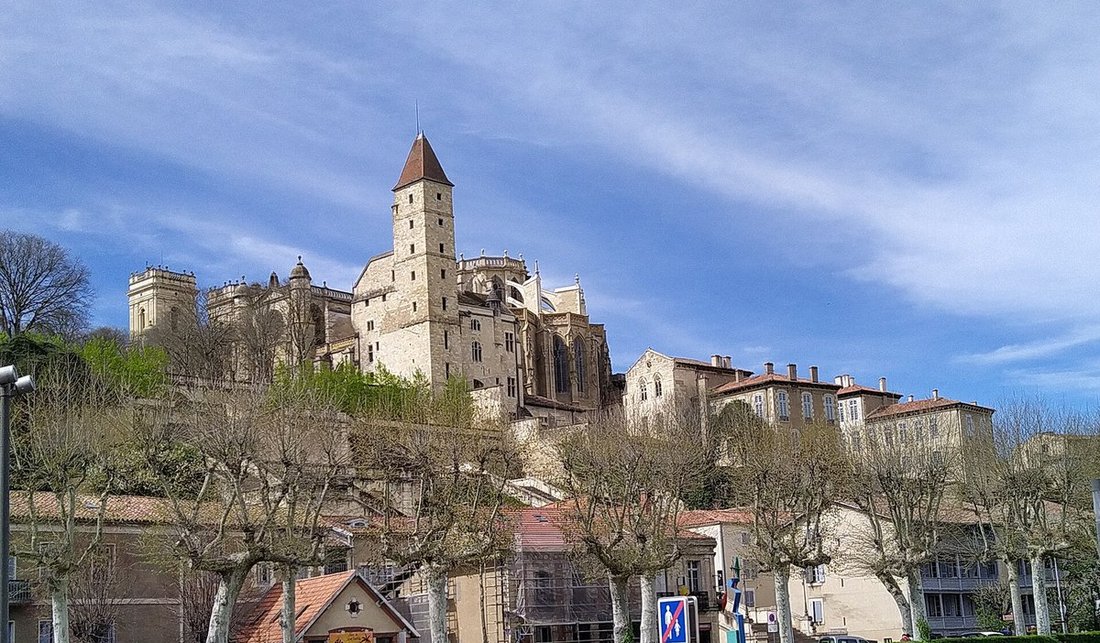
Drive through the French département of Gers today and you pass a town called Auch. The name sounds like nothing at all. It is one syllable, unremarkable, and hard to pronounce for anyone without Gascon. And yet that name is the last surviving trace of a people who lived between the Garonne and the Pyrenees two thousand years ago: the Ausci. Their town carried three names in succession — a native one, a Roman one, and one that is neither. In the end it was the tribal name that won. This is neither an accident nor a peculiarity of one place. It is a pattern that lies across half of France. And the Ausci are the case in which it can be unfolded most cleanly — because here, exceptionally, the oldest name can still be read.
No king of the Ausci is recorded, no battle they won, no treaty they concluded. What remains of them is some eighty Latin inscriptions, a few lines in four ancient authors, an excavated hill — and a town name. The town name has proved the toughest of all. It has outlived the people, the Roman province, the duchy of Aquitaine and the French monarchy, and it still stands on every road sign.
That is more remarkable than it sounds, because the town in question had its own older, meaningful name. It lost it. What survived was the name of the people who lived there.
The territory of the Ausci lay in the basin of the Gers, a tributary of the Garonne, in the middle of the country later called Gascony. Their neighbours were the Elusates around Eauze and the Lactorates around Lectoure — both likewise small peoples with their own name and their own principal place. First-century BC Aquitania was not a great power but a patchwork of such units, most of them controlling hardly more land than four or five modern cantons.
Within that patchwork, however, the Ausci were no minor group. Scholarship ranks them, together with the Tarbelli, as the most powerful of the Aquitanian peoples. The hard argument is epigraphic: the Ausci left around eighty inscriptions — more than any other Aquitanian people except the Convenae.
The name Ausci enters world literature at an entirely unceremonious point: in an enumeration. In 56 BC Publius Crassus, Caesar's young subordinate commander, campaigned through Aquitania. He first defeated the Sotiates, then a large coalition of Vocates and Tarusates who had even fetched commanders from neighbouring Spain — men who had served under Sertorius and understood Roman camp discipline. After that second defeat, Aquitania gave up. Caesar records it in a single sentence:
Hac audita pugna maxima pars Aquitaniae sese Crasso dedidit obsidesque ultro misit; quo in numero fuerunt Tarbelli, Bigerriones, Ptianii, Vocates, Tarusates, Elusates, Gates, Ausci, Garumni, Sibusates, Cocosates.
"When news of this battle spread, the greater part of Aquitania surrendered to Crassus and sent hostages of its own accord; among them were the Tarbelli, the Bigerriones, the Ptianii, the Vocates, the Tarusates, the Elusates, the Gates, the Ausci, the Garumni, the Sibusates and the Cocosates."Caesar, Bellum Gallicum III,27; translation: Glanz & Gravur
Eleven names in one line. Of those eleven, one is now a prefecture town, one is a region, and the rest have vanished. The passage is worth remembering: the earliest evidence for the Ausci is a name in a row of names — and it is precisely as a name that it survived.
Three further ancient authors mention the Ausci. Pliny the Elder lists them among the peoples of Aquitania (Naturalis historia IV,108), but without any emphasis whatsoever — they stand between the Consoranni and the Elusates in a long, uniform run of small names. Anyone relying on that list alone would take the Ausci for one tribe among twenty. Ptolemy, in the second century, already knows the Roman form of the town name.
The friendliest witness is Pomponius Mela, writing under Claudius: he calls the town of the Ausci the finest in Aquitania. And he still calls it by its native name. That is a dating clue easily missed: in the middle of the first century AD, the old name was still the usual one.
The politically most important notice about the Ausci comes from Strabo. He reports that the Romans granted the Latin right to certain of the Aquitani, as they had done in the case of the Ausci and the Convenae. This is no throwaway remark: the ius Latii opened the path to Roman citizenship for a community's magistrates and lifted the whole place, legally, out of the mass of subjected peoples.
One correction that is frequently got wrong in popular accounts: this passage is not Strabo IV,2,1 but IV,2,2. In IV,2,1 the Ausci appear only in passing, with the remark that their land has good soil; that section is otherwise about the gold of the Tarbelli and about Lugdunum of the Convenae. The sentence on the Latin right comes only in the following section, after the enumeration of Ruteni, Gabales, Cadurci and Vellavii. Anyone citing it should check the reference rather than copy it.
The native name of the town survives in several variants: Elimberris, Elimberrum, Eliumberrum. It is not an empty sound but a transparent word. It is read as an Aquitanian compound of an element meaning "town, settlement" and one meaning "new" — the same building blocks that live on in modern Basque as iri or hiri and berri. Elimberris simply means: the new town.
This matters, because it is only rarely possible to translate a pre-Roman place name in Gaul at all. Here it works, and it works because the Aquitani were not Celts. Their language is the best known predecessor of Basque; it survives almost exclusively in the form of personal and divine names on Latin inscriptions — roughly two hundred personal names and some sixty names of deities. Names such as Cison, Sembe, Andere and Nescato stand recognisably beside Basque gizon "man", seme "son", andere "lady" and neskato "girl". The names in the Auscian inscriptions are largely of this kind.
Elimberris does not stand alone. The same formula appears in Illiberis at the foot of the eastern Pyrenees — modern Elne in Roussillon — and in Iliberri, the pre-Roman settlement beneath present-day Granada. Three places, far apart, with the same name: "new town". It is one of the strongest single pieces of evidence that a continuous linguistic landscape lay here, one that respected neither the Pyrenean line nor any later state border.
The comparison is just as instructive at the other end. Elne is no longer called Illiberis; it carries a late antique name going back to the empress Helena. Granada carries a name mediated through Arabic. And Elimberris carries the name of its people. Three places, three completely different ways of losing an old name.
Here it gets interesting. Almost every short account states that Elimberris was the pre-Roman oppidum of the Ausci. The excavations of the last twenty years paint a different picture.
About ten kilometres north of Auch, in the commune of Roquelaure, lies the rocky spur of La Sioutat. Since 2007 it has been investigated in thirteen planned campaigns by the French national institute for preventive archaeology (Inrap) together with the TRACES laboratory of the University of Toulouse-Jean-Jaurès, under the scientific direction of Philippe Gardes; the excavations concluded in 2019. The finding: a settlement develops on the spur as early as the sixth century BC, terraced, protected by a rampart, with houses of timber and earth on post foundations and floors partly paved with amphora sherds.
The finds show long-distance contact from the outset: Massaliote amphorae and Attic pottery already in the sixth century BC. The site lay on the Gallic isthmus, the land bridge between the Mediterranean and the Atlantic, along which wine — first Etruscan and Campanian, later Tarraconensian — travelled from Narbo via Tolosa northwards. The Ausci did not sit in a backwater but on one of the most important trade axes of Gaul.
Two finds from La Sioutat change the picture of the Ausci especially sharply. The first: around 20 BC a building of nearly 2,000 square metres goes up on the southern slope, its wall paintings approaching Pompeian work in quality; parts of them are today in the Musée des Jacobins in Auch. The excavators consider a member of the native elite the likely patron. That fits Strabo's note on the Latin right precisely: here lived a local elite that had risen legally and was showing it.
The second find comes from the final campaign of 2019: a coin die. A coin die is not an ornament but a means of production — whoever owns one strikes money. As evidence for the political weight of the place within Aquitania, that is harder than any mention by an ancient author.
The settlement on the spur is not abandoned after the Roman conquest. Around 30 BC, timber and earth give way to stone footings and life continues. Only in the middle of the first century AD is the site left — and deliberately so: the centre of gravity shifts to Auch. The excavators give two reasons, one administrative and one entirely practical. Sewerage and water supply are almost impossible to install on an uneven rocky spur; down by the river they are not.
Which brings us to a detail that makes the story better still: Auch itself is a double town. The older settlement lay on the left bank of the Gers; the new Roman quarters grew up on the floodplain to the right. Archaeology there has documented the sewer network, potters' kilns, terra sigillata assemblages, inscriptions and houses with mosaics.
Under the Empire the town receives a new name: Augusta Auscorum, "the Augusta of the Ausci". The name is built from two components, and neither of them belongs to the place. The first is the emperor's name — Augustus. The second is the name of the people in the genitive plural. What remains is a formula found all over Gaul: an imperial honour plus a statement of jurisdiction.
The native name does not die at once — Mela still uses it, and the Latin form Elimberrum continues to appear in the sources. But officially it has been replaced. For the town this meant promotion. For its name it meant the beginning of the end.
Behind this lies no linguistic accident but administrative logic. Rome organised Gaul not by cities but by civitates — by peoples, each assigned a principal place. That place was first and foremost the administrative seat of a community. Officially, therefore, one did not say "the city of X" but "the civitas of the Y". Grammatically, the city was an appendage of its people.
As long as the Empire functioned, both names stood side by side. When, in late antiquity, administrative language became more dominant than local tradition, the relationship tipped. In practice, "Augusta of the Ausci" was reduced to "the Ausci".
In the early fourth century the town is attested as civitas Auscius. The emperor's name has gone; the actual place name went long before. What remains is the bare tribal name — and it enters Romance sound development. By way of the Gascon form Aush it becomes French Auch.
The result is peculiar: today's town name is not the name of the town. It is the name of a population group that has not existed as a distinct entity for a millennium and a half. The place name preserved the tribal name while the tribe itself disappeared.
Once noticed, the pattern is everywhere. Lutetia, the chief place of the Parisii, is already Lutetia apud Parisios in the third century, then civitas Parisiorum — and finally Paris. Durocortorum, the great city of the Remi, becomes Reims. Avaricum, the oppidum of the Bituriges, attested around AD 400 as civitas Biturigum, becomes Bourges. Limonum of the Pictones becomes Poitiers. Augustoritum of the Lemovices becomes Limoges. Vesunna of the Petrocorii becomes Périgueux.
In every one of these cases the same sentence applies: the sonorous old city name has vanished, the tribal name has won. Anyone speaking today of Paris, Reims, Bourges, Poitiers, Limoges or Périgueux is not naming a city at all, but a tribe.
With the Ausci, however, something is added that the other cases cannot offer. Lutetia, Avaricum and Vesunna are Celtic names that can be analysed but translated only with reservations. Elimberris can be translated — because an entirely different language family was at work here. The Auscian case is therefore the only one in the series in which both the displaced and the victorious layer of naming can genuinely be read.
Administrative history comes to the town's aid once more. When Diocletian divided Aquitania, the province of Novempopulana, "that of the nine peoples", emerged in the south-west. Its capital was at first not Auch but Elusa — Eauze, the chief place of the Elusates, raised to metropolis towards the end of the second century. Only after the destruction of Elusa in 409 did Auch move to the top.
That this exchange of rank really took place can be read in a list. The Notitia Galliarum, a late antique register of the Gallic provinces and their communities, records twelve civitates under Novempopulana. In first place, as chief city, stands civitas Ausciorum. And in last place, right at the end of the run, stands civitas Elosatium. The order is the message: the old metropolis appears as the tail end of the very list that documents its own replacement.
Three things remain in the end. First, the inscriptions, in which people with Aquitanian names and occasionally Roman citizenship formulae appear side by side — the clearest evidence that what happened here was not the disappearance of a people but a population changing language. Second, the hill of Roquelaure with its terraces, its amphorae, its palace and its coin die. Third, a name on a road sign.
Of these three, the name is the least conspicuous and at the same time the most durable. It no longer carries a meaning anyone could pronounce, and precisely for that reason no one replaced it. Meaningful names get translated, reinterpreted, adapted. A name that means nothing any more is simply passed on.
Readers interested in this world will find the neighbours and contemporaries of the Ausci here as well: the Convenae, who received the Latin right in the same sentence of Strabo; the Tarbelli with their gold; the Sotiates, whom Crassus defeated first; the Santones and Segusiavi further north; along with overviews of Celtic warriors, Celtic religion and the Celtiberians, whose commanders stood on the opposing side in 56 BC.
The Convenae · The Tarbelli · The Sotiates · The Vellavi · The Gabali · The Segusiavi · The Celtic Warriors.
All History & Finds articles →
Exactly one word survives from the Aviones: their name. No grave, no inscription, no coin, no second ancient writer who …
Read more →