Exactly one word survives from the Aviones: their name. No grave, no inscription, no coin, no second ancient writer who mentions them. They stand in a single list in Tacitus, between the Reudigni and the Angles, and after that the record closes for good. And yet a great many books state quite precisely where they are supposed to have lived: on islands. That information comes not from a source but from the name itself. This is entirely legitimate, because when nothing else survives, historical linguistics is the last tool left. But one has to know what that tool can do and where it begins to confirm itself. The Aviones are a textbook case, because here the whole process can be traced step by step: how a word turns into a map, and exactly where the chain of evidence bends into a circle.
The source situation of the Aviones can be summed up in one sentence, and that sentence is shorter than the name of the people. They appear once in the whole of ancient literature, in the list of peoples in the Germania of Tacitus. Neither Pliny nor Ptolemy names them, nor any Roman military writer; there is no inscription, no military diploma, no late antique administrative list. Archaeology does not help either: there is no site, no pottery form, no cemetery type that scholarship could assign to the Aviones. Anyone writing about them has exactly one line of text and one word. That whole paragraphs have nonetheless been written about their way of life, their neighbours and their settlements is not due to new finds, but to the fact that people have carried on calculating from the name.
In the fortieth chapter of his Germania, Tacitus describes a group of peoples whom he explicitly counts among the Suebi in the following chapter. The chapter does not, however, begin with the seven names: it begins with the Langobards, and the run of seven follows only in the second sentence. The Aviones stand second in it, after the Reudigni and before the Angles. Then comes the famous passage on the wagon procession of Nerthus, which applies not to the Aviones alone but to the entire group.
Reudigni deinde et Aviones et Anglii et Varini et Eudoses et Suardones et Nuithones fluminibus aut silvis muniuntur. Nec quicquam notabile in singulis, nisi quod in commune Nerthum, id est Terram matrem, colunt.
Next come the Reudigni and the Aviones and the Angles and the Varini and the Eudoses and the Suardones and the Nuithones; they are protected by rivers or forests. There is nothing remarkable about any one of them individually, except that they worship Nerthus in common, that is to say, Mother Earth.Tacitus, Germania 40; translation: Glanz und Gravur
It is worth being clear about how little is actually stated here. Tacitus gives no landscape, no river, no island, no place and no compass direction for these seven peoples. He says only that they are protected by rivers or forests, and that is a formula which fits almost any region north of the central uplands. He even says explicitly that there is nothing remarkable about the individual peoples, and moves straight on to the shared cult. Everything one reads today about the settlements of the Aviones is therefore inferred either from the neighbouring names in the list or from the word itself. Even the widespread statement that they sat in southern Jutland is nothing but a deduction from the fact that the Angles occur in the same run and that the Angles can be located.
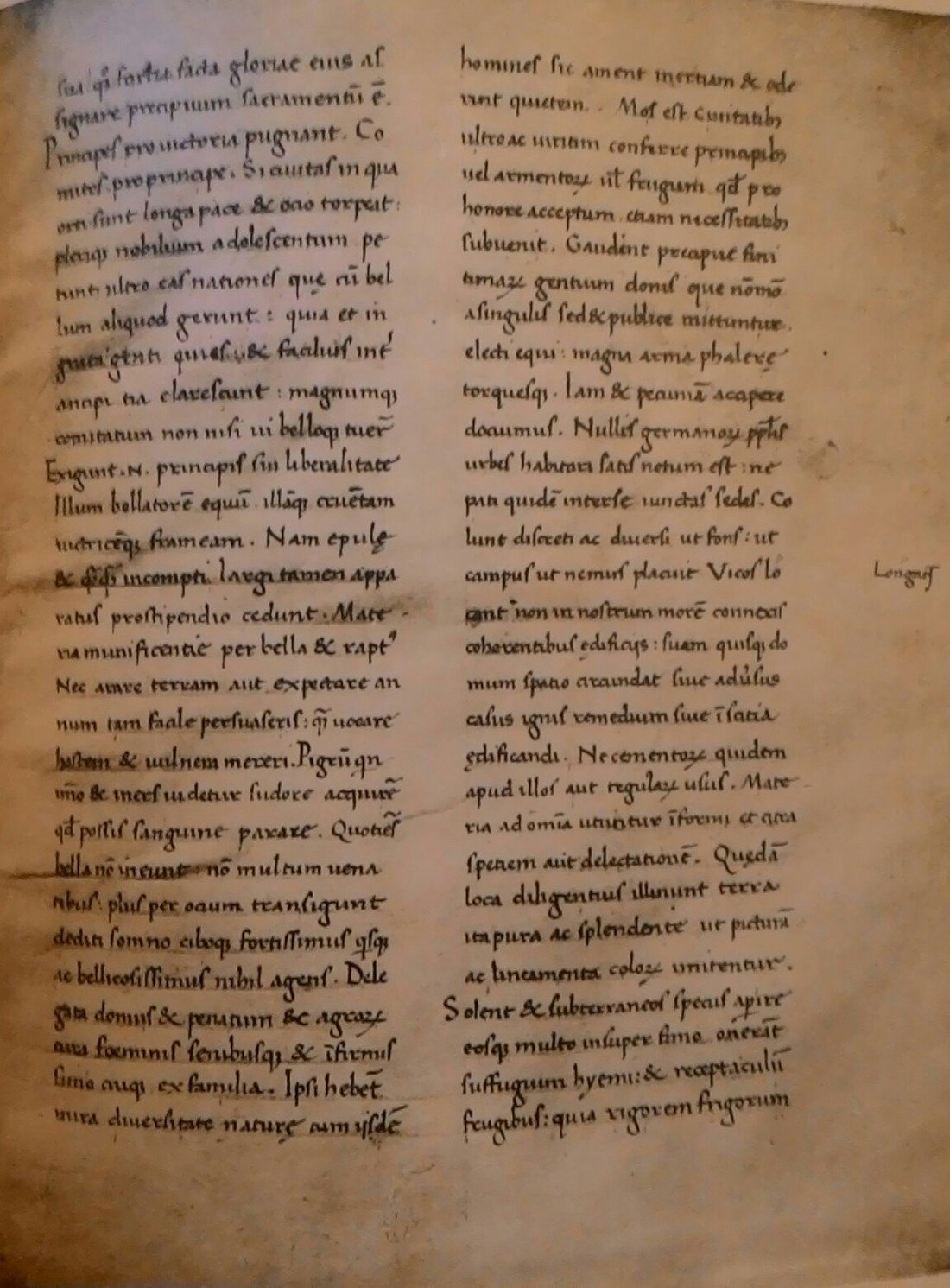
Before deducing anything from a word, one should know how reliably that word reached us. The Germania depends on a single lost manuscript, the Codex Hersfeldensis, written in the ninth century, reported at Hersfeld Abbey in 1425, taken to Italy by Enoch of Ascoli in 1455 and there broken up and copied. The original has been missing ever since. The only textual witness regarded as a direct copy is the Codex Aesinas, rediscovered in 1908 and today kept in Rome as Cod. Vitt. Em. 1631. The eight Carolingian leaves bound into that volume, however, belong to the Agricola; the Germania itself stands in it entirely in a fifteenth-century hand. For our word that means roughly fourteen centuries of copying between Tacitus and the oldest surviving witness.
In the literature one meets the forms Aviones and Auiones side by side, and one might think two readings were competing here. That is a misunderstanding. In Latin manuscripts u and v are one and the same letter; whether a modern editor prints Aviones or Auiones is a question of transcription, not of transmission. The genuine textual crux in this sentence lies elsewhere, with the Suardones: the manuscripts read Suarines, while the form Suardones appears only in the margin of one manuscript, was taken into the text by older editions, and travelled from there into countless translations. Readers interested in that side of the matter will find it treated at length with the Eudoses. For the Aviones the position is simple: the name itself is textually unremarkable.
This is exactly where onomastics comes in, and rightly so. A tribal name is a linguistic object like any other. It has a stem, a suffix, a sound history, and it can be compared with other words of the same language stage. In a situation with no second source and no archaeological find, the name really is the only piece of antiquity still in hand. No serious scholar would forgo it. The problem begins one step later, when the meaning of a word turns into a statement about geography, economy or religion. A name is first of all evidence for a language. Whether it is also evidence for a landscape has to be shown independently, and with the Aviones that is precisely what cannot be done.
The analysis is in principle straightforward. The Latin ending -ones is the usual rendering of a Germanic n-stem, a suffix that turns a word into a designation for people: those of X, those belonging to X. The same formation occurs in many other names in the Germania. What remains is the stem Avi- or Awi-, for which scholarship posits Proto-Germanic *awjō. Taken together this yields a reconstruction along the lines of *Awjōniz, roughly the people of the *awjō. So far the sum works out, and the sound correspondences cause no difficulty. The decisive question is not whether the analysis is right, but what *awjō actually means, and at this point matters become uncomfortably more precise than the shorthand suggests.
Proto-Germanic *awjō belongs to an Indo-European root for water, the same one that lies behind Latin aqua. Its descendants are attested right across the Germanic languages: Old Norse ey, Old English īeg or ēg, Old Frisian ā, Old High German ouwa, and from the last of these modern German Aue. English island belongs here too, by way of Old English īegland. In Scandinavian place names the same element appears in formations such as *awjalandą, and in names such as *Skaðinawjō or *Batawjō it is the base word. The word family is therefore large, old and well documented. Anyone interpreting the Aviones as people of the water is on firm ground. The only question is which kind of water-land is meant.
Here lies the sore point of the whole construction. *awjō does not simply mean island; it denotes the thing on the water: island, holm, water-land, meadow, floodplain. German Aue to this day means not an island but damp meadow land beside a river. For Old English īeg, place-name scholarship explicitly records the sense of slightly raised dry ground offering settlement sites in areas surrounded by marsh or liable to flooding, as probably in the name Isle of Ely; alongside it stands Old English ealand, river-land, watered place, meadow by a river. Render *Awjōniz as people of the water-land or people of the holm, then, and it fits the entire North German and Jutish marsh and lowland belt. It fits every river lowland from the Ems to the Oder. The one thing it does not deliver is a location on an island in the sea.
One can now watch this vagueness harden into certainty. The reasoning recurs in the literature in this form: the name means islanders, so the Aviones must have sat on an island. And since Tacitus in the same chapter speaks of a sacred grove on an island in the Ocean, the two fit together splendidly, which confirms the island reading of the name. That is a closed circle. The island location is inferred from the name, and the name is then justified by the island location. Neither step adds any new information. The problem is compounded by the fact that the Nerthus island in the text applies to the whole group of seven and not to the Aviones; there is no sentence linking the Aviones to that island. How the cult is actually described can be read in the piece on the Nerthus group and on the goddess Nerthus herself.
There is even a textual argument against the convenient equation. In chapter 40 Tacitus writes in insula Oceani, on an island of the Ocean. The Baltic, by contrast, he names elsewhere with a term of its own: in the chapter on the Aestii he speaks of the right-hand shore of the Suebic Sea. He therefore has two distinct designations available and uses the wide one in the Nerthus passage. Whether the sacred island accordingly lies in the Baltic, in the North Sea or in a purely literary remoteness cannot be decided from the wording. Anyone placing the Aviones on a particular Baltic island is relying on an identification that the Latin text does not supply. That is no proof of the opposite, but it strips the circle of its apparent self-evidence.
That the method works in principle is shown by a counter-example from our own region. The name of the Batavi is generally traced to a formation with the same element *awjō, roughly good island. Here, however, one has something the Aviones lack: an independent control. In chapter 29 of the same work Tacitus writes that the Batavi inhabit not so much the bank as an island of the river Rhine. Caesar already knows the Rhine island. Add to that inscriptions, military diplomas, a well-studied archaeological landscape in the Rhine-Meuse delta and continuous attestation across centuries. The name says island, and the sources independently say island as well. That is the constellation in which an etymology genuinely proves something. With the Aviones every single one of these controls is missing.
How easily the ear can be deceived is shown by an island name that looks as though it wore the Germanic word for island plainly at its end: Norderney. The ending -ey recalls Old Norse ey, and many take it for exactly that. The documentary record says otherwise. In sixteenth- and seventeenth-century sources the island appears as Norder Nie Oech, as Ninoorderooghe and as Norder neys Oog, that is, as the new northern Oog. The word for island here is Oog, as in Langeoog or Spiekeroog, and the component we now hear as -ney is the adjective new. The modern name therefore contains the compass direction and the word new, while the noun island dropped off over time. A name that sounds like island and contains none.
The most famous case is printed on every map. The ancient manuscripts of Pliny give the name of the great northern island as Scadinavia or Scatinavia; the form current today, with an inserted n, is regarded as secondary and is usually put down to an error in transmission. Behind it lies a Germanic formation with that very element *awjō, traceable in Old English as Scedenig and in Old Norse as Skáney. The name of an entire subcontinent thus rests on a form that was probably never spoken. English island has a similar history: the silent s was inserted only in the sixteenth century, by false association with isle, which goes back through French to Latin insula and is not related to the Germanic word at all. Spellings, in short, are not witnesses.
One can also test the matter from the other side and ask whether the islands of the region in question even bear Germanic island names. Fehmarn, the large island off the east Holstein coast, does not. Its name is explained as Slavic, from Wagrian fe more, in the sea, and appears in older sources as Vemere, Fembre or in latinised forms such as Imbria. That is a reminder that several languages have assigned names in this area over the centuries, and that the present-day name landscape by no means reaches back unbroken into the time of Tacitus. Anyone looking for an island whose name might supply evidence for the Aviones is searching in a landscape whose stock of names has been overwritten more than once. This too belongs among the limits of the method, and it is rarely mentioned.
The real difference between a tribal name that carries weight and one that carries none lies in its afterlife. The name of the Angles survives to this day in the district of Angeln in Schleswig and in the name of England. With the Varini a connection with the river name Warnow has long been debated, with good arguments on both sides. With the Jutes the trail leads to Jutland and to Kent. With the Harudes the same name turns up in two widely separated places, which creates problems of its own. For the Aviones there is nothing of the kind: no district, no region, no river, no village, no medieval attestation. Their name never landed anywhere in the terrain. And that removes precisely the bridge which, for their neighbours, turns a word into a place.
The strongest proposal links the Aviones with the Swedish Baltic island of Öland and with the Eowan of the Old English poem Widsith. Both have something to be said for them. Öland goes back to a formation with the island word, and in his report in the Old English Orosius around 890 Wulfstan does indeed call the island Eowland. In Widsith, line 26 reads Oswine weold Eowum ond Ytum Gefwulf, Oswine ruled the Eowan and Gefwulf the Jutes, and the preceding line already names the Wernas. Two consecutive lines therefore contain exactly the neighbours who stand side by side in Tacitus. What is striking, though, is what this argument rests on: not on sound, but on adjacency. It is an argument from the list, not from phonology, and the Öland equation itself goes back to older interwar literature. Alongside it, a connection with the Chaibones attested in 286 has occasionally been considered; it causes phonological difficulty and cannot be regarded as established.
What remains is a sober balance that does the Aviones more honour than any localisation. Their name is a genuine piece of antiquity: old, cleanly transmitted and linguistically transparent. It attests that the Germanic-speaking world of the first century had a word for water-land and that group designations could be formed from it. That is no small thing. It does not attest where that group sat, how large it was, whether it formed a coherent unit at all, or whether the designation was a self-description or a name given by outsiders. Anyone claiming more is calculating with an unknown. How the religious framework of these peoples is to be judged as a whole is treated in the overview of Germanic religion; how a single sentence can carry a whole people is also shown by the Sedusii, the Suiones and the grove of the Semnones.

The Nerthus League · The Reudigni · The Eudoses · The Angles · The Warni · The Jutes · The Suebi.
