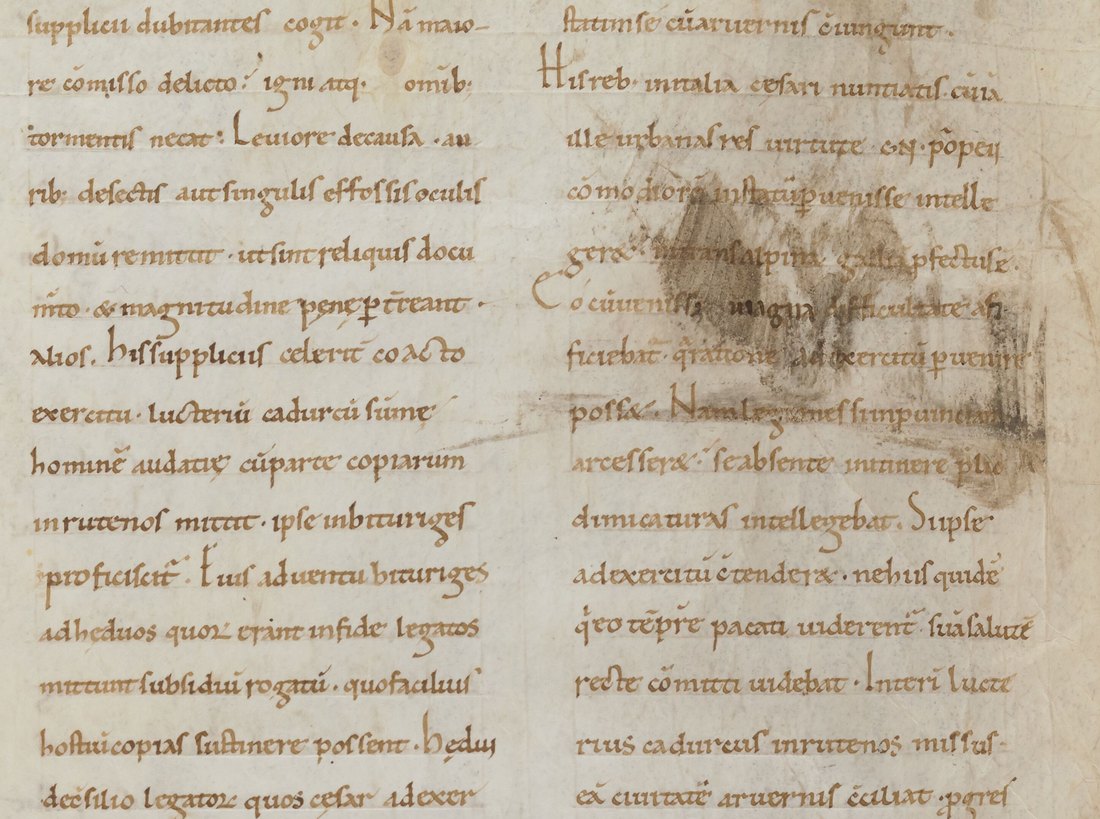
Seven names stand side by side in one line: Harudes, Marcomanni, Triboci, Vangiones, Nemetes, Sedusii, Suebi. Six of them reappear in the ancient record; some become towns, some become landscapes, some become whole kingdoms. One never reappears at all. The Sedusii are the last and thinnest name on Caesar's list, and for that very reason the most instructive. They show exactly how much a single textual attestation can carry, and where the study of ancient peoples from texts runs into its limit.
Everything genuinely attested about the Sedusii fits into a single sentence: in late summer 58 BC they stood as a separate contingent in the battle line of Ariovistus, somewhere on the Upper Rhine plain, and were defeated by Caesar's legions. That is the entire stock. No location, no size, no leader, no custom, no second attestation.
Caesar names them exactly once, in chapter 51 of the first book of his war commentaries. After that the record falls silent. Neither Pliny nor Tacitus nor Ptolemy nor Strabo lists a people of this name. Nor do the inscriptions of the Roman Rhineland, which for other peoples of the region supply cohort names, statements of origin and dedications by the dozen. What we have is one entry in a list, surrounded by a hole.
For a blog that otherwise lives on runestones, grave finds and saga texts, this is an unusually meagre subject. It is also, precisely for that reason, one of the most honest. Anyone who wants to understand how unstable our knowledge of the so-called Germanic peoples really is will learn more from a negative finding than from a princely burial.
Caesar describes how the army of Ariovistus is finally forced into a pitched battle. The Germani leave their camp, form up by peoples at equal intervals, and seal off their own rear with wagons. In that enumeration the Sedusii appear, second from last, between the Nemetes and the Suebi.
Tum demum necessario Germani suas copias castris eduxerunt generatimque constituerunt paribus intervallis, Harudes, Marcomanos, Tribocos, Vangiones, Nemetes, Sedusios, Suebos, omnemque aciem suam raedis et carris circumdederunt, ne qua spes in fuga relinqueretur.
Caesar, Bellum Gallicum I,51; own translation
Only then, and under compulsion, did the Germani lead their forces out of camp and draw them up by peoples at equal intervals: Harudes, Marcomanni, Triboci, Vangiones, Nemetes, Sedusii, Suebi. And they ringed their whole line with travelling wagons and carts, so that no hope of flight should be left.
It is worth being clear about what kind of sentence this is. It is not an ethnographic report, not a table of nations, not a piece of regional geography. It is a military snapshot: the deployment of an enemy army, noted down from the far side of the field. Everything we believe we know about the Sedusii hangs on this one line.
The background lies in a power struggle among Gallic confederations. On Caesar's account two camps contended for primacy in Gaul; one was led by the Aedui, the other by the Arverni and the Sequani. The latter hired Germanic warriors from across the Rhine, initially some fifteen thousand men. With their help they won the battle of Magetobriga, probably in 61 or 60 BC. Afterwards the hired men simply stayed.
The Aeduan Diviciacus lays the situation before Caesar in a long speech: by now there are some hundred and twenty thousand Germani in Gaul, a third of Sequanian land is occupied, a further third is being demanded, and a few months earlier twenty-four thousand Harudes had arrived, for whom land was likewise required. These figures stand in Caesar's text in indirect speech. They are the statements of a petitioner, not a count.
In the same year Caesar had already turned back the Helvetii. The campaign against Ariovistus followed directly, and it turned an intra-Gallic conflict into a Roman war on the Rhine frontier.
The man the Sedusii served under was no stranger to Rome. In 59 BC, during Caesar's own consulship, the Senate had recognised Ariovistus as rex atque amicus, king and friend of the Roman people. Caesar pointedly reminds him of this benefaction the following year, while declaring war on him.
The title promises more than it delivers. Rex is a Roman category imposed on a foreign counterpart; it says nothing about what standing Ariovistus actually held among the groups that followed him. Scholarship generally assumes that his authority extended over those groups which had crossed into Gaul with him, and that the individual peoples retained leaders of their own. Dieter Timpe described Caesar's portrayal of Ariovistus as propagandistic stylisation: the barbarian king as a revenant of the Cimbrian threat, against whom Rome must protect its allies.
It is also worth noting that, according to Caesar, Ariovistus spoke fluent Gaulish and had married, as his second wife, the sister of the Norican king Voccio. The image of a hermetically sealed Germanic world beyond the Rhine does not survive contact with Caesar's own text.
Caesar tells the campaign as a test of nerve. At Vesontio, the fortified centre of the Sequani, panic breaks out among his officers after Gallic traders dwell on the size and ferocity of the Germani. Caesar makes a speech, the army steadies itself, the march resumes. There follow an inconclusive parley between the two leaders, a manoeuvre by Ariovistus against Caesar's supply line, and days of cavalry skirmishing.
Caesar explains why Ariovistus avoided a decisive battle for so long by reference to an oracle: the matrons of the army had declared by lots and divination that victory was not fated before the new moon. Whether that was the real reason is open; Cassius Dio simply supposes that Ariovistus meant to starve the Romans out. What remains notable is that the oracle appears in Caesar's text as an explanation at all. It fits what other sources report about the role of casting lots in Germanic religion.
Only when Caesar leads his troops directly up to the enemy camp does Ariovistus have to come out. And in that moment, under compulsion and unwillingly, the line is formed in which the Sedusii appear for the only time in recorded history.
Caesar writes generatim, by descent groups, by peoples. Ancient commentators explain this by noting that kinsmen fight better shoulder to shoulder; Tacitus says much the same about Germanic formations some century and a half later. So if we follow Caesar, the deployment really was organised by groups of origin.
But a deployment is what it is. What Caesar enumerates are contingents, not settlement areas. His vantage point is a Roman command position facing a battle line. He presumably had the names from deserters, prisoners or Gallic intermediaries, exactly as he had the figure for the Harudes and the account of the lot oracle. We may assume that men stood in that line who would not have described themselves as belonging to any of the seven names at all.
The later careers of the neighbouring names are what make the silence around the Sedusii so conspicuous. The Marcomanni build a kingdom in Bohemia under Maroboduus a few decades later and occupy Rome until the Marcomannic Wars of the second century. The Triboci sit on the Upper Rhine around Strasbourg in the imperial period and give their name to the civitas Tribocorum. The Vangiones become the civitas Vangionum, with Borbetomagus, modern Worms, as its centre. The Nemetes supply the civitas Nemetum with Noviomagus Nemetum, modern Speyer.
The Harudes resurface in Ptolemy and in the Res Gestae of Augustus, though with serious problems of localisation. And the Suebi were never a single tribe but a collective name that runs on for centuries and echoes finally in the Alamanni and in the regional name Swabia.
Six names, then, acquire an afterlife: as an administrative district, as a landscape, as a kingdom, as a collective term. One does not.
A tribal name occurring only once can mean several very different things. First, the group may have been small and absorbed into larger formations after the defeat, an entirely ordinary process in a world where followings regrouped according to success and failure. Second, the group may have existed under that name only as a warband, never as a lasting settlement community. Third, the name may not be a name of its own at all, but an accident of transmission.
The third possibility is less exotic than it sounds. It has a concrete philological foothold, and it leads straight into the question of how ancient texts reached us in the first place.
Caesar's work survives not in the original but through medieval manuscripts written centuries after his death. Errors occur along that chain, especially with proper names that mean nothing to the copyist.
And the name is not stable. The late antique historian Orosius tells the same episode and lists the same peoples, but in place of the Sedusii his text has a different form. In Carl Zangemeister's standard edition it reads: fuerunt autem in exercitu Ariovisti Arudes Marcomanes Triboci Vangiones Nemetes Eduses et Suebi. The Sedusii have become Eduses. Further variants such as Edures and Eudures are reported from the manuscript tradition of Orosius.
Orosius is not an independent witness to the event; he draws on Roman literature and states himself that he excerpted Suetonius. But he is a witness to the text. His exemplar evidently did not read at this point what our Caesar manuscripts read.
From this arises a suspicion that has been voiced repeatedly: the initial S of the Sedusii may not belong to the name at all. In Caesar's list the word immediately preceding is Nemetes. A copyist faced with Nemetes Edusios could easily double the final S of the first word, and the next generation reads Nemetes Sedusios. Such doublings are among the commonest types of error in manuscript transmission.
On that assumption one is no longer dealing with a people called Sedusii but with one called Eudusii or Eudoses. Reject the assumption and the Sedusii remain, but then one has to explain why Orosius read something else. The question is not settled. It is also worth noting that this very stretch of text contains a second, better known crux: in the account of the pursuit to the Rhine the manuscripts vary between five, fifteen and fifty miles, and both Plutarch and Orosius give the large figure. Same chapters, same uncertainty.
If the reading Eudusii is taken seriously, a connection opens up. In the Germania Tacitus names a group of peoples protected by rivers and forests who jointly worship the earth goddess Nerthus: Reudigni, Aviones, Angles, Varini, Eudoses, Suardones and Nuithones. Since the nineteenth century the Eudoses of that group have occasionally been identified with Caesar's Eudusii and located in the north, usually on the Cimbrian peninsula.
A third element is sometimes added: older Latin renderings of Ptolemy give, on the same peninsula, a name in the form Fundusii, and it has been proposed that this is a misread Eudusii. That would yield an attractive line: Caesar's contingent of 58 BC, Tacitus' Nerthus worshippers, Ptolemy's peninsular dwellers.
The trouble is that this line is a chain of conjectures. Every link depends on an assumed scribal error, none on hard evidence. One may find it plausible; one should not mistake it for knowledge. And it has an awkward side effect: it would tie a contingent fighting in Alsace to the Danish North Sea coast, more than seven hundred kilometres away, on the strength of similar-sounding names alone.
There is no secure derivation of the name. Popular websites offer one nonetheless: strip the Latin ending, keep sedus, connect it with a Germanic word for custom or habit that survives in Gothic sidus and Old High German situ, or alternatively with a root for sitting, and interpret the Sedusii as the settlers. That is resemblance of sound, not proof, and it works only so long as one presupposes the reading Sedusii, which is precisely the point in dispute.
The sober answer is that the name has not been explained. Whether it is Germanic at all is not established; German-language reference works speak of a perhaps Germanic tribe. That Caesar calls all seven groups Germani says little, since what makes someone a German in his usage is not language but the side of the Rhine and the political alignment.
The most honest answer sits in an English school commentary on this very passage: the whereabouts of the Sedusii are quite uncertain. That has been the position since the nineteenth century, and it has not improved.
Localisations circulate all the same. One reads that the Sedusii sat east of the Rhine, somewhere in the hinterland, because the early Suebic confederation was concentrated there. One reads that their territory was later taken over by the Alamanni in Franconia. One occasionally reads of a link with the Sudetes or with the Suardones of Tacitus. All of this consists of inferences from proximity, sound and plausibility, not from sources. Caesar says not one word about where the Sedusii lived.
The difference between assertion and evidence is total here. That a group fought in an army which had crossed from the right bank of the Rhine into Gaul makes it likely that it came from somewhere east of the river. It does not say where.
The obvious move is to ask archaeology. For the Upper Rhine of the mid first century BC it can say a great deal and very little at once. A great deal, because the settlement history of the region is well studied: the originally Celtic Upper Rhine and lower Neckar area appears strikingly thinly settled or wholly unsettled from the years of the Gallic wars onwards, and only from roughly the mid first century AD can Elbe Germanic groups be identified there, later appearing in Roman administrative language as Suebi on the Neckar.
Very little, because finds do not carry names. Pots, brooches and burial customs produce distribution maps that are bundled into archaeological cultures, but an archaeological culture is not a people. Sebastian Brather has taken that equation apart in detail and shown what nineteenth and early twentieth century assumptions are built into it. There is no assemblage that could be assigned to the Sedusii, and there would be none even if we knew where they lived.
A further complication: the geographical passages in Caesar's work that are most often used for localisation are themselves suspected in scholarship of being later insertions. The source one would like to draw on is, at this point, not itself secure.
Seen from the Aachen region, the episode is not as distant as it sounds. The Triboci around Strasbourg, the Vangiones around Worms, the Nemetes around Speyer: this is the chain of Rhine dwellers that continues downstream into our own landscape. Further north sit the Treveri on the Moselle, the Eburones between Meuse and Eifel, and a little later the Ubii around Cologne and Bonn. The same river, the same Roman ordering logic, the same questions of belonging.
And the same trap. It is tempting to slot the Sedusii into that chain and assign them a place on the Upper Rhine because their neighbours in the list can be located there later. That would be exactly the fallacy. Caesar says only that they stood in Ariovistus' army. Everything beyond that is an addition of ours, and it does not become correct by looking tidy.
Behind the individual case lies a fundamental question. Caesar's generatim leaves open what actually held the unit together: common descent, a following gathered around a leader, a settlement community, or a temporary association formed for one crossing of the Rhine. In a world where groupings re-formed according to success, all four could apply at once or shade into one another quickly.
Roman ethnography translated that mobility into fixed lists of names, because lists can be administered. That we still think in tribes when we talk about the Iron Age is in good part an inheritance of that administrative language. It applies to the Semnones, to the Chatti, to the Cherusci, and it applies in especially pure form to the Sedusii, of whom nothing survives but the list entry itself.
The same mechanism is visible when Rome files foreign deities under Roman names. There too order is produced by sorting the unfamiliar into familiar compartments. How far that carries we have set out elsewhere in our piece on the interpretatio Romana.
There is a temptation in historical writing to fill the gap because it looks uncomfortable. A name becomes a tribe, the tribe becomes a settlement area, the settlement area becomes a map with a neatly hatched patch. None of that is in the source. In the end one believes one knows something that was never known.
The Sedusii are the case that cures this temptation. They mark a limit value: the minimum of transmission at which the name still exists and everything else already does not. Taking them seriously means taking seriously that the handsome tribal maps of the Iron Age consist in many places of exactly this material, of list entries, similar-sounding names and good intentions.
And one last, unspectacular thought remains. Behind that single word stood people. They marched west with an army, they formed up in a line on a late summer day, they lost, and they fled to the Rhine. We do not know their names, their language or their graves. What remains of them is an accusative plural in a Roman war report, together with the uncertainty whether even that was copied correctly.
This much is secure: Caesar names seven contingents in the battle line of Ariovistus, among them the Sedusii, in Bellum Gallicum I,51. The battle took place in late summer 58 BC in the Upper Rhine region, and Ariovistus escaped across the river. It is further secure that the Senate had recognised Ariovistus as rex atque amicus in 59 BC, that Caesar places the figure of a hundred and twenty thousand Germani in Gaul in the mouth of the Aeduan Diviciacus, and that the Harudes are given as twenty-four thousand persons. Finally, it is secure that Orosius, in Zangemeister's edition, offers the form Eduses where Caesar has the Sedusii. Everything else is not secure: settlement area, size, language, etymology, ethnic affiliation, and even the correct form of the name.
Claims about the Sedusii circulate online that stand in no source. First, the assertion that they supplied six thousand horsemen and six thousand foot: those figures belong to Bellum Gallicum I,48 and describe the cavalry of Ariovistus' whole army, together with the well known tactic in which a selected foot soldier ran alongside each rider. They have nothing to do with the Sedusii. Second, the placing of them in Franconia or generally east of the Rhine: Caesar names no dwelling place, and the standard commentary on the passage states explicitly that their whereabouts are quite uncertain. Third, the etymology as the settlers: it is derived from sound alone and additionally presupposes the disputed reading Sedusii. Fourth, the figure of a hundred and twenty thousand Germani: it is part of a plea in indirect speech, not a census. And fifth, the tacit assumption that a name on a list is automatically a people with land, language and history. That is the real legend at issue here.

The Harudes · The Marcomanni · The Triboci · The Vangiones · The Nemetes · The Suebi · The Helvetii.
All History & Finds articles →
Long before the Viking Age and before the Icelandic Edda there was Germanic cult – and one of the most striking stood …
Read more →