Seven names stand side by side in the fortieth chapter of the Germania, separated by nothing but a Latin „and": Reudigni, Aviones, Angles, Varini, Eudoses, Suarines, Nuithones. One of those seven gave its name to an entire country – England. The other six disappeared, and the first in the row, the Reudigni, disappeared most thoroughly of all: the name occurs exactly once in the whole of surviving antiquity, in that single sentence, and never again. No second author, no inscription, no coin. This is not a footnote problem for specialists. It is the most interesting question the list can be asked. Why does one people's name survive in the record while another's does not? The answer has remarkably little to do with size or power – and a great deal to do with who later acquired writing, a church and a history of their own.
The Reudigni are the textbook case of a people of whom nothing remains but the letters. Scholars call this a hapax legomenon: a word that occurs exactly once in the entire surviving body of writing. It appears in Tacitus, in the work known as De origine et situ Germanorum, written around AD 98, in chapter 40. After that the record falls silent.
It is worth measuring how thin this is. Of the Chatti we know how they fought and how they wore their hair. Of the Batavi we have votive stones, military diplomas and a revolt. Of the Ubii we have a city that is now called Cologne. Of the Reudigni we have a word, a subordinate clause about rivers and forests, and Tacitus's explicit statement that there is nothing remarkable about them.
That is precisely what makes them instructive. A people about whom everything has been said once the sentence is translated forces us to think about the state of the sources themselves – and about what we actually mean when we say a people „vanished".
Chapter 40 does not in fact open with the Reudigni but with the Langobardi, relatives of the Suebi: Contra Langobardos paucitas nobilitat – „The Langobardi, by contrast, are ennobled by their small numbers." Only the second sentence brings the list: Reudigni deinde et Aviones et Anglii et Varini et Eudoses et Suardones et Nuithones fluminibus aut silvis muniuntur – „Then the Reudigni and Aviones and Angles and Varini and Eudoses and Suarines and Nuithones are protected by rivers or forests."
And further: Nec quicquam notabile in singulis, nisi quod in commune Nerthum, id est Terram matrem, colunt – „And there is nothing remarkable about them individually, except that in common they worship Nerthus, that is, Mother Earth." The remainder of the chapter belongs to the cult: the grove on an island in the ocean, the veiled wagon, the cattle, the peace that lasts as long as the goddess is travelling, and the lake in which the attendants are drowned.
So about the Reudigni themselves the text says exactly this: they are named, they are protected by rivers or forests, and they share a deity with six neighbours. Nothing more.
Reading the list backwards, the unevenness of the afterlife is immediately obvious. The Angles acquired a country and a language named after them. The Varini reappear centuries later: in Procopius, in Frankish politics, and as the eponyms of a Carolingian law book, the Lex Angliorum et Werinorum hoc est Thuringorum. The Eudoses can with some probability be traced in Old English verse and are connected by part of the scholarship with the Jutes.
With the Aviones and the Suarines matters grow thin: proposals exist for both, but every proposal first has to bend the transmitted name into shape. The Nuithones, like the Reudigni, are a hapax. And the Reudigni themselves have not even one uncontested point of connection.
That is the real observation. The seven stand in a single sentence as equals. What later became of their names has nothing to do with that sentence – and everything to do with what happened after Tacitus.
One repeatedly reads that the Reudigni were the „first" or even the „leading" people of the group because Tacitus names them first. There is no basis for this. In the Germania Tacitus regularly works geographically outward from a starting point, and his sequences are demonstrably a matter of presentation, not rank.
Nor do we know whether the sequence comes from Tacitus at all or from his source. The Germania is desk work: Tacitus never set foot in Germania; he processes older ethnography, merchants' knowledge and military reports. For the north his information is at its weakest – visible in the fact that he has less to say about seven peoples together than about the Chatti alone.
Anyone who reads a hierarchy out of a position in a sentence is mistaking a line of text for a map. It is the same error that turns an enumeration into a confederacy.
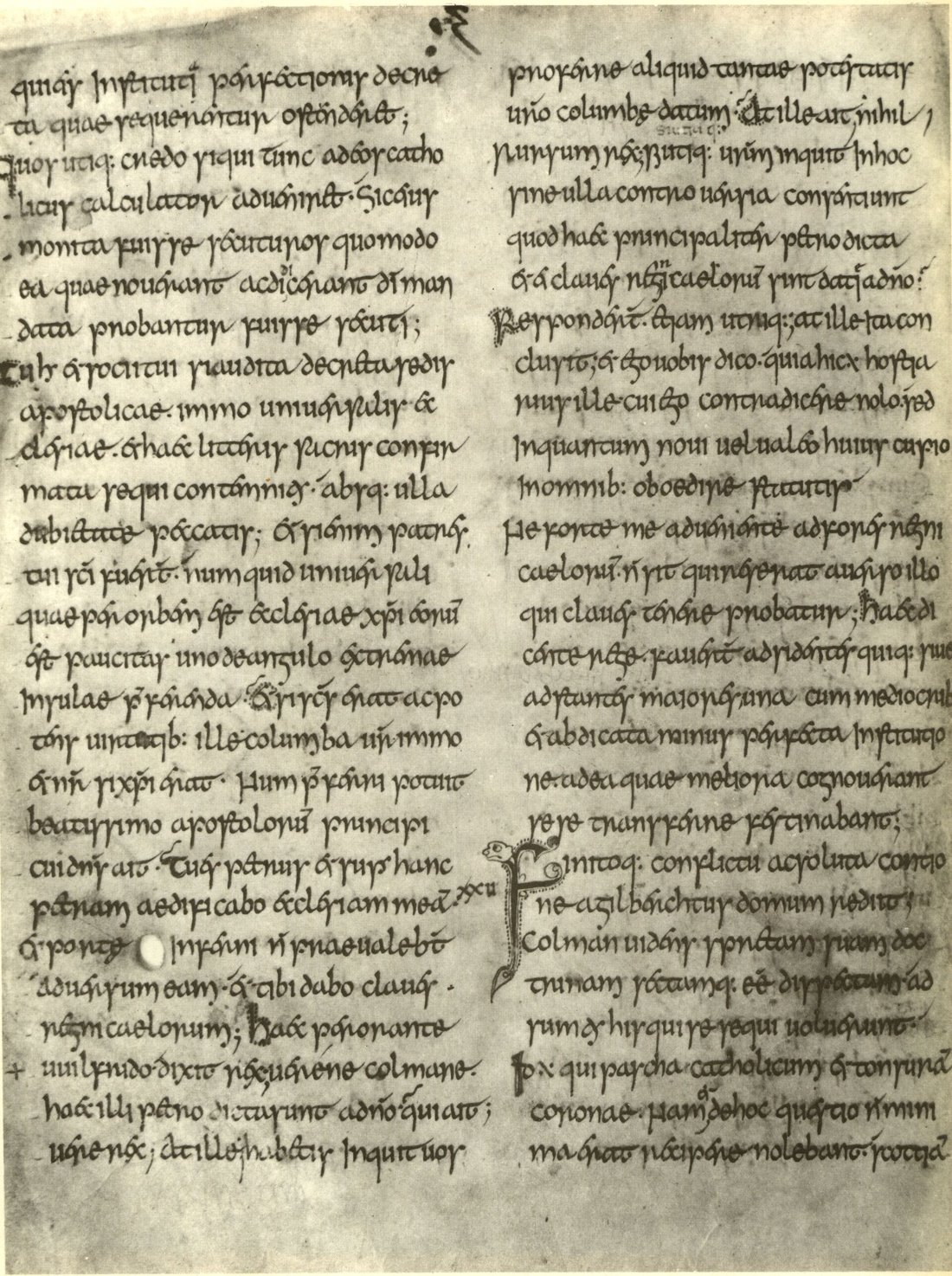
The Germania does not rest on a broad manuscript base. The entire text hangs on a lost ninth-century manuscript, the so-called Codex Hersfeldensis, which reached Italy in the fifteenth century and was then broken up. What survives is a descendant: the Codex Aesinas, discovered at Jesi in 1902 and today in the national library in Rome.
And here a clarification is worth making that is often lost: the famous eight Carolingian leaves in the Aesinas belong to the Agricola, not to the Germania. The Germania itself stands in that codex on leaves written by the humanist Stefano Guarnieri in the fifteenth century – he even imitated the older script. What we read, therefore, is a humanist copy of a lost manuscript of an ancient text.
This does not devalue the text. But it explains why individual names in the Germania wobble – and why, for a name that occurs only once, there is no second attestation to check it against.
The scholarly history of the Reudigni is largely a history of conjecture. A geographical dictionary of 1854 already sums it up drily: some have wished to change the name to Reudingi or Deuringi in order to link them with the later Thuringians, „but all is uncertain".
Later Gudmund Schütte proposed reading Rendingi or Randingi; the Reudigni would then be identical with the Rondingas of the Old English Widsith catalogue, and their name would survive in Danish Randers. Other proposals use the form Reudingi to make them an ancestral people of the Saxons in western Holstein.
Here is this article's most important correction: these are conjectures, not manuscript variants. The transmitted form is Reudigni. Every one of the readings above presupposes that the text is wrong – and then supplies the proof of that from the very interpretation it is meant to support. That is a circle, and the serious literature says so.
For the transmitted form two explanations recur. One connects it with the Germanic root behind German „roden", to clear land: the Reudigni would then be something like „the people of the cleared land". The other assumes a root for reed or marsh: „the people of the fen".
Both sound plausible, and that is exactly the problem. Germanic ethnonyms can almost always be attached to some root if one is willing to stretch a few sounds. An etymology only becomes solid when a second attestation, a place name, an inscription or a related tribal name supports the reconstruction. Here that is entirely absent.
The honest verdict is therefore this: the meaning of the name Reudigni is unresolved. Anyone who finds a confident translation online is reading a guess that lost its conditional mood somewhere along the way.
The gap in the record can be measured quite precisely. Pliny the Elder, who in the fourth book of his Natural History gives long lists of Germanic peoples, does not name them. Ptolemy, whose Geography blankets northern Germania with coordinates in the second century, does not name them. The Peutinger Table does not name them; the Notitia dignitatum does not name them.
Epigraphic traces are equally absent. There is no cohort or ala of the Reudigni in Roman service, no tombstone recording the origin, no dedication. That is no different for their neighbours in the chapter, but for peoples near the Rhine such as the Tungri, Sunuci or Batavi the picture is entirely different – there epigraphy carries half the evidential burden.
This difference is the key to the whole subject. Those who lived on the Roman frontier were written down, because Rome traded with them, fought them or recruited them. Those who lived beyond it were mentioned once in a list – or not at all.
Proposed locations are plentiful and mutually contradictory. The 1854 dictionary places the Reudigni on the right bank of the Elbe north of the Langobardi. Others look for them in Mecklenburg, others in Holstein, others again on the Danish islands or in Jutland. Schütte, by way of Randers, wanted to pin them down specifically in eastern Jutland.
The basis for all this is exceedingly narrow. Tacitus names no river, no settlement, no neighbour outside his own list. The single geographical statement – „protected by rivers or forests" – applies to all seven together and is in any case an ethnographic formula rather than a description of terrain.
So when you see a map with a patch labelled „Reudigni", you should know what you are looking at: a hypothesis in colour. Maps of this kind are extremely useful for displaying scholarly opinion and extremely misleading if taken for evidence.
One might hope that archaeology would help where the written record fails. It does not – at least not in the way one would like. For the coastal zone between the Elbe and Jutland there are well-researched find groups, cemeteries, settlements and sacrificial sites. What there is not is any way of assigning one of those find groups to one of the seven names.
The methodological reason has been worked out for decades: an archaeological culture is an ordering concept for material traits, not a people. Brooches, pottery forms and burial customs follow workshops, fashions and contacts, not political borders. Sebastian Brather set out this critique systematically in 2004; it is standard today.
For the Reudigni this means that even if we happened to excavate their settlement area, we could not recognise it as theirs. Names do not lie in the soil. They lie in texts – and their text is one.
Three places further along the same row stand the Angles. Some 630 years after Tacitus, a monk at Jarrow in northern England, Bede, wrote an ecclesiastical history of the English people and explained in it where his countrymen came from. The passage is one of the most consequential sentences in European historiography.
Aduenerant autem de tribus Germaniae populis fortioribus, id est Saxonibus, Anglis, Iutis. ... Porro de Anglis, hoc est de illa patria quae Angulus dicitur, et ab eo tempore usque hodie manere desertus inter prouincias Iutarum et Saxonum perhibetur, Orientales Angli, Mediterranei Angli, Merci, tota Nordanhymbrorum progenies ... ceterique Anglorum populi sunt orti.
Bede, Historia ecclesiastica gentis Anglorum I,15; own translation
They had come from the three stronger peoples of Germania, namely the Saxons, the Angles and the Jutes. ... From the Angles, that is from that country which is called Angulus and which is said to have lain deserted from that time until today between the territories of the Jutes and the Saxons, sprang the East Angles, the Middle Angles, the Mercians, the whole line of the Northumbrians and the remaining peoples of the Angles.
From Angli came Angelcynn, from that Engla land, from that England. The name survived not because the Angles were more numerous or braver than their six neighbours in the list – there is no evidence for that – but because their descendants acquired three things the Reudigni never did.
First, a new country with stable kingdoms in which the name was used as a political designation. Second, the church, and with it the Latin alphabet and scriptoria in which people wrote. Third, and decisively, someone who wanted to write down his own origins. Bede is not telling the story of Germania but the story of his people – and a people needs a name of origin for that.
Transmission is not a natural process. It is an achievement of institutions. Where nobody wrote, there is nothing to find – no matter how many people lived there.
Bede's claim that Angeln had lain deserted since the migration is unusually testable – and it stands up surprisingly well. Settlement studies for the Angeln district in Schleswig reckon with a fall in occupation to roughly half in the fourth century and to roughly a quarter in the fifth, compared with the second and third. Cemeteries break off, and pollen profiles show that cereal cultivation largely ceases.
At the same time caution is in order. Bede was writing some 300 years after the events and had an interest in a clear foundation story. On present understanding the departure was not a single exodus but a process spread over decades, and the causes were probably multiple: wetter conditions, abandonment of heavy soils, raiding from the sea.
And a settlement gap does not prove where the people went. It only proves that they did not stay.
The link between writing and survival is best illustrated by an Old English poem. Widsith is a catalogue of rulers and peoples, recorded in the tenth-century Exeter Book but preserving older material. And there, in immediate succession, the names from Germania 40 reappear: Billing Wernum – the Varini; Oswine weold Eowum ond Ytum Gefwulf – the Eowan and the Ytas; and a few lines later Offa weold Ongle – the Angles with their king.
These names survived because a society that came from this region was writing, centuries later, in England, and kept its old neighbourhoods in memory. Widsith is poetry, not historiography, and must not be read as a charter. But it is the proof of the mechanism.
The Reudigni appear here too – but only if one first rewrites them as Rondingas, the people over whom a þyle rules in the same verse. That is not evidence. That is the wish for evidence.
The obvious explanation for the disappearance of the Reudigni is that they were too small and were swallowed by larger neighbours. It is convenient but unprovable – and Tacitus himself supplies the counter-argument. In the same chapter he says explicitly of the Langobardi that it is precisely their small numbers that distinguish them. The Langobardi later founded a kingdom in Italy, and their name still clings to Lombardy.
Numbers therefore explain nothing. What does explain things is contact and continuity. Whoever came within reach of a literate power was recorded. Whoever kept a political identity across centuries could feed a name into law texts, charters and regional labels. Whoever had neither vanished from the record without a single person having to die.
The Reudigni were probably not wiped out. They were most likely absorbed into what later went by the names Saxons, Danes or Angles – except that we have no witness to it.
Tacitus names several dozen peoples in the Germania. A substantial share of them occur in his work alone. One can read those names as an inventory – and end up with an ethnic map that never existed. Or one can read them for what they are: snapshots of what was circulating in Rome about the north around AD 98, arranged according to the ordering assumptions of a Roman senator.
Modern scholarship has largely completed this shift of perspective. The question today is less where exactly a tribe sat and more how group membership arose in the first place, how mutable it was and how far it was imposed from outside. Ethnonyms appear in this light as something mobile: adopted, abandoned, newly coined.
Around the Reudigni, meanwhile, a small cosmos has grown over four centuries: conjectures, maps, place-name equations, genealogies, occasionally national history. Almost all of it has grown out of a single word. One can smile at that, but should not – these were serious attempts to extract a statement from too little material. They only become wrong at the moment when someone deletes the conditional and turns a hypothesis into a map.
That is why the Reudigni are not the sad remnant of a lost history but a methodological test case: they mark where the limit of our knowledge runs. The most honest sentence about them is also the shortest – we know their name. Everything else is interpretation, and it should be left visible as such.
Set the six vanished peoples side by side and a pattern emerges. All seven lived beyond the Roman zone of interest, in the north, in a landscape Rome never conquered. None of them supplied Roman auxiliaries, none appears in a treaty, none in a triumphal report. They are the part of Germania Rome simply had nothing to do with.
That is exactly where the documentary gap begins. Between Tacitus around AD 98 and the first written sources that illuminate the north from within lie centuries of near-total silence. Anyone who changed their name in that period, joined a larger grouping or emigrated did so unobserved.
The Angles fall outside this logic because they left the region and went to a place where writing resumed. That is the whole difference. Not strength, not luck in war – a change of location into a space with script.
In the end the list in Germania 40 is a small lesson in durability. Seven names, equally old, equally well attested, equally far from Rome. One became a country. One became a law book. Two became a line in a poem. Three became nothing.
What made the difference was not an event that could be dated to a year but a chain of conditions: that someone wrote, that someone copied what was written, that a copy survived a monastery, that a humanist found it and that it did not burn. For the Nerthus peoples that chain broke at almost every link.
For the Reudigni it failed to break at exactly one point. One sentence, one lost manuscript, one fifteenth-century copy – and that is why their name still stands there, almost two thousand years later, in a row with six others, one of which is called England.
The Nerthus League · The Eudoses · The Angles · The Warni · The Jutes · The Suebi · The Harudes.
All History & Finds articles →
Long before there were Vikings in the sense of the sagas, there was already a town in south-west Jutland: Ribe, founded …
Read more →A sword folded double like a soft ribbon. A blade twisted like a corkscrew. A piece of iron that someone deliberately …
Read more →