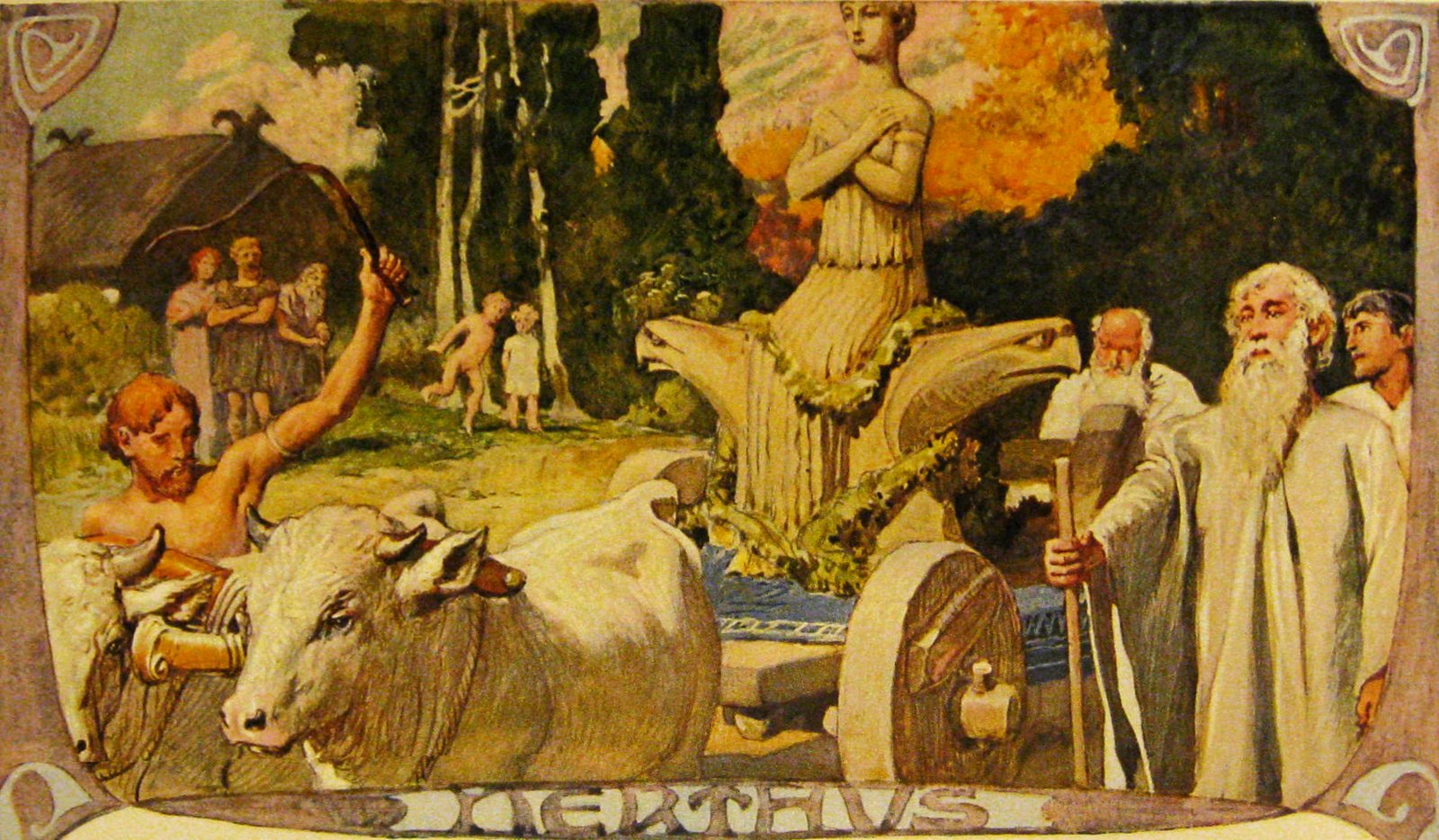
 Tacitus describes one of the most striking cults of the Germani: seven tribes of the north jointly worshipped the earth goddess Nerthus, whose wagon travelled the land in peace. Who were these peoples?
Among the many Germanic tribes the Roman historian Tacitus lists in his "Germania", one group is especially mysterious: seven peoples who formed no common realm but shared a common cult. They worshipped the earth goddess Nerthus. Tacitus names them in one breath: the Reudigni, Aviones, Angles, Warini, Eudoses, Suarines and Nuithones. Some of them later became famous, others vanished almost without trace – but together they form one of the most important pieces of evidence for Germanic religion before the Viking Age.
The seven Nerthus tribes sat in the north of Germania, probably in the area between the lower Elbe, Jutland and the Baltic coast. Few of them can be located exactly. The Angles later became world-famous: they gave England its name. The Warini appear centuries later in a law book and a legend. The rest – Reudigni, Aviones, Eudoses, Suarines, Nuithones – are named only at this one place in Tacitus and remain for us scarcely more than names. That is exactly what makes them interesting: they are a window into a world of which we have lost almost everything.
The core of the league was the goddess. Tacitus writes that the tribes jointly worshipped Nerthus, "that is, Mother Earth", and believed that she intervened in human affairs. Her sanctuary lay in a sacred grove on an island in the ocean. There stood a wagon, veiled with a cloth, which only the priest was allowed to touch. This idea of an earth-bound goddess of fertility and peace is deeply Germanic – and it has, as we shall see, a bridge into Norse mythology.
The most famous part of Tacitus' account is the procession of Nerthus. When the priest sensed that the goddess was "present" in her sanctuary, her veiled wagon, drawn by cows, was solemnly driven through the land. Wherever she came, festival peace reigned: "Then alone are days of rest known, then alone is peace loved," writes Tacitus. No war, no weapons – the people celebrated as long as the goddess dwelt among them. It is one of the most peaceful images handed down to us from Germanic religion.
Yet the cult also had a grim side. After the procession, says Tacitus, the wagon, the cloth and "if one may believe it, the deity herself" were washed in a hidden lake. The slaves who performed this service were then swallowed by the lake – drowned, so that the secret of the goddess remained preserved. "Hence a secret dread and a pious ignorance of what that may be which only those doomed to die behold," writes the Roman. Fertility and death, peace and sacrifice lay close together in the Nerthus cult.
The name Nerthus leads far beyond the imperial era. Linguistically Nerthus corresponds exactly to the Old Norse Njörðr – the Vanir god of the sea and wealth of the Viking Age. Astonishing here is the change of gender: the female earth goddess of the Germania became a male god. How this happened is disputed among scholars; some suspect a divine sibling pair. Either way, the identity of names documents an astonishing continuity: a cult Tacitus described around 98 AD echoes almost a thousand years later in the Norse world of gods.
The most famous Nerthus tribe grew great only after Tacitus. The Angles from today's Schleswig moved to Britain in the 5th century together with Saxons and Jutes and gave the land its name: Angla-land, England. The Warini lived on too – as Varini in the "Lex Angliorum et Werinorum" and in a legend of the Byzantine Procopius. That members of a fertility-cult league of all things became founding peoples of England shows how much the Germanic world was in motion.
For centuries people have puzzled over where the sanctuary of Nerthus lay. Popular guesses are Zealand, Funen or the islands of the Danish Baltic; Rügen too has been named (there lies a "Herthasee", whose name, however, rests on a modern misreading of "Nerthus" as "Hertha"). The honest answer is: we do not know. Tacitus names only an "island in the ocean". All concrete locations are later interpretations – beautiful, but unprovable.
The Nerthus league is a stroke of luck for the tradition. It shows that Germanic tribes joined not only into war leagues but also into cult leagues – that religion could bind tribes that were politically separate. It shows a goddess of earth, peace and fertility, long before Odin and Thor. And it shows how deep the roots of Norse mythology reach: from the earth goddess of the seven tribes to the sea god Njörðr of the Vikings. For an honest picture of Germanic religion it is indispensable.
Almost everything we know about the Nerthus league stands in a single chapter: Tacitus, Germania 40. That is both blessing and curse – a wonderfully detailed source, but only one, written by a Roman who was never in the north and reported at second hand. Archaeologically the cult and the island cannot be securely grasped; bog finds of wagons (such as the ceremonial wagon tradition) and sacrificial lakes give only a general setting. What is secure – the names of the tribes, the cult of Nerthus – we separate carefully here from the many interpretations.
Even if the sanctuary of Nerthus cannot be pinned down, archaeology knows the cult wagon as a Germanic phenomenon. From Danish bogs come the richly decorated Dejbjerg wagons (pre-Roman Iron Age), and the later Oseberg burial contained an intricately carved ceremonial wagon. Such wagons were evidently built not for everyday use but for solemn processions – exactly as Tacitus describes for Nerthus. The find does not prove the Nerthus cult, but it shows that the idea of a sacred, travelling wagon was firmly anchored in the Germanic world.
The Nerthus league was no isolated case. Tacitus also describes the Semnones' grove, a supra-regional sanctuary to which many Suebian tribes travelled. Such cult leagues show a side of the Germanic world easily overlooked: alongside war and feud there were binding sanctuaries, common festivals and priesthoods that brought tribes together across political borders. Religion was a bond that held where no king ruled – an important counterweight to the image of the eternally quarrelling barbarians.
"They jointly worship Nerthus, that is, Mother Earth, and believe that she intervenes in human affairs and comes riding among the peoples."after Tacitus, Germania 40 (public domain, own translation)
Nerthus – the earth goddess · The Angles · The Warni.
All History & Finds articles →
While Uppsala is famous above all from a text, Thuringia holds the best-excavated Germanic sanctuary in the ground: the …
Read more →