Nordalbingia ("the land north of the Elbe", from Latin Albis = Elbe) was the northernmost part of the old Saxon land, in today's Holstein and the Hamburg area. Saxon groups such as the Holsten, Stormarn and Dithmarschen lived here – and here too ran the seam between the Frankish empire and the Danes in the north.
In the course of his Saxon wars (772–804) Charlemagne subjected Nordalbingia too. At the end stood a harsh measure: whole Saxon population groups were resettled, and the conquered land partly handed to the allied Obodrites (Slavs). With that the old order north of the Elbe was broken – and a new, Frankish-controlled border arose.
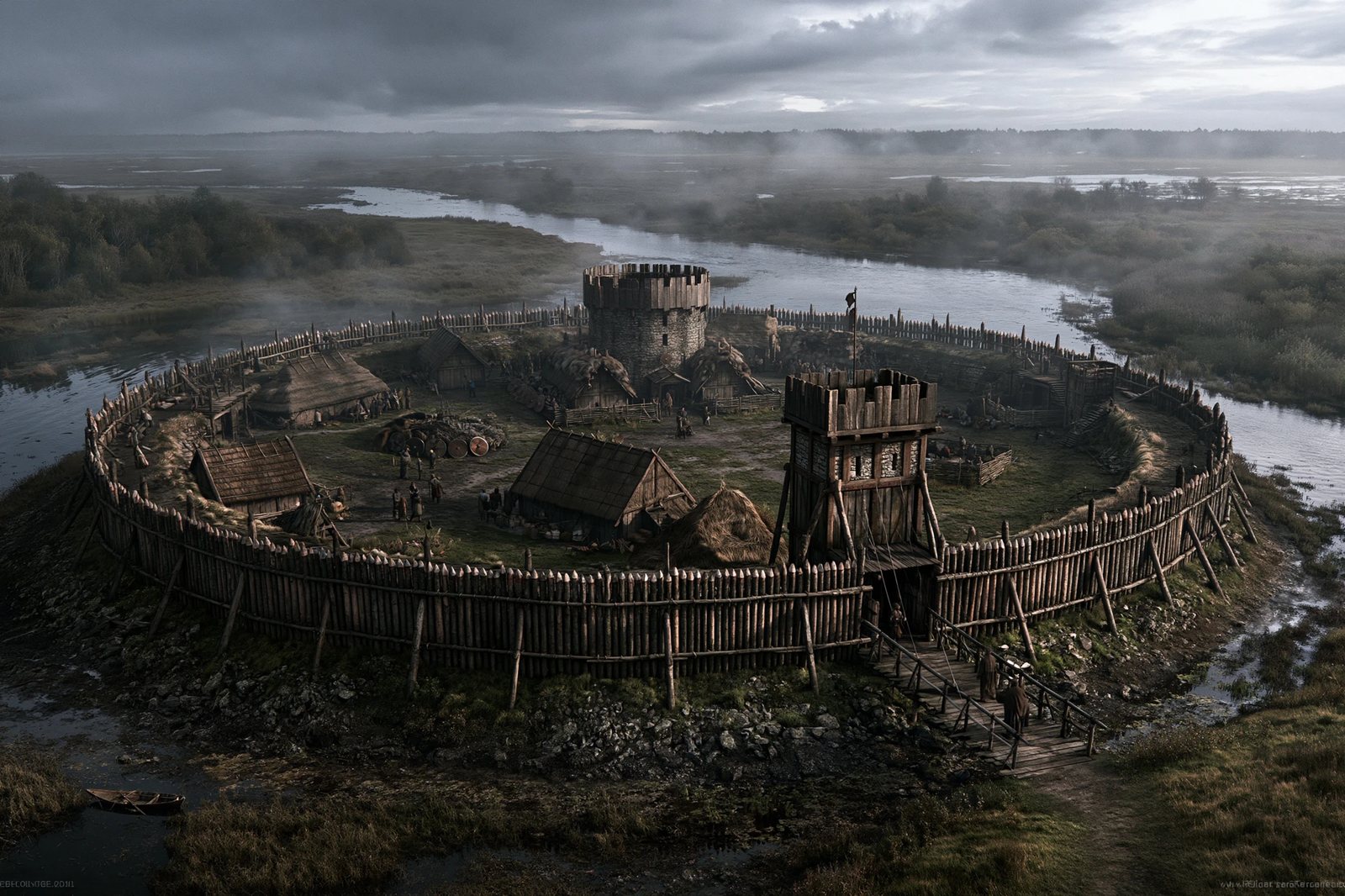
Around 809/810 Charlemagne had the fort Esesfeld built on the Stör (near today's Itzehoe) – the first Frankish fortification north of the Elbe. It was meant to secure the new border against the Danes, whose king Godfred was at the same time strengthening the Danevirke. So two great powers fortified their sides of the same border at once.
Nordalbingia was also a filter for trade: through places like Bardowick ran the exchange with the Slavs and the North, and Charlemagne's Capitulary of Thionville (805) regulated where trade was allowed – and forbade the export of weapons to the neighbours. Later, from here, Hamburg became the mission and trade outpost towards the north. Nordalbingia was thus less a people than a task: to control border, trade and faith.
"Wits must he have who wanders wide, but all is easy at home."Hávamál 5, after Henry A. Bellows 1923 (public domain)
Nordalbingia – "the land north of the Elbe" – was the northernmost region of the Saxons, in today's Holstein. Situated on the border with Danes and Slavs, it was a contested borderland between the Germanic, Norse and Slavic worlds.
In the course of his long Saxon wars (772–804) Charlemagne subdued Nordalbingia too. The Saxons of this region offered stubborn resistance until Charlemagne forced the region harshly into his empire.
To break the resistance, Charlemagne had parts of the Nordalbingian Saxons resettled and settled other groups. Such forced transplantations were among the harshest means of Frankish power politics.
Around 809/810 Charlemagne had the fortress of Esesfeld built on the Stör – the first Frankish fortification north of the Elbe. It mirrors Gudfred's expansion of the Danevirke on the Danish side: two powers securing their border.
Nordalbingia is the German side of the Viking-Age frontier: where the Danevirke stood in the north, a Frankish fort secured the other side in the south. The famous story of Northmen and Franks played out here, very concretely, in the landscape.

The Danevirke · Sliasthorp & Füsing · Viking traces in Germany · The Cherusci & Arminius · The Chatti.
All History & Finds articles →
While Uppsala is famous above all from a text, Thuringia holds the best-excavated Germanic sanctuary in the ground: the …
Read more →Long before there were Germanic peoples – some 4,300 years ago – people in today’s Saxony-Anhalt raised a vast ring of …
Read more →