 Germany was never "Viking country" – and yet the Norsemen left clear traces here: as neighbours in the north, as traders on the Rhine and, for a few hard years, as feared raiders at the very gates of Aachen. An overview of what really remained.
When people think of Vikings they think of Scandinavia, England, Iceland. But the Viking age also unfolded on German soil – only differently than the TV clichés suggest. There was no lasting conquest here and no great settlement. What there was: a frontier in the north, trade routes, and a few years full of smoke and violence on the Rhine.
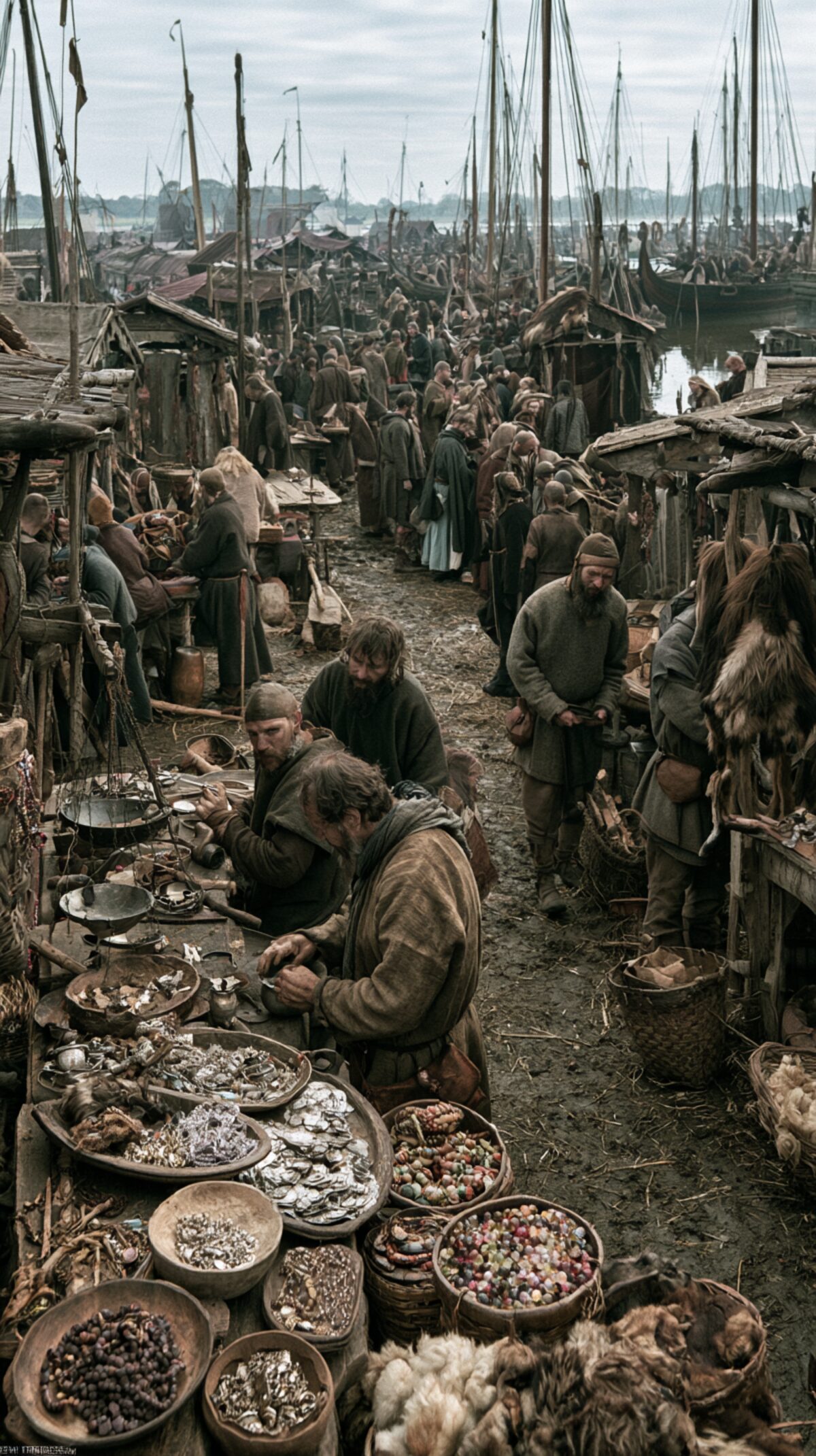
Germany's strongest Viking trace lies in present-day Schleswig-Holstein: Hedeby (Haithabu), one of the greatest trading places of the Viking age, protected by the mighty frontier rampart Danevirke. Here, at the narrowest point between the North Sea and the Baltic, goods from half the known world changed hands – furs, silver, amber, slaves. In 2018 Hedeby and the Danevirke together became UNESCO World Heritage. Back then Hedeby lay in the Danish frontier zone; today its museum with reconstructed houses stands near Schleswig – a real piece of the Viking age in Germany.
In the 9th century Viking fleets pushed up the great rivers into the Frankish empire. In the winters of 881 and 882 an army ravaged the Rhineland: Aachen, Charlemagne's palace, was plundered, along with Cologne, Bonn, Zülpich, Jülich and the monastery of Prüm in the Eifel, and later Trier. For our region this is the most tangible Viking moment: the North suddenly stood before the gates of the old imperial city. The Norsemen wintered in fortified camps, such as at Asselt on the Meuse, and had their withdrawal bought off with silver – the Danegeld.
Beside the sword the North also came with the scales. Dorestad on the Rhine (in today's Dutch–German border area) was one of the greatest trading places of north-western Europe, a hub between Franks and Scandinavians, until raids and the shifting river course brought it down. At Duisburg a Viking army wintered on the Rhine in 883/884. Rhenish goods – pottery from the Vorgebirge, millstones of Mayen basalt lava from the Eifel – turn up as far as Hedeby and Scandinavia. Trade linked the region around Alsdorf with the far North long before any border existed.
On the North Sea coast, on Sylt, Föhr and Amrum, lie ring forts from the Viking age – refuge forts such as the Tinnumburg or the Lembecksburg. And in the north the Elbe, with Nordalbingia, formed the restless frontier between the Christian Saxons, the Franks and the heathen Danes; here ran the old Ox Road, here the worlds met. Germany, then, was not the Vikings' goal – but it was their neighbour, their trading partner and, for a few bitter years, their plundering ground.
Cattle die, / kinsmen die,
and so one dies oneself;
but one thing I know / that never dies:
the fame of a dead man's deeds.Hávamál 77, translation after Henry Adams Bellows 1923 (public domain)
What remained of the Vikings in Germany is rarely a sword in the ground – more often a rampart, a trade route, a place-name, a line in a chronicle. But it is enough to show that the North was never as far away as it seems.

The Vikings before Aachen · Hedeby · Dorestad – the great trading place · The North Frisian ring forts · The Viking winter camps.
All History & Finds articles →
The Vikings came, raided – and stayed. Over the winter, at least. Instead of sailing home after every raid, they …
Read more →Many call the Varus battle the „big bang of Germany". Yet another battle shaped our lands far more deeply – one in …
Read more →High above the world of humans, beyond the burning rainbow bridge, lies Asgard – the fortified home of the Æsir. It is …
Read more →Almost 1,500 years before the first Germanic peoples entered Roman history books, a highly developed Early Bronze Age …
Read more →