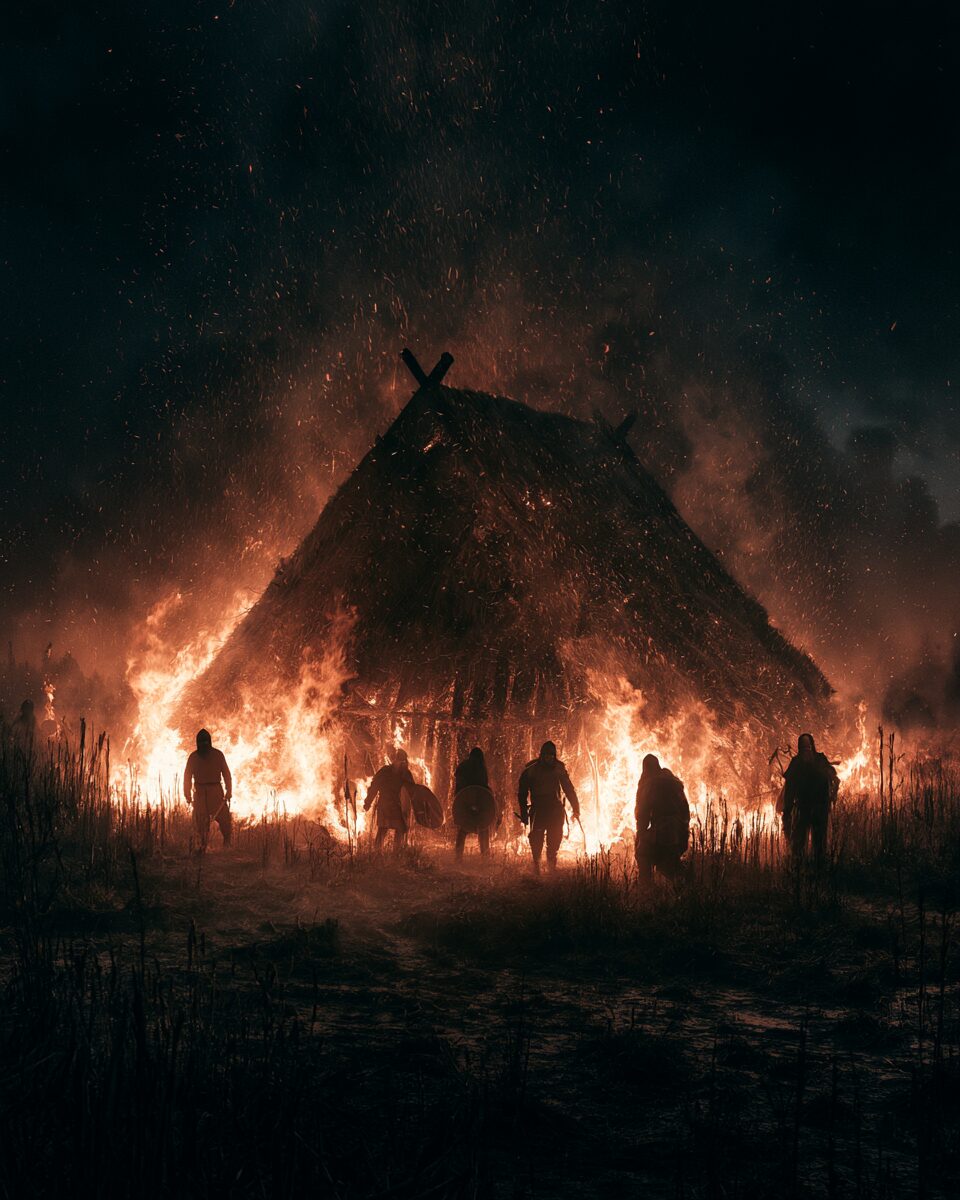
Yes, the Vikings really did reach Aachen: in late autumn 881 a Danish army under the kings Godfrid and Sigfrid raided Charlemagne's palace and set it on fire. The Annals of Fulda add that the raiders turned the king's chapel, the core of today's cathedral, into a stable for their horses. Their base was a fortified winter camp on the river Meuse whose exact location is still disputed. Here is what the sources actually say, which other towns burned, and where you can follow the trail today.
Picture Aachen Cathedral on a wet November afternoon. No tour groups, no guides, no gingerbread shops across the square. Just horses. They stand inside the octagon beneath the dome that Charlemagne built as an image of the heavenly Jerusalem, and the men who rode them speak a language nobody here understands. Outside, the palace is burning.
This is not a scene from a streaming series. It is one of the strangest lines in early medieval history writing, and it happened about ten kilometres from our workshop in Alsdorf. We have gone back to the sources sentence by sentence, and corrected a few things our first version of this article told too quickly.
The story starts in England, not in Aachen. In 878 King Alfred of Wessex defeated the Danish army at Edington (see our article on Alfred the Great). Part of the force the Anglo-Saxon sources call the micel here, the "Great Army", decided England held nothing more for them. According to the Anglo-Saxon Chronicle, they crossed to the Continent in 879 and made their first camp at Ghent. We tell the earlier story in The Great Heathen Army (865–878) and the continental chapter in The Great Army on the Continent (879–892).
This was not a band of pirates landing at random. It was an alliance of several leaders and their followers who stayed together for years, built camps, negotiated and collected tribute. How such war bands were organised is explained in Lið, Félag, Hird, Leiðangr. Ships carried them up the rivers deep inland; on land they rode captured horses. A Frankish levy needed weeks to assemble. By then the Northmen were long gone.
In the winter of 880/881 one group dug in at the old imperial palace of Nijmegen. The East Frankish king Louis the Younger besieged them but could not break the strong walls. The Northmen promised to leave his kingdom, burned the palace and sailed back to the Rhine. Both the Annals of Fulda and Regino of Prüm tell the story the same way.
On 3 August 881 the young West Frankish king Louis III defeated a Viking army at Saucourt near the Somme. The Annals of Fulda claim 9,000 horsemen were killed, a figure to treat with the same caution as almost every chronicler's number. The victory was celebrated in the Old High German Ludwigslied, one of the oldest surviving poems in the German language.
It solved nothing. According to the Annals of St-Vaast, the Northmen repaired their ships at Ghent and sailed up the Meuse to spend the winter there. The heartland between Meuse and Rhine now lay open. Charles III, later nicknamed "the Fat", had been crowned emperor in Rome in February 881 and was still in Italy. Louis the Younger lay ill at Frankfurt. There was no field army in the Rhineland ready to meet the raiders. For how the Carolingians normally raised troops, see our article on the Carolingian military system.
The Viking campaign in the Rhineland, 881–892
Interactive map: drag the slider or press ▶. Real places and rivers, own drawing – not a to-scale map.
In November 881, Regino writes, the kings Godfrid and Sigfrid set up camp at a place called Haslon on the Meuse. The Annals of St-Vaast call it Haslao, the Annals of Fulda Ascloha, adding that it lay fourteen miles from the Rhine. A camp like this was a temporary town: rampart and ditch, ships drawn up on the bank, stores, workshops and captives. Raiding parties rode out from here and came back with their loot.
Nobody knows exactly where it was. For a long time Elsloo, north of Maastricht, was the favourite. Today many historians prefer Asselt near Roermond in Dutch Limburg, because the name fits better and so does the distance given in the Annals of Fulda. In 1929 the archaeologist Jan Hendrik Holwerda dug at Asselt and believed he had found a Carolingian royal palace. In 2017 the Dutch archaeologist Leo Verhart reassessed that excavation and was blunt: Holwerda had forced ordinary walls and potsherds into a conclusion he had reached beforehand, and there were no Scandinavian finds at all. In short, archaeological proof of the camp is entirely missing. On place-name grounds Verhart leans slightly towards Asselt, but he keeps Elsloo and even Maasmechelen in play.
Regino describes the campaign in two waves. On the first ride the Northmen burned Liège, Maastricht and Tongeren. On the second they turned east: Cologne and Bonn, plus the nearby fortified places of Zülpich, Jülich and Neuss. The Annals of Fulda also list Cambrai, the Hesbaye and "all of Ripuaria", the Frankish lands west of the Rhine around Cologne. Cologne and Bonn, they say, went up in flames along with their churches and buildings. Canons and nuns who escaped fled to Mainz, carrying church treasure and relics with them.
For us this is an uncomfortably familiar map. Jülich, Zülpich, Neuss and Cologne are places where we buy materials and deliver orders. The raiders very probably used the old Roman roads that still criss-crossed the Rhineland: firm ground, straight lines, and a rich target at the end of each one. Cologne's local histories add that the city first paid silver and was burned anyway. That is plausible, but it does not come straight from the annals.
Then came the palace. Around 881 Aachen was not a large town but a palace site: royal hall, chapel, service buildings and the hot springs the Romans had already used. Charlemagne had been buried here since 814, in the church of St Mary, traditionally consecrated in 805. Militarily it was nearly worthless. Symbolically, it could hardly have mattered more.
Three sources mention the raid, and they do not say the same thing:
"ubi in capella regis equis suis stabulum fecerunt" – where they made a stable for their horses in the king's chapel.Annales Fuldenses, year 881 (Latin text after Friedrich Kurze's MGH edition of 1891; our own translation)
So the famous stable really is in a contemporary source. It is not a later fairy tale. But it appears in only one of the three, and its author was nowhere near Aachen; he was writing far away in the East Frankish kingdom. We have no eyewitness account.
Why horses in a church? The practical answer: a big roofed stone building makes an excellent stable in a wet November. Whether the raiders meant it as a deliberate humiliation, no source tells us. For the chroniclers, that is exactly how it landed.
From Aachen the rich abbeys were only a short ride away: Inden, today's Kornelimünster on Aachen's southern edge, founded under Louis the Pious, and Stavelot and Malmedy in the Ardennes. Monasteries offered precious metal in crosses, chalices and book covers, food stores, livestock, and people who could be sold or ransomed. How central the trade in captives was to the Viking economy is covered in our article on slavery among the Vikings.
The hardest blow fell on Prüm in the Eifel, one of the richest houses in the East Frankish realm. Regino, who later became its abbot, writes under the year 882 that the Northmen crossed the Ardennes and entered the monastery on the feast of Epiphany, 6 January. They stayed three days and plundered the surrounding country. Local peasants gathered on foot to resist. Seeing that this crowd had no training, the Northmen charged and cut them down, in Regino's telling more like cattle than men. Then they returned to their camp with the loot. Once the crowd had scattered, fire from the outbuildings spread to the monastery, and there was nobody left to put it out.
Note what Regino does not say: he does not claim the raiders set the abbey alight on purpose. The fire spread because no one was left to fight it. That is more precise, and more bitter, than any horror story. The Annals of Fulda, incidentally, already list Prüm under 881, one of those small mismatches that arise when chroniclers divide a winter campaign between two years differently. Later accounts say the abbey's most famous relic, the Sandals of Christ, was carried to safety while much of the library burned. We found no reliable figures for that.
Regino is our most important voice, and he is not neutral. Prüm was attacked in 882 and again in 892. After the second raid Abbot Farabert stepped down, and Regino was elected his successor in 892. He lost the office in 899, moved to Trier and there wrote his world chronicle, which runs to 906. He was writing about violence that had struck his own house, from a distance of some twenty years.
That does not make him unreliable, but he needs careful reading. A monk had every reason to paint the "heathens" as godless destroyers, and Regino also uses the disaster to criticise the nobles and kings who failed to protect the land; his untrained peasant crowd is part of that argument. The Annals of Fulda, for their part, survive in several continuations with different political leanings, and the Mainz continuation is openly hostile to Charles III. To understand 881/882, you have to read these voices against each other.
On 20 January 882 Louis the Younger died at Frankfurt. Regino says the Northmen greeted the news with joy and gave themselves over entirely to plunder. On 5 April 882, Maundy Thursday, they took Trier, the old Roman city on the Moselle that Regino calls the "noblest city of Gaul". They stayed until Easter, laid waste the surrounding land, set the city on fire and moved on towards Metz.
At Remich on the Moselle they were met by Bishop Wala of Metz, Archbishop Bertulf of Trier and Count Adalhard. The Northmen won, and Wala was killed – a bishop dying in battle. The raiders then hurried back to their fleet laden with plunder. In Mainz, the old walls were hastily repaired.
Only now did the empire move. Charles III returned from Italy, held an assembly at Worms in May 882 and raised an army from several peoples of his realm, with the Bavarians marching on the east bank of the Rhine and the rest on the west. An ambush outside the camp failed; the Annals of Fulda blame traitors bribed by the Northmen.
For twelve days Charles besieged the camp at Ascloha. The Bavarian continuation of the Annals of Fulda reports a violent hailstorm that damaged part of the camp's defences, and sickness in the besieging army caused by the stench of rotting corpses. Then came negotiations. The outcome:
The Mainz continuation called this a shameful buy-off. Part of the money came from church treasuries, and the emperor was rewarding a man who had just wrecked his great-grandfather's palace. Modern historians, Simon MacLean among them, take a cooler view: tribute and turning a Viking leader into a vassal were standard tools of Carolingian politics. Paying bought time. The English faced the same dilemma, as our article on Danegeld and the Battle of Maldon shows. And a generation later, a very similar arrangement on the Seine would succeed spectacularly, with Rollo and the birth of Normandy.
In Frisia the deal soon soured. From 882 Godfrid held land on the Lower Rhine as the emperor's vassal, and when a Danish army plundered much of the Low Countries in 884, he did nothing to stop it. In 885, according to Regino, he allied himself with his brother-in-law Hugh, son of Lothar II, who was making his own bid for power. Godfrid sent two Frisian counts to the emperor demanding Koblenz, Andernach, Sinzig and other royal estates, supposedly for the sake of their wine.
At a meeting at a place called Herispich, where the Rhine and the Waal divide, a Frankish noble named Everhard, whose property Godfrid had seized, struck him on the head with a sword, and the men of Margrave Henry finished him off. All the Northmen found in the Betuwe were killed. Hugh was blinded. So ended the man who had sacked Aachen: not in battle, but at a parley that was a trap.
The Northmen came back. In 891 an army weakened by fighting in Brittany crossed into Lotharingia. King Arnulf had the Meuse crossing near Maastricht blocked, but the raiders crossed further upstream near Liège and, according to Regino, vanished into the woods and marshes near Aachen. The next morning the Frankish army crossed the Geul, a small tributary of the Meuse that rises in eastern Belgium and flows through southern Limburg. A disorderly pursuit ran into an ambush, the Frankish army broke and fled, and Archbishop Sunderold of Mainz was killed. Regino dates the disaster to 26 June 891.
The reply came in the autumn. The Northmen entrenched themselves behind a rampart of timber and earth on the Dyle near Leuven. Arnulf ordered his men to dismount, unusual for Frankish horsemen, and stormed the camp on foot. The Annals of Fulda report that the two kings Sigfrid and Godfrid fell and that sixteen royal standards were captured. Whether this Sigfrid was the same man as in 881 is uncertain. This Godfrid certainly was not: the Godfrid of Aachen had been dead for six years.
The Viking raids on the Rhineland have an odd imbalance: lots of text, almost no finds. No grave, no weapon and no camp in the Aachen area can yet be firmly linked to the Great Army. The Meuse camp, as we saw, has never been excavated. Burn layers in Cologne, Bonn or Trier are hard to tie to a specific year; a layer of ash rarely tells you who lit the fire.
One of the rare tangible traces comes from Zutphen in the Netherlands. There, inside the rampart of a later fortification, archaeologists found burned huts, the skeletons of a woman and a girl, and bones with injuries. Cattle skulls suggested the attackers slaughtered livestock on the spot and took only the meat. The finds were shown in 2004 in the exhibition "Wikinger am Rhein" at the Rheinisches Landesmuseum in Bonn, a sobering reminder of what a raid meant for the people on the receiving end.
And the swords dredged from the Rhine and the Meuse? Most are Frankish blades that could have ended up in Frankish or Scandinavian hands; the Carolingians even tried to ban the export of weapons to the North by law. A sword from a river is not proof of Vikings. More in our article on the Viking sword.
Towns with a Roman past repaired their old walls: Mainz in 882, Cologne by 883 at the latest. Refuge forts went up on hilltops, like the one in the Ardennes Regino mentions under 892, though that one did not help. For what such strongholds looked like on both sides, see Fortresses and Ramparts of the Viking Age.
Aachen's church of St Mary was restored, and faster than you might think. In 936 Otto I was raised to the kingship here, seated on Charlemagne's throne in the upper gallery, and around thirty more royal coronations followed until 1531. The stable of 881 was an episode, not a ruin for centuries.
The monasteries kept the memory alive, often wrapped in miracle stories about relics saved from the flames. This is where record and legend blur. If a local history book tells you a particular chapel or castle was "destroyed by the Normans", ask whether there is a ninth-century source for it. Often there is not. "The Normans" became shorthand for any old disaster.
Want to see the places for yourself? All of these are real and easy to reach from Aachen:
From our workshop in Alsdorf the cathedral is less than twenty minutes by car. We don't run a shop with opening hours; we are an online store. If you live in the region, though, you can arrange to collect your order from us or drop off a piece you want engraved; see our page on engraving in and around Aachen.
We engrave runes, knotwork and motifs from the Edda. It would be easy to show the Vikings only as heroes. Aachen 881 reminds us that the same world that produced rune stones and skaldic poetry meant fire, hunger and enslavement for the people between the Meuse and the Rhine. Taking the Viking Age seriously means telling both sides. And if you want to know who lived here long before, read our article on the Germanic tribes of the Rhineland.

Did the Vikings really attack Aachen? Yes. Regino of Prüm, the Annals of Fulda and the Annals of St-Vaast all report that Northmen plundered and burned the palace at Aachen in the winter of 881/882.
Did the Vikings use Aachen Cathedral as a horse stable? The Annals of Fulda say, under the year 881, that the Northmen made a stable for their horses in the king's chapel. The other two sources do not mention it, so it is well attested, but by a single source.
Where was the Viking camp of 881? On the Meuse, at a place called Haslon or Ascloha. Most historians now favour Asselt near Roermond; Elsloo used to be the preferred candidate. No excavation has confirmed either.
Which Rhineland towns did the Vikings sack in 881/882? Among others Liège, Maastricht, Tongeren, Cologne, Bonn, Zülpich, Jülich, Neuss and Aachen, the monasteries of Kornelimünster, Stavelot, Malmedy and Prüm, and in April 882 Trier.
Are there Viking finds from Aachen? So far no find from the Aachen area can be firmly linked to the raid of 881; we know it from written sources.
For courage. For remembrance. For legends that live on.
All History & Finds articles →
The Vikings came, raided – and stayed. Over the winter, at least. Instead of sailing home after every raid, they …
Read more →Many call the Varus battle the „big bang of Germany". Yet another battle shaped our lands far more deeply – one in …
Read more →High above the world of humans, beyond the burning rainbow bridge, lies Asgard – the fortified home of the Æsir. It is …
Read more →Almost 1,500 years before the first Germanic peoples entered Roman history books, a highly developed Early Bronze Age …
Read more →