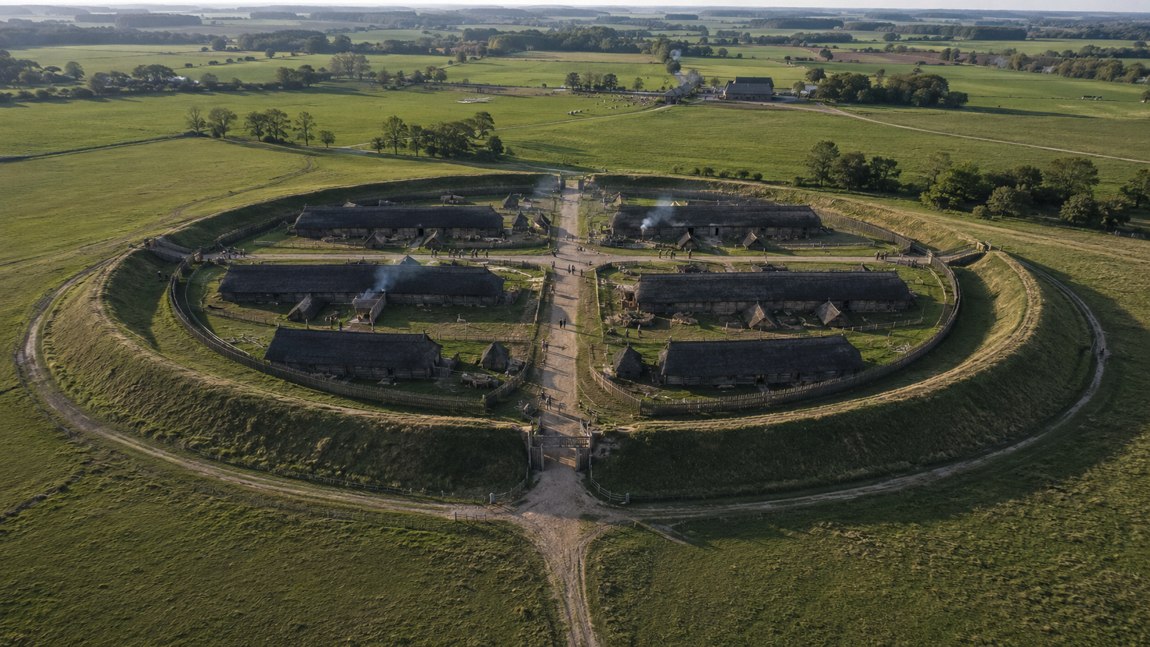
When people hear „Viking fortress“, many picture a grey stone castle with battlements and a drawbridge. But the strongholds of the North looked nothing like that: perfectly circular earthen rings, ramparts running for miles, palisades of oak. This guide shows what Trelleborg, Aggersborg, the Danevirke and the Birka garrison really were - and why the famous ring fortresses stood for only a single generation.
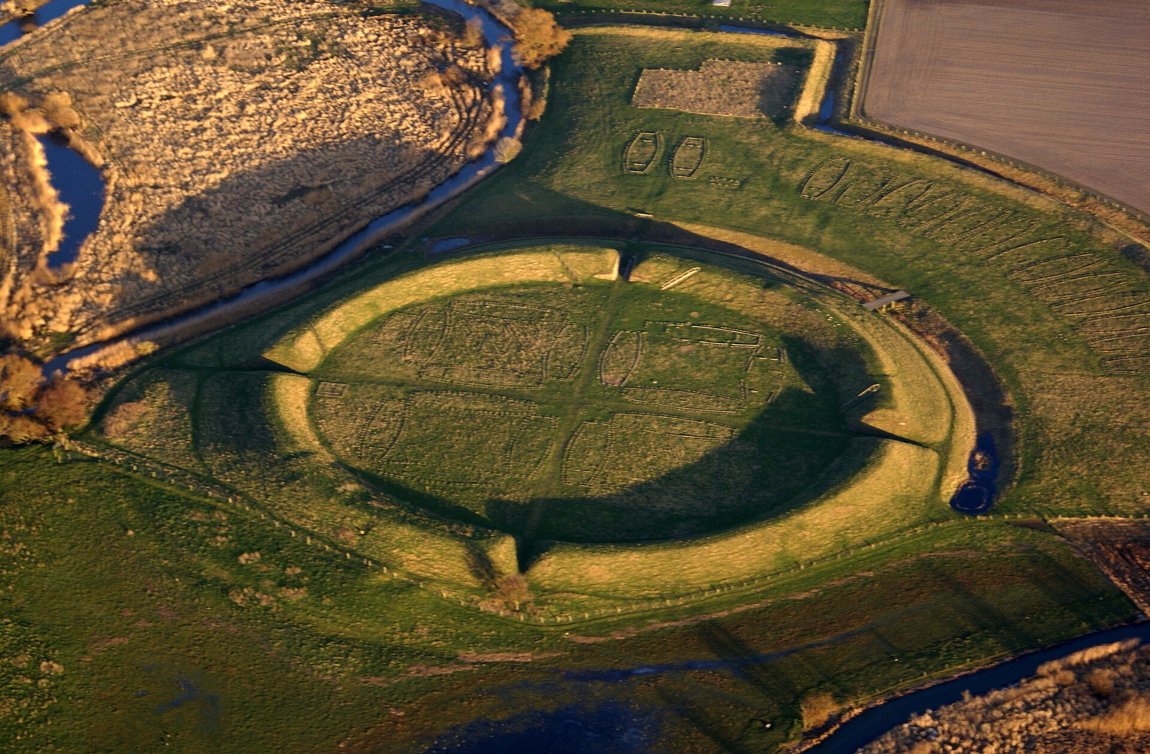
Let us start with the biggest misconception: the Viking-Age fortress is not a stone castle. The high walls, keeps and gatehouses of dressed stone we know from the High Middle Ages appeared in the North only centuries later. A Viking-Age fortress was built from earth, turf and timber - a heaped-up ring rampart with a ditch in front, an oak palisade on top and timber-clad gates. Stone castles in the proper sense arrive in Scandinavia only with the Christian royal castles of the twelfth and thirteenth centuries.
That takes nothing away from their power. A rampart several metres high, crowned by a man-high palisade and fronted by a deep ditch, was a formidable bulwark. And because earth and timber decay, these sites today mostly survive as low circles in the landscape - which makes it easy to underestimate how massive they once were.
The most striking chapter of the story is the Danish ring fortresses, also called Trelleborg-type fortresses. Five are securely known today: Trelleborg on Zealand, Aggersborg and Fyrkat in Jutland, Nonnebakken on Funen (buried beneath the modern city of Odense) and Borgring near Koege. They all follow the same astonishingly precise plan.
Each is exactly circular. Four gates pierce the rampart, aligned precisely to the four points of the compass. Two crossing, timber-paved streets link the gates and divide the interior into four equal quarters. In each quarter stood long houses, often grouped in a square around a courtyard. This geometric rigour is so unusual that one conclusion is inescapable: a central power planned and surveyed these sites. They were not villages that grew over time but designs laid out on a drawing board.
Trelleborg near Slagelse on Zealand gave the whole type its name. Its inner ring rampart is about 136 metres across. What sets it apart is an additional outer, crescent-shaped rampart with further houses and its own ditch. Inside the ring stood sixteen great hall-houses in four groups. Trelleborg was excavated as early as the 1930s by Poul Noerlund and remains the reference site against which all the others are measured.
Aggersborg on the Limfjord in northern Jutland is the largest of the ring fortresses. Its inner rampart is around 240 metres in diameter - nearly twice Trelleborg. The Limfjord was a strategic waterway linking the North Sea and the Baltic; whoever held Aggersborg controlled a key route. The fortress was built on top of an existing village, which was levelled for it - another sign that a powerful builder here imposed his will without hesitation.
Fyrkat near Hobro in Jutland is among the best-studied of these sites. Here, among other finds, a rich female grave came to light, with grave goods pointing to a high-ranking woman - perhaps a seeress or völva. Fyrkat shows that the ring fortresses were not merely barracks: they also held living and workshop areas for women, craftspeople and families.
Nonnebakken on Funen is the hardest of the five to grasp: it lies entirely buried beneath the modern city of Odense and is known only from excavation results and older surveys. Its name - „the nuns' hill“ - comes from a much later period.
For a long time only four ring fortresses were known. Borgring near Koege on Zealand was confirmed beyond doubt as the fifth Trelleborg fortress only in 2014 - with the help of geophysics and a comprehensive laser scan (LiDAR) that revealed the low rampart in the terrain. Excavations found burnt gate structures and a slight deviation of the gates from the exact axis. Borgring shows how modern technology still expands our picture of the Viking Age - and that further such fortresses may yet lie undiscovered in the landscape.
The tight dating to around 980 points to one name: Harald Bluetooth, king of the Danes. He unified the realm, promoted Christianity and left on the great Jelling stone a self-portrait that carved his claim to power into stone.
King Harald ordered these monuments made in memory of Gorm, his father, and in memory of Thyra, his mother - that Harald who won for himself all of Denmark and Norway, and made the Danes Christian.Great Jelling stone, runic inscription (paraphrased), public domain
A king who „won for himself all of Denmark“ needed instruments to control that realm. The ring fortresses lie on important land and water routes. They served less to fend off an external enemy than to dominate the king's own land: as bases for administration, troops and the enforcement of royal power. The immense building effort - tens of thousands of oak trunks, precise surveying, coordinated labour - was itself a message: behold what your king can do.
The largest defensive work of the North is not a ring but a line: the Danevirke. This vast border rampart ran across the narrowest point of the Jutland peninsula, in what is now Schleswig, protecting the Danish heartland to the south - against Franks and Saxons. In all, the system comprises some thirty kilometres of ramparts in several sections and building phases.
The Danevirke is older than the Viking Age in the narrow sense; its earliest sections reach back into the eighth century. But it was precisely in the Viking Age that it was massively expanded. It worked in tandem with the famous trading centre of Hedeby (Haithabu), whose semicircular rampart secured the settlement on the landward side. Danevirke and Hedeby have been joint UNESCO World Heritage since 2018. For those who want to know more, we have a dedicated deep-dive on the Danevirke.
The great trading towns, too, were fortified. Birka on the island of Björkö in Sweden's Lake Mälaren had, besides a town rampart, its own garrison on a rise - a fortified warrior quarter with a hall, weapon finds and equipment that in part points as far as the steppe world of the East. The garrison shows that defence in the Viking Age did not consist only of earthen ramparts but also of standing armed crews at strategic points. Trade and defence belonged together: where silver and goods flowed, protection was needed. Birka's town rampart itself, enclosing the settlement on the landward side, was a lower earthen bank with timber gates - no match for the rigorous ring fortresses, but another example that defensive works belonged to the picture of every significant settlement.
It is easy to imagine the ring fortresses as pure soldiers' camps. Yet the finds from Fyrkat and Trelleborg paint a more layered picture. Alongside weapons and riding gear came spindle whorls, loom weights, jewellery and tools - the traces of women, craftspeople and whole households. In the long hall-houses people lived, cooked, forged and wove. The rich female grave at Fyrkat, with its unusual grave goods, even points to a person of high spiritual or social rank.
The fortresses were therefore probably mixed sites: a royal base with an armed crew, but at the same time a place of dwelling and workshop, a store and an administrative seat. They bundled power, production and control in one place - a kind of temporary seat of government from which the surrounding land could be dominated and taxed. It is precisely this dual role that makes them such fascinating testimonies of an emerging royal power.
The ring-rampart idea was not confined to Scandinavia. Along the North Sea coast and in the Saxon-Frisian region there are numerous ring-rampart sites and refuge forts. On the North Frisian Islands, for instance, several ring ramparts survive - refuge forts into which the population could withdraw with their livestock during raids. They were not permanently inhabited fortresses but places of refuge for an emergency. We have a separate article on the North Frisian ring ramparts as well.
Important for an honest account: not every circular rampart in northern Germany is a „Viking fortress“. Many ring ramparts are older (Bronze or Iron Age) or younger (early-medieval Saxon). The circular ground plan alone proves nothing about Vikings - only dating and find material can tell.
Building a ring fortress was a major construction site and a feat of engineering at once. First the circle was surveyed and staked out. Then the rampart was heaped up - a core of earth and turf, often stabilised by an internal timber construction (boxes or a lattice) so it would not slump apart. On the outside a timber revetment secured the slope, and on top ran a palisade or a wall-walk. In front of the rampart lay a deep ditch. The four gates were elaborately built from heavy oak planks and in part fitted with towers.
All of this consumed enormous quantities of timber. For the palisades, gates, houses and rampart structures of a single ring fortress, whole oak forests had to fall. And that very wealth of timber is a blessing for research today: through the tree rings of the surviving oak, the fortresses can be dated to the year. Such a work could not be thrown up on the side. It needed planning minds to stake out the circle, it needed fellers, carpenters, earth-movers and provisioners - and it needed a builder who could command and feed these crowds. The building itself was thus already an expression of rule.
As enormous as the effort was, the use was brief. The ring fortresses stood for only a single generation - roughly from about 980 to around the turn of the millennium. Then they were abandoned, decayed and were not rebuilt. Why? They had probably served their purpose: they secured Harald Bluetooth's rule during a turbulent phase of unifying the realm. As the balance of power shifted - Harald fell into conflict with his son Sven Forkbeard - the fortresses lost their function.
This short lifespan is itself an important finding. It shows that the ring fortresses were not permanent towns or border fortresses but a time-limited grand project of one particular royal power. They are better compared to a vast political statement than to a standing system of fortifications - built to make power visible, and abandoned once that power was secured by other means.
Today the defensive works of the Viking Age are in part World Heritage: the Danevirke and Hedeby since 2018, the five ring fortresses since 2023. Visitors mostly see low green circles and ramparts - unremarkable at first glance, yet testimonies to a strikingly methodical building art. They speak less of wild raiders than of organised rule, precise surveying and the ability to mobilise thousands of people for a common work.
It is exactly this view - past the cliche, onto what the finds and ramparts really yield - that makes the Viking Age far more fascinating than any fantasy image. If you want to dive deeper: we have our own articles on the Trelleborg ring fortresses, on the Danevirke and on the trading centre of Hedeby.

Trelleborg – Harald's ring fortresses · The Danevirke · Hedeby · The North Frisian ring forts.