After Edington, England had become a bad place for a Viking army. Alfred had beaten Guthrum, Guthrum had been baptised, and his men were sharing out East Anglia among themselves. Not everyone wanted to farm. An army camped on the Thames at Fulham crossed the Channel in 879. For thirteen years it moved from winter camp to winter camp through the Frankish realm, besieged Paris for the better part of a year, got paid, got beaten – and in 892 it was back in Kent. A story told in annals, in verse and in one short line of the Chronicle.
For the winter of 878–9 the Anglo-Saxon Chronicle notes two things side by side. Guthrum's army moved from Chippenham to Cirencester and stayed there a year before going to East Anglia and sharing out the land. And that same winter a band of Vikings gathered and settled in at Fulham on the Thames. The next entry says this army went over the sea to Ghent in Frankia and stayed there a year. The Chronicle puts it under 880; the Frankish sources show that it happened in the autumn of 879.
That point matters, and it is often skipped. The army that turns up on the Continent is not simply the Great Heathen Army of 865 packing its bags after peace with Alfred. Guthrum's men stayed in England. What crossed in 879 was a force that very likely included veterans of the English campaigns alongside newcomers from Scandinavia. How the mix looked, no source says. Yet the Chronicle treats it as one body: when it returns in 892, it calls it "the great army that we spoke about before".
Why Frankia, and why then? In April 879 the West Frankish kingdom lost its king, Louis the Stammerer. His sons Louis III and Carloman were young and their claim was contested. A kingdom in a succession dispute was to such an army what Northumbria in civil war had been in 866: an opening.
The best source for the years that follow is Frankish, not English. The Annals of Saint-Vaast, the Annales Vedastini, were written in the monastery of Saint-Vaast at Arras, in the middle of the region the army was plundering. Their author knew the places he lists, and he had seen many of them burn.
The pattern is the one known from England: the army takes a fortified camp on a river, often in or next to a monastery, and draws plunder and tribute from the country around it. The chronicler in Wessex followed its movements with surprising care. After Ghent he records, year by year: further up into Frankia, where the Franks fought the army and it got itself horses afterwards; up the Meuse; up the Scheldt to Condé; up the Somme to Amiens. Every sentence a winter camp.
Part of this time the army, or part of it, spent on the Meuse and the Rhine. From the camp at Asselt Aachen was sacked in 881, and the following year Emperor Charles III, known as the Fat, stood before the camp and negotiated instead of storming it. We tell those chapters in full in 881: When the Vikings stood before Aachen and in Winter camps on the Rhine.
The Franks were not defenceless. On 3 August 881 the young King Louis III defeated a Viking army at Saucourt-en-Vimeu near the mouth of the Somme. The Annals of Saint-Vaast report it, and the Frankish sources speak of thousands of enemy dead. There is no need to believe the figure. That it was a real victory, one may.
What makes it stand out is what became of it: a song in the vernacular. The Old High German Ludwigslied, preserved in a manuscript at Valenciennes, praises the king, and was composed before he died in August 882. It opens:
Einan kuning uueiz ih, heizsit her Hluduig, ther gerno gode thionot.
"I know a king, his name is Louis, who gladly serves God."Ludwigslied, lines 1–2; our translation
The song reads the Northmen as God's punishment for the sins of the Franks and Louis as the man who turns it aside. For us it is one of the few contemporary pieces in which we hear how the people under attack sang about the army, not just wrote about it. Saucourt did not stop the army. It moved east.
In October 882 the army dug in at Condé on the Scheldt and laid waste Carloman's kingdom from there. In 883 it went to the Somme, pushed to Lavier with horsemen and ships, and made its winter camp at Amiens. The Annals of Saint-Vaast describe a country in which monasteries and churches burned all the way to the Oise.
Early in 884 the West Frankish magnates, gathered at Compiègne, sent a baptised Dane called Sigfrid to negotiate with his countrymen. The outcome is one of the big figures of these years: twelve thousand pounds of silver, in return for hostages and a truce until autumn. In October 884 the army left Amiens. Part of it went to Leuven on the Dyle; another part, according to the Anglo-Saxon Chronicle, went back to England, to Rochester in Kent, where Alfred drove it off.
In December 884 King Carloman died in a hunting accident. The West Frankish kingdom passed to Charles the Fat, who now held almost the whole of Charlemagne's empire for the first time since Louis the Pious. To the army it made no difference. It had learnt that the Franks paid.
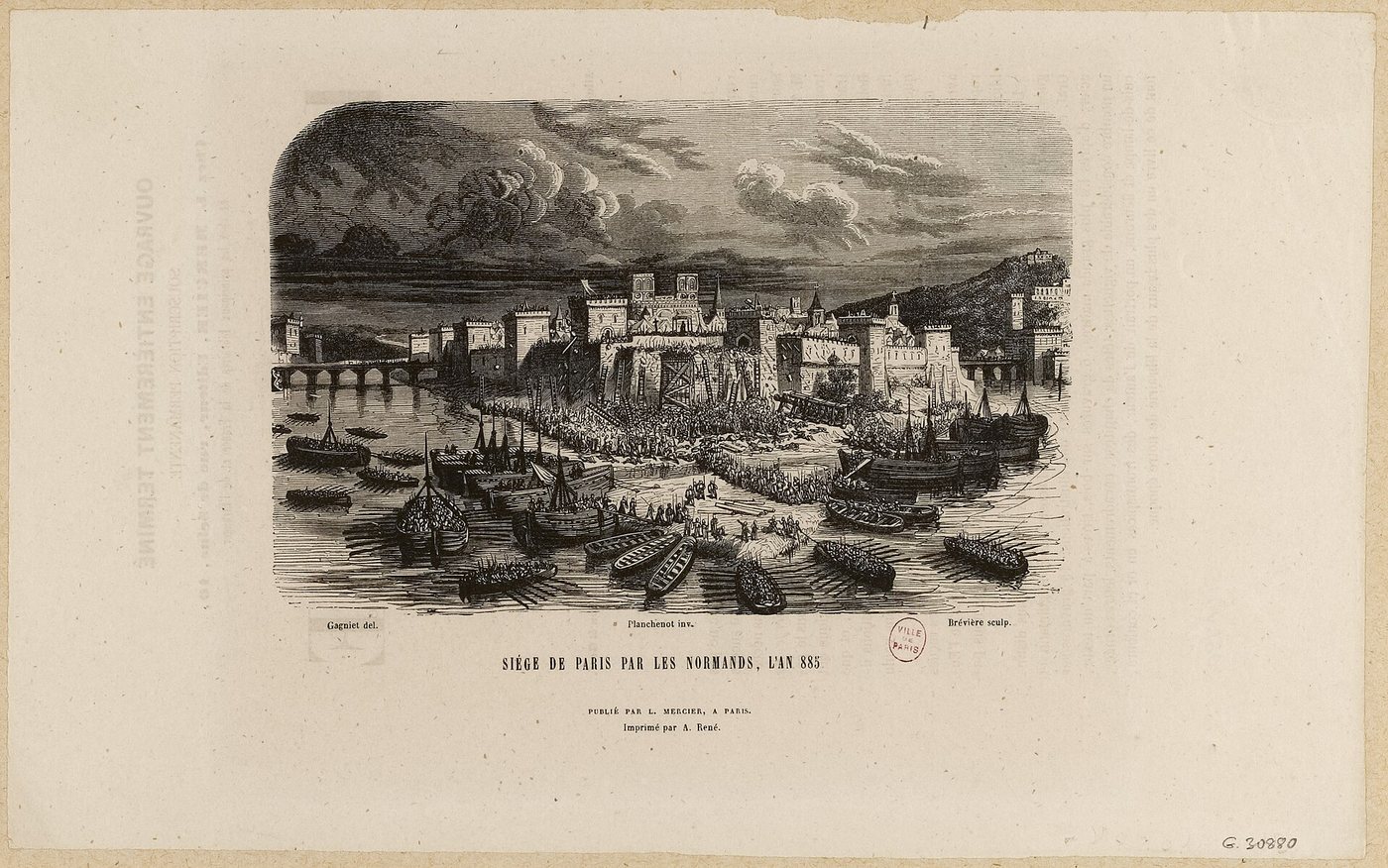
In the summer of 885 the reunited army moved up the Seine, took Rouen and, after a siege, forced the stronghold at Pontoise to surrender. At the end of November it stood before Paris. Paris at that time was essentially the island in the Seine, the Île de la Cité, with its wall, its cathedral and two bridges. Each bridge was covered by a tower on the bank. Under Charles the Bald fortified bridges like these had become a way of blocking fleets from going upriver.
For what things looked like inside the city, one reads Abbo of Saint-Germain. Abbo was a monk of Saint-Germain-des-Prés, lived through the siege himself and in the 890s wrote a Latin poem about it, the Bella Parisiacae urbis, "The Wars of the City of Paris", almost 1,400 hexameters in three books. Abbo speaks of seven hundred large ships plus smaller boats and of some forty thousand men. No historian believes these numbers. They are rhetoric; Abbo was writing an epic, and an epic needs a vast army.
His details are more useful: siege engines on wheels, fireships floated against the bridge, defenders pouring boiling wax and pitch from the tower. And names. The defence was led by Count Odo of Paris and Bishop Gauzlin, with Gauzlin's nephew Ebolus, abbot of Saint-Germain. On the other side the sources name a king Sigfrid. Whether he was the same Sigfrid who had negotiated for the Franks in 884 cannot be settled.
On 6 February 886 floodwater carried away the small bridge on the left bank. The tower behind it was cut off. The army attacked and set it on fire, and the garrison was killed. Abbo names twelve defenders who, he says, surrendered on the strength of promises and were cut down all the same. He makes martyrs of them. Whether there were exactly twelve, and whether the number is not also meant biblically, cannot be checked.
After that it became a slog. Sigfrid left in the spring in exchange for a payment; others stayed. In April 886 Bishop Gauzlin died, probably of a disease going round the besieged city. Odo slipped out to seek help from the emperor and fought his way back in. An East Frankish relief force under the commander Henry arrived, achieved little, and in August 886 Henry was killed when he and his horse fell into one of the ditches the army had dug around its camp.
In October 886 Charles the Fat came in person with a large army. He did not attack. He paid. Seven hundred pounds of silver were promised, due in the spring, and the army was allowed to go further up the Seine into Burgundy. Some historians see calculation in this: the Burgundian magnates were no friends of the emperor. The Parisians refused to let the ships through their bridges; according to later accounts the army dragged them some way overland and sailed on above the city – the Annals of Saint-Vaast say nothing about it. In Burgundy it besieged Sens without taking it.
For Charles, Paris was a political disaster. Contemporaries saw an emperor who arrived with a superior army and then offered silver. In November 887 the East Frankish magnates deposed him and raised his nephew Arnulf of Carinthia in his place. Charles died in January 888. Charlemagne's empire broke for good into its parts, and in the annals of these years the army on the Seine is one of the reasons.
In the west, in February 888, the magnates elected the man who had held Paris: Odo became king, the first West Frankish king who was not a Carolingian. In June 888 he defeated a Viking army – the battle usually goes by the name of Montfaucon, though the Annals of Saint-Vaast place it on the Aisne. The army itself stayed in the country, moved through the lands of the Seine and the Oise in 889 and 890 and as far as the Cotentin, where it destroyed Saint-Lô. The winter of 890–1 found it at Noyon on the Oise.
In 891 the army turned east into Arnulf's kingdom. On 26 June it defeated a Frankish force on the Geul near Maastricht; Archbishop Sunderolt of Mainz was killed. The Annals of Fulda reproach his haste. In the autumn the army lay in a fortified camp on the Dyle near Leuven, protected by river and marsh. There Arnulf attacked and won. The Annals of Fulda and Regino of Prüm report that two of the army's kings fell, Sigfrid and Godfrid, and that sixteen standards were taken. The Anglo-Saxon Chronicle records the victory in one sentence:
Her for se here east, 7 Earnulf cyning gefeaht wið ðæm rædehere ær þa scipu cuomon, mid Eastfrancum, 7 Seaxum, 7 Bægerum, 7 hine gefliemde.
"In this year the army went east, and King Arnulf fought against the mounted army before the ships came, with East Franks and Saxons and Bavarians, and put it to flight."Anglo-Saxon Chronicle, manuscript A, entry for 891; our translation
The word rædehere, the mounted army, says a lot. The fleet of 879 had long since become a force that moved overland on horseback and let the ships follow. The battle itself and the camp at Leuven are covered in our piece on the winter camps on the Rhine.
The army was not destroyed. It wintered once more near Leuven. In 892 famine came on top, as the Annals of Fulda report. In the autumn the army moved to Boulogne. There, the Chronicle says, it was given ships and crossed to England in a single passage, horses and all: 250 ships came into the mouth of the river Lympne in the east of Kent. Shortly afterwards one Hæsten sailed into the Thames with eighty ships. For Alfred the second great war of his reign had begun.
Contemporary record: the army's stations come from the Annals of Saint-Vaast, the Annals of Fulda and the Anglo-Saxon Chronicle, which confirm each other even where their year numbers are one apart. Regino of Prüm finished his chronicle only around 908 but still stood close to the events.
Contemporary poetry: Abbo's poem on Paris and the Ludwigslied. Both are witnesses of their time, but not minutes of a meeting: Abbo's numbers are epic, and the Ludwigslied is praise of a ruler.
Archaeology has so far barely caught the army on the Continent. There is no camp like Torksey in England, with thousands of plotted finds, for Ghent, Condé or Amiens.
Later tradition is chiefly what Dudo of Saint-Quentin told around 1015. He places Rollo before Paris in 885–6 already. No ninth-century source names him there. How Rollo later gained a foothold on the lower Seine is told in The Vikings in France.
Modern interpretation covers the size of the army, its make-up and how much it contributed to the break-up of the Carolingian empire. The answers vary from historian to historian.
Thirteen years, a dozen winter camps, an imperial crown lost along the way, and a city that held. Paris has not forgotten Odo. For courage. For memory. For legends that live on.

The Great Heathen Army · The Vikings in France & Normandy · Rollo of Normandy · The Vikings before Aachen · The Viking winter camps · The Danelaw · The Norse in Brittany.