Everyone knows Normandy. Few know that there nearly was a second one on the Loire. For almost two decades, from 919 to 936, Brittany was a land where Norse leaders sat in Nantes, monks fled east with their relics and the Breton nobility waited in England for better times. Then a young man with a crooked beard came back across the sea. What we know about those years rests on a few lines by a canon of Reims, on a late chronicle from Nantes – and on a burnt boat on an island off Lorient.
On 24 June 843 Nantes was celebrating the feast of John the Baptist. The cathedral was full. That day ships came up the Loire. The attackers broke into the city, killed Bishop Gohard – Gunhard in some sources – along with many clergy and lay people, and plundered Nantes.
The nearest contemporary report comes from the Annals of Saint-Bertin, the official year-book of the West Frankish kingdom. They state briefly that the Northmen attacked Nantes, killed the bishop and many clerics and lay people of both sexes, plundered the city and then moved on to Aquitaine. Finally they built houses on an island and wintered there, as if they meant to stay for good. The island is probably Noirmoutier off the mouth of the Loire, where Northmen had already appeared in earlier years.
Why 843 and why Nantes? The city was in dispute. A few weeks earlier, in May, the Frankish count Lambert had defeated the count of Nantes appointed by Charles the Bald at Blain. The later Chronicle of Nantes claims that Lambert himself guided the Northmen up the Loire. That is an accusation made in hindsight, not a fact – but it shows how people later explained the disaster. Who lived at Nantes before, in antiquity, we tell in our piece on the Namnetes.
After 843 the Loire was a highway for fleets for decades. The Northmen operating here were not a single force. They were shifting groups under shifting leaders, sometimes allied, sometimes at odds, with winter camps on islands in the river. They sailed up as far as Tours and Orléans. And they sailed on along the Atlantic coast: the fleet that attacked Seville in 844 very probably came from this milieu. What that looked like in al-Andalus we tell under the Madjus.
For the Bretons these fleets were both a danger and a tool. The ninth-century Breton rulers Nominoë, Erispoë and Salomon were fighting for independence from the Frankish empire, and the Northmen were a factor in that game – as enemies, as paid allies, as opponents to be bought off with tribute. The Breton realm survived the ninth century. It did not survive the tenth.
After the death of the Breton king Alain the Great around 907 there was no strong hand. In 913 Landévennec was plundered, the largest monastery in the west of the peninsula. The monks fled east with the bones of their founder, Saint Guénolé, and eventually found refuge at Montreuil near the Channel coast. Other communities followed.
That flight has a consequence still felt today. The books went with the relics. Manuscripts by Breton scribes from before the Vikings are now in Paris, London, Oxford and elsewhere, but hardly any remain in Brittany itself. Brittany literally exported its early written culture in order to save it.
The key source for the following years is a contemporary: Flodoard, a canon of Reims, who wrote annals year by year from 919. Under 919 he notes that the Northmen laid waste the whole of Brittany and that the Bretons were carried off, sold or driven out. The nobility fled across the sea to England and into Francia.
The leader of the Loire Northmen, according to Flodoard, was a man called Ragenold, in Old Norse probably Rǫgnvaldr – Ragnvald. In 921 Robert, the powerful margrave of Neustria, besieged the Loire Northmen for five months without success. Then he gave way: he granted them Brittany, which they had ravaged, together with the district of Nantes. Flodoard adds that they began to accept the Christian faith.
That sounds like the pattern that had worked on the Seine ten years earlier: land in exchange for baptism and peace. There it produced Normandy – a story we tell under Rollo. On the Loire things turned out differently. Through the 920s Ragnvald and his men kept raiding deep into Francia. No lasting lordship with a county, succession and church emerged.
The years between 919 and 936 are the darkest in Breton history in a double sense: it was a time of foreign rule, and we see almost nothing of it. Historians speak of a Norse domination of Brittany, but we do not know what it looked like. Were there dues? Settlers? A fixed seat other than Nantes? The sources are silent.
We only know that not all Bretons had left. In 931 Bretons in the west rose up and, according to Flodoard, killed many Northmen, including their leader Felecan. The answer came quickly: a leader named Incon advanced from the Loire with an army and crushed the rising. These names too are known only from Flodoard's few lines.
Among the Bretons in English exile was a young noble called Alan, grandson of Alain the Great. He grew up at the court of King Æthelstan. The byname Barbetorte – crooked beard, twisted beard – comes from later tradition. Under 936 Flodoard records in a single sentence what happened next:
Brittones a transmarinis regionibus, Alstani regis praesidio, revertentes terram suam repetunt.
"The Bretons, returning from the lands beyond the sea under the protection of King Æthelstan, reclaimed their land."Flodoard of Reims, Annales, s.a. 936; our translation
The details come only from the Chronicle of Nantes. In its account Alan landed near Dol, fought his way across Brittany and took Nantes in 937. The city lay so deserted, overgrown with thorns and brambles, that he had to cut a path to the cathedral with his sword. A powerful image. Whether it is more than an image cannot be checked.
The decision came in 939. Flodoard reports a Breton victory over the Northmen that year. According to Breton tradition this was the battle of Trans, east of Dol, on 1 August 939, fought by Alan together with Count Judicaël Bérenger of Rennes and Hugh of Maine. After that the Loire Northmen vanish as a power in Brittany. Alan ruled until his death in 952, now as duke rather than king. The men who fought from Rennes stand in a long line that we begin with the Redones.
The archaeology of Norse Brittany is thin, but it has two sites of real importance.
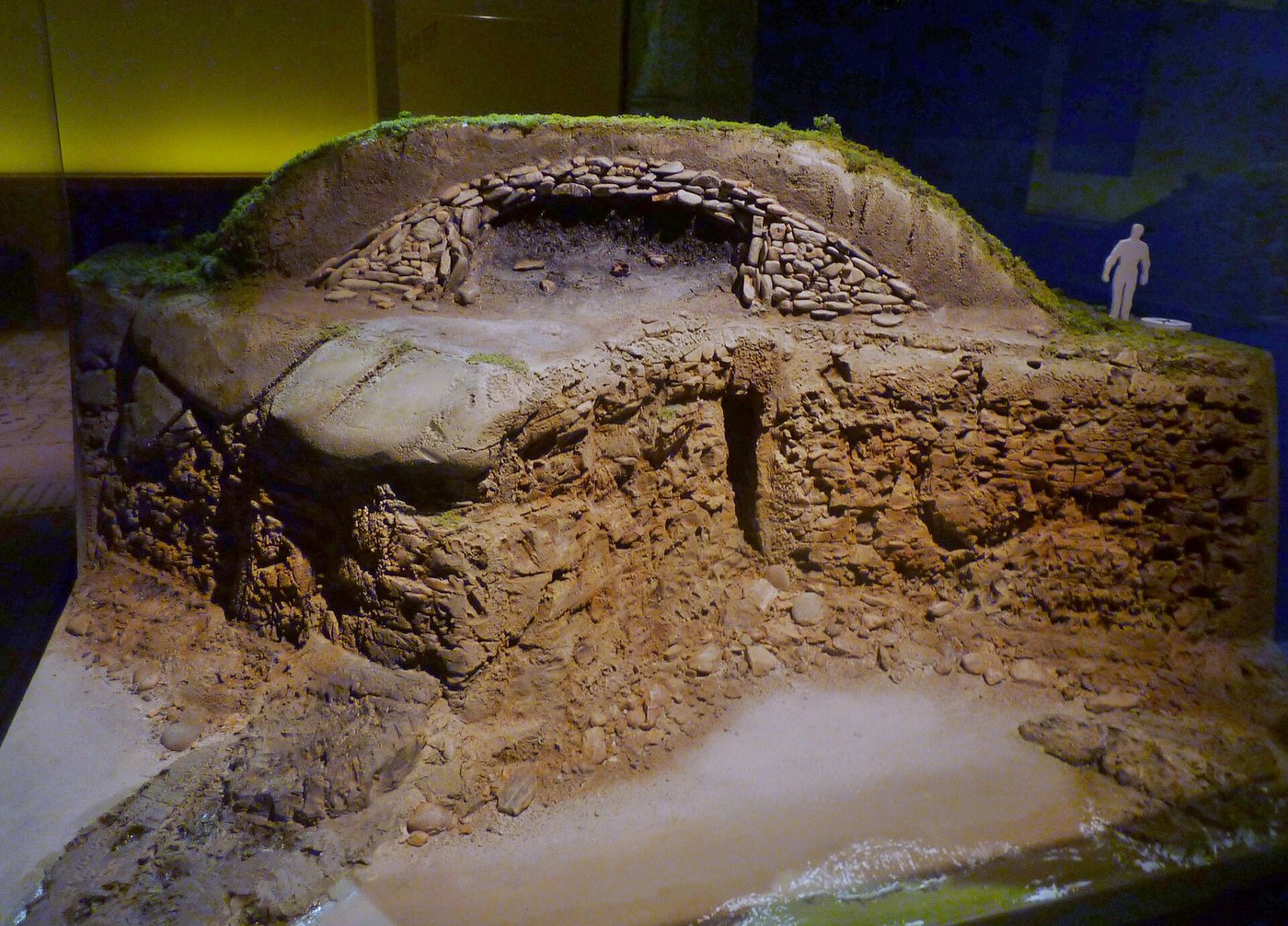
On the Île de Groix off Lorient, Paul du Chatellier and Louis Le Pontois excavated a mound about seventeen metres across in 1906. It held the remains of a cremation in a ship whose rivets survived. The grave goods were rich: two swords, axes, spears, arrowheads, around twenty shield bosses, bronze vessels, a gold ring, silver ornaments and smith's tools such as an anvil, hammer and tongs. According to the excavation reports at least one adult, probably a second person, and animals were burned with the ship. The grave is dated to the tenth century. It is the only secure Viking Age ship burial in present-day France. Most of the finds are now in the Musée d'Archéologie nationale at Saint-Germain-en-Laye.
Who was buried here nobody knows. A leader from the period of Norse rule, a man from Ragnvald's circle, has been suggested. That is possible, and it is an appealing thought. Nothing more.
The second site is the Camp de Péran at Plédran near Saint-Brieuc, a round fortification with rampart and ditch. Its rampart is vitrified – a fire burned so hot that the stone melted. For a long time the site was thought to be prehistoric. Excavations in the 1980s changed the picture: tenth-century pottery, radiocarbon dates from that period and a silver St Peter penny from York, struck around 905–925. The obvious interpretation is a site used by Northmen that was attacked and burned in the 930s. That fits well with the fighting of the reconquest. The link cannot be proven. But the York coin shows where silver reached this place from: the world of the Irish Sea and northern England, which also included the Isle of Man.
Contemporary evidence covers the attack on Nantes in 843 with the bishop's death (Annals of Saint-Bertin), the devastation of Brittany in 919, the grant to Ragnvald in 921, the rising of 931, the Bretons' return with English help in 936 and a victory over the Northmen in 939 (all Flodoard).
Archaeological evidence covers the Groix ship burial and the use and destruction of the Camp de Péran in the tenth century.
Later tradition is the Chronicle of Nantes. It was written in the eleventh century and survives only in fragments and in extracts by later authors. From it come Lambert's alleged treachery, Alan's landing near Dol, the thorns of Nantes and many details of the battle of Trans. We read it with respect and with caution.
Modern interpretation covers the phrase "Norse rule", the attribution of the Groix grave to a leader of the Loire Northmen and the link between Péran and the fighting of the 930s.
Why there was no second Rouen on the Loire is open to long debate. Perhaps time was short and no leader had Rollo's staying power; perhaps no Frankish king negotiated in earnest. We draw the larger picture of West Francia under the fleets in the Vikings in France. Brittany, at any rate, came back. For courage. For memory. For legends that live on.
Rollo of Normandy · The Vikings in France & Normandy · The Redones · The Namnetes · The Madjus in al-Andalus · The Great Army on the Continent.