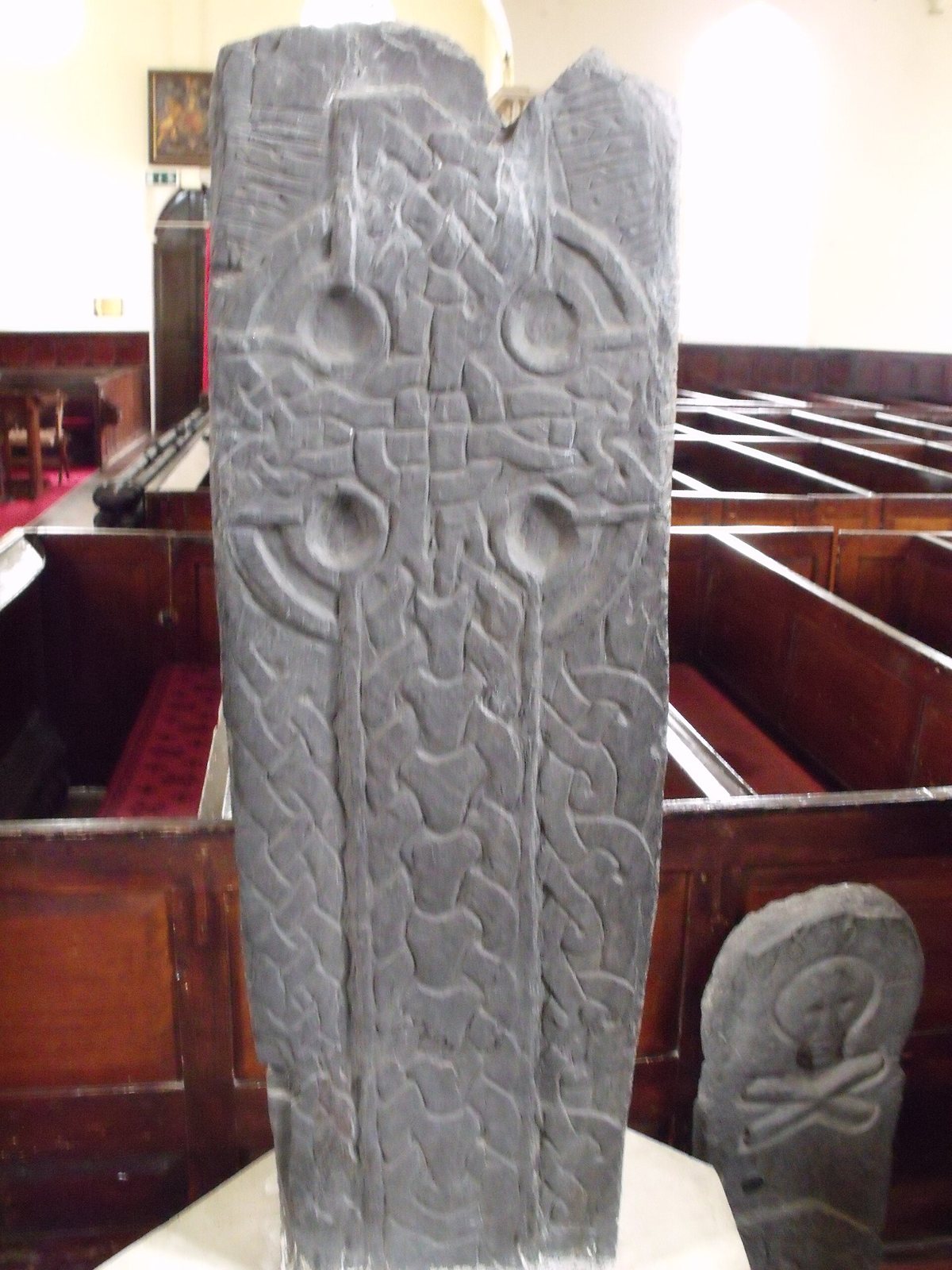
The Isle of Man is a small island. Even so, it has more Viking Age runestones than some whole regions of Scandinavia. One of its carvers signed his work with a line that sounds like an advertisement: he made this cross, and all of them in Man. From the late ninth century, Norse settlers came to this island in the middle of the Irish Sea, buried their dead in boats, married into Gaelic families and left behind a kingdom that only passed to Scotland in 1266. And a parliament whose age deserves a closer look than the speeches usually give it.
Man lies almost equidistant from England, Scotland, Ireland and Wales. For Viking Age seafarers it was not the edge of anything but a hub. Anyone sailing from Dublin north to the Hebrides and on to Orkney passed it, and so did anyone trading between Ireland and Northumbria. The island belongs in the wider story of the Vikings in Ireland, Scotland and the Isles.
There are practically no contemporary written sources about the arrival of the Norse on Man. No chronicle notes when the first ship landed. What we know comes from the ground and from stone: graves, silver hoards and crosses. The graves begin in the late ninth and early tenth centuries. The people who made them met a Christian, Gaelic-speaking population with churchyards and small chapels, the keeills.
The best-known graves were excavated by a man who had not chosen to be on Man at all. Gerhard Bersu, a German archaeologist, was interned on the island during the Second World War and was allowed to dig under supervision. In 1945 he uncovered a boat burial at Balladoole in the south of the island, near Castletown.
Nothing of the boat survived except the iron rivets that had held its planks together. They trace the outline of a clinker-built boat about eleven metres long. In it lay a man buried with riding gear – bridle, stirrups, spurs – with a shield, knives, a fire steel and an iron cauldron. There was no sword. The grave is dated to roughly 850–950.
The find has an uncomfortable twist. The boat was set directly over older Christian stone-lined graves, partly cutting into them. Whether that was deliberate – a statement about who now owned the land – or whether the old cemetery was simply used as a prominent spot cannot be decided. Both views are held. What is certain is that the man buried here had people willing to haul a boat up a slope to bury him this way. How widespread the custom was is shown by graves from Norway to Brittany.
A year later Bersu excavated a mound about twelve metres across at Ballateare near Jurby in the north of the island. At its centre lay a young man in a coffin of thin oak planks. With him were a sword with silver inlay, deliberately broken, a hacked shield boss, three spearheads and a knife.
Higher in the mound lay a second body, a woman aged between twenty and thirty. Her skull shows a severe injury at the back, according to the report most likely a blow from a blade. Above her lay a layer of burnt animal bone: horse, cattle, sheep, dog.
Bersu interpreted the woman as a human sacrifice. That reading is still the usual one, but it remains a reading. Whether she was killed for the funeral, whether she was unfree, whether she died willingly or whether her death merely coincided with the man's – no bone can answer that. Recent research has warned against linking such finds too quickly with the well-known Arabic accounts from the Volga. At Balladoole, too, there are hints of a further body in the mound.
Most people who think of the Norse on Man think of the crosses. The island has a good two dozen stones with Viking Age runic inscriptions, plus many cross slabs without one. Almost all are written in so-called short-twig runes, a variant of the Younger Futhark best known from Norway and Sweden. Most of the stones belong to the tenth century, a few probably to the early eleventh.
That is remarkable, because they are Christian crosses. The Norse on Man raised memorials in the Scandinavian manner – "X raised this cross in memory of Y" – but in the form of the cross slabs usual in the British Isles. Two traditions in one stone.
One carver names himself. A cross at Andreas says Gaut made it, son of Björn from Kuli. On a cross at Kirk Michael he goes further:
Gautr gerði þanna ok alla í Mǫn.
"Gaut made this and all in Man."Rune cross, Kirk Michael (Br Olsen 208B); normalised reading after the Samnordisk runtextdatabas, our translation
It need not be taken literally. But it fits the evidence: with Gaut a distinct style begins on Man, round wheel-headed crosses on a Scottish and Irish model, covered with ring-chain and interlace that link to the Scandinavian Borre style. Scholars have attributed several unsigned crosses to him or his workshop.
Where Gaut came from is open. Kuli has been linked to the farm of Cooley in Kirk Michael. The Norwegian linguist Carl Marstrander read Kolli instead and thought of the Hebridean island of Coll, which would make Gaut's father an islander. Both are possible; neither is proven.
The Kirk Michael cross that carries Gaut's line also names its patron: Melbrigdi, son of Athakan the smith. Both names are Gaelic; the inscription is Norse. On other crosses, men with Norse names marry women with Gaelic ones or the other way round, and sons receive names from the other language. This mixed world is exactly what Irish annals describe with the word Gall-Goídil. And one cross at Kirk Michael sums up the ethics of these families in a sentence: better to leave a good foster-son than a bad son.
The most famous piece stands in the church at Andreas. The inscription is short: Thorwald raised this cross. The images are not. On one face a bearded man points a spear down at a wolf, his foot in the animal's jaws, a large bird on his shoulder. On the other a figure holds a cross and a book, beside a fish and a serpent.
The usual reading: the first scene shows Odin with his raven, devoured by the wolf Fenrir at the end of the world, the second the triumph of Christ. Pagan ending and Christian renewal on one stone. It is a good interpretation, and we find it plausible. But it is an interpretation: no inscription names Odin, and the story of Odin's death by the wolf is known in developed form only from thirteenth-century texts. The dating also varies, from the mid-tenth to the eleventh century. We compare it with the Gosforth Cross in Cumbria in Gosforth and Thorwald's Cross.
Every year in early July the island's parliament still meets in the open air on Tynwald Hill at St John's, and new laws are proclaimed. The name comes from Old Norse þingvǫllr, assembly field – the same word as Þingvellir in Iceland and Tingvoll in Norway. So a Norse-style assembly on Man is very likely.
On the island and in guidebooks you will often read that Tynwald is the oldest continuous parliament in the world, founded in 979. Neither claim survives scrutiny. There is no evidence for 979; the year was chosen so that a millennium could be celebrated in 1979. The place first appears in writing in the Chronicle of the Kings of Man: a few years earlier as the scene of a battle, then under the year 1237 as a place of assembly:
congregatio totius Mannensis populi apud Tingualla
"an assembly of the whole people of Man at Tynwald"Chronica regum Manniae et Insularum, s.a. 1237; our translation
Iceland's Althing is older, even though it was suspended between 1800 and 1845. The composition of Tynwald and the House of Keys only come into view from the fifteenth century. "Continuous" therefore means without a documented break – but also without documents for the first centuries. Put honestly: Tynwald stands in a tradition that reaches back to the Viking Age, but the chain is not proven.
Politically, Man only comes into focus in the eleventh century. Before that it moved between the spheres of the kings of Dublin – the Ostmen – and the Earls of Orkney. Then came Godred Crovan.
According to the Chronicle of Man, Godred was with the Norwegian army destroyed at Stamford Bridge in 1066 and fled to Man afterwards. In 1079, on his third attempt, he took the island after a battle at Sky Hill. The chronicle says he let his men choose between plundering the land and settling on it, and then divided the land between victors and islanders. Later he also ruled Dublin for a time. He died on Islay in 1095. Of his sea power the chronicler writes that he kept the Scots so subdued that no shipbuilder dared use more than three bolts. That sounds like legend, and it was written down a century and a half later.
Godred's descendants ruled the Kingdom of Man and the Isles, which included the Hebrides, for almost two centuries. The Norse called these islands Suðreyjar, the Southern Isles – the word survives to this day in the name of the diocese of Sodor and Man. The kings acknowledged Norwegian overlordship; in 1098 Magnus Barelegs came in person with a fleet. In the island's folklore Godred probably became the legendary King Orry, said to have given Man its order.
The end came through Scotland. After the failed Norwegian expedition of 1263 and the death of the last king, Magnus Olafsson, in 1265, Norway ceded Man and the Hebrides to Scotland for a cash payment in the Treaty of Perth of 1266.
Almost everything we know about this kingdom in detail comes from a single manuscript. The Chronica regum Manniae et Insularum is now in the British Library. Its main part is generally thought to have been written around 1261/62 at the Cistercian abbey of Rushen on Man, in Latin, and continued by other hands to 1316. The entries begin in 1016; the early ones are brief and partly taken from the Chronicle of Melrose.
That matters. On Godred Crovan the chronicler writes at a distance of almost two centuries, and he writes for that man's descendants. From the late twelfth century the chronicle becomes fuller and more reliable. For the Viking Age proper, the ninth and tenth centuries, it says almost nothing.
Archaeologically attested are Norse boat and mound burials of the late ninth and tenth centuries such as Balladoole and Ballateare, numerous silver hoards and a good two dozen rune crosses with Norse and Gaelic names.
Attested by inscriptions are the names of patrons and the dead, Gaut as carver with his line about "all in Man", and Thorwald as patron of the Andreas cross.
Later tradition is the Chronicle of the Kings of Man, written around 1261/62, with Godred's conquest of 1079 and the Tynwald assembly of 1237. Later still are the stories of King Orry.
Modern interpretation covers the human sacrifice at Ballateare, the Odin on Thorwald's Cross and the claim of the oldest continuous parliament with its founding year of 979.
What remains is more than enough: a small island where Norse and Gaels wrote a shared life in stone – in two languages, beneath one cross. For courage. For memory. For legends that live on.
The Vikings in Ireland, Scotland & the Isles · The Gall-Goídil · The Earls of Orkney · The Ostmen · Gosforth & Thorwald’s Cross – Ragnarök on Christian Stones · The Norse of Jórvík.

