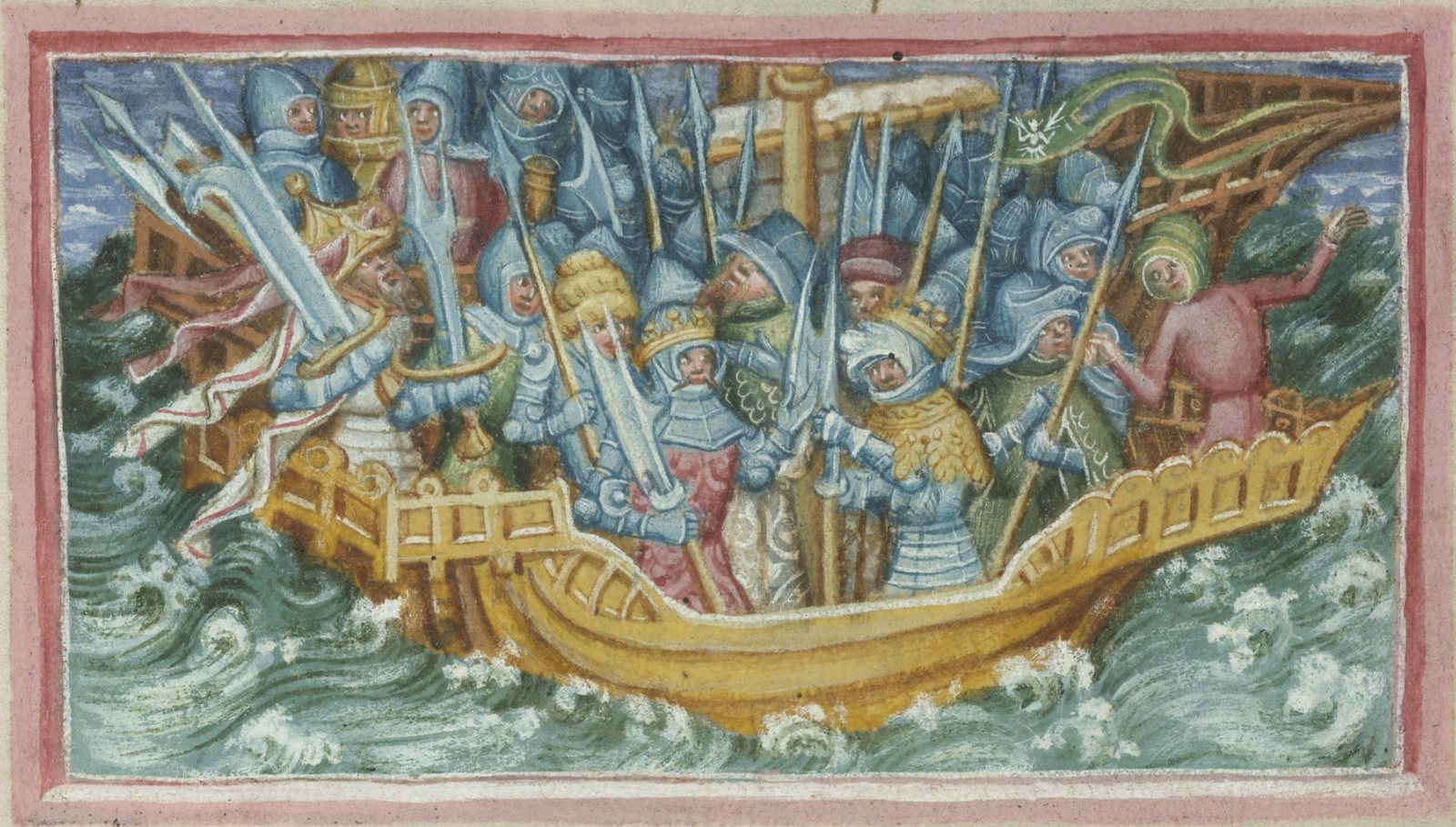
 Of all the sons of Ragnar Lodbrok, Ivar is the most tangible. Where the father dissolves into mist and legend, the son surfaces in sober annals: as the leader of an army that toppled a kingdom. And yet it is he who carries the most puzzling byname in all the North.
Ragnar Lodbrok is a composite figure, condensed from several men and a great deal of poetry. His son Ivar inn beinlausi, „the Boneless," is something else: a figure who leaves traces outside the Norse sagas too – in the Anglo-Saxon Chronicle and in the Irish annals. That makes Ivar one of the few „Viking heroes" where legend and a historically graspable person touch. Which is exactly what makes him so interesting to us: here we can show, on a living example, where the saga ends and the chronicle begins – and how far the two diverge.
The Norse tradition (Ragnars saga loðbrókar, Ragnarssona þáttr) was written down only in the 13th century, roughly 400 years after the events. The near-contemporary witnesses, by contrast, are the Anglo-Saxon and Irish annals. Where the two meet it becomes interesting – and where they part ways, one should believe the chronicles, not the sagas.
In 865 an army landed on the coast of East Anglia that the Anglo-Saxon Chronicle calls the mycel hæþen here – the „Great Heathen Army." This was no longer a raid of a few boats but a coordinated campaign of conquest under several leaders over years. In East Anglia the army wintered, procured horses and so became mobile; from there it thrust deep inland. Norse tradition places Ivar and his brothers Halfdan and Ubba at its head. As a motive it names revenge for their father Ragnar, said to have been killed by the Northumbrian king Ælla – in a pit full of snakes, according to legend. Whether that occasion happened as told is uncertain. That a great army came in 865, stayed, and changed England for decades is not.
The army marched north and in 866 took the city of York, the old Roman Eoforwic, an important centre of Northumbria. The timing was well chosen, for Northumbria was tearing itself apart in a quarrel between two kings: Osberht and Ælla. Only once the city was lost did the two reconcile and try jointly, in March 867, to retake York. The assault ended in catastrophe. The Anglo-Saxon Chronicle reports it briefly and bloodily:
This year the army went from the East Angles over the mouth of the Humber to the Northumbrians, as far as the city of York. And there was great discord among that people … and both the kings were slain, and the survivors made peace with the army.Anglo-Saxon Chronicle, year 867 (trans. after J. Ingram / J. A. Giles, public domain)
Northumbria was broken, a client king was installed, York became a Norse centre of power – the later Jórvík. This is not saga material but the beginning of decades of Scandinavian rule in the north of England, still visible today in language, place-names and law.
Norse tradition embellishes Ælla's death: Ivar is said to have performed the „blood eagle" on him, a cruel ritual execution in which the victim's back is opened and the ribs spread like wings. Here caution is essential. The „blood eagle" is attested almost only in late skaldic verse and saga literature, and scholarship – prominently Roberta Frank in her 1984 study – has shown that the gruesome scene most likely rests on a misunderstood skaldic kenning: a poetic image of the eagle spreading its wings over the slain and staining them with blood was turned, over the centuries, into an elaborated torture. As a secure historical practice the blood eagle cannot be documented – and certainly not as a specific act by Ivar upon a specific king. This does not mean the Viking age was gentle; violence and revenge were part of its world. But the minutely elaborated ritual execution that haunts novels, series and metal covers is literature, not evidence. Anyone who sells it as historical fact confuses a poetic image with a report.
The strongest historical thread leads to Ireland. In the Irish annals a man named Ímar appears from 857 on, a king of the Norsemen who rules Dublin together with Amlaíb (Olaf) and wages war for years between Ireland and Britain. In 870 the two besiege the rock fortress of Alt Clut (Dumbarton), stronghold of the Britons of Strathclyde, for months; in 871 they return to Dublin with a great fleet and countless captives. Many historians identify this Ímar with Ivar – the Old Norse Ívarr and the Irish Ímar mean the same man. His death is recorded in the Annals of Ulster for the year 873, with a striking formula: Ímar, „king of the Norsemen of all Ireland and Britain," ended his life. If this identification holds, then the commander of the Great Army did not die in England but as a mighty sea-king in the west – founding a dynasty that shaped Dublin for generations: the Uí Ímair, the „House of Ivar."
No Viking-age byname has been interpreted as often as inn beinlausi. The proposals range widely: a bone disease (such as brittle-bone disease, osteogenesis imperfecta), so that he was carried or borne into battle on a shield; an almost snake-like flexibility that made him uncatchable in a fight; a metaphorical „impotence," since Old Norse bein could also be linked with the leg and thus euphemistically with virility; or simply a legendary epithet attached to him only late. The honest answer is: we do not know. The earliest attestations of the byname are themselves later than his activity, and the sagas contradict one another. Some depict him as physically impaired, others as cunning and agile. „The Boneless" is a riddle that each generation answers anew – usually to the taste and medical notions of its own age.
Ivar was not alone. The Great Army was an alliance of several leaders, and beside him his brothers Halfdan and Ubba appear again and again. After the fall of Northumbria the army turned south and east: in 869 the kingdom of East Anglia collapsed and its king Edmund was killed – later venerated as a holy martyr. Mercia came under heavy pressure, and in the end only Wessex under Alfred the Great held firm. Ivar himself disappears from the English record in this phase; his path leads, if the identification with Ímar is correct, to Ireland and Scotland, to sieges and raids in the Celtic west. But the army remained and changed England fundamentally: raiding became settlement, warriors became settlers, and in the north and east the „Danelaw" arose, the region of Danish law. To this day, place-names ending in -by and -thorpe and countless Norse words in English recall that here it was not only an army that passed through, but a population that stayed. Ivar thus stands at the beginning of a development that reached far beyond his own life – a commander whose campaign reshaped a country, even if he never saw the outcome himself.
Documented close to the events are the Great Heathen Army (Anglo-Saxon Chronicle, from 865), the taking of York in 866 and the death of the two Northumbrian kings Osberht and Ælla in 867. Also documented is a mighty sea-king named Ímar in the Irish annals, whose death the Annals of Ulster record for the year 873. The identification Ímar = Ivar is the widely held, well-grounded, but not entirely proven interpretation. This makes Ivar markedly more tangible historically than his father Ragnar – even though the personal details (byname, revenge motive, blood eagle) come from the much later saga tradition.
The „blood eagle" on King Ælla is not a secure factual report but most likely a misunderstood skaldic kenning (Frank 1984), elaborated in literature centuries later. The pit full of snakes in which Ragnar died is a saga motif, not a chronicle finding. And the meaning of the byname „boneless" is open – every supposed diagnosis is speculation. The Ivar of the series „Vikings" is a dramatised construct: the historical core is the commander of an army and the probable Dublin king, not the elaborated on-screen psychogram.
In „Vikings," Ivar becomes the most dazzling of Ragnar's sons: the physically impaired, brilliant and cruel strategist who, out of the shadow of his disability, outstrips all the others. That is powerful drama – and it seizes on a real core: Ivar truly was the military mind whom chronicle and annals remember. But the inner conflicts, the dialogue, the personal coldness are storytelling, not source. What remains when you set the series aside is impressive enough: a leader whose army toppled an English kingdom, and a sea-king whose death the Irish thought important enough to record in 873. You do not need the embellishment – the chronicle alone carries the legend.
Ragnar's sons · The Great Heathen Army · Ragnar Lodbrok · Stamford Bridge 1066.
All History & Finds articles →
Carved in stone over 1,000 years ago, a king proclaims the unification and baptism of Denmark – the same king whose …
Read more →