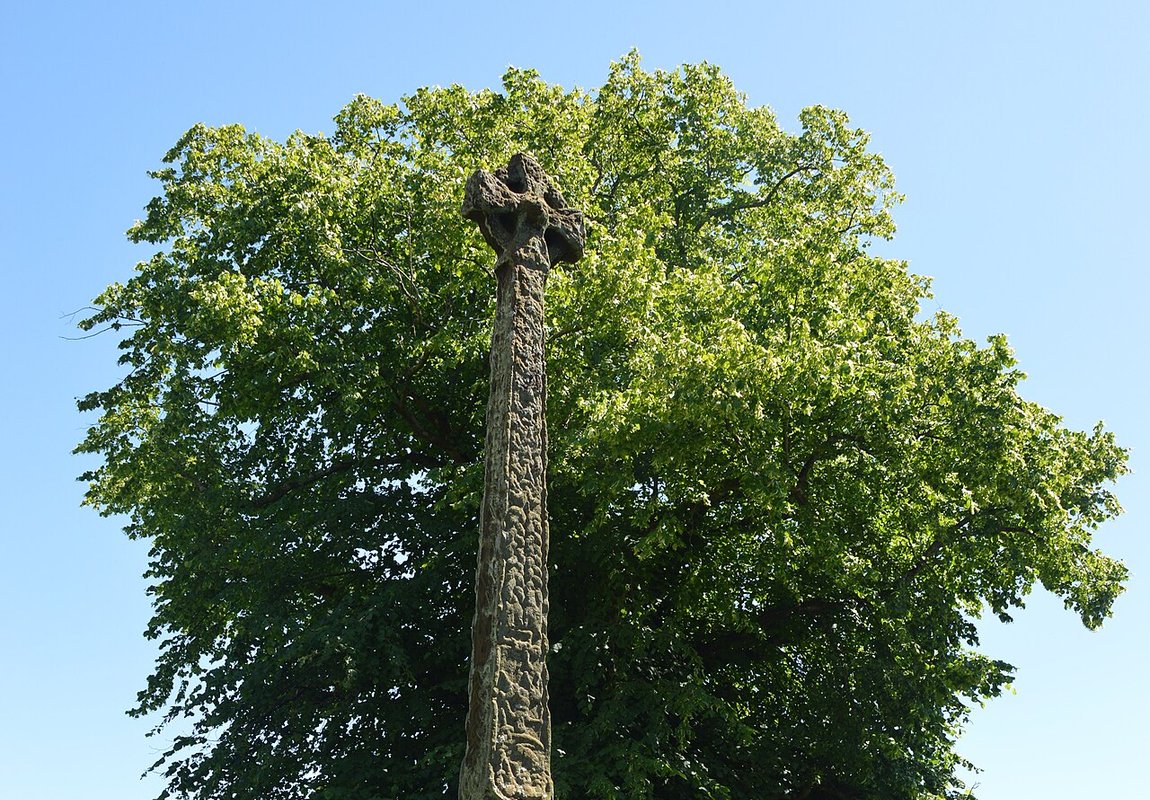
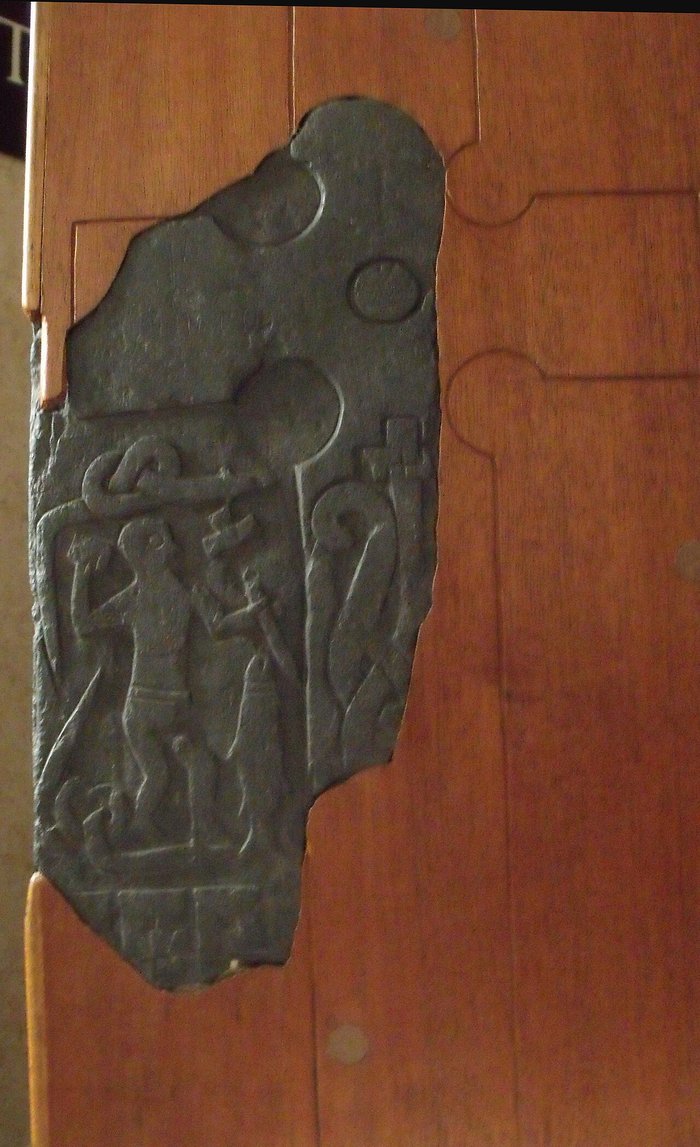
The Gosforth Cross in Cumbria and Thorwald's Cross from Kirk Andreas on the Isle of Man are tenth-century Christian crosses carved with scenes from Ragnarök. At Gosforth, Víðarr probably forces open a monster's jaws, a bound Loki lies beneath a serpent while Sigyn holds her bowl, Heimdall raises his horn – and below them Christ hangs on the cross. On Thorwald's Cross a wolf swallows a spear-bearing figure with a bird at his shoulder, widely taken to be Odin and the reverse shows a figure with cross and book. Here is what the stones actually show, how old they are and how historians read them.
Picture a churchyard on the Cumbrian coast, some time around the year 930. Among the fresh graves rises a slender shaft of red sandstone, taller than two men standing on each other's shoulders. At the top is a cross. Further down, wolves snap, serpents coil, riders tumble head over heels, a bound man writhes and a woman kneels with a bowl. Anyone who had come here from Norway or Ireland would have known these images. It was the end of the world – carved on a monument to the new God.
That tension is what makes the two best-known Viking-Age crosses in the British Isles so compelling. The Gosforth Cross in Cumbria and Thorwald's Cross from Kirk Andreas on the Isle of Man show gods from the Ragnarök tradition, and yet both belong to churchyards. One honest warning first: not a single figure on these stones is labelled. Every name – Víðarr, Loki, Odin – is an interpretation, however well argued. We will tell you how firm each one is.
Here is something that often gets lost: the crosses are considerably older than the texts we use to explain them. The Gosforth Cross is currently dated to the first half of the tenth century, usually around 920 to 950. The Poetic Edda, which contains Völuspá, "The Seeress's Prophecy", survives in a single Icelandic manuscript of about 1270, the Codex Regius. Snorri Sturluson wrote his Prose Edda, with the fullest account of Ragnarök in Gylfaginning, around 1220.
So roughly three centuries separate stone from parchment. The carvers in Cumbria and on Man were not illustrating "the Edda". They knew oral versions of the myths that resembled the later written ones – how closely, we cannot say. Turned around, that makes these crosses precious evidence: they prove that stories such as Loki's binding or Odin's death in the wolf's jaws were already circulating in the tenth century, long before a Christian Icelander set them down in ink.
"The sun turns black, earth sinks in the sea, / The hot stars down from heaven are whirled."Völuspá 57, translated by Henry Adams Bellows (1923)
The Gosforth Cross still stands where it was raised, in the churchyard of St Mary's, Gosforth, in west Cumbria, a few miles from the Irish Sea. Historic England's official listing gives its height as 4.42 metres – about fourteen and a half feet – and describes it as red sandstone. It is the tallest surviving Viking-Age cross in England and one of the most complete. The lower shaft is round like a tree trunk; above, it becomes a tapering, square-sectioned pillar crowned by a small ring-headed cross with interlace and a central boss.
The Cumbrian coast had once been part of Northumbria. In the tenth century Scandinavian families settled here, many probably by way of Ireland and the islands of the Irish Sea. The form of the cross is Anglo-Saxon and insular; much of its imagery is Norse. Gosforth is therefore not a "Viking monument" in the narrow sense but an Anglo-Scandinavian work, made by people fluent in both visual languages.
Its rediscovery is a story in itself. The Gentleman's Magazine described the column in 1799 and took it, correctly, for a Christian funerary monument. But the carvings were hidden under lichen. In the late autumn of 1881 the Reverend William Slater Calverley and the local doctor Charles Arundel Parker had the stone gently cleaned with a wet brush, and the scenes emerged. Calverley connected them with the Eddic poems and published his foundational reading in 1883. Plaster casts went to what is now the Victoria and Albert Museum in 1882, where they can still be seen, and in 1887 Calverley had a full-size replica made for the churchyard at Aspatria.
At the top of the west face stands a figure with a staff and a horn, holding back two gaping beast-heads. Since Calverley he has been identified as Heimdall, the watchman of the gods, whose Gjallarhorn announces the final battle. Völuspá says only that Heimdall blows his raised horn; nothing in the texts has him fending off monsters with a staff. Either the stone tells us more than the written tradition preserves, or it tells something different and our label is only approximately right.
Below comes a horseman with a spear, falling head-first, and then the scene even sceptics rarely dispute: a bound man with a serpent knotted about him, and beside him a kneeling woman holding a bowl. That fits Loki's punishment remarkably well. In Völuspá the bound figure lies in a grove, and Sigyn sits joylessly beside her husband. The prose at the end of Lokasenna and Snorri's Gylfaginning fill in the rest: the gods bind Loki to rocks with the entrails of his own son, Skaði hangs a venomous snake above him, and Sigyn catches the dripping poison in a bowl. When she turns away to empty it, the venom strikes his face, and his convulsions are earthquakes.
"By his side does Sigyn sit, nor is glad / To see her mate."Völuspá 35, translated by Henry Adams Bellows (1923)
The stone shows no entrails and no earthquakes. But a bound man, a serpent and a woman with a bowl form so specific a group that coincidence is hard to believe. This is Gosforth's most important contribution to scholarship: the story of Loki's punishment, Sigyn's bowl included, existed around 930 in a form strikingly close to the version Snorri wrote down three hundred years later.
At the top of the east face a monster rears with open jaws. Before it stands a human figure with a spear or staff, apparently planting one foot in the creature's mouth. In 1899 Calverley described this as Víðarr, son of Odin, with his shoe on the jaw of the Fenris wolf, about to slay him. The reading has largely held.
Comparing it with the texts is revealing. Völuspá has Víðarr thrust his sword through the wolf's gaping mouth into its heart, avenging his father. Snorri, by contrast, says Víðarr steps into the wolf's lower jaw with one foot – the foot wearing a thick shoe assembled from all the leather scraps people have ever trimmed from their shoes – and tears the upper jaw apart with his hand. If Calverley is right, the Gosforth carver knew a version closer to Snorri's prose than to the poem. Caution is still in order: the figure is small and weathered.
In the lower panel of the same face comes the one unmistakably Christian scene: the Crucifixion. Christ stands with outstretched arms, blood streaming from his side. To one side stands a man with a spear, to the other a woman with a long trailing garment or hair, and below them two beasts. Most scholars read the attendants in Christian terms: the spear-bearer is Longinus, who in John's Gospel pierced Christ's side, and the woman is Mary Magdalene or the Virgin. Calverley even toyed with a Norse double reading as Baldr's death with Höðr and Nanna – an idea now generally regarded as a stretch.
The layout is striking all the same: Víðarr's victory over the wolf sits directly above the Crucifixion. A deliberate pairing – the son who avenges his father, and the Son whose death defeats evil – is possible, though it cannot be proved.
The narrow sides are harder going. According to Historic England's description, the south face shows a stag, a wolf or hound and a horseman; some have seen Odin here, with a wolf above that is sometimes named as Garmr, the hound of Völuspá. The north face has a long rod ending in a beast-head with wing-like projections, and two riders, one of them upside down again. The winged creature has been suggested as Surtr, the fire giant.
These identifications are far less secure than Loki and Sigyn. The inverted rider is often taken as an image of death or defeat. And at the foot of the rounded shaft a tree-like pattern grows upward – Yggdrasil, the World Tree, to some; the Tree of Life of Christian art to others. Neither can be proved.
In March 1882, while measuring the cross, Parker noticed a worn slab used as a step beside the socket. Its hidden underside was carved. George Stephens, the runologist working in Copenhagen, recognised a story you may know from the Edda: Thor and the giant Hymir out fishing. Two figures sit in a boat, a line drops into the water, and the bait is an ox's head. Below, a hart struggles with a serpent. The slab, possibly from a second cross, is now displayed inside the church.
The fishing trip was one of the favourite subjects of Norse art. Thor tries to haul the Midgard Serpent out of the sea; according to Snorri he braces so hard that his feet burst through the bottom of the boat, until Hymir panics and cuts the line. The same story appears on the Altuna runestone in Uppland, on the Danish stone from Hørdum, where Thor's foot visibly pushes through the hull, and on the Gotlandic picture stone Ardre VIII, which features in our article on the picture stones of Gotland.
Why put this scene on a cross? A common explanation points to Pope Gregory the Great, who described the Devil as Leviathan, caught by God on a hook baited with Christ. Thor's fishing trip could serve as a familiar parable for that idea. Whether anyone at Gosforth actually thought this way, we do not know.
Inside the church lie two hogbacks as well: grave monuments shaped like houses with a curved ridge, a typical Viking-Age creation of northern England and southern Scotland. They were found in 1896–97 beneath the foundations of a twelfth-century wall. The larger shows men fighting serpents, the smaller two armed groups facing each other. Together with several cross-head fragments, they show that tenth-century Gosforth was an important church site with a highly capable workshop of sculptors.
Across the Irish Sea, in the church at Andreas in the north of the Isle of Man, a fragment is kept that is even more blunt. It is a small, badly damaged slate slab, number 128 in the Manx series. A runic inscription runs along its edge, and only the beginning survives: Þorvaldr reisti kross … – "Thorwald raised (this) cross …". Whom he raised it for has broken away with the rest of the stone.
Its date is disputed. The Scandinavian Runic-text Database (Rundata) places it around 940; the archaeologist Aleks Pluskowski prefers the eleventh century; others think of the later tenth. What is certain is that it belongs to the generations after Scandinavians settled on Man from around 900 – a settlement that at first still produced pagan burials such as the ship grave at Balladoole.
On one face a bearded man holds a spear pointing down at a wolf. His right foot is inside the animal's mouth. A large bird perches on his shoulder. The usual reading: Odin with his spear Gungnir is swallowed by the Fenris wolf at Ragnarök, and the bird is one of his ravens – Huginn or Muninn, as Andy Orchard has suggested. Völuspá knows the moment as Hlín's second sorrow: Frigg, having lost Baldr, now loses her husband too.
"Now comes to Hlin yet another hurt, / When Othin fares to fight with the wolf."Völuspá 53, translated by Henry Adams Bellows (1923)
The other face shows a large cross and beside it a figure holding a cross in one hand and a book in the other, trampling a serpent, together with a fish – the old symbol of Christ – and knotted snakes. Most read this as Christ treading down evil, an image common in Christian art and rooted in Psalm 91, where the righteous will trample the lion and the dragon. Some prefer a missionary or saint carrying the Gospels.
Read together, the two faces make a powerful statement: on one side the old All-Father dies, on the other the new Lord triumphs over the serpent. It is not quite that simple, though. In Norse tradition Odin's death is itself part of the end of the world, which is followed by a new green earth, as we explain in What Comes After Ragnarök?. The stone need not be a "victory over the heathens". It may set two stories of ending and renewal side by side.
A parallel stands in Sweden. On the runestone from Ledberg in Östergötland, probably eleventh-century, a figure places its foot in the mouth of a four-legged beast. This too is usually read as Odin and Fenrir, though some scholars relate the scenes to the fate of the dead man commemorated.
The Isle of Man is a special case. This small island preserves more Viking-Age runestones than many regions of Scandinavia: R. I. Page counted 26 in the 1980s, against 33 for the whole of Norway. Manx crosses combine the Celtic cross-slab with Scandinavian ornament and inscriptions in Old Norse. They also reveal a mixed society in which Norse and Gaelic names stand side by side.
One sculptor made sure he would be remembered. A cross at Kirk Michael records that Melbrigði, son of Aðakán the smith, raised it for his soul – "but Gautr made it, and all in Man". Melbrigði is the Gaelic Máel Brigte, "servant of St Brigid": a man with an Irish name commissioned a Norse carver to make a cross with a Norse inscription. A second signed cross at Andreas, for a father named Ófeigr, calls Gautr the son of Bjǫrn from Kuli or Kolli. Where that was is disputed – Cooley on Man has been proposed, and so has Coll in the Hebrides.
What "all in Man" means is debated too. Most take it as a proud claim to be the first, or the leading, Norse cross-carver on the island. The Norwegian archaeologist Haakon Shetelig attributed several more crosses to Gautr or his circle and linked their ornament to the Borre style, a tenth-century animal style built on ring-chains and interlace. Thorwald's Cross carries a ring-chain on its shaft too. There is no proof it came from Gautr's workshop, but it belongs to the same sculptural tradition.
Gosforth and Andreas are not isolated. On Man there are four crosses with scenes from the Sigurd legend, at Andreas, Jurby, Malew and Maughold. On the Andreas cross (no. 121), Sigurd stabs the dragon Fáfnir from below; above, he roasts its heart and sucks his burnt thumb, which lets him understand the birds, while his horse Grani stands by. The reverse probably shows Gunnar in the snake pit. At Jurby a figure holds a horn and a short sword with a bird above – Heimdall with the Gjallarhorn is a proposal, not a certainty.
Northern England has more. Kirkby Stephen church in Cumbria holds a tenth-century stone with a bound figure known locally as "the Bound Devil"; whether Loki, Satan or both are meant is still argued. Sigurd scenes and Weland the smith appear on other northern English stones. In Scandinavia, runestones such as the Skarpåker stone in Sweden borrow Ragnarök language to voice a father's grief, and the Christ figure on the Jelling stone speaks Christian in a Norse visual dialect.
On the basic question – why pagan gods on crosses? – there are several research positions, and they are not mutually exclusive.
Christian typology. Calverley already saw parallels: Loki's binding mirrors Satan bound in the Book of Revelation, Víðarr's victory over the wolf mirrors Christ's victory over evil. The archaeologist Richard N. Bailey developed this approach in a number of studies. The idea is that church patrons chose scenes from native myth that could be read as parables of Christian salvation history and the Last Judgement. The myth is not refuted but put to work as a foreshadowing – just as medieval theologians read Old Testament events as pointing forward to Christ.
Syncretism. Others stress that people in the tenth century lived with both worlds at once without feeling a contradiction. Thorwald's Cross is therefore often described as "syncretic art". Thomas DuBois has shown how long old and new practices overlapped during the Nordic conversion. A patron could trust in Christ and still believe that Odin would fall to the wolf.
Settler identity. The art historian Lilla Kopár examined Norse mythological imagery in Anglo-Scandinavian sculpture in her book Gods and Settlers (2012). She also asks what these images meant for a community of newcomers finding its place in a Christian landscape. The pictures address two audiences at once: clergy and settlers.
One question remains open: is an end of the world followed by a new world purely pagan at all? Some scholars suspect Christian influence on Völuspá itself. The crosses do prove that parts of the story were known in the tenth century – but in a milieu where Christian and Norse ideas were already intertwined. For the wider background, see our article on the Christianisation of the Germanic peoples.
For us in the workshop in Alsdorf, Gosforth and Andreas show how a sculptor a thousand years ago could pack a whole story into a few cut lines: a foot in a jaw, a bowl above a face, a raven on a shoulder. No words, yet the scene speaks. That is exactly what we chase in a good engraving. And the stones remind us that the North did not turn Christian overnight. Next time you pass an old cross covered in interlace, look closer. There may be a wolf waiting.
For courage. For remembrance. For legends that live on.
How old is the Gosforth Cross? The Gosforth Cross dates from the first half of the tenth century, usually placed around 920–950. That makes it roughly 300 years older than the manuscript of the Poetic Edda.
What is carved on the Gosforth Cross? Besides interlace and animals, it shows scenes usually read as Ragnarök: Heimdall with his horn, Loki bound with Sigyn and her bowl, Víðarr at the wolf's jaws – and, at the bottom of the east face, the Crucifixion of Christ.
Where is Thorwald's Cross? The fragment is kept in the parish church at Andreas in the north of the Isle of Man.
Does Thorwald's Cross really show Odin? The figure is not labelled. But a man with a spear and a bird on his shoulder, whose foot is inside a wolf's mouth, fits Odin's death at Ragnarök so well that this identification is widely accepted.
Why are pagan gods carved on Christian crosses? Scholars give several reasons: Norse myths were used as parables for Christian ideas, society was living through a transition with both faiths present, and the images spoke to Scandinavian settlers in their own visual language.
Who was Gautr? Gautr was a Viking-Age sculptor on the Isle of Man. He signed two runic crosses and claimed on the Kirk Michael cross that he made it "and all in Man".
Ragnarök · The Fenris-wolf · Odin · Picture Stones.
All Runes & Writing articles →
A single rune, cleanly lasered into slate or wood, is a strong motif: minimal, ancient, full of meaning. The only …
Read more →Leifr Eiríksson, Guðrún Ósvífrsdóttir, Ragnar Loðbrók: names from the North sound like little stories – and that is …
Read more →England, the year 1073 – seven years after the Norman Conquest. In the margin of a Christian manuscript someone carves …
Read more →On the Danish island of Funen stands the Glavendrup stone – it bears the longest runic inscription in Denmark, along …
Read more →