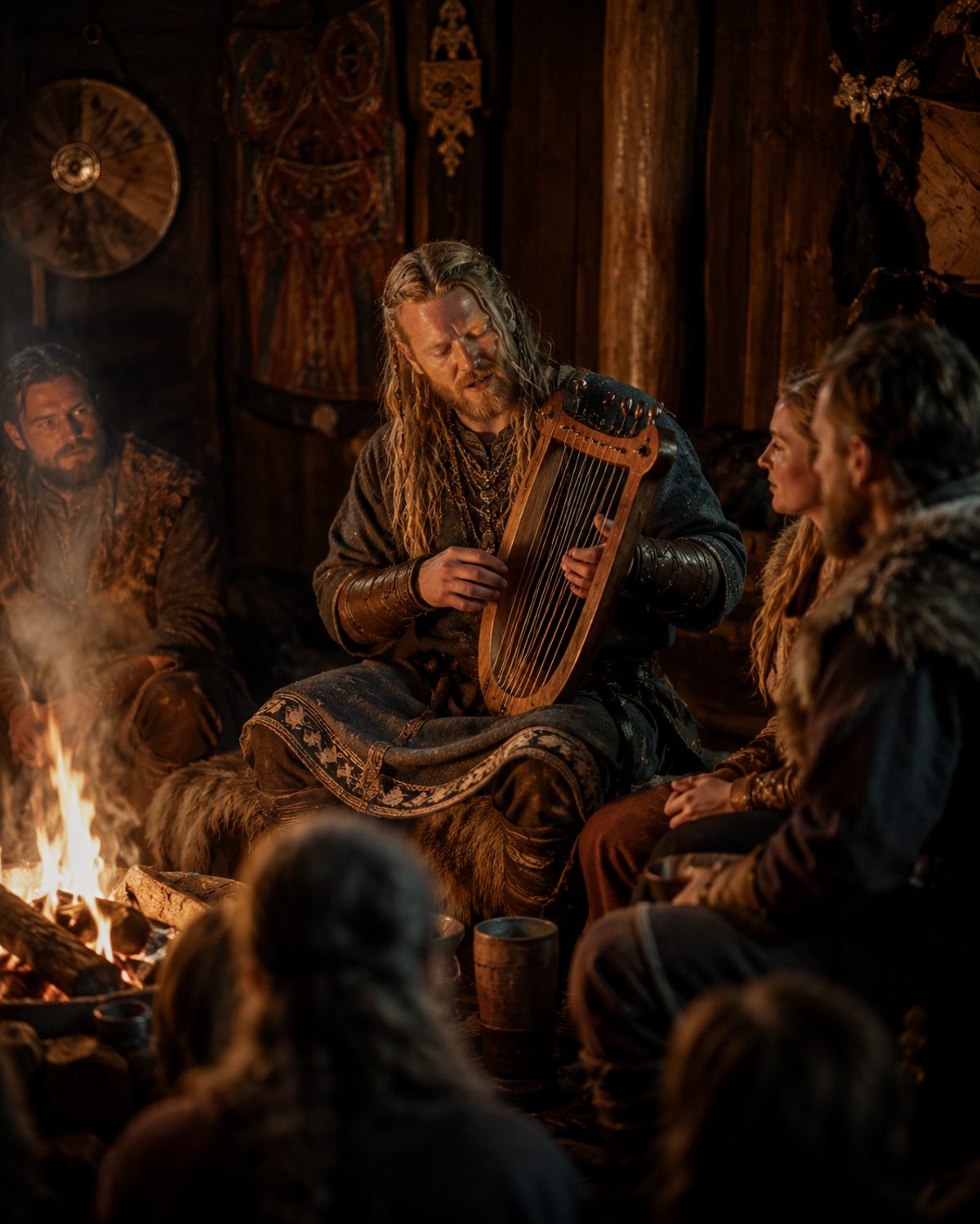
Genuine Viking names are mostly built from two parts with their own meaning – Þorsteinn is "Thor's stone", Ásbjǫrn "god-bear" – followed by the father's name in -son or -dóttir and often a nickname nobody got to choose. They are recorded on runestones, in Iceland's Landnámabók and in the sagas. Here you will learn how the names were formed, how a child was named, why so many people were named after Thor or after the dead – and you will find twenty male and twenty female names with meaning and source.
A farmyard somewhere in the North, some time in the tenth century. A child has been born, the father holds it, and in a moment it will be named. Not with a sound picked from this season's list, but with a name that carries something: the closeness of a god, the strength of an animal, the memory of a grandfather who died last winter.
That is what makes Viking names so compelling. They follow rules. Most are built from parts any speaker of Old Norse understood, followed by the father's name and often a nickname handed out by everyone else. Because people named their dead on runestones and Icelanders wrote down whole lists of settlers, we know a surprising amount about them – enough to tell genuine names from invented ones. At the end of this article you will find twenty men's and twenty women's names with meaning and source. For more choice, see our lists of Nordic boys' names and Nordic girls' names, and our names page.
Not every "Viking name" online is one. There are three big sources, and they sit at very different distances from the Viking Age (roughly 793 to 1066).
Runic inscriptions are contemporary – real voices from the period. Thousands of memorial stones, mostly in Sweden and Denmark, repeat the same formula: "X had this stone raised in memory of Y, his father." The wording barely changes; the names change constantly. That is why we know so many people who would otherwise have vanished without trace. Sweden's National Heritage Board points out that men are named far more often, so we know more men's names than women's. The inscriptions are collected in the Scandinavian Runic-text Database (Rundata) at Uppsala University, and the names are catalogued in Lena Peterson's Nordiskt runnamnslexikon (2007).
Landnámabók, the "Book of Settlements", describes how Iceland was settled between about 870 and 930. Its surviving versions date from the thirteenth and fourteenth centuries. They name more than 3,000 people and about 1,400 settlements – a treasure trove, with the caveat that centuries separate the events from the writing.
The sagas and the Edda. The Icelandic sagas overflow with names, patronymics and nicknames, but they are thirteenth-century literature. Their names mostly match what runestones and Landnámabók show. With heroes of legend – Sigurd, Brynhild, Gudrun – the names are genuinely Norse, but the people are not historical.
Many Old Norse names are compounds – linguists call them dithematic: a first element and a second element, each with its own meaning. The principle is shared across the Germanic languages; English has it in Edward, Alfred and Godwin. Þorsteinn combines the god's name Þórr with steinn "stone"; Ásbjǫrn combines áss "god" with bjǫrn "bear"; Sigríðr combines sigr "victory" with fríðr "beautiful, beloved".
A compound name is not a sentence. Nobody meant that the baby was a stone, and Gunnhildr, built from two words for "battle", is not a double helping out of enthusiasm. Elements were combined according to patterns, often drawn from the family's own stock. In the kin of Egill Skallagrímsson, the wolf runs through the generations like a thread: Úlfr, Kveldúlfr ("Evening Wolf"), Þórólfr ("Thor-wolf").
Typical second elements for men: -steinn (stone), -bjǫrn (bear), -úlfr/-ólfr (wolf), -geirr (spear), -ketill/-kell (cauldron, perhaps helmet), -mundr (protection), -arr (often from -herr "warrior"). For women: -hildr and -gunnr (both "battle"), -dís (goddess, female guardian spirit), -gerðr (enclosure, protection), -ríðr/-fríðr (beautiful, beloved), -unnr, -laug. Some elements are still debated; -laug is linked by some to "vow", by others to "washing".
There were also single-element names and short forms. The Danish Tóki is usually explained as a pet form of a Thor-name – plausible, though not certain in every case.
Animals are everywhere in the Norse name stock. The National Museum of Denmark lists Ormr (serpent), Úlfr (wolf) and Bjǫrn (bear) as popular animal names, and the University of Nottingham's "Vikings in the East Midlands" project describes Úlfr as very common throughout Scandinavia. Birds appear too: Hrafn (raven, Odin's bird) and Ari (eagle), the name of Ari Þorgilsson, the twelfth-century Icelandic historian.
Why predators? The obvious reading is that the name was meant to pass on some of the animal's strength and ferocity. We cannot prove it – nobody left us their reasons. In compound names, the animal element had long since become a fixed building block. Nobody called Bernard thinks of a bear either, though one is hiding in there.
One god outshines all others in Norse naming: Thor. Þorsteinn, Þorbjǫrn, Þórólfr, Þorgeirr, Þorkell, Þorfinnr; for women Þóra, Þórdís, Þorgerðr, Þórunn. The National Museum of Denmark notes that many boys in the Viking Age were named after Thor, giving Toke, Thorsten and Troels as examples. Rudolf Simek, in his Dictionary of Northern Mythology, observes that personal names containing Þórr are recorded with great frequency in the Viking Age but not before it. He suggests they may also have been a statement against advancing Christianity – a hypothesis, not an established fact.
Odin turns up in personal names far more rarely. One of the few examples stands on German soil: on the small Sigtrygg stone at Hedeby, the woman who commissioned it calls herself the daughter of Óðinkárr, and the Danish Skern stone names another Óðinkárr. Why people preferred Thor, we do not know. A common guess: Thor was seen as a dependable protector of people, Odin as unpredictable.
A more general element is Ás- "god, one of the Æsir": Ásbjǫrn, Ásgeirr, Ásmundr, Ásgerðr. Freyr or Freyja probably lie behind Freydís, and the divine byname Yngvi/Ing probably behind Ingiríðr and Ingólfr – the name tradition gives to the first Norwegian settler of Iceland.
Which name was number one? There is no reliable, freely available ranking you could simply copy. Peterson's lexicon lists the names with every attestation, and Rundata now covers more than 6,800 inscriptions from all periods. But any count depends on how spelling variants are grouped and whether medieval inscriptions are included. If you find "the ten most common Viking names" with exact figures online, ask for the source.
What is solid: Thor-names are very frequent in Viking Age runic inscriptions. Þorfastr, for instance, was common in Swedish inscriptions but does not occur at all in Norwegian or Icelandic texts – proof that naming fashions were regional. Sweden's National Heritage Board lists Erik, Sven, Ragnar, Gunnar and Olav, and Astrid, Ingrid, Sigrid and Ragnhild, as runestone names still in use today.
Women are named less often, but they appear with confidence – as sponsors, heirs and mothers. On the Glavendrup stone on Funen, Ragnhildr had the stone raised for her husband Alli. On the Sigtrygg stones at Hedeby, Ásfríðr honours her son, King Sigtryggr.
The Younger Futhark had only sixteen characters, so one rune often stood for several sounds. Þorsteinn therefore appears as something like þurstin. To see how your own name looks in this script, try our rune name generator; the characters themselves are explained in Runes and their meanings.
The Viking Age had no fixed family surnames. After the given name came the father's name in the genitive, plus -son or -dóttir ("daughter") – a patronymic. Leifr, son of Eiríkr, is Leifr Eiríksson; his half-sister is Freydís Eiríksdóttir; Ósvífr's daughter is Guðrún Ósvífrsdóttir.
Not every name forms its genitive with -s. Þorbjǫrn becomes Þorbjarnarson, Bjǫrn becomes Bjarnarson, Sigurðr becomes Sigurðarson, Ketill becomes Ketilsson. Þorbjǫrn's daughter is a Þorbjarnardóttir, like Guðríðr Þorbjarnardóttir of the Vinland sagas.
Less often, a child was named after the mother – a matronymic – for instance when she outranked the father. The most famous case is the Danish king Sveinn Ástríðarson, Sweyn Estridsen, named after his mother Ástríðr, sister of Cnut the Great. The link to the royal house clearly counted for more than the name of his father, Ulf.
The second name changed with every generation; it was a position on the family tree. In Iceland the system lives on: most Icelanders still carry a patronymic or matronymic.
If three men called Þorsteinn Þorbjarnarson sat at the same assembly, something more was needed. That was the nickname (Old Norse viðrnefni or auknefni). It described looks, origin, character or a deed – respectful, mocking, sometimes coarse.
Runestones already know nicknames. The Glavendrup stone gives Alli an epithet usually read, with a question mark, as "the pale"; other Danish stones name a Karl "the good" and a Tosti "the sharp". The famous nicknames, though, come from later sagas and royal histories, above all Snorri Sturluson's Heimskringla (c. 1230):
You did not choose a nickname; you were given one – and you rarely shook it off. A name that carried lasting renown was the highest thing you could achieve:
"Cattle die, kinsmen die, you yourself die the same; but fame never dies for the one who earns a good name."Hávamál 76 ("Deyr fé, deyja frændr …"), our own translation
A name was conferred. The sagas describe a fixed formula: the child was sprinkled with water, Old Norse ausa vatni, and named. In Egils saga (chapter 31), Skalla-Grímr's first son is sprinkled with water and called Þórólfr; a little later the younger brother is sprinkled with water, given a name and called Egill. In Heimskringla, Óláfr Tryggvason is born while his mother is on the run; in Samuel Laing's 1844 translation, "water was poured over it, and it was called Olaf after the grandfather".
The Edda knows the custom too. In Rígsþula, the poem about the origin of the social ranks, the newborn thrall Þræll and later Jarl, ancestor of the nobility, are sprinkled with water and named. In Hávamál (stanza 158), Odin lists a charm that works when he sprinkles a young man with water: that man will not fall in battle.
Whether the rite is truly pagan remains disputed. The resemblance to baptism is obvious, and every text was written down by Christians. Some scholars see ausa vatni as baptism projected back into the past, others as a genuine pre-Christian custom. In favour of the second view, the texts keep it verbally distinct from baptism (skírn).
It is widely held that naming marked the child's acceptance into the family; exposure of infants, which tradition presents as a pagan practice, was no longer an option afterwards. A gift often went with the name, the nafnfesti ("name-fastening"): in heroic poetry, the valkyrie Sváva gives Helgi a sword along with his name. Related is the tannfé, the "tooth-gift" for a first tooth – according to Grímnismál, the gods gave Freyr Álfheimr as a tooth-gift in days of old. More on life's milestones in our article on pagan life celebrations.
Where did a name come from? Very often from a dead member of the family. Egils saga offers the textbook case: Skalla-Grímr's brother Þórólfr had been killed in Norway. The first son received his name, and everyone said he would be very like the uncle he was named after. In the royal houses, Haraldr, Sveinn, Knútr, Óláfr and Magnús alternate through the generations.
Many scholars suspect more than piety: with the name, something of the dead person's luck and nature was meant to pass to the child – the hamingja we describe in Fylgja and Hamingja. The Edda itself plays with the idea: a prose note at the end of the second Helgi poem says that in olden times people believed in rebirth, and that Helgi and Sváva were reborn. The scribe adds drily that this is now called old wives' folly.
All of these are attested on runestones, in Landnámabók or in the sagas. Meanings follow mainstream scholarship; uncertain ones are marked.
| Old Norse | Modern | Meaning | Source |
|---|---|---|---|
| Þorsteinn | Thorsten | Thor + stone | runic inscriptions (þurstin), Landnámabók |
| Þorbjǫrn | Torbjörn | Thor + bear | runic inscriptions, Gísla saga |
| Þórólfr | Thorolf | Thor + wolf | Egils saga |
| Þorfastr | Torfast | Thor + firm | Swedish runic inscriptions |
| Þorkell | Thorkel | Thor + cauldron (helmet?) | Thorkell the Tall, England c. 1010 |
| Bjǫrn | Björn | bear | king at Birka, Vita Anskarii (9th c.) |
| Úlfr | Ulf | wolf | common across Scandinavia |
| Ormr | Orm | serpent | runic inscriptions, sagas |
| Sveinn | Sven | lad, young man | Hedeby stones |
| Eiríkr | Erik | "alone" (?) + mighty | Eric stone at Hedeby |
| Haraldr | Harald | army + ruler | Jelling stones |
| Gormr | Gorm | uncertain | Jelling stones |
| Óláfr | Olaf | ancestor + heir | Heimskringla |
| Leifr | Leif | heir, descendant | Vinland sagas |
| Ketill | Ketil | cauldron | Landnámabók |
| Grímr | Grim | mask, helmet | Egils saga |
| Egill | Egil | uncertain | Egils saga |
| Gunnarr | Gunnar | battle + warrior | Njáls saga, runestones |
| Ragnarr | Ragnar | counsel/gods + warrior | runestones |
| Hákon | Håkon | high + descendant | Heimskringla |
Women's names are rarer on runestones, but Landnámabók and the sagas are full of them. They were not gentler – read the second elements.
| Old Norse | Modern | Meaning | Source |
|---|---|---|---|
| Ástríðr | Astrid | love + beautiful | runestones, Heimskringla |
| Ásfríðr | Asfrid | god + beautiful | Sigtrygg stones, Hedeby |
| Auðr | Aud | wealth | Landnámabók |
| Bergþóra | Bergthora | help + Thor | Njáls saga |
| Brynhildr | Brynhild | mail-coat + battle | Edda, heroic legend |
| Freydís | Freydis | Freyr/Freyja + goddess | Vinland sagas |
| Guðríðr | Gudrid | god + beautiful | Vinland sagas |
| Guðrún | Gudrun | god + secret | Laxdæla saga, Edda |
| Gunnhildr | Gunhild | battle + battle | Heimskringla |
| Hallgerðr | Hallgerd | rock + protection | Njáls saga |
| Helga | Helga | holy | Gunnlaugs saga |
| Hildr | Hild | battle | Edda |
| Ingiríðr | Ingrid | Ing + beautiful | runestones |
| Ragnhildr | Ragnhild | counsel/gods + battle | Glavendrup stone |
| Sigríðr | Sigrid | victory + beautiful | runestones |
| Þóra | Thora | feminine of Thor | sagas |
| Þórdís | Thordis | Thor + goddess | Gísla saga |
| Þorgerðr | Thorgerd | Thor + protection | Laxdæla saga |
| Þórunn | Thorunn | Thor + (disputed) | Landnámabók |
| Þyri/Þórví | Thyra | Thor + sanctuary (?) | small Jelling stone |
Brynhildr and Hildr come from legend and myth, but the names were also used in everyday life. Thyra, wife of Gorm the Old, is known from the small stone at Jelling.
Germany has Viking names first-hand. Four runestones were found around Hedeby near Schleswig. On the two Sigtrygg stones, c. 940, Ásfríðr, daughter of Óðinkárr, honours her son King Sigtryggr, son of Gnúpa; the runes were carved by a man called Gormr. The Eric stone, c. 995, was raised by Þórulfr, a retainer of Sveinn, for his partner Eiríkr, who died "when warriors besieged Hedeby". On the Skarthi stone, King Sveinn – very probably Sweyn Forkbeard – honours his retainer Skarði, who had gone west and then died at Hedeby. Nine names on four stones, all from the tenth century.
The Nordic pattern lingered in the far north of Germany. In the Duchy of Schleswig, tied to the Danish crown until 1864, shifting patronymics in -sen were still normal in the eighteenth century; a royal rescript of 1 November 1771 aimed to impose fixed surnames, which took a long time. Petersen, Jensen and Hansen are such frozen patronymics – formed from Christian given names, though, not Viking ones.
As first names, a few classics made it into German. Thorsten was among the most common boys' names in Germany between 1960 and 1980. Sven was rare there before 1950 but several times reached the top ten boys' names of a year in the 1970s. Knut, Olaf, Björn, Ingrid, Astrid, Sigrid and Helga have long been at home there too. Anyone called Thorsten today carries a name that stood on runestones a thousand years ago.
Since the TV series "Vikings", two names have been in particular demand. Both deserve a sober look.
A rule of thumb for any name from film or games: if it appears neither on runestones nor in Landnámabók or the sagas, it is probably modern.
A Viking name was a small archive. It remembered the dead, placed the child under a god's protection, lent it the strength of bear or wolf and fixed its place in the family tree. The nickname came later – and told what a life had made of it all. In our workshop in Alsdorf we engrave names like these into slate, wood and glass. Send us yours and we will gladly help you trace where it comes from.
What was the most common Viking name? No reliable ranking with figures is freely available. What is certain is that Thor-names like Þorsteinn, along with Úlfr, Bjǫrn and Sveinn, are frequent in runic inscriptions.
What do -son and -dóttir mean in Viking names? They are patronymics: Leifr Eiríksson is "Leif, son of Erik", Freydís Eiríksdóttir "Freydis, daughter of Erik". There were no fixed family surnames.
What are some real Viking names for girls? Astrid, Ingrid, Sigrid, Ragnhild, Gudrun, Thora or Gunhild, for example – all attested on runestones, in Landnámabók or in the sagas.
Was Lagertha a real person? There is no evidence for it. She appears only in Saxo Grammaticus around 1200 and is considered legendary.
How did Vikings name their children? According to the sagas, the child was sprinkled with water and named, often after a dead relative. Whether the custom was purely pagan is debated.
Is Thorsten a Viking name? Yes. Thorsten goes back to Old Norse Þorsteinn, "Thor + stone", attested in runic inscriptions as þurstin.
For courage. For remembrance. For legends that live on.
Runes & their meaning · Vegvísir & Ægishjálmr · Ragnar Lodbrok · Egill Skallagrímsson · The picture stones of Gotland.
All Runes & Writing articles →
England, the year 1073 – seven years after the Norman Conquest. In the margin of a Christian manuscript someone carves …
Read more →On the Danish island of Funen stands the Glavendrup stone – it bears the longest runic inscription in Denmark, along …
Read more →Most runestones honour lords and warriors. The Danish Hørning stone, however, gives space to a very different voice …
Read more →It is the largest group of runestones commemorating a single event: about 26 stones, scattered across central Sweden …
Read more →