An Old Norse name is not a word but a kit of parts. Two elements from a fixed stock, often handed down from a dead grandfather to a newborn child. Search for "Viking names" today and you find lists in which Ragnar stands beside Odin and Björn beside Freya. Part of that material is carved on eleventh-century runestones. The other part was invented in the nineteenth century, when Romanticism discovered the north. We sort it out – with attestation, with meaning, and with an honest "no one knows" wherever the etymology is disputed.
Most Germanic names are dithematic. The first element comes from a large stock – þór- (the god Thor), sig- (victory), ragin- (counsel of the gods), arn- (eagle), her- (army), ás- (god, Æsir). The second comes from a smaller one – -steinn (stone), -bjǫrn (bear), -valdr (ruler), -mundr (protection), -ulfr (wolf), -geirr (spear), -ketill (kettle, probably also helmet). Þorsteinn is "Thor-stone", Ragnvaldr "counsel-ruler", Arnbjǫrn "eagle-bear".
And here the misunderstanding begins that every second name list online repeats. The two elements did not have to make sense together. An Arnbjǫrn was neither eagle nor bear. The woman's name Gunnhildr consists of two words that both mean "battle". Names were not read as sentences; they were worn as heirlooms. Anyone who invents a fine overall meaning for a name today turns a tool into a motto.
Beside these stand monothematic names. Bjǫrn, Ulfr, Steinn, Ormr ("serpent, dragon"), Sveinn ("young man, retainer"), Búi ("the settled one"). Some are short forms of longer names, others never were anything else. For many the question can no longer be decided.
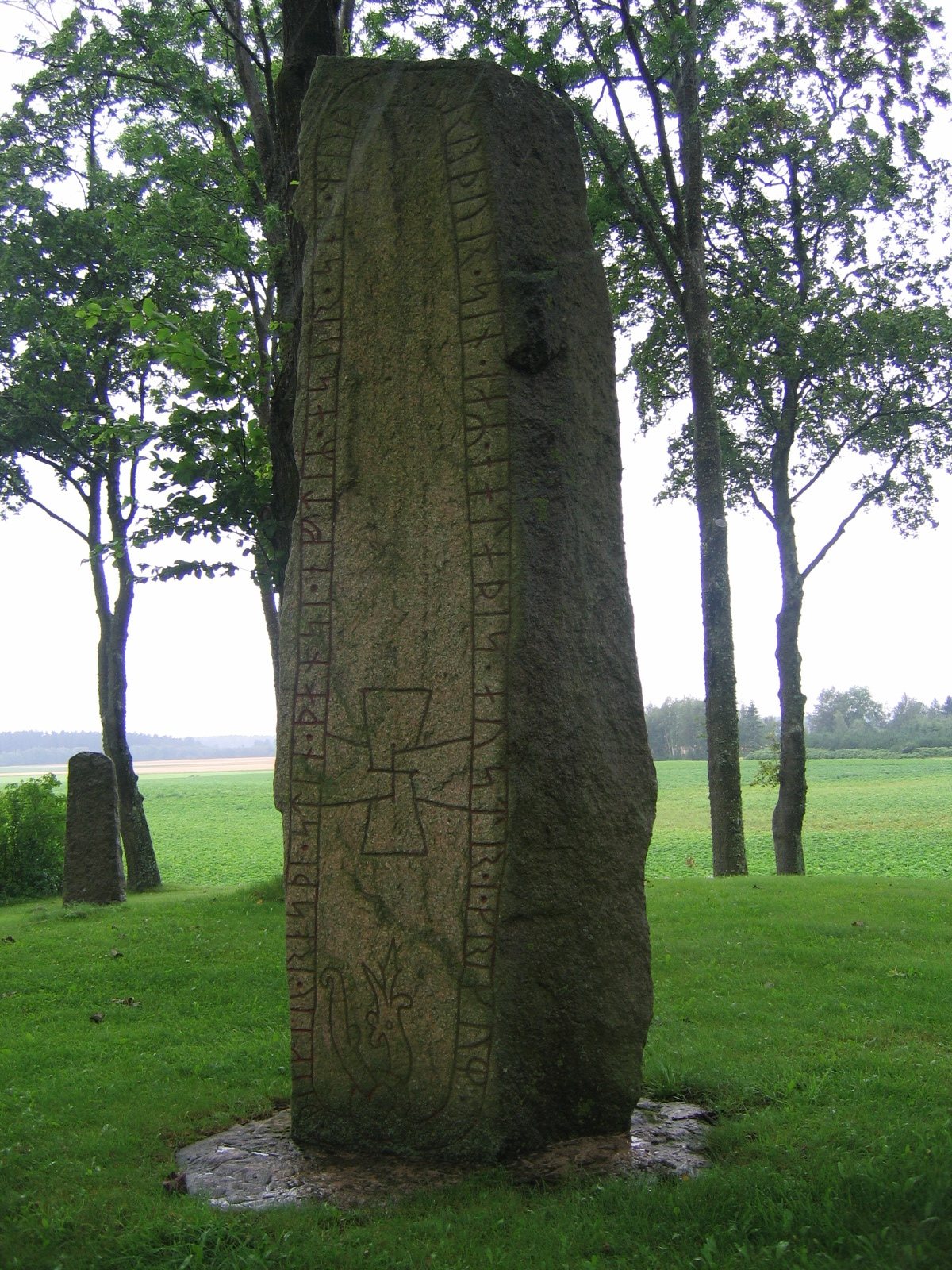
Runestone U 1034 stands by the church of Tensta in Uppland. Three brothers had it raised for their father: Þorbjǫrn, Þorsteinn and Styrbjǫrn for Þorfastr. It was carved by Öpir, one of the most prolific carvers of the later eleventh century. Four names, and Þór- appears three times. That is not chance but the principle of variation: one element of the father's name travels into the children's names and makes the bond audible. The third son, Styrbjǫrn, inherits the other element, -bjǫrn.
The second principle is naming after the dead. A child was given the name of a deceased relative, often a grandparent. More than piety was involved: with the name, so the widespread idea went, something of the dead person's luck and strength passed to the living one. More on that world in our article on kin and family.
The third principle is alliteration. In the tradition about the Ynglings, Dómaldi, Dómarr, Dyggvi and Dagr follow one another – four generations, one initial sound. That ruling families were built this way is plain to see; whether the names were ever given in that order, or whether later poets tidied them up, is another question.
None of this was a rule. Stone Ög 81 from Högby in Östergötland lists the five sons of a man called Gulli: Ásmundr, Ǫzurr, Halfdan, Kári and Búi. No shared element anywhere. Five brothers, five building blocks.
The commonest name element in the north is Þór-. In Landnámabók, the Icelandic book of settlements, seven of the ten most frequent men's names begin with it: Þorsteinn, Þórðr, Þorkell, Þorbjǫrn, Þórir, Þorgeirr, Þórarinn. Add to these the names in Frey- and in Ás- (Ásmundr, Ásgeirr, Ásbjǫrn).
What is almost entirely missing is the bare divine name as a personal name. Nobody was called Þórr, nobody was called Freyr. You carried the god inside your name, not as your name. The exceptions are two, and both involve Odin of all gods: the Danish bishop Óðinkárr of Ribe (attested from 1005, died 1043) and the woman Óðindísa on stone Vs 24 from Hassmyra in Västmanland – a name that occurs nowhere else. The second element of Óðinkárr has still not been securely explained.
A given name did not help much when four men in the same valley were called Þorsteinn. So the byname was added, Old Norse viðrnefni. In his 2015 dissertation Paul Peterson collected 517 Old Norse bynames, most of them from Landnámabók.
They describe looks, origin, craft, character, success and failure: Ketill flatnefr, "flat-nose". Þorsteinn ógæfa, "ill-luck". Haraldr hárfagri, "fair-hair" – who according to the tradition was earlier called lúfa, "shaggy-head". Bynames could mock, and they could be inherited.
On runestones they are rare. The overwhelming part of the runic name material consists of bare given names plus a statement of kinship: X had the stone raised in memory of Y, his father. Anyone hunting for a byname on a stone must hunt a long time.
The selection below gives a source for every name. Runestones are cited after the Samnordisk runtextdatabas, the Icelandic names after Landnámabók. Meanings are given only where scholarship agrees.
For some of the best-known names, certainty ends earlier than name lists would like.
Ívarr can be traced to two different base forms, one with "yew", one with the Ing element – both are argued. Óláfr goes back to a *Anu-laibaʀ, where the sense of the second element ("descendant", "heir") is debated. With Eiríkr the quarrel is over the first element: "sole" or "ever". Ketill literally means "kettle"; whether the name refers to the sacrificial cauldron or to a helmet is open.
On top of that comes a hard reading problem. The younger futhark has only sixteen characters and does not distinguish voiced from voiceless sounds. The elements Guð- ("god") and Gunn- ("battle") often look identical in runes. Anyone giving a meaning in such cases is giving a probability, not a fact. How the writing system works is explained in our introduction to the runes.
This is where the chaff separates. Ragnar, Björn, Ivar, Harald, Knut, Sven, Erik, Sigurd, Leif, Flóki and Hrólfr (Rollo) are old and attested. Other names from the same lists are not.
Odin, Balder, Loke and Freja count in Scandinavian name scholarship as recent formations: the name books record them only from the nineteenth and twentieth centuries, and Loke later still. Behind that stands Romantic nationalism, which turned gods and goddesses into baptismal names – precisely what the Viking Age had avoided. Thor as a bare given name is somewhat older, but it too does not belong to the Viking Age.
And Lagertha? The name stands in Saxo Grammaticus around 1200 as Lathgertha, in a Latin text about a woman who probably never existed. As an Old Norse woman's name it is not attested. We have a separate article on Lagertha.
None of this is a reason to dislike a name. It is only a reason to place it correctly. People ordering an engraving usually want to know where they stand.
Contemporary evidence means the names on runestones of the ninth to eleventh centuries, plus names in Frankish, Anglo-Saxon and Arabic texts of the period. Here the name stands on a stone that someone raised for a dead person they knew.
Later tradition means the Icelandic texts of the twelfth to fourteenth centuries: Landnámabók, sagas, kings' histories. They name thousands of people and are irreplaceable for the stock of names – but they write about a period two to four hundred years gone.
Modern interpretation means the etymologies. The base forms of most name elements are secure; the reading of individual names often is not.
Modern invention means the divine given names of the nineteenth and twentieth centuries, and the names from television series and games that have slipped into the lists.
Anyone looking for a name will find its spelling in the younger futhark in our name lexicon with runic transcription. The female side of the same world stands with the Norse girls' names. A name is the shortest thing a person leaves behind, and on a stone it lasts a thousand years. For courage. For memory. For legends that live on.
Runes & their meaning · The Icelanders · Kin & Family · Norse Girls' Names · Lagertha the Shield-Maiden · Elder & Younger Futhark.
.JPG)