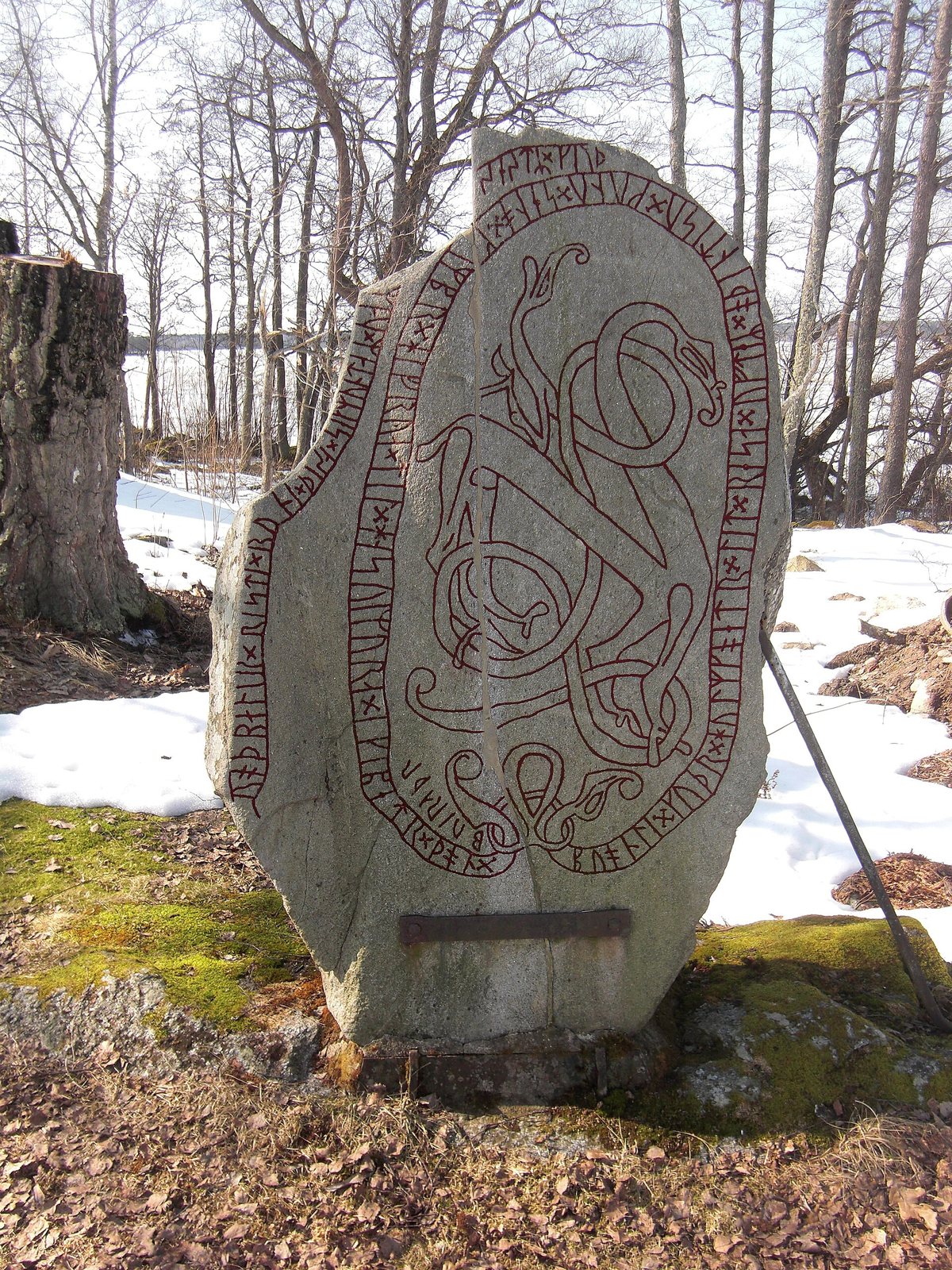
On a stone in Västmanland stands a sentence a man had cut in verse for his dead wife around 1070: to Hassmyra will come no better housewife. Her name was Óðindísa, and it occurs nowhere else. Such stones are rare, and that is exactly what makes them matter. Viking Age women's names stand on runestones, in Landnámabók, in the sagas – but they stand there in far smaller numbers than men's names. We show which names are actually attested, what they mean, and what the gaps reveal about the tradition.
The design is the same as for men's names: two elements from a fixed stock. Only the second stock differs. Instead of -steinn, -valdr and -ulfr we find -fríðr (fair, beloved), -gerðr, -hildr (battle), -dís (female protective deity), -laug, -bjǫrg (help, rescue), -unnr (wave), -vé (sanctuary), -veig.
The first elements are the same as the men's: Þór-, Ás-, Ing-, sig- (victory), geirr (spear), ragin- (counsel of the gods), hall- (stone). Ástríðr is "god" plus "fair", Ragnhildr "counsel" plus "battle", Ingibjǫrg "Ing" plus "help".
Here too the elements did not have to make sense together. Gunnhildr consists of two words that both mean "battle". That is not a declaration of war but a kit of parts quoting itself. And as with the men there are short forms whose full originals can no longer be reconstructed with confidence: Tóla, Tófa, Inga, Gróa.
Runestones name the sponsor first and the dead person second. Women stand in that first position more often than the image of stone-raising as men's business suggests. Birgit Sawyer built a thesis on it: runestones were above all declarations of inheritance. Whoever had a stone raised made public who inherited from whom – and because women in the north could inherit, they appear as sponsors. The thesis has not gone unchallenged, but it explains the formula better than any other.
The fullest example lies on Färingsö in Lake Mälaren. Stone U 29 from Hillersjö tells a family history across three generations: Geirlaug married Geirmundr, their son drowned; she married Guðríkr, and of their children only Inga survived; Inga married Ragnfastr at Snottsta, husband and child died and she inherited; then she married Eiríkr, and when Inga died her mother Geirlaug inherited from her own daughter. The stone ends with an invitation: Raþ þu runaʀ – interpret the runes.
Then there are stones on which women speak for women. On the Dynna stone N 68 in Hadeland, Gunnvǫr, daughter of Þrýðríkr, had a bridge built in memory of her daughter Ástríðr – "the handiest maiden in Hadeland". The stone was made around 1040 to 1050 and carries the three Magi in its imagery. On U 489 from Morby, Gullaug had a bridge made for her daughter Gillaug. And in Jutland, Tófa, daughter of the Obodrite prince Mistivir and wife of Harald Bluetooth, had stone DR 55 raised for her mother.
Denmark's best-known sponsor is Ragnhildr. She raised the Glavendrup stone DR 209 for her husband Alli and, on the usual attribution, the Tryggevælde stone DR 230 as well – both by the same carver Sóti, both with a curse against anyone moving the stone.
And then Vs 24 from Hassmyra: Holmgautr had it raised for Óðindísa, his wife, in verse in fornyrðislag. More on the room for manoeuvre women had in that world in our article on women in the Viking Age.
Runestones after the Samnordisk runtextdatabas, Icelandic names after Landnámabók and the sagas. Meanings only where scholarship agrees.
The Icelandic texts of the thirteenth century are the richest source of names we have. They are also the latest. Between the settlement around 900 and the writing down lie three hundred years in which names were passed on, reshaped and literarily selected.
One example sits right in the middle of the tradition. The woman who sailed her own ship from Scotland to Iceland is called Auðr in Íslendingabók and Landnámabók, but Unnr in Laxdæla saga. Her byname wavers too: djúpúðga, "the deep-minded", becomes djúpauðga, "the deeply wealthy", in part of the manuscript tradition. One woman, two names, two meanings – and no way for us to get behind the texts. We tell her story under Aud the Deep-Minded.
It is much the same with Sigríðr storráða, "Sigrid the Haughty", who appears in the kings' sagas as Olaf Tryggvason's antagonist. Since the late nineteenth century scholars have doubted that she existed; several women have probably flowed together into her, among them the Polish princess who turns up in Thietmar of Merseburg and Adam of Bremen. The name Sigríðr is genuine. The person probably is not.
The imbalance is plain. Landnámabók records far more distinct men's names than women's. And of the 517 Old Norse bynames collected by Paul Peterson, only about three per cent belong to women.
That does not mean women had fewer names. It means less was written about them. The texts care about property, feud, inheritance and descent – and there women appear as daughters, mothers, widows and heirs, rarely as actors with a story of their own. Where they do stand at the centre, it turns concrete at once: a mistress of a farm who runs the place, a seeress, a widow who pays for a stone.
It also means being careful with popular claims. The fighting woman that every name list now offers as an explanation is a topic of its own with very thin evidence – we took it apart under the shield-maiden.
Frögärd of Ösby is called a runemistress in many texts. She was not. In 1926 Erik Brate read a sequence of characters on U 203 as a carver's signature; in 1943 Elias Wessén showed that the passage cannot be read that way. The stone was carved by Åsmund Kåresson. On the stone Frögärd is the granddaughter – and on Sawyer's reading that was exactly the grandfather's point: to secure her inheritance.
One carver, however, is known by name: Gunnborga, who appears as the carver on inscription Hs 21 in Hälsingland. She is the one secure case in the entire corpus. Whether there were others we do not know – carvers' signatures are rare in general.
Astrid, Sigrid, Ragnhild, Thora, Gudrun, Ingeborg, Helga, Tove, Inga and Signe are old and attested. Other names in the same lists are not.
Freja and Freya are attested as given names only in the twentieth century. In the Viking Age Freyja was the name of a goddess and, beyond that, simply a word for "lady" – people were not called that. Ylva sounds ancient and is a young given name: formed as a feminine counterpart to Ulf, and not attested from the Viking Age. Saga and Idun follow the same pattern: divine names that became given names in the nineteenth and twentieth centuries. And Lagertha stands as Lathgertha only in Saxo Grammaticus around 1200, in a Latin text – as an Old Norse woman's name the form is not attested.
Anyone having a piece engraved with a name should know what they are holding: a name from the eleventh century or one from the nineteenth. Both are fine. They should just not be confused.
Contemporary evidence means the women's names on runestones of the tenth and eleventh centuries: Óðindísa, Geirlaug, Inga, Ragnhildr, Tófa, Tóla, Ástríðr, Gunnvǫr, Þyrvé. Here the name stands where contemporaries put it.
Later tradition means Landnámabók and the sagas of the twelfth to fourteenth centuries. They supply most of the stock of names – and most of the stories that are better not taken for reports.
Modern interpretation means the etymologies, often less secure for women's names than for men's, because elements such as -laug, -gerðr and -ríðr have not been definitively explained.
Modern invention means goddesses' names used as given names, and characters from series and games.
The spelling of each of these names in the younger futhark is in our name lexicon with runic transcription; the male side of the same world is with the Norse boys' names. A name on a stone is often the only thing left of a person. For courage. For memory. For legends that live on.
Viking women · Aud the Deep-Minded · The Shieldmaiden · Norse Boys' Names · Runes & their meaning · The Icelanders.

_0322.jpg)