When we speak of "Viking kings" today, we quickly picture a single mighty ruler on a throne of dragon-carved wood. Reality was more colourful, harder and far more fragmented: for centuries countless petty and regional kings shared the North, and only late did individual men manage to unite whole realms. This overview walks through the most important rulers – and draws a clean line between what the sources prove and what the sagas added later.
Kingship in the Viking Age was never a given. There was no automatic hereditary throne on which the eldest son simply followed. A king's son had good prospects, but he had to be recognised – by the powerful families, by his retainers and, not least, by the thing, the assembly of free men. In Norway and Iceland the consent of the regional things was central; a ruler who broke the law or turned the great families against him could be deposed or killed as quickly as he had risen.
At the same time kingship carried a sacral glow. Many ruling houses traced their descent from the gods – the Norwegian Ynglings, for instance, from Freyr, others from Odin. Whether there was a real belief in "royal luck" or whether that is a later literary idealisation remains disputed. What is certain is that a king had to deliver success – good harvests, plunder, victory. If success failed, legitimacy soon crumbled too.
Above all, for a long time there was no single king "over all Scandinavia". Norway, Denmark and Sweden were not fixed states but landscapes full of competing petty kings, jarls and chieftains. The unification of these realms is the real great story of the Viking Age – and it took generations.
At the head of the Norwegian line of kings stands Harald Hárfagri, Harald Fairhair. According to tradition he swore not to cut his hair or beard until he had brought all Norway under his rule – hence the byname. The turning point was the sea battle in Hafrsfjord (traditionally dated to around 872), in which he defeated the allied rival kings of the south-west. Many great men who refused to submit are said to have emigrated as a result, among other places to Iceland. More about Harald Fairhair and the unification →
Caution is needed here: Harald is historical, but his unification of Norway is told above all in king's sagas of the 13th century, a good three hundred years later. How comprehensive his rule really was is debated in scholarship. That he counted as the ancestor and founding figure, however, is beyond dispute – almost all later Norwegian kings traced themselves back to him.
Harald's succession shows exemplarily how fragile kingship was. His son Erik earned the byname Blóðøx, Bloodaxe – in the saga because he fought his way to sole rule with the blood of several brothers. He could not hold Norway and became king twice in York in northern England. The York coins bearing ERIC REX are one of the hardest pieces of evidence of all for a named Viking king on English soil. He fell around 954, and with him the Viking kingship of York ended. More about Erik Bloodaxe and York →
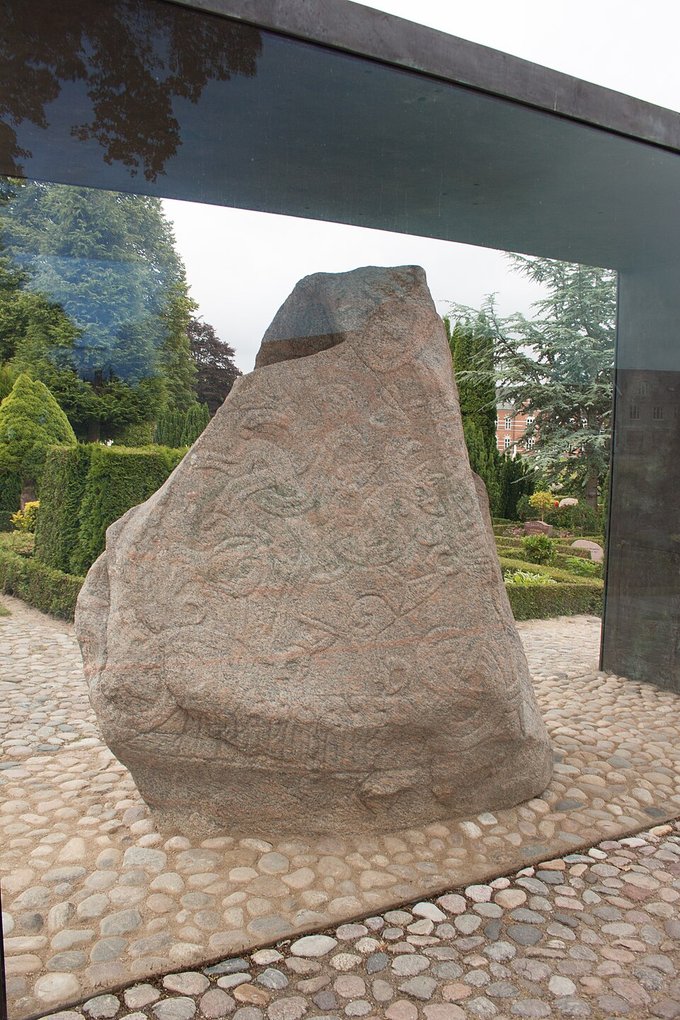
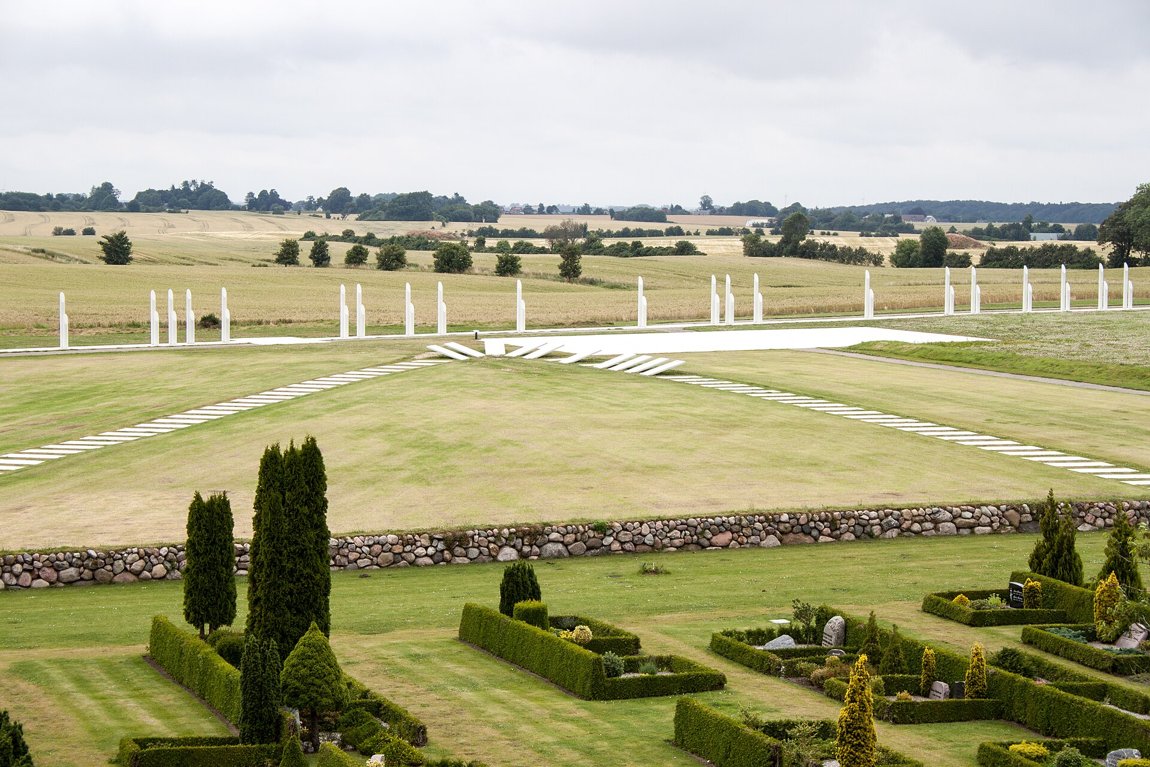
In Denmark the continuously traceable line of kings begins with Gorm the Old. He is the first Danish king whose rule can be reliably grasped, and he founded the dynasty of the Jelling kings. His monument still stands in Jelling in Jutland: the small rune stone he had raised for his wife Thyra. Gorm himself was still a heathen – the great turn came only with his son.
Harald Bluetooth (Haraldr blátǫnn) is the key figure of the Danish 10th century. He united the realm, adopted Christianity and had a network of enormous ring fortresses built (Trelleborg, Fyrkat, Aggersborg, Nonnebakken, Borgring) – the expression of a strikingly organised royal power. His most famous testimony is the great Jelling stone, often called "Denmark's baptismal certificate", with the oldest depiction of Christ in the North.
King Harald had these monuments made in memory of Gorm, his father, and of Thyra, his mother – that Harald who won for himself all Denmark and Norway, and made the Danes Christian.Inscription of the great Jelling stone (DR 42), paraphrased translation
Hardly any royal inscription sums up the programme so tersely: unification plus Christianisation, carved in stone. More about Harald Bluetooth, Jelling and the ring fortresses →
Harald's son Sweyn Forkbeard (Sveinn tjúguskegg) brought Danish power to a new peak. After years of raiding against England he launched his conquest in 1013, drove out King Æthelred and was recognised as king – only to die suddenly a few weeks later, in early 1014. He was the father of Cnut, who would complete the work. More about Sweyn Forkbeard →
Cnut (Knútr inn ríki) is the mightiest ruler of the whole Viking Age. He became king of England (1016), inherited Denmark and for a time also won Norway – a North Sea empire linking England and Scandinavia under one crown. Cnut ruled not as a plundering Viking but as a Christian great king who dealt with emperor and pope and even travelled to Rome in 1027. His name carries the famous tide legend: Cnut is said to have commanded the sea to draw back – not out of arrogance, as often told, but in the oldest version as a lesson in humility, to show his courtiers that earthly power counts for nothing before God. More about Cnut the Great and the North Sea empire →
In Norway Christianisation was pushed through by two kings named Olaf – often with force. Olaf Tryggvason, a brilliant warrior and seafarer with the magnificent ship Ormrinn langi, evangelised forcefully and fell around the year 1000 in the sea battle of Svolder against overwhelming odds. More about Olaf Tryggvason →
Olaf Haraldsson, later Olaf the Holy, strengthened Christianity but was driven out by rebellious magnates and Danish power. On his attempt to return he fell in 1030 at the battle of Stiklestad. Soon afterwards he was canonised and became rex perpetuus, the "eternal king" of Norway – the failed ruler became the most important saint of the North. His grave in Nidaros (Trondheim) became a place of pilgrimage.
Harald Hardrada, the "hard ruler", embodies the Viking age at its close like almost no one else. As a young man he fled from Stiklestad, served for years in the famous Varangian Guard of the Byzantine emperor, gathered fame and wealth in Constantinople and returned to Norway as king. In 1066 he crossed to England to win the English crown – and fell in the battle of Stamford Bridge. His death is regarded by many as the true end of the Viking Age, only weeks before the Norman conquest at Hastings. More about Harald Hardrada and Stamford Bridge →
Not every mighty Viking became a king in Scandinavia. Rollo (Hrólfr), according to tradition, received land at the mouth of the Seine – the later Normandy – from the West Frankish king in the treaty of Saint-Clair-sur-Epte in 911. From his descendants sprang the very house that conquered England in 1066 under William the Conqueror. A Viking leader thus became a line of dukes who shaped European history. More about Rollo and Normandy →
The great kings of the Viking Age stand for one of the most gripping turning points in European history: from the world of chieftains and petty kings to the Christian realms of the High Middle Ages. They were warriors and statesmen, heathens and Christians, conquerors and lawgivers – and their stories are so powerful precisely because they stand on the threshold between old and new. Looked at honestly, their names reveal no fantasy heroes but real people wrestling for power, recognition and an afterlife in memory – and that is at least as impressive as any saga.
Harald Bluetooth · Cnut the Great · Harald Hardrada · Erik Bloodaxe · Rollo of Normandy · Ragnar Lodbrok.
All History & Finds articles →
While Uppsala is famous above all from a text, Thuringia holds the best-excavated Germanic sanctuary in the ground: the …
Read more →Olaf Tryggvason ruled Norway for only about five years – yet he became one of the loudest figures of the Viking Age. A …
Read more →