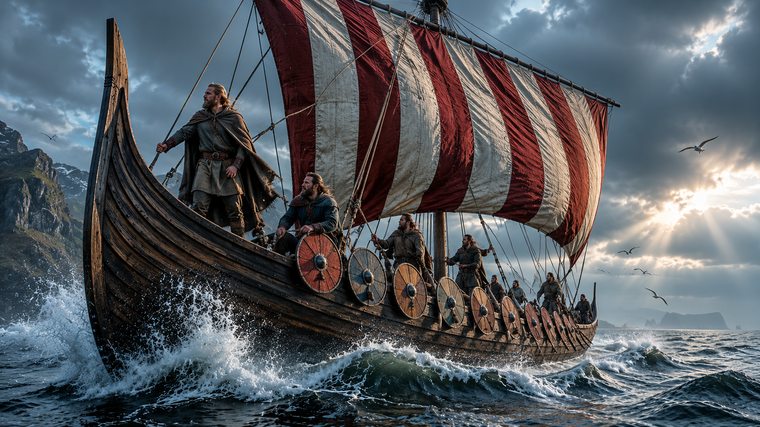
Olaf Tryggvason ruled Norway for only about five years – yet he became one of the loudest figures of the Viking Age. A king's son raised in exile, a sea-warrior who grew rich abroad, a man who accepted baptism and then drove his own country toward Christianity with startling force. At the end stand a sea battle, a magnificent ship and a leap overboard that people still argue about. Much of this is well attested; some of it is the pious wishful thinking of the chroniclers. So let us keep it clean and separate what is documented from what is legend.
According to tradition, Olaf was a great-great-grandson of Harald Fairhair and the son of the petty king Tryggvi Olafsson. His father was killed while Olaf was still a child, and his mother fled with him into exile. The sagas send the boy across the Baltic world and into the Rus, to the court of Novgorod – details best taken with a pinch of salt, since they conveniently polish the later hero.
Olaf becomes more tangible as the leader of Viking fleets in the West. In the 980s and early 990s an "Anlaf" appears in the accounts of raids on England, and Olaf Tryggvason is very likely the man behind the army that ravaged southern England in 991. Anyone interested in this era will find more in our broad overview of the Vikings in England. The most famous clash of those years – the battle of Maldon and the first great Danegeld – deserves its own chapter, which we lay out in Danegeld and the Battle of Maldon. From English sources we know at least that a Norseman named Olaf threatened London in 994 alongside the Danish king, was paid off in silver, and was confirmed in the faith in England – baptism as part of a peace settlement, not a sudden bolt of enlightenment.
With the wealth and backing gained in England, Olaf returned to Norway around 995. The country's strongman until then, Jarl Hakon of Hlaðir, had become hated by his own people; he died in less than glorious fashion, said to have been killed by his own servant in a pigsty. Olaf filled the power vacuum and had himself acknowledged as king – above all along the coast and in the west, where his fleet counted for something.
His reign stayed short and rested less on a firm realm than on personal following, silver and fear. He moved in a world of hard sea-warriors and mercenary brotherhoods; the half-legendary Jomsvikings belong to the same rough milieu from which Olaf drew both his men and his enemies. Kingship here meant being constantly on the move, binding allies to yourself, removing rivals – and taking care that the powerful men in the neighbouring lands did not lose their patience.
Olaf is remembered as one of Norway's two great missionary kings. Rather than gentle persuasion, the sources tell of coercion: those who accepted baptism were left in peace; those who refused felt Olaf's wrath. The sagas report smashed cult images, levelled sacrificial sites and chieftains forced to choose between the font and death. Iceland and the North Atlantic islands were caught in his slipstream too – missionaries, pressure and shrewd diplomacy nudged conversion along there, though hardly by Olaf's fist alone.
The missionary drive was not a single feat of strength but stretched over decades. The second great missionary king, Olaf Haraldsson, carried the work on and fell in 1030 at the Battle of Stiklestad – only afterwards did Christianity take lasting hold in the North. So one should neither credit Olaf Tryggvason with the sole "conversion of Norway" nor take the image of the sword-missionary at face value: it comes largely from Christian authors who needed a champion of the faith.
Among Olaf's more solid traces is the founding of a trading and royal site at the mouth of the river Nið where it meets the Trondheim fjord: Nidaros, the later Trondheim. The location was cleverly chosen – sheltered, well connected, on the threshold between the rich south and the far north. Whether Olaf truly settled the spot first or merely gave royal weight to an existing place is uncertain in detail. What is certain is that over the 11th century Nidaros rose to become the religious heart of Norway – not least because Saint Olaf was venerated there. The town thus far outlived its founder and became the most enduring monument of his brief reign.
No royal ship of the Viking Age is as famous as Olaf's showpiece, the Ormrinn langi, the "Long Serpent". The sagas rave about a huge longship with many rowing benches, an intricately carved dragon's head and a hand-picked crew of the realm's strongest warriors. It was weapon and message in one: whoever could have such a ship built showed that he had timber, craftsmen, gold and followers in abundance.
One may read the chroniclers' measurements with a wink – round, impressive numbers are simply good form in a hero's praise. Yet the core is plausible: splendid royal ships did exist, and a ruler like Olaf will have treated his finest vessel like a floating throne. It was precisely this ship that would stand at the centre of his final fight.
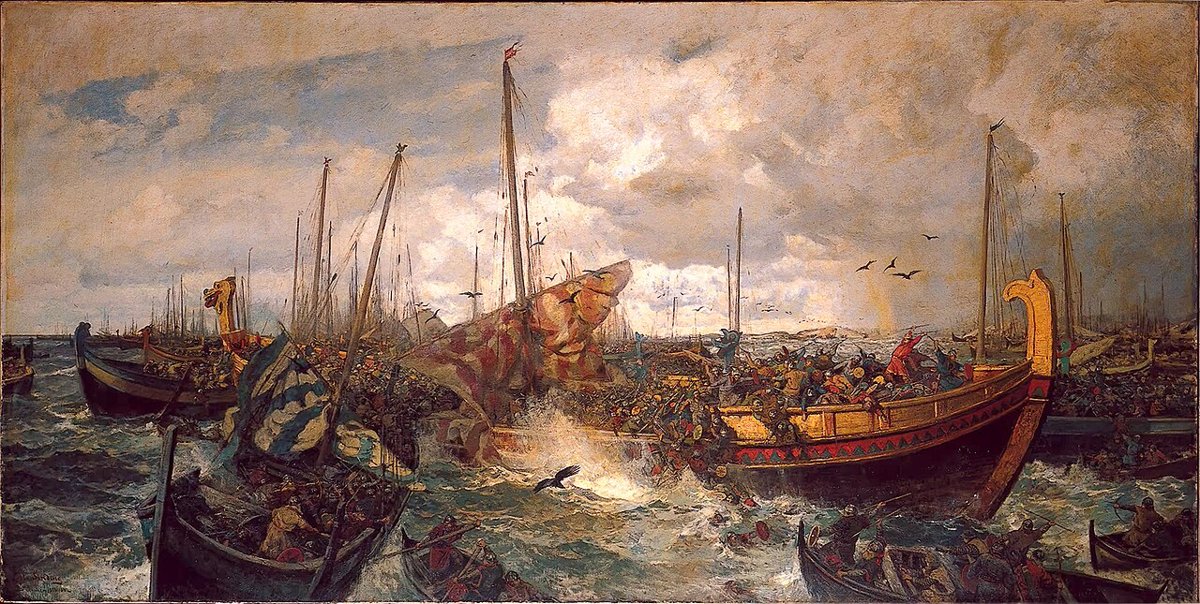
Around the year 1000 Olaf sailed his fleet into a carefully laid trap. An alliance of his enemies had come together: the Danish king Sweyn Forkbeard, the Swedish king Olof, and Jarl Eirik, son of the very Jarl Hakon whom Olaf had ousted. As Olaf's ships passed a place called Svolder, the allies fell upon them.
The sagas portray the sea battle as high drama: Olaf lashes his best ships together, the Long Serpent in the middle, and fights until the deck empties. In the end, in the most famous version, Olaf leaps overboard in full armour and vanishes beneath the waves. The victors then divided Norway among themselves; Jarl Eirik took over a large share of the actual power.
Then King Olaf Trygvason sprang overboard, and threw his shield over his head, and sank beneath the waters.Heimskringla, Saga of Olaf Tryggvason; trans. Samuel Laing, 1844 (public domain)
Attested: That a Norwegian king named Olaf Tryggvason ruled from about 995 to 1000, vigorously promoted Christianity and fell in a sea battle against a Danish-Swedish-Norwegian alliance is supported by several independent strands: the near-contemporary English accounts of payments to a Norse army in the 990s, the skaldic poetry of his own and the following generation, and later Adam of Bremen and the Icelandic kings' sagas. Sweyn Forkbeard and Jarl Eirik as the victors of Svolder are regarded as historical. Nidaros/Trondheim as an early royal and trading town is archaeologically tangible.
Myth-check: Where exactly Svolder lay no one knows to this day – the proposals range from the Öresund to the waters off Rügen. Oddr Snorrason's saga of Olaf is not a sober chronicle but a hagiographic life in the tone of a saint's legend, casting Olaf as the forerunner of Saint Olaf; accordingly, the ship counts and speeches turn out splendidly. A particular favourite is the legend that Olaf survived the leap into the sea, secretly escaped and journeyed on as a monk or pilgrim in distant lands – that is pious wishful thinking, not evidence. And the "conversion by the sword", though told at length in the sources, was sharpened by Christian authors who needed a militant hero of the faith. What remains historically is an energetic, violent king whose missionary work only truly endured decades later.
Olaf Tryggvason was born into a world that wanted him dead before he had properly seen it. His father, Tryggvi Olafsson, a petty king in the southern Norwegian district of Viken, was—according to the saga tradition—slain by the sons of Erik Bloodaxe and Gunnhild; his heavily pregnant mother Astrid fled with what she could carry and gave birth to the boy on an island in a lake. From there begins a tale of flight no skald could have invented better: across the land, across the Baltic, always one step ahead of Gunnhild's men.
The Heimskringla goes on to say that the ship carrying Astrid and little Olaf east toward kin in Garðaríki—the Old Norse name for the Rus, the land of rivers and trading towns—was seized by Estonian vikings. Olaf, still a child, is said to have been sold into slavery, and only years later recognised at a market by a relative and bought free. Whether it happened exactly so is another matter; what is certain is that the Baltic and slavery went together like salt and herring, and that an abducted royal child would have been no exception.
What follows is the classic making of a rootless warrior: years at the court of Prince Vladimir in the Kievan Rus, where Norse mercenaries and traders set the tone and a young man with a sword-arm quickly found his place; then viking raids out along the eastern ways and westward, to the coasts of England and Ireland. And it is there, in the seas of the British Isles, that tradition finally places his baptism—on the Scilly Isles off Cornwall, where a hermit is said to have foretold his future. The heathen raider became a baptised man with a plan.
Attested: The Rus as a sphere of Norse warriors and traders is well documented (trade routes, the Dnieper road, names in Byzantine and Arabic sources). Olaf's time in the east and his western raids are reported alike by Oddr Snorrason's Olafs saga and Snorri's Heimskringla; the Anglo-Saxon Chronicle names an "Anlaf" fighting in England in 991.
Myth-check: The slavery episode, the recognition at market, and the hermit's prophecy on Scilly are too neat to pass unchecked—they come from sagas written two centuries after Olaf and with a clear hagiographic purpose. The core (exile in the east, a warrior's career in the west, baptism in the isles) is plausible; the cinematic details are embellishment, not record.
Olaf returned to Norway around 995 as a baptised man—and he did not come to ask. The old lord of the land, Jarl Hákon of Hlaðir, had kept faith with the old gods and tended the great cult sites of Trøndelag; when he fell through his own excess and the fury of his followers, the road lay open. Olaf seized it, had himself proclaimed king, and made the conversion of the North his programme—with a thoroughness that sounds less like gentle mission and more like a campaign.
The sagas paint a king who sailed up the coast from assembly to assembly and gave the farmers a choice between baptism and the blade. Sanctuaries were destroyed, idols toppled, resisters treated with a harshness that even Christian chroniclers do not conceal but rather celebrate. Those who refused lost property, limbs, or life; those who were shrewd let themselves be baptised and bided their time. The old faith did not vanish overnight—it went under, into customs, names, and the things one kept to oneself.
This deserves an honest framing: what reaches us as the glorious triumph of the cross was, for many people, a forced change of faith under threat of death. The sources that turn Olaf into a missionary hero are themselves ecclesiastical—they had an interest in reading his harshness as piety. That the old belief lived on in hiding for generations does not argue against the force of the conversion, but for the toughness of what was meant to be written over.
Attested: The fall of Jarl Hákon and Olaf's seizure of power around 995 are historically secure; the intense, often violent Christianisation of Norway under Olaf Tryggvason and later Olaf Haraldsson is broadly documented (Heimskringla, Historia Norwegiae, church sources).
Myth-check: Individual forced-baptism scenes are literarily sharpened, penned by an author who wished to cast Olaf as the forerunner of Saint Olaf. The hard line overall is attested—not every drastic anecdote. "Missionary king" is a pious title; from the point of view of those on the receiving end, it was the enforcement of rule with the cross as banner.
No king without his ship, and Olaf had the most famous of all: Ormrinn langi, the "Long Serpent." According to tradition he had it built at Nidaros by a shipwright named Þorbergr skafhǫgg—and one of the finest craftsman's anecdotes of the North clings to his skill. When Þorbergr was absent one night, someone had damaged the planking of the half-finished ship with deep notches; but the next morning the master planed the entire strake down to his notches—and out came a finer line than before. Who had cut the notches, the saga slyly reveals: Þorbergr himself.
The Long Serpent was no mere vessel but a floating statement of status. To build and maintain a ship of that size was possible only for one who had men, timber, and silver in abundance—it was a king's declaration to the world. In the sagas it counts as the most splendid longship ever to sail Norwegian waters, with a dragon's head at the stem and room for a small army. Whoever saw it was meant to grasp exactly whom he was dealing with.
For all the admiration: what we know of the Long Serpent's dimensions we know from the sagas, not from the ground. There is no find that could safely be called "Ormrinn langi." The surviving great viking ships—Gokstad, Oseberg, and the Skuldelev finds—give us an idea of what was technically possible, but the sagas' specific figures are narrative, not measurement. The ship remains impressive nonetheless—only as an image painted by the skalds.
Attested: Great longships of the late viking age are archaeologically documented (Roskilde 6; Skuldelev 2 with a keel over 30 metres); royal ships as prestige objects are well attested. The building anecdote around Þorbergr and the Long Serpent's role as Olaf's showpiece are handed down by Snorri's Heimskringla.
Myth-check: All concrete figures for the Long Serpent's length, rowing benches, and crew come from saga texts—no archaeological find bears this name. Þorbergr's plane-trick is a wonderful craftsman's tale, but a tale all the same. We engrave honestly: the ship was real and vast, its measurements are literary tradition.
Olaf's end came not in a lost battle against a single foe but in a carefully laid ambush by three enemies who had joined against him. On the voyage home from the south—the sagas place the site at an island called Svolder somewhere in the western Baltic—waited the Danish king Sven Forkbeard, the Swedish king Olof, and, most dangerous of all, Jarl Eirik Hákonarson, son of the Hákon whom Olaf had overthrown. Personal revenge, Dano-Swedish power interests, and the old reckoning of the Hlaðir line all ran together that day.
According to tradition, the allies let Olaf's fleet sail past and fell at the end upon the Long Serpent, on which the king himself stood. Eirik drove his own feared ship, the Járnbarðinn, the "Iron-Ram," with its reinforced bow into the fray. Olaf's men fought a hopeless battle on ships lashed together, board to board, until the decks emptied and the attackers rolled up the Long Serpent from astern. When there was no holding any longer, Olaf—so the famous image goes—leapt overboard in full armour and vanished into the sea.
Attested: The sea-battle at Svolder around the year 1000, the alliance of Danes, Swedes, and Eirik Hákonarson, and Olaf's death belong to the firm stock of the kings' sagas (Heimskringla, Oddr Snorrason's saga) and are supported by the skaldic poetry of the time.
Myth-check: The precise course—the passing fleet, the speeches, the leap overboard in full armour—is the dramatic elaboration of later tellers. That Olaf fell at Svolder against an alliance and perished there is the attested core; the stagecraft around it is saga artistry.
Hardly had Olaf vanished when his second, longer life began—the one in story. Around 1190 the monk Oddr Snorrason wrote at Þingeyrar an Olafs saga that is less a royal biography than a saint's life: Olaf is styled the pathfinder of Christianity, a Norse John before the actual saint, the later Olaf the Holy. Another Þingeyrar monk, Gunnlaugr Leifsson, worked on the same material. Only Snorri Sturluson, a good quarter-millennium later, brought the king into the soberer, politically considered form in his Heimskringla that we mostly read today.
Because no body was found, popular tradition would not let Olaf die. The legend held stubbornly that he had not drowned at Svolder at all, but had dived, escaped, and ended his life as a monk or pilgrim far from home—some claimed to have seen him years later in the Holy Land. It is the same human need that will not let great figures simply go under; a king who leaps into the sea and whose body the sea keeps is practically an invitation to legend.
"King Olaf escaped from this battle with his life"—so, Snorri says, some spoke afterwards, yet he himself records that no one who could report anything reliable ever saw him again.after Snorri Sturluson, Heimskringla (Óláfs saga Tryggvasonar), transl. Samuel Laing 1844
And where, then, did Svolder lie? To this day no one knows. The sources quarrel over whether the island is to be sought near Rügen, in the Øresund region, or elsewhere in the western Baltic—a battle-site without an address, fitting for a king without a grave. Whoever tracks Olaf Tryggvason ends up chasing a man who is half history, half legend: powerfully attested in the broad lines, in the detail a creature of the tellers who loved him.
Attested: Oddr Snorrason's Olafs saga (c. 1190), the work of Gunnlaugr Leifsson, and Snorri's Heimskringla are the main sources; that the exact location of Svolder is unknown and debated is regarded as settled in scholarship.
Myth-check: Olaf's survival as monk or pilgrim is pure legend, born of the missing body and the affection of the tellers. Oddr's saga is deliberately hagiographic—it means to edify, not to record. What remains historical: Olaf fell at Svolder, his location and his end in the sea are unattested in detail, and all the rest belongs to legend.
The Vikings before Aachen · Hedeby · Dorestad – the great trading place · The North Frisian ring forts · The Viking winter camps.
All History & Finds articles →
The Vikings came, raided – and stayed. Over the winter, at least. Instead of sailing home after every raid, they …
Read more →Many call the Varus battle the „big bang of Germany". Yet another battle shaped our lands far more deeply – one in …
Read more →High above the world of humans, beyond the burning rainbow bridge, lies Asgard – the fortified home of the Æsir. It is …
Read more →Almost 1,500 years before the first Germanic peoples entered Roman history books, a highly developed Early Bronze Age …
Read more →