When we picture Vikings, we usually see longships off English monastery coasts and sails over the North Sea. But an entire branch of the Norse world sailed the opposite way: east. Above all Swedish travellers, known as Varangians, followed not the coastline but the great rivers of the east – the Volkhov, the Dnieper and the Volga. These rivers were their roads: into the vast interior of Eastern Europe, down to Byzantium, and on to the markets of the Caliphate. Out of traders, mercenaries and settlers there grew in time a new entity that bore the name Rus – a word that still echoes today in Russia and Ukraine. This page gathers what we know about the Vikings in the east and points to our in-depth individual articles.
The west beckoned with monastery treasures and fertile farmland; the east beckoned with silver. In the 9th and 10th centuries the Abbasid Caliphate struck silver coin in enormous quantities, and this silver wanted to be exchanged for the goods of the north: furs from the northern forests, wax, honey, amber – and, uncomfortable as it sounds, enslaved people. For Swedish travellers who sat on the edge of the Baltic anyway, the road east lay nearer than any voyage to England. What matters here: these journeys were first of all trade, not raid. Whoever wanted to go upriver had to negotiate, pay tolls, forge alliances and wait patiently through the winter. The image of the plundering berserker fits poorly here; more fitting is the image of an armed merchant who was at once oarsman, porter, diplomat and, in an emergency, warrior. The boats were correspondingly small and light: no mighty dragon-ships, but nimble craft that the crew could carry over a land bridge when they had to. Whoever travelled the east thought in years, not weeks – often wintering along the way, learning foreign tongues and marrying into foreign families.
The east did not begin with a war of conquest but with a marketplace. On the river Volkhov, where it meets Lake Ladoga, rose Staraya Ladoga (Old Norse Aldeigjuborg) – according to dendrochronology already around the middle of the 8th century, that is, even before the raid on Lindisfarne in 793. Here Scandinavians, Finns, Balts and Slavs met; here archaeologists found early glass-bead workshops and the first imported flood of silver coin from the Orient. Ladoga was the gate: anyone wanting to go further south had to pass through. From such transshipment points, trade felt its way into the continent river-stretch by river-stretch. Further inland grew, somewhat later, the fortified princely seat known as the Gorodishche near Novgorod, which began to draw the threads of this network together. It was not about glory but about the steady flow of goods – and about controlling those points where waterways crossed.
The most famous account of the origins of the Rus stands in the Old Russian Primary Chronicle. It reports that the quarrelling tribes of the north sent "across the sea" for the Varangians and summoned a prince named Rurik, who first settled in the Novgorod region; his successors made Kiev on the Dnieper the centre of a far-reaching realm. From this web of river towns, tribute lands and trade routes came Kievan Rus – a state in which a Norse elite and a Slavic population quickly bound themselves together. Within a single generation the princes bear Slavic names, and Norse Waldemar becomes Vladimir. How much of Rurik is a real person and how much the back-projection of later chroniclers remains disputed; the chronicle was written roughly two hundred years after the events and wanted to give a dynasty a worthy ancestor. What is certain: the road led from trading post to lordship, and within a few generations a Norse warrior-trading elite became a Slavic-speaking, Orthodox-baptised dynasty – Vladimir's baptism in 988 sealed the change. More in our deep-dive Kievan Rus.
The most important axis carried a name of its own: "the road from the Varangians to the Greeks". It ran over rivers and lakes from the Baltic to the Black Sea and on to Constantinople. Where two river systems did not meet, the boats had to be dragged or rolled overland – over so-called portages that demanded everything of the crews. Its most dangerous stretch were the rapids of the Dnieper, at which the boats had to be unloaded and partly carried – a bottleneck where the travellers were exposed to steppe horsemen. An extraordinary testimony comes from the Byzantine emperor Constantine VII Porphyrogenitus in his handbook "De administrando imperio" (mid-10th century): he gives the rapids twice – once "in Slavonic", once "in Russian", and the "Russian" names are unmistakably Old Norse. Names such as Ulvorsi, Gelandri or Baruforos are pure gold for the history of language, for they show in black and white that the Rus of that age spoke Norse. We unfold the whole road together with its names in The Road from the Varangians to the Greeks.
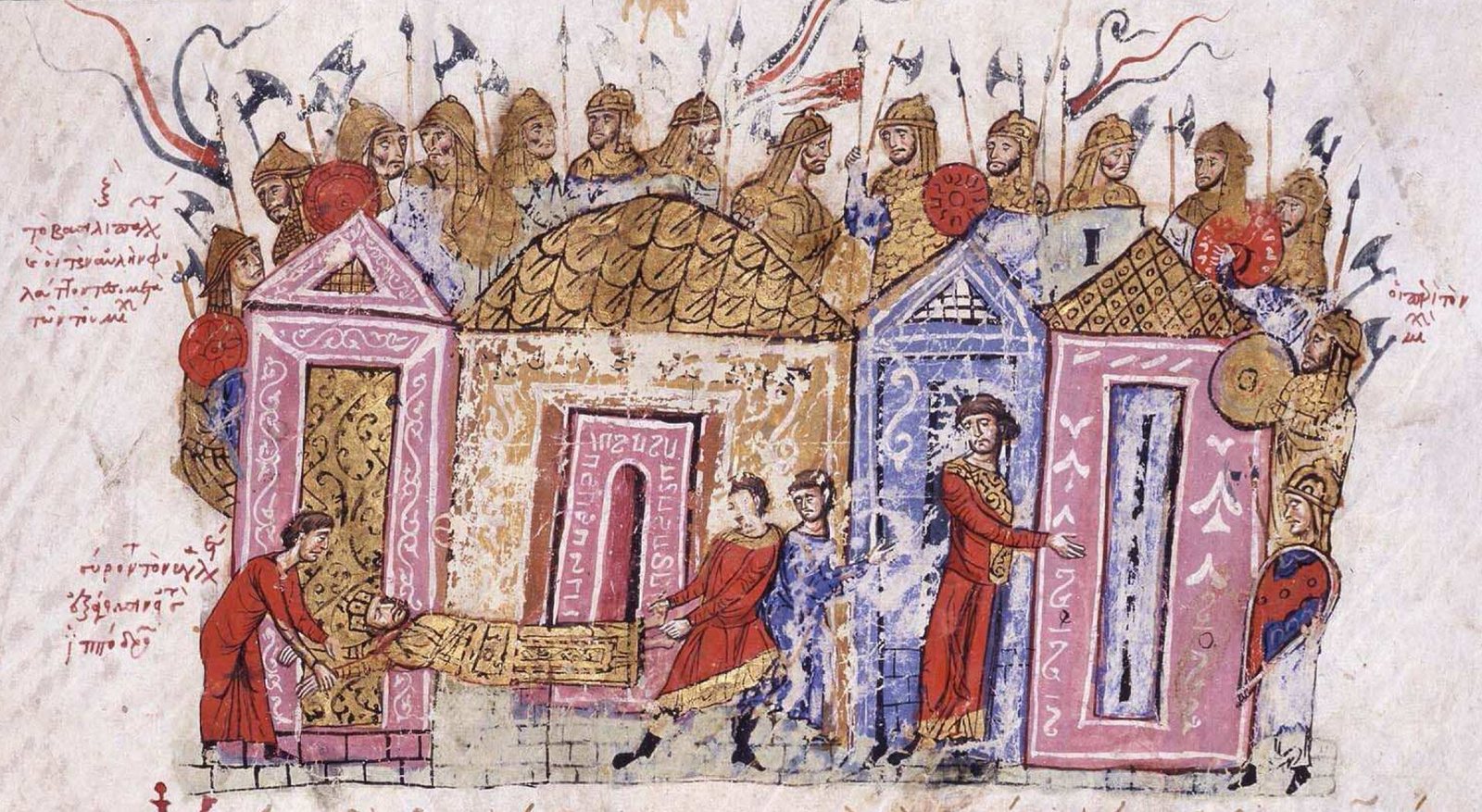
At the end of this road lay Miklagard, "the great city" – Constantinople. For the Northmen it was the dazzling destination above all others: the richest metropolis of the known world, with walls, domes and gold such as the sparse north did not know. There, travellers became warriors in the emperor's service. The Varangian Guard, traceable from the late 10th century, was an elite bodyguard in which Scandinavians staked their lives for good silver. Its most famous man was the later Norwegian king Harald Hardrada, who as a young prince made his career in Byzantine service before returning home and finally falling at Stamford Bridge in 1066. Norse rune-carvers left their marks in the Hagia Sophia, and Swedish runestones lament death in "Grikkland" – stone obituaries for men who did not survive the road south. The pay from Byzantium flowed back to the north and financed many a hall, many a runestone, many a wedding. More in Miklagard and the Varangian Guard.
Besides the Dnieper there was a second great road that reached even further: the Volga. It led not to Byzantium but to the Volga Bulgars on the middle Volga, and from there into the realm of the Khazars and into the Caliphate of the Abbasids. Along this way came that Islamic silver which surfaced in thousands of finds on Gotland, in Sweden and in the Baltic: the dirham coins, often chopped into hacksilver weighed out by the gram – with folding scales and small bronze weights that were part of the standard kit of the east-faring merchant. Without the oriental stream of silver the Scandinavian Viking Age is hard to imagine; when it dried up in the late 10th century, the whole trading system of the north began to totter. The most striking eyewitness account comes from the Arab envoy Ibn Fadlan, who in 921/922 met a group of the Rus on the Volga and described their appearance, their trade and an elaborate ship burial. His text is one of the most important and at the same time strangest sources on the eastern world of the Vikings – to be read in Ibn Fadlan and the Rus on the Volga.
All of this did not begin in a vacuum. Before a ship sailed up the Volkhov, it had crossed the Baltic – and that had long been a busy inland sea in which Scandinavians and West Slavs lived and traded door to door. On the southern coast, trading towns such as Wolin at the mouth of the Oder flourished, where Slavic and Scandinavian culture merged so closely that the sagas later transfigured the place into legendary Jomsborg. Further west sat Slavic neighbours such as the Obodrites, whose market Reric the Danish kings took so seriously that they cleared it out and forced the merchants to Hedeby. The "east" was therefore no distant other but the natural continuation of a network that began on one's own doorstep. Whoever wants to see how differently Danes, Swedes and Norwegians chose their directions of travel finds the overview in Regional Vikings; the southern Baltic world is illuminated by Wolin and Jomsborg and The Obodrites.
A better burden may no man bear / for wanderings wide than wisdom; / it is better than wealth on unknown ways, / and in grief a refuge it gives.Hávamál, stanza 11, translation by Henry Adams Bellows (1923, public domain)
Attested: Staraya Ladoga is secured by dendrochronology and early dirham finds as a trading place of the mid-8th century. The Old Norse names of the Dnieper rapids stand in Constantine VII's "De administrando imperio". Ibn Fadlan's account of 921/922 is near-contemporary and independent. The vast silver hoards on Gotland document the flow of oriental silver to the north. All of this is source and find, not legend.
Myth-check: The question of the origin of the Rus – Scandinavian or Slavic – has been a politically charged dispute since the 18th century (the "Normanist controversy") and is still not free of ideology today. The honest answer is a fusion: a Norse-shaped ruling class that quickly merged into a Slavic majority population. That "Rus" originally meant Vikings is the well-founded majority reading, but not undisputed. Caution too with Rurik: his supposed brothers "Sineus" and "Truvor" are regarded by many scholars as a misunderstanding of the chronicle – Old Norse "sine hus" (his house/retinue) and "thru varing" (faithful following) may have wrongly become personal names. Rurik himself remains a figure between history and foundation legend.
The Vikings before Aachen · Hedeby · Dorestad – the great trading place · The North Frisian ring forts · The Viking winter camps.
All History & Finds articles →
The Vikings came, raided – and stayed. Over the winter, at least. Instead of sailing home after every raid, they …
Read more →Many call the Varus battle the „big bang of Germany". Yet another battle shaped our lands far more deeply – one in …
Read more →High above the world of humans, beyond the burning rainbow bridge, lies Asgard – the fortified home of the Æsir. It is …
Read more →Almost 1,500 years before the first Germanic peoples entered Roman history books, a highly developed Early Bronze Age …
Read more →