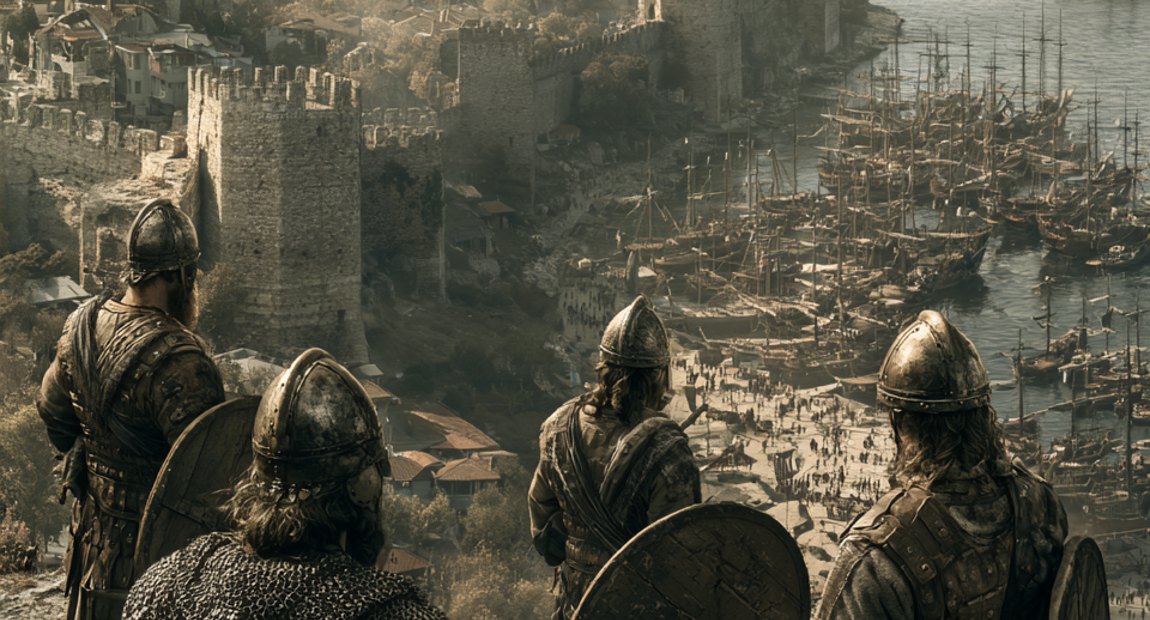
To a farmer from Uppland, „the great city" was as unimaginable as another planet. Constantinople had walls that fire could not take, domes of gold and more people than the whole North had inhabitants. The Norsemen called it Miklagarð – and some of them set out to serve there, to trade, and, if need be, to die for the emperor. This is the story of the Varangian Guard: the furthest road a Viking could ever walk.
While Norsemen in the west were raiding monasteries and founding farmsteads in Iceland, others were drawn east. Along the rivers of the Rus – the Volkhov, the Dnieper and their side channels – ran a long chain of trading posts, portages and rapids reaching all the way to the Black Sea. On its southern shore lay the goal: Constantinople, the heart of the Byzantine Empire, known in Norse sources simply as Miklagarð, „the great city". The name was no exaggeration. The city was richer, larger and older than anything a Scandinavian knew, and its emperor sat on a throne whose tradition reached back into Roman antiquity.
That the Norsemen knew the way there so precisely is itself on record. In his work on the administration of the empire, the tenth-century emperor Constantine VII Porphyrogenitus noted the names of the Dnieper rapids – in both a Slavic and a clearly Norse form. For the dangerous stretches where boats had to be lifted from the water and hauled overland, the Rus had their own words. People who coin such names have travelled the route often enough.
The first contact was anything but friendly. In the year 860 a Rus fleet appeared before the city without warning and laid waste to the suburbs along the Bosporus. Patriarch Photios preached two shaken sermons about the „people from the north" who had come out of nowhere. Yet the real point of these expeditions was usually not conquest – the walls of Constantinople were rightly held to be impregnable – but the trade agreement. One arrived with a fleet in order to force out tolls, quarters and rights.
That is exactly what happened. After the campaigns of the tenth century the Rus gained toll-free trade, fixed tribute per boat and their own merchants' quarter by the monastery of St. Mamas outside the city. A second push in 941 ended catastrophically for the attackers: the Byzantine fleet burned their boats with the notorious „Greek fire", that secret incendiary weapon that went on burning even upon water. Bishop Liutprand of Cremona, whose stepfather had served as an envoy in the city, recorded the terror of that weapon. Yet even this setback led in the end to a fresh treaty. Out of the interplay of battle and bargaining grew a lasting relationship – and from it the most famous Norse company of the Middle Ages.
Varangians was the eastern name for the Norsemen who came as mercenaries and merchants. Towards the end of the tenth century the Byzantine emperor formed a unit of his own from them: the Varangian Guard, his personal bodyguard. The advantage was obvious. These men were strangers, without kin and without any stake in the endless palace intrigues of the capital. They were bound to the emperor, not to a Byzantine noble family. Whoever must protect the person everyone wants to overthrow is safest if he himself owes nothing to anyone else.
The service was hard, but golden. The guardsmen fought not only in the capital but marched with the armies to Sicily, Bulgaria and the Near East. They were feared for their long battle-axes, which is why Byzantine sources also call them the „axe-bearing barbarians". Pay came in gold, and there were privileges of which a farmer back home could only dream. So the longest voyage a Norseman could undertake was also the most lucrative – if he survived it.
No name is more closely bound to this world than that of Harald Sigurdsson, called Harðráði, „the hard in counsel". At fifteen he fought in 1030 at the battle of Stiklestad beside his half-brother Olaf – and fled after the defeat. By way of the Kievan Rus, at the court of Prince Yaroslav the Wise, he reached Constantinople and made his career there in the Varangian Guard. He fought in Sicily, in Bulgaria and in the eastern Mediterranean, and he returned to the North with plundered wealth to become king of Norway.
Remarkably, Harald even appears in a Byzantine source. The Strategikon of Kekaumenos, a book of counsel from the eleventh century, mentions an „Araltes" in imperial service – that is, Harald himself, seen through Byzantine eyes. For a Norse warrior this is a rarity: he is attested not only by the sagas of his homeland but also by the pen of those he served. His end is among the most famous of the Viking age. In 1066 he claimed the English throne, won at Fulford, but fell five days later, on 25 September, at Stamford Bridge. Three weeks after that the English king was defeated by the Normans at Hastings. For many historians the Viking age ends with Harald's death.
Four winters I hid my sorrow; often I had to learn how small the world grows for a prince. Yet the maiden in gold would not let me linger in Grikkland.After Snorri Sturluson, Heimskringla, Haralds saga Sigurðarsonar (public-domain trans.)
Not all returned with gold. Many did not return at all. Of them speak the quietest witnesses of this story: some thirty runestones in Sweden known as Greklandsstenarna, the „Greece stones". They stand above all in Uppland and Södermanland and were raised down to about 1100. Their inscriptions commemorate men who went to Grikkland – to the Byzantine Empire – and stayed there. The carvers use fixed terms that recur again and again: Grikkland for „Greece", Grikkjar for „the Greeks", and for one who made the journey the word grikkfari, „Greece-farer".
A particularly striking boulder stands at Ed, north of Stockholm. It was raised on the order of a man named Ragnvaldr, who had himself been in Greece – and not as a common soldier, but, as the inscription says, as „leader of the host". Here a returned guard officer had his own rank set in stone before time could forget it. These stones are primary sources in the most literal sense: no chronicler stands between us and what was written there. The wish to preserve a name and a voyage for those who come after is the same one that still makes us engrave things into stone and wood today.
The most moving proof of the Norse presence in Miklagard, however, stands not in Sweden but in the city itself. On a marble parapet of the upper gallery of the Hagia Sophia, the greatest church of Christendom, someone scratched his name in runes. Not much is still legible, but one word is certain: „Halfdan". Most likely a bored guardsman stood here during an endless service and did what people have always done wherever they have been – he recorded that he had been there. It is the Norse „Halfdan was here", carved into the marble of a wonder of the world.
That the Norse link to Byzantium held for a long time is shown by one last figure: as late as 1195 the emperor Alexios Angelos asked the kings of Denmark, Norway and Sweden each to send him a thousand warriors. By then the Viking age proper was long over – yet the memory of the pay in the great city lived on. From the suburbs that stood in flames in 860 to the marble of the Hagia Sophia, the whole arc of the Norse world is spanned: raiders, traders, mercenaries, guardsmen – and a name in the stone, so that no one would forget him.
The Varangian Guard as a Norse-dominated bodyguard of the Byzantine emperor is well documented in Byzantine sources. The roughly thirty Greece runestones (with Rundata signatures such as U 112 from Ed) are surviving primary sources and expressly name Grikkland, Grikkjar and grikkfari. The runic graffiti in the Hagia Sophia, including the name Halfdan, demonstrably exist. Harald Hardrada's service in Byzantium is attested both by Snorri's Heimskringla and by the Byzantine Strategikon of Kekaumenos („Araltes").
The tale that in 907 Oleg set his boats on wheels, rolled them overland before the walls and then nailed his shield to the gate comes from the Russian Primary Chronicle and bears legendary features – it is a powerful image, not a protocol. Harald's famous dying stanza before Stamford Bridge, too, was shaped by Snorri two centuries later. And although the Varangians were at first predominantly Norsemen, the company changed over time: after 1066 increasing numbers of Anglo-Saxons joined, men who had fled from the Normans.

Stamford Bridge 1066 · The longships · Hedeby · The shield wall · Ibn Fadlan & the Rus.
All History & Finds articles →
Whoever won did not always keep the spoils. In the Roman Iron Age, Germanic victors sank the entire equipment of …
Read more →While Uppsala is famous above all from a text, Thuringia holds the best-excavated Germanic sanctuary in the ground: the …
Read more →Long before there were Germanic peoples – some 4,300 years ago – people in today’s Saxony-Anhalt raised a vast ring of …
Read more →King Hákon the Good, a son of Harald Fairhair, fought all his life against the sons of his brother Eric Bloodaxe. Two …
Read more →