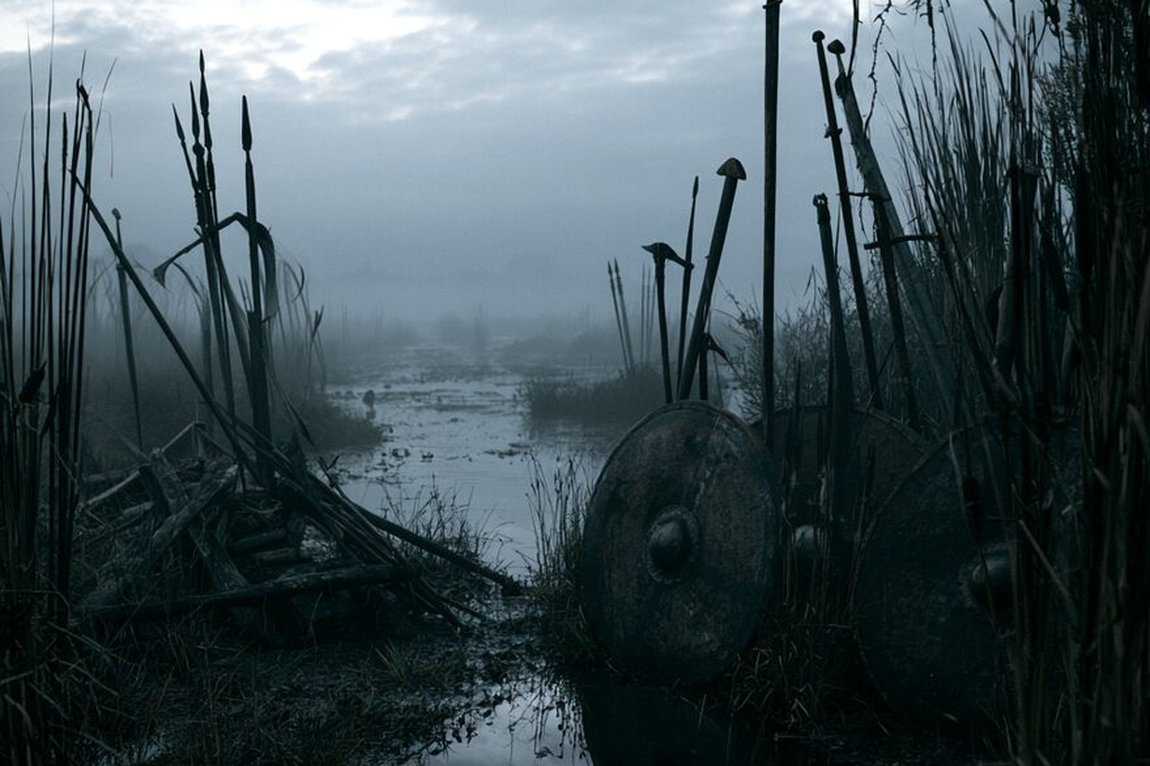
Whoever won did not always keep the spoils. In the Roman Iron Age, Germanic victors sank the entire equipment of defeated armies in lakes and bogs – as a thank-offering to the powers. Three find-places make this overwhelmingly clear.
What does a victorious army do with the captured gear of the beaten foe? One could keep it, sell it, reuse it. The Germanic peoples of the Roman Iron Age did something quite different: they wilfully destroyed the spoils and sank them entirely in lakes and bogs – as a vast thank-offering to the powers that had granted them victory. It is hard for us to grasp today, yet the finds speak an overwhelmingly clear language.
This ritual was not a peculiarity of the imperial age alone; it has deep roots. Centuries earlier Roman authors report the same custom among the Cimbri and other northern peoples, who after their victories dedicated all their plunder to the gods instead of using it.
„The clothing was torn up and cast away, the gold and silver thrown into the river, the men’s breastplates hacked to pieces." — after Orosius, Histories 5.16 (on the Cimbri)
Exactly this picture – weapons deliberately made useless, given to the water – meets us again in the great bog finds of northern Germany and Denmark, many of them right in our wider neighbourhood in Schleswig and Jutland.
The most impressive find-place is Illerup Ådal in East Jutland. From the former lake over 15,000 objects came to light; the largest single offering falls around 205 AD. Hundreds of spear- and lance-heads, shields, swords with partly imported Roman blades, plus the warriors’ personal things like fire-steel sets, combs and belt fittings. The sheer quantity allows conclusions about army strength and rank: from the costly gear one can distinguish simple warriors, sub-commanders and a few richly equipped leaders.
In the Ejsbøl bog in Southern Jutland the complete gear of a single defeated force can even be reconstructed: some 200 men, about 190 foot-warriors and nine to twelve mounted leaders, with bows, arrows, lances and swords. In both cases the decisive thing is the same: the weapons were deliberately destroyed before deposition – bent, broken, hacked apart. No victor was ever to use them again; they now belonged to the powers alone.
To the same offering horizon belongs one of the most famous finds of the North: the Nydam ship from the Schleswig region. It is a rowing boat of oak some 23 metres long, dendrochronologically dated exactly to the years 310–320 AD. With its slender, clinker-planked hull it is a direct forerunner of the later Viking longships – though still without mast and sail, driven by oarsmen alone.
That so valuable a ship was not used but deliberately sunk in the bog shows the full force of this offering practice. Not only weapons but whole boats with their gear were given to the bogs. The Nydam boat survived almost 1,600 years in the oxygen-poor bog water and stands today in the museum at Gottorf Castle in Schleswig – a silent witness to how seriously the old faith was taken.
The bog finds are a stroke of luck for research, for the wet, oxygen-poor environment preserves wood, leather and textiles that would otherwise long have perished. So they give us an unusually precise picture of the arms, the organisation and even the origin of these armies – some pieces of gear point to Scandinavia, others to the interior of Germania. The battles from which the spoils came were fought over long distances.
Honesty, though, requires naming the limits: that these are booty-offerings after a victory is well argued – the systematically destroyed enemy gear in the lake and bog context allows hardly any other reading. But which deity received the offering no find tells. One thinks of a war-god like the later Tyr or Odin, yet that remains reconstruction. For us these bogs are a striking witness to how deeply war, thanks and faith were interwoven in the North – centuries before the first Viking ship put to sea.
The Grove of the Semnones · Longships · Cult & Law · Bog Butter.
Moesgaard Museum (Illerup); Jysk Arkæologisk Selskab (Ejsbøl); Museum of Archaeology Gottorf Castle (Nydam). Rudolf Simek, Dictionary of Northern Mythology.
All History & Finds articles →
While Uppsala is famous above all from a text, Thuringia holds the best-excavated Germanic sanctuary in the ground: the …
Read more →Long before there were Germanic peoples – some 4,300 years ago – people in today’s Saxony-Anhalt raised a vast ring of …
Read more →King Hákon the Good, a son of Harald Fairhair, fought all his life against the sons of his brother Eric Bloodaxe. Two …
Read more →Long before there were Vikings in the sense of the sagas, there was already a town in south-west Jutland: Ribe, founded …
Read more →