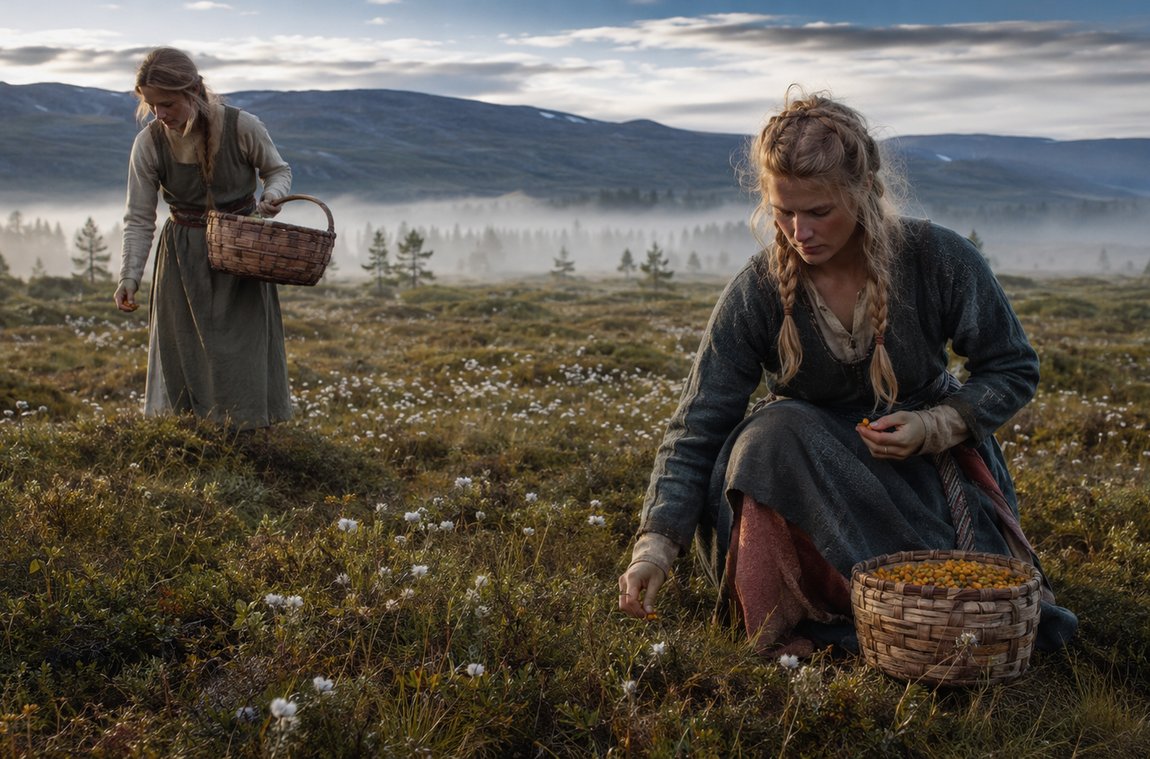
Again and again, peat-cutters in Ireland, Scotland and Scandinavia find the same riddle: a lump of waxy, ancient butter, buried deep in the bog. Some is thousands of years old. But why was it there?
It is a scene that has repeated for centuries: a peat-cutter in Ireland, Scotland or Scandinavia drives his spade into the black bog – and strikes a lump of waxy, strangely smelling matter, often in a wooden vessel or wrapped in bark. What he has found is butter. Some of these finds are centuries, a few even thousands of years old. The great question over which scholarship still argues is simply: why was it there?
Fat and butter were, in the old world, a precious, energy-rich good – no everyday article one threw away carelessly. That people buried whole casks of it deep in the bog must therefore have had a good reason. Two explanations wrestle with each other, and both have much to be said for them.
The most obvious explanation is preservation. A bog is cold, low in oxygen and acidic – in short, a near-perfect natural fridge. Butter and fat kept here over long periods, protected from rot and pests. In a world without refrigeration the bog was an ideal store, especially for the surplus of the summer months that one wished to keep for the lean winter.
„Food and clothing the man needs who has fared over the fell." — Hávamál 3, after Bellows
The Hávamál verse reminds us how central food and provision were in the thinking of the Norse. Some sources even hint that the sharp, earthy bog flavour of the aged butter was positively prized – rather as we today prize a strong, matured cheese. Whoever wanted to store a precious fat supply safely and tastily thus buried it in the bog.
Yet to the Germanic peoples the bog was far more than a larder. For many centuries they sank offerings to the gods and powers here: weapons and jewellery, precious gear, even people – the famous bog bodies. The bog was held to be a threshold, a passage to the other world, at which one presented one’s gifts to the powers of water and the depth.
The butter may belong in this line: a precious, nourishing gift entrusted to the bog to beg for fertility, protection or favour. To offer a cask of the best butter was a tangible, real sacrifice – one gave up something that meant life and warmth.
The truth is probably: it was both, and often it cannot be cleanly told apart. Some butter-casks sit in plain pits without any ritual context – that speaks clearly for storage. Others lie at known offering-places, together with unmistakable votive gifts – that speaks just as clearly for a sacrifice. Both readings are well-argued, and neither is provable. The truth likely varies from find to find; there is no simple either-or.
That is exactly what makes bog butter so fascinating to us. It stands on the threshold between the wholly practical and the holy, between kitchen and cult – and reminds us that these two spheres were never as strictly separated in our ancestors’ lives as in ours. A store could be an offering, an offering a store for the other world. It is such small, earthy riddles that make the Germanic past so alive for us.
Everyday Viking Life · Mead & Storage · Nerthus & the Bog · Cult & Law.
Finds of bog butter (Ireland/Scotland/Scandinavia); National Museum of Denmark on bog finds. Rudolf Simek, Dictionary of Northern Mythology.
All Everyday Life & Craft articles →
There are tools that become legend. Among the Vikings it was a sword – or rather: a whole group of swords, all bearing …
Read more →The Viking ship was not merely a tool – it was a status symbol. And at its top there often gleamed a masterpiece of …
Read more →Matted hair, unwashed for years, reeking across the meadhall – that is the Viking of cliché. The finds tell another …
Read more →Coarse brown sacking, a shaggy fur collar, and of course the obligatory horned helmet – that is the Viking of film and …
Read more →