Viking clothing was mostly wool and linen, often dyed and carefully tailored: women wore a long underdress with an apron dress on top, held up by two oval brooches at the shoulders, while men wore a knee-length tunic, trousers, a belt and a cloak pinned at one shoulder. Fur and leather existed too, but as linings, shoes and belts rather than full costumes. Below you will find how we know this, which details are still argued over, and what to take from it if you are putting together your own kit.
Cloth is one of the most fragile things people make. A sword survives a thousand years in the ground; a wool tunic only does so under special conditions: no oxygen, permanent frost, a waterlogged bog, or direct contact with metal whose corrosion salts preserve the fibres. Everything we know about Viking clothing therefore rests on a handful of lucky survivals and a great deal of patient detective work.
Three kinds of evidence have to be combined. First, the archaeological textiles: rags from the harbour of Hedeby, cloth remains from the graves at Birka, Mammen and Oseberg. Second, images: tiny silver figurines, picture stones and the woven tapestry from the Oseberg burial. Third, written sources: the Arab envoy Ibn Faḍlān, an eyewitness from the tenth century, and much later Icelandic texts such as the poem Rígsþula or the sagas, which were written down in the thirteenth century. A saga line about a red cloak is not a grave find, and a grave find does not tell you how the cloak was worn.
Perhaps the most important wardrobe of the Viking Age is a harbour basin on the Schlei inlet in northern Germany. In the tenth century the people of Hedeby stuffed worn-out garments, soaked in tar, into the seams of their ships and jetties as caulking. Whatever sank into the silt survived without air. The Swedish textile archaeologist Inga Hägg spent years on these rags and published them in 1984 as volume 20 of the official Hedeby excavation reports.
What makes them special is that they are everyday clothes: worn, patched and cut up. From seams, hems and cutting edges Hägg could show that the tailors of Hedeby used darts, inserted gores and set-in sleeves. The catch: because the pieces ended up as harbour rags, nobody knows for sure where on the body any given fragment once sat. Every reconstruction from Hedeby is a reasoned interpretation, not a museum sewing pattern.
Graves give the opposite picture. At Birka on Lake Mälaren, Hjalmar Stolpe excavated around 1,100 graves between 1871 and 1895. The cloth there mostly survives as small scraps, corroded onto the backs of brooches, buckles and mounts. But at least we know where on the body they lay. Agnes Geijer's 1938 study of the Birka textiles laid the foundation that research still builds on. Birka also produced the most splendid trims of the period: tablet-woven bands with silk and brocaded gold or silver thread.
In Denmark, the chamber grave at Mammen (Bjerringhøj), opened in 1868 and dated by its timber to the winter of 970/971, contained the remains of an exceptionally rich man's outfit: wool embroidered with animals and acanthus tendrils in red, blue and yellow, a fur-lined cape, and tablet-woven bands of lilac silk with gold and silver thread.
And then there is Oseberg. The ship burial of 834 held wool and linen, many pieces of silk, weaving tools and the famous tapestry.
Images fill gaps the soil leaves open. The Oseberg tapestry, a band only 16 to 23 centimetres wide, shows a procession of wagons, horses and people. Female figures wear long, floor-length garments; some figures carry weapons, one wears an animal mask and another a headdress with horns.
Even clearer are the small figures of women in gilded silver found across Scandinavia. The best known turned up in 2012 at Hårby on the Danish island of Funen: 3.4 centimetres tall, carrying sword and shield, wearing a long patterned dress, her hair tied at the back of the head. For more on the hairstyles these figures show, see our article on Viking hairstyles.
Among the texts, the Eddic poem Rígsþula is unusually useful because it describes three social ranks through their clothes. Its date of composition is disputed, and it survives only in a fourteenth-century manuscript. The great-grandmother of the thralls wears a band on her head and a kerchief with clasps on her shoulders. The free farmer's bride is "in goatskins clad", and she carries keys. And the noble mother is described like this:
Gay was her cap, on her breast were clasps, / Broad was her train, of blue was her gown Rígsþula, st. 28, trans. Henry Adams Bellows (1923)
That is poetry, not an inventory. Yet it fits remarkably well with what graves and figurines show: headwear, brooches on the chest, long dresses and blue as the colour of the well-off.
The base layer of women's dress was a long underdress with sleeves, often linen, sometimes fine wool. Several Birka graves preserved finely pleated linen that probably belonged to such underdresses. At the neck the underdress was often closed with a small round brooch.
Over it, women across much of Scandinavia wore the garment now most associated with the Viking woman: the apron dress, also called a suspended dress or, in German, Hängerock. It was an overdress not sewn over the shoulders but hung from narrow straps. The straps passed through two oval bronze brooches sitting around the collarbones. The name smokkr, often heard among reenactors, is a suggestion by the researcher Thor Ewing, not a label attested on any find.
The oval brooches, also called tortoise brooches after their shape, are the archaeological fingerprint of this dress. They survive in the ground, and fibres often cling to their backs: the wool of the apron dress on the outside, the linen of the underdress beneath, and the strap loops in between.
The dress was widespread, but it was not uniform. At Hedeby, oval brooches are comparatively rare in graves. On Gotland women wore their own brooch types instead, the so-called animal-head brooches.
How exactly an apron dress was cut is one of the liveliest debates in textile archaeology. After the Birka finds, Agnes Geijer imagined a rectangular cloth wrapped around the body and open at one side. Inga Hägg first read the evidence as a closed, tube-shaped garment. Others proposed a dress open at the front, and still others two separate panels front and back, a solution now largely discredited and nicknamed the "tea towel" apron dress in reenactment circles.
The key piece once again comes from Hedeby harbour: two fragments of fine, brown-dyed wool, one about 30 centimetres high with a hemmed top edge and a dart. Over that dart runs a decorative cord only one or two millimetres wide, made of red and yellow threads. Hägg interpreted it as a fitted, closed garment that hugged the upper body and flared over the hips, while openly admitting that parts of her full reconstruction remained guesswork.
The upshot: there is no single correct apron dress. A closed version after Hedeby is well founded; so is a wrapped version after Birka. The honest approach is to name the region and the find you are following.
Between the two oval brooches, many women hung strings of beads made of glass, rock crystal, carnelian or amber, along with pendants, coins and small tools such as needle cases, shears or knives on chains and cords. Some wore a third brooch in the middle of the chest, often trefoil or round, to close a cloak or shawl. How these pieces were made and combined is covered in detail in our article on Viking jewellery.
When it comes to headwear, the evidence thins out. Small caps of silk or wool survive from Dublin and York, and Birka has remains of headwear with metal thread. The figurines show hair knots, sometimes with a cloth or cap. Whether married women always covered their hair, as later law texts and sagas suggest, cannot be securely shown for the Viking Age itself.
One detail that is easy to forget: keys. In Rígsþula the farmer's wife carries keys, and keys really do turn up in women's graves, often at the belt or on the brooch chain. You can read more about the role of women in the Viking Age in a separate article.
The basic men's garment was a tunic: a hip- to knee-length overgarment of wool, worn over a linen shirt when needed. The Hedeby fragments show set-in sleeves, gores for fullness in the skirt and cuts that sat closer to the body than many modern costumes do. A belt held the tunic in and carried knife, pouch, fire steel and comb.
Trousers call for honesty. No complete pair of trousers survives from the Viking Age itself. At Hedeby, Hägg identified several fragments as possible trouser parts, among them pieces of thin, pleated wool that she read as wide, baggy and rather high-status trousers. Another fragment had been dyed reddish brown with walnut shells. At Mammen, blue cloth found at the lower leg has been interpreted as the cuff of long trousers. The well-preserved trousers from Skjoldehamn in northern Norway are a special case: depending on which test you trust, their date falls in the late Viking Age or in the thirteenth century, and who wore them is also debated.
The often-quoted baggy "Rus trousers", wide in the leg and gathered below the knee, rest on fragments like these and on images from the East. What is certain: men wore trousers, and they were made of wool.
Over everything went the cloak, a large rectangular or semicircular cloth. Ibn Faḍlān describes a garment that covers one side of the body and leaves one hand free, which is exactly what you would expect from a cloak fastened at one shoulder. That it was usually the right shoulder, to keep the weapon arm free, is a reasonable and often repeated interpretation; graves, however, show cloak brooches in several positions. Fastenings included ringed pins and large penannular or ring brooches, types with roots in Ireland and Scotland that became fashionable through contact with the British Isles. One Birka grave held a ring brooch at hip height that probably secured a patterned cloak.
On their legs many men wore leg wraps: long woollen bands wound around the calf from ankle to knee. Birka grave 905 offers good evidence, with two small bronze hooks found below the knees that probably held such wraps or hose in place.
Shoes were turnshoes: sewn inside out and then turned, so the seam ended up on the inside. Hedeby and York have produced large numbers of them, as low shoes, ankle shoes and taller boots with straps or toggles. So leather was there: on the feet, at the belt, in pouches and scabbards. How it was worked is explained in our article on leatherworking.
An eastern variant deserves its own mention. In several Birka graves, buttons and trims point to a coat closed at the front, reminiscent of steppe caftans and Byzantine fashion. At least five graves show traces of a garment buttoned from neck to waist.
Two of the best-known clothing finds from the North are often sold as "Viking clothing" even though they are not. Being honest here means naming the period.
The Thorsberg trousers come from the Thorsberg bog near Süderbrarup in Angeln, northern Germany, and are now in the state museum at Gottorf Castle in Schleswig. They belong to the Roman Iron Age, roughly the second to fourth centuries AD, several centuries before the Vikings. They are about 125 centimetres long, with belt loops and attached foot pieces. As a hint at how trousers in the North could be built, they are valuable. As proof of a ninth- or tenth-century pair, they are not.
The Lendbreen tunic emerged in August 2011 at Lendbreen in Oppland, Norway, an ice patch at about 1,900 metres. Radiocarbon dates place it around AD 230 to 390. It is the oldest complete garment found in Norway: a wool tunic in diamond twill, deliberately mottled with light and dark brown undyed wool, with set-in sleeves and two patches on the back. By modern sizing it would fit a slim man of about 1.70 to 1.76 metres. Two reconstructions, commissioned by the Museum of Cultural History in Oslo and the Norwegian Mountain Centre, each took just over 400 working hours.
The two staple fabrics of the Viking Age were wool and linen. Wool came from short-tailed Nordic sheep, whose fleece mixes fine underwool with coarser outer hair. By sorting, spinners could produce everything from soft dress fabric to hard-wearing sailcloth. Linen from flax was more laborious to make but smooth, light and pleasant against the skin, the classic fabric for underdresses and shirts.
Silk was luxury itself. It came north along the eastern trade routes from Byzantium, the Islamic world and ultimately Central and East Asia. At Birka, Oseberg and Mammen it appears mostly as narrow strips and trims sewn to collars, hems and caps. No complete silk garment survives from Scandinavia. How far those trade routes reached is the subject of our article on Viking trade.
Fur served as lining, trim and insulation, especially in cloaks and caps, as finds such as Mammen confirm. What is missing is the Viking in a sleeveless leather jerkin with a fur vest over bare arms. The find record does not have him.
The most stubborn cliché about Viking clothing is that it was drab. Fibre analysis says otherwise. The British textile archaeologist Penelope Walton Rogers chemically identified dyes in finds from York and elsewhere: indigotin from woad for blue, dyes from madder root for red, a yellow that combined with woad for green, and purple from lichens. The classic yellow dye weld was found on imported silk; for some of the yellow in the wool she could not identify the plant and called it "Yellow X".
The regional pattern she observed is intriguing: reds dominate in the English Danelaw, purples in Ireland, blues and greens in Scandinavia itself. Hedeby adds browns to brown-blacks from walnut shells and iron. Kermes, a red made from scale insects, appears only on silk, which therefore arrived already dyed from the south.
Colour meant effort. A bright red or deep blue cloak was a statement about wealth. Natural wool in white, grey, brown and black was entirely normal alongside it, and as the Lendbreen tunic shows, you could design with that too. How dyers worked is covered in our article on dyeing in the Viking Age.
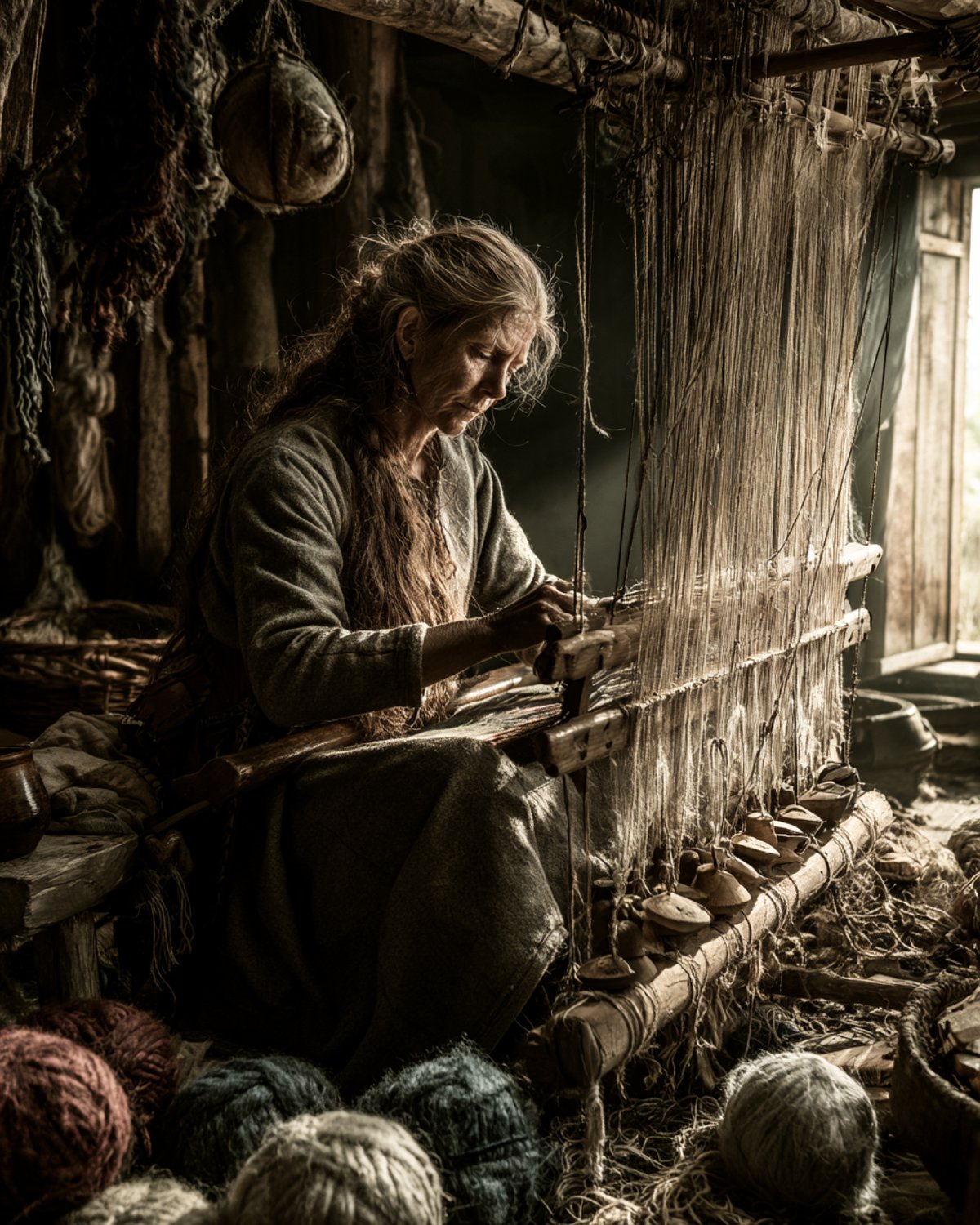
Cloth was woven on the warp-weighted loom: the warp threads hung vertically from a beam and were tensioned at the bottom by loom weights of clay or stone. These weights are found in pit houses across Scandinavia, sometimes still lying in rows as they hung. Typical weaves were tabby and twill, with lozenge and diamond twills for finer cloth, as already seen on the Lendbreen tunic.
For borders and trims there was tablet weaving: small square plates of wood, bone or leather with holes in the corners carry the warp threads, and turning the tablets produces a firm, patterned band. Dozens of band patterns are known from Birka, many with silk and metal thread, and the Oseberg burial contained equipment for the technique together with a band in progress. More on this in our article on Viking weaving. Socks, mittens and caps were made in nålebinding, in which a single broad needle links short lengths of yarn into loops. The famous sock from the Coppergate excavations in York shows the technique.
The labour involved is hard to overstate. The 400-plus hours for the Lendbreen reconstruction show that a single garment tied up weeks of work, with hand-spinning as the real bottleneck. Clothing was wealth, worn until it ended up as caulking in a harbour.
The only detailed description of clothing from the Viking Age itself comes from an outsider. Aḥmad ibn Faḍlān travelled in 921/922 as envoy of the caliph of Baghdad to the Volga Bulghars and met traders there whom he calls the Rūs. He writes that the men wear a garment covering one side of the body and leaving one hand free. Each woman wears on each breast a "box" of iron, silver, copper or gold, generally understood as the oval brooches, along with neck rings of gold and silver, one for every ten thousand dirhams her husband owns, and above all she prizes beads of green glass.
Ibn Faḍlān wrote with an outsider's eye for an Arabic-speaking audience, so he is not an inventory. But the brooches, the beads and the one-sided cloak match the grave finds so well that his account ranks among the most valuable sources we have. More on him and his text in our article on Ibn Faḍlān.
Anyone sewing or buying kit today faces a market where "Viking" is stuck on everything. First: which region and which century? A man from Birka around 950 looked different from a farmer in western Norway around 850. Second: which find stands behind the pattern? Third: materials. Wool in twill or tabby, linen next to the skin, plant dyes or natural shades, and no synthetics that melt by the campfire.
Typical pitfalls: selling Thorsberg trousers as "Viking trousers" without naming the period; fur and leather everywhere; too much jewellery on too little cloth; black faux-leather wristbands with runes. And one important point: oval brooches belong on the shoulders of a woman's dress, not on a man's cloak. At events such as the Viking Days in Schleswig you can meet groups who work very closely from the finds.
If you want the whole picture, including beards, hair, grooming and jewellery, carry on with What did Vikings look like?
What did Viking women wear? A long underdress, usually linen, with a wool apron dress on top held at the shoulders by two oval brooches. Strings of beads, a cloak or shawl when needed, and often some form of headwear completed the outfit.
What did Viking men wear? A hip- to knee-length wool tunic over a linen shirt, wool trousers, a belt with knife and pouch, leg wraps, leather turnshoes and a cloak fastened at the shoulder with a ring brooch or pin.
Did Vikings wear leather clothing? Hardly. Leather is attested for shoes, belts and pouches, fur for linings. Full leather garments are not documented in the finds.
What colours was Viking clothing? Besides natural shades there was blue from woad, red from madder, yellow and green, and purple from lichens. Strong colours were expensive and signalled status.
Are the Thorsberg trousers Viking trousers? No. They date to the Roman Iron Age, several centuries before the Viking Age, though they show how trousers in the North could be constructed.
For courage. For remembrance. For legends that live on.
Everyday Viking life · Hedeby · Viking women · The shield wall · Berserkers.
All Everyday Life & Craft articles →
Viking jewellery was rarely just decoration. A pair of brooches held the dress, an arm-ring was status symbol and …
Read more →Barely an image of the „real Viking“ reaches us today without dark runic and knotwork tattoos. But how do we actually …
Read more →Most Vikings were not raiders but farmers, traders and craftspeople. A look inside the long house where their lives …
Read more →An entire heroic epic on a single teak panel: rider, ship and figures. Our Atli motif stands in an ancient Norse …
Read more →